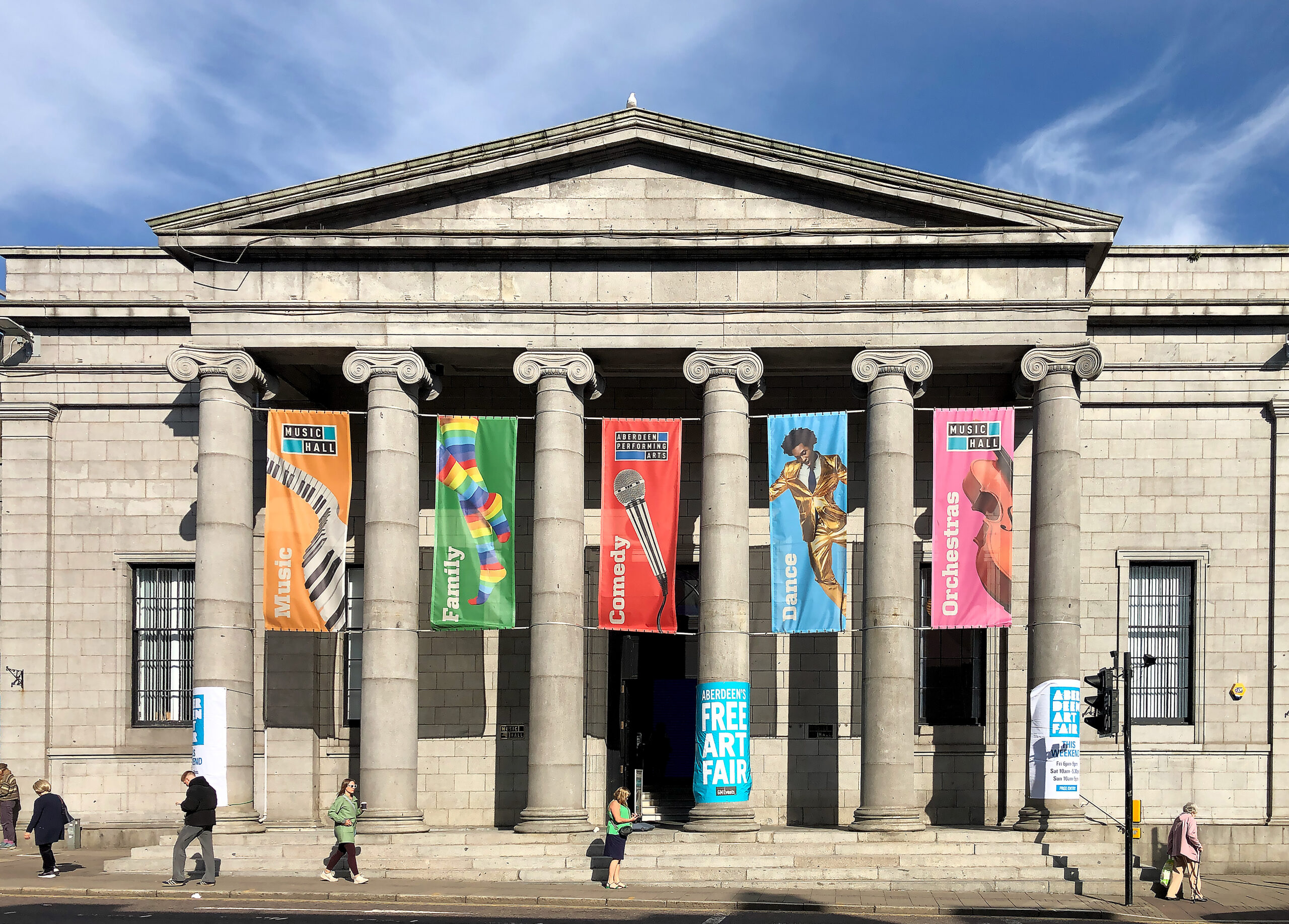
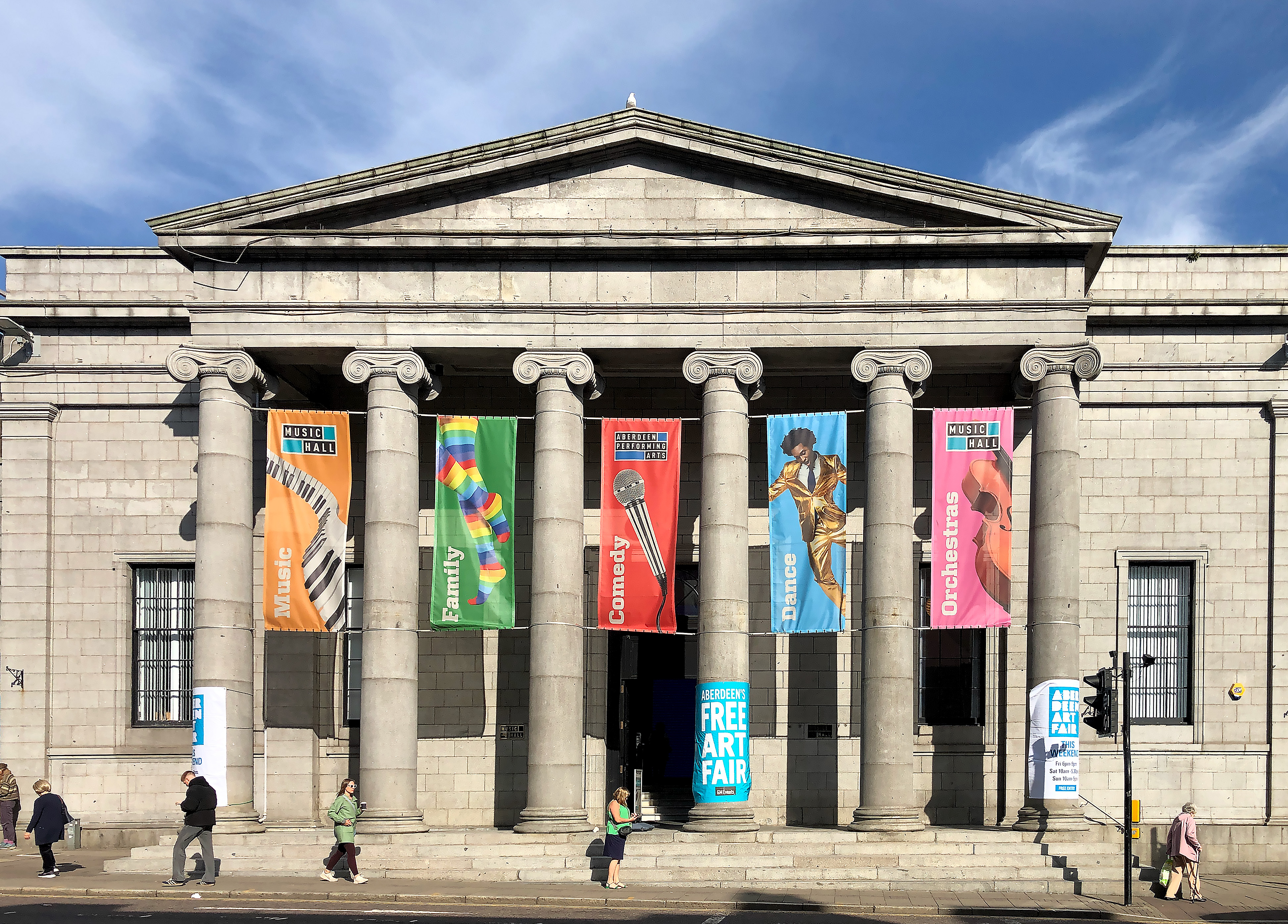
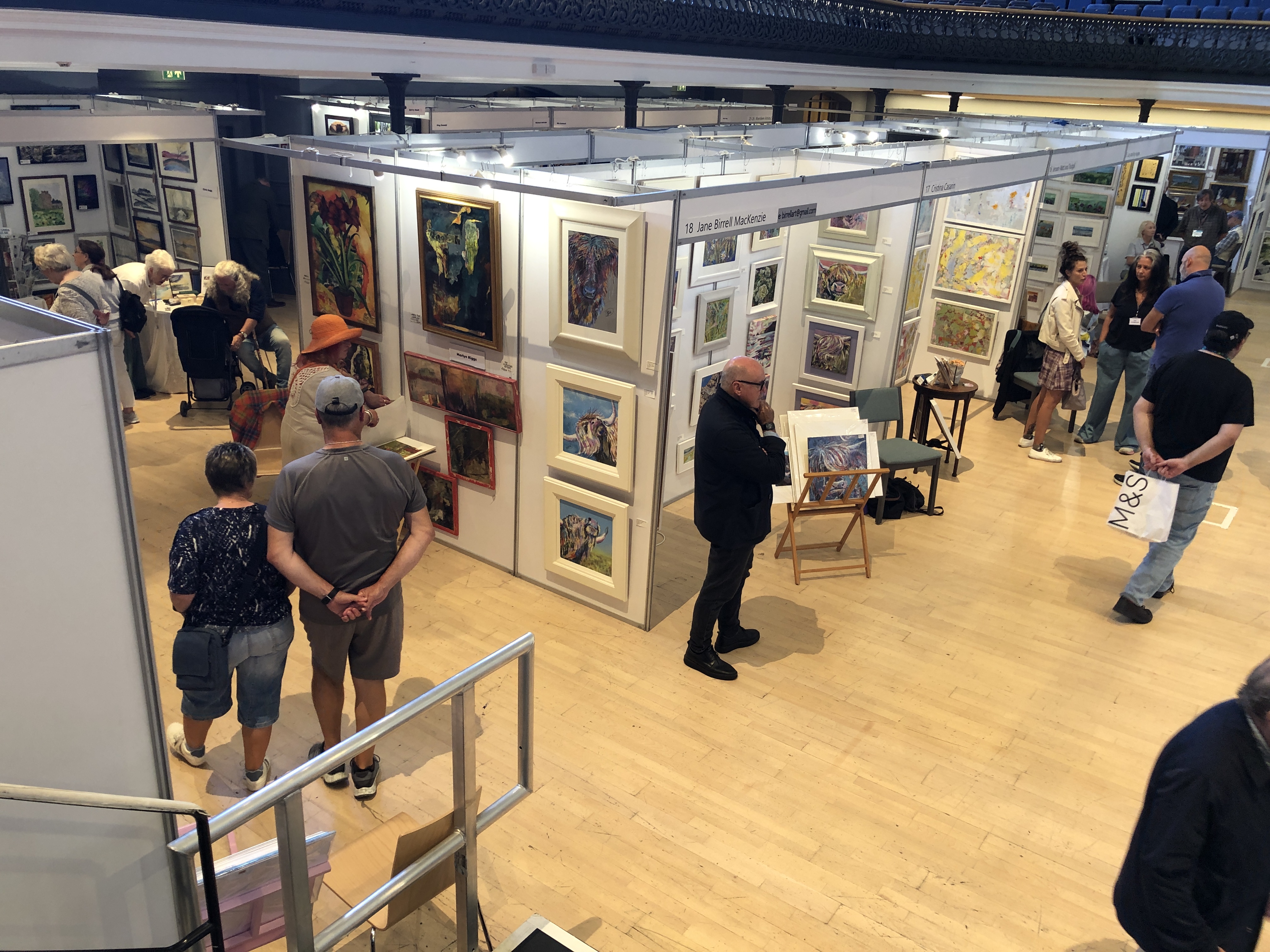
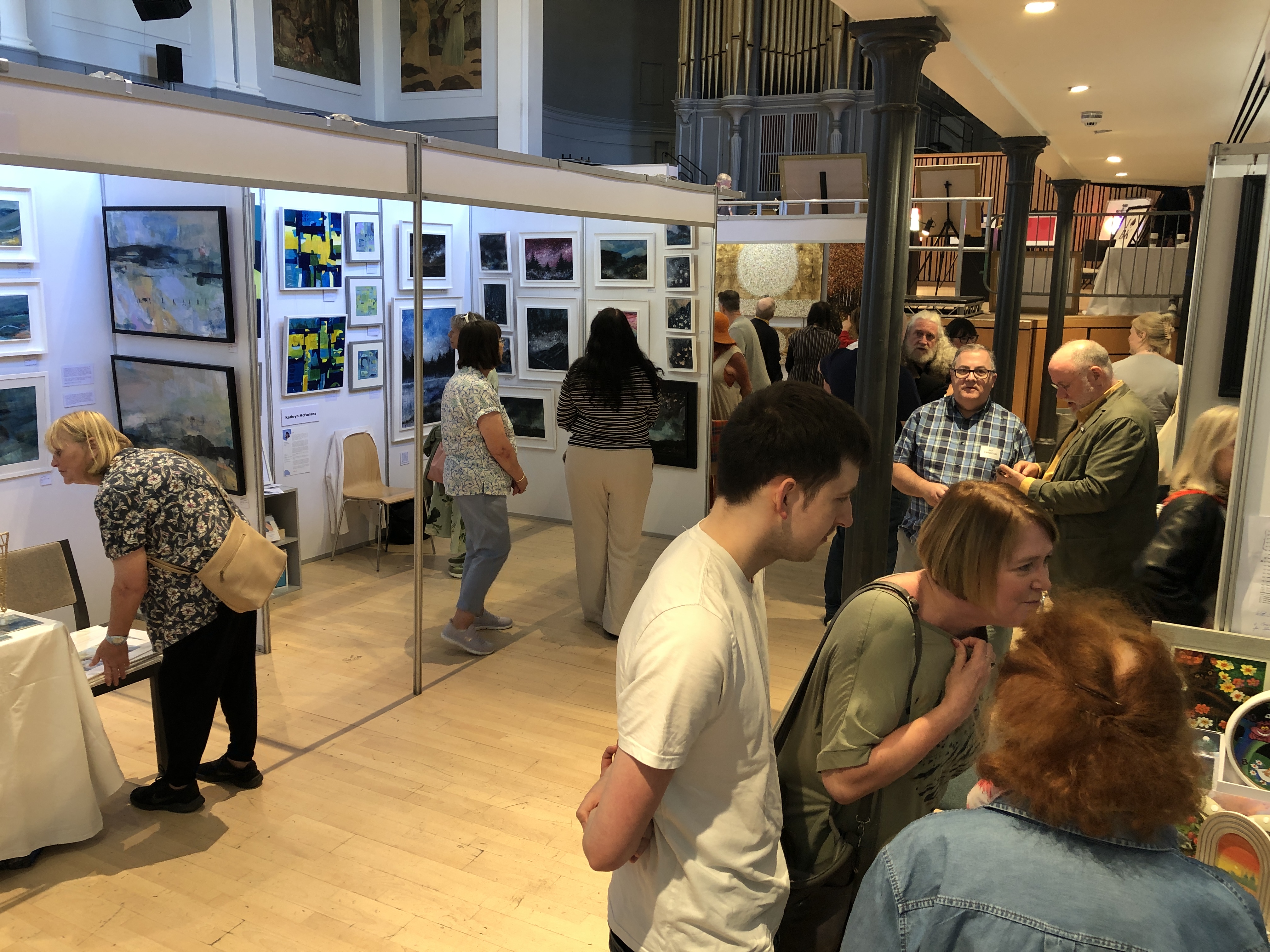
Being new to the area, on 11th August I joined the Aberdeen Artists Society (AAS). Several days later while looking for art fairs in Scotland to try to exhibit at, I discovered that there was an annual art fair in Aberdeen between 30th August and 1st September. However, the deadline for applications was in March(!), and all places were obviously taken. I was naturally disappointed that I was so late to the scene.
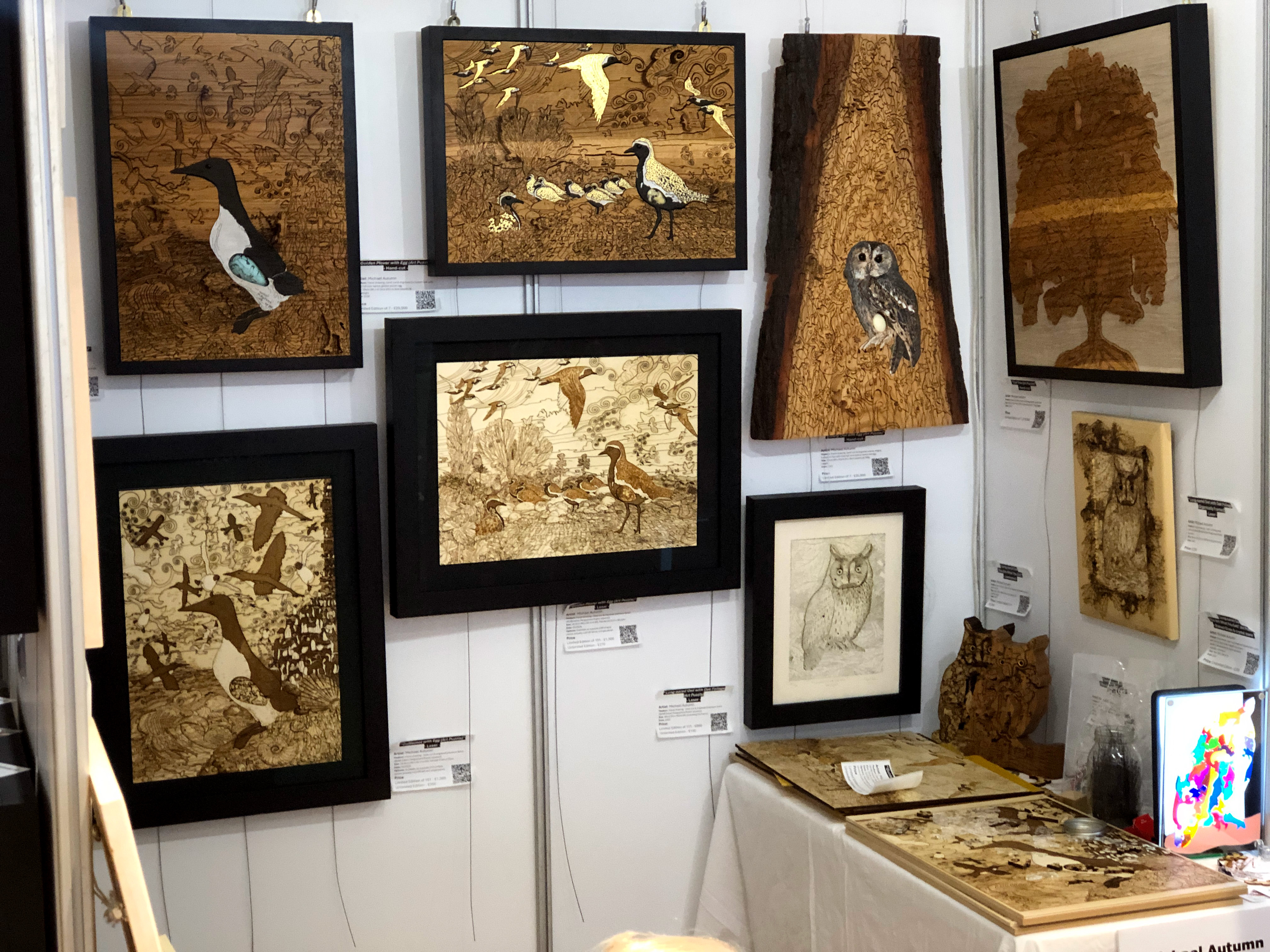
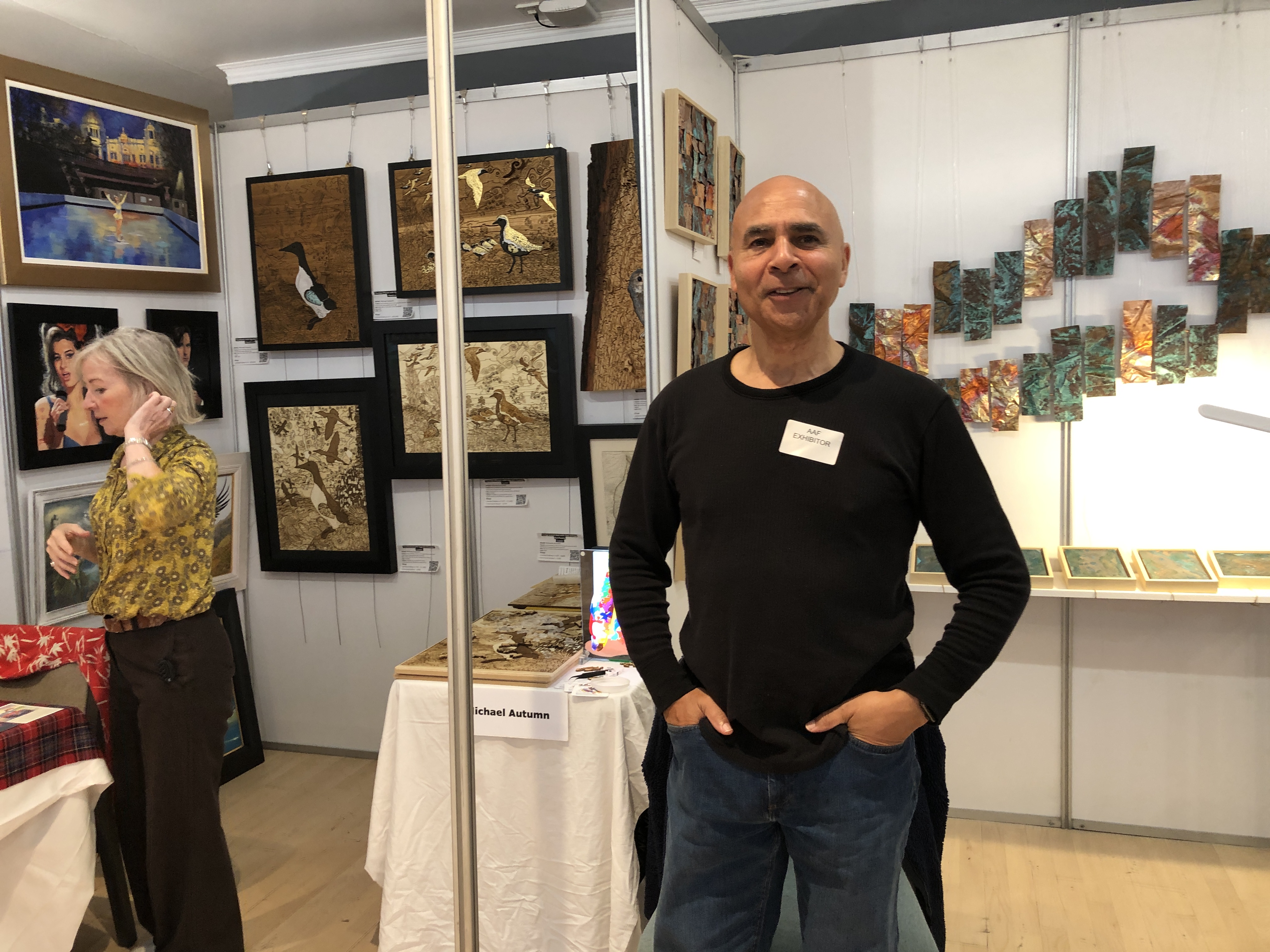
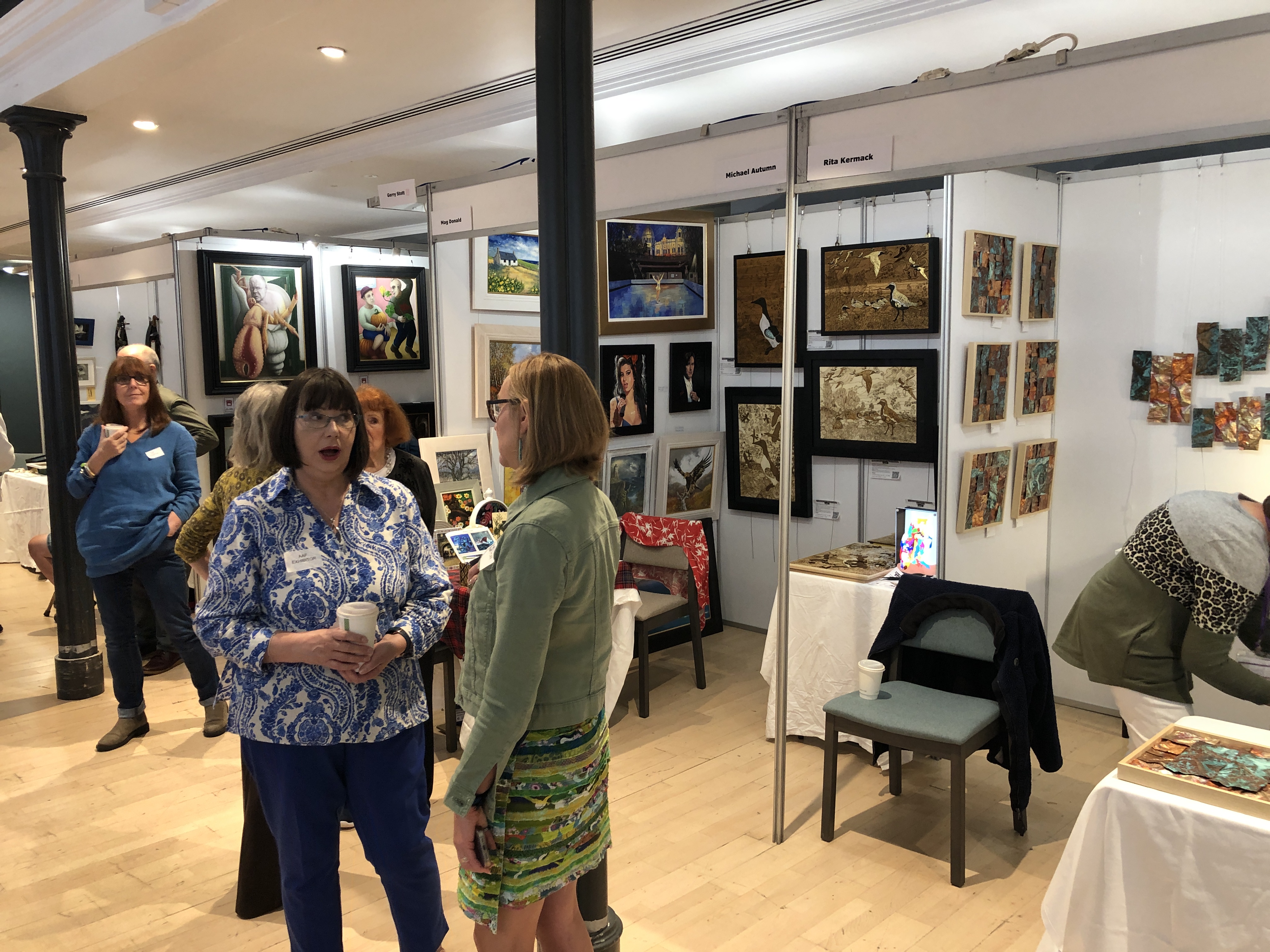
Since there was a block-booking by AAS for a number of the available stands at the fair, I thought I would just message them in the very remote chance that there was a cancellation. The following week, Sunday, I woke up to discover an email back from AAS admin that there had been a cancellation – and anyone interested in taking it should reply. I couldn’t believe my luck and responded immediately – and asked for further details. At this point in time, I didn’t know I would get it – but was excited to be at least in with a chance… Later in the day I learned I could have it – a 3-metre stand (@2.4m high) and snapped it up. I had less than two weeks to prepare what I was going take. I have some number-ones of limited-edition artworks – which I like to keep for myself – and so I set about making additional copies of them (with frames). And I researched and bought a portable LED light panel to illuminate my “Long-eared Owl (Art Puzzle) – (You Are What You Eat) – Stained Glass”. This worked really well at the exhibition – and help draw people to my stand (when it wasn’t completely blocked).
It was a very busy couple of weeks preparing for the exhibition, but I naturally wanted to make the most of this opportunity. I especially thought I should take all my hand-cut original thick solid oak art puzzles – that have never been seen in public before. These are large and heavy – too heavy for the provided hanging system – so I had to quickly source suitable ones of my own.
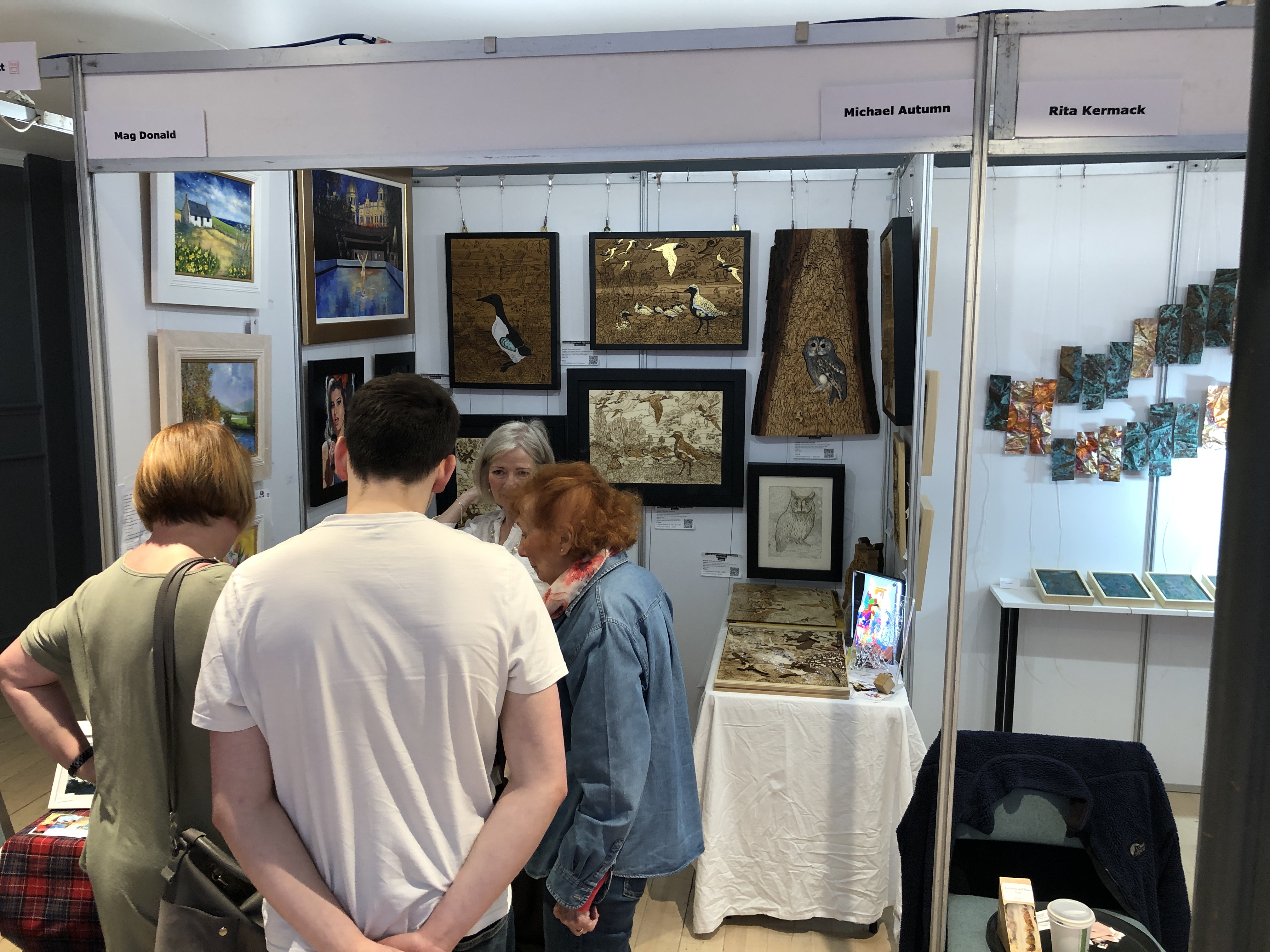
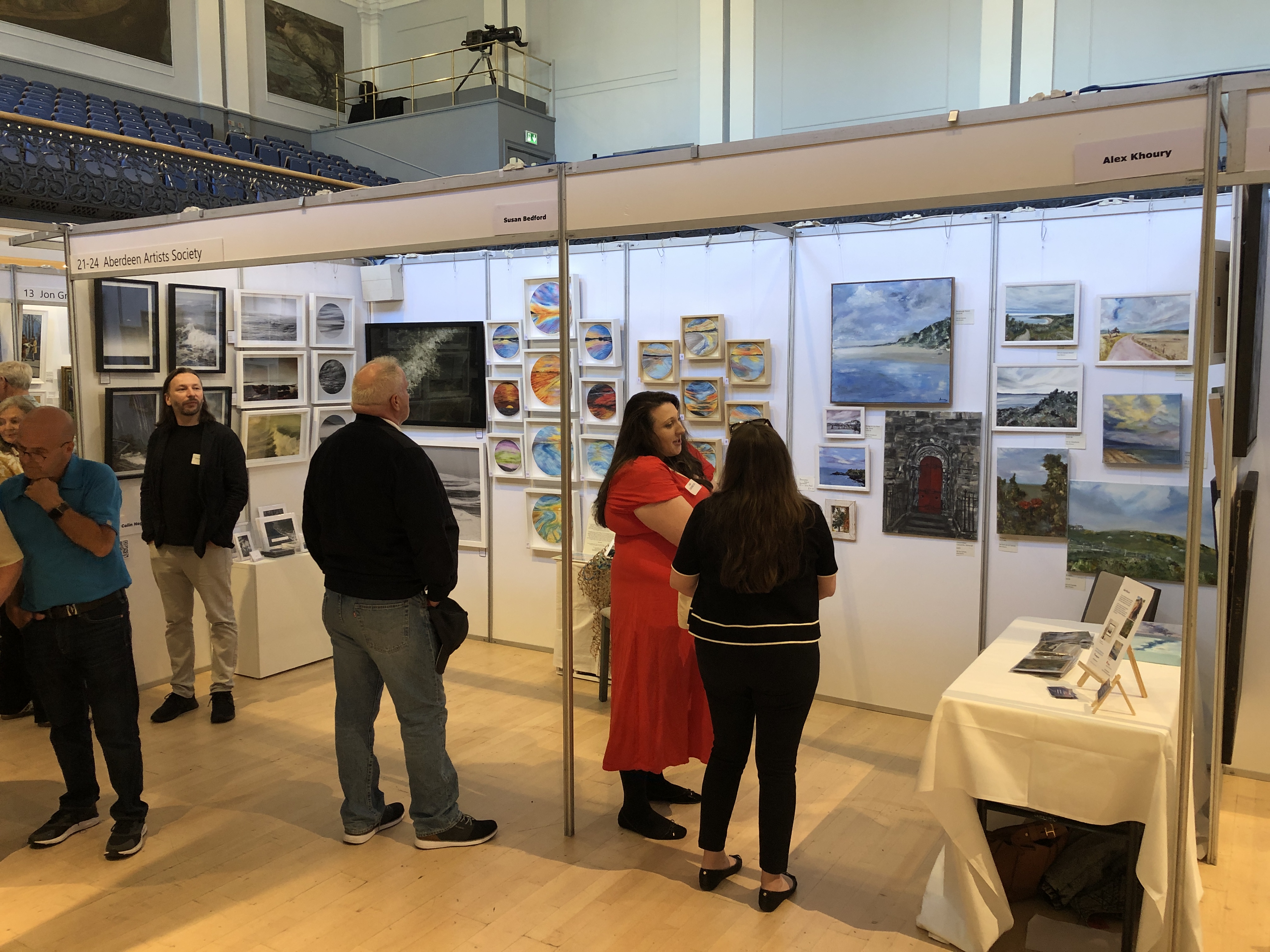
Friday afternoon of the 30th was the setting up time – with a private viewing scheduled between 6-9pm. I was a bit late in starting but managed to complete my stand just after 6pm – when the guests (and friends of exhibitors) starting to arrive…
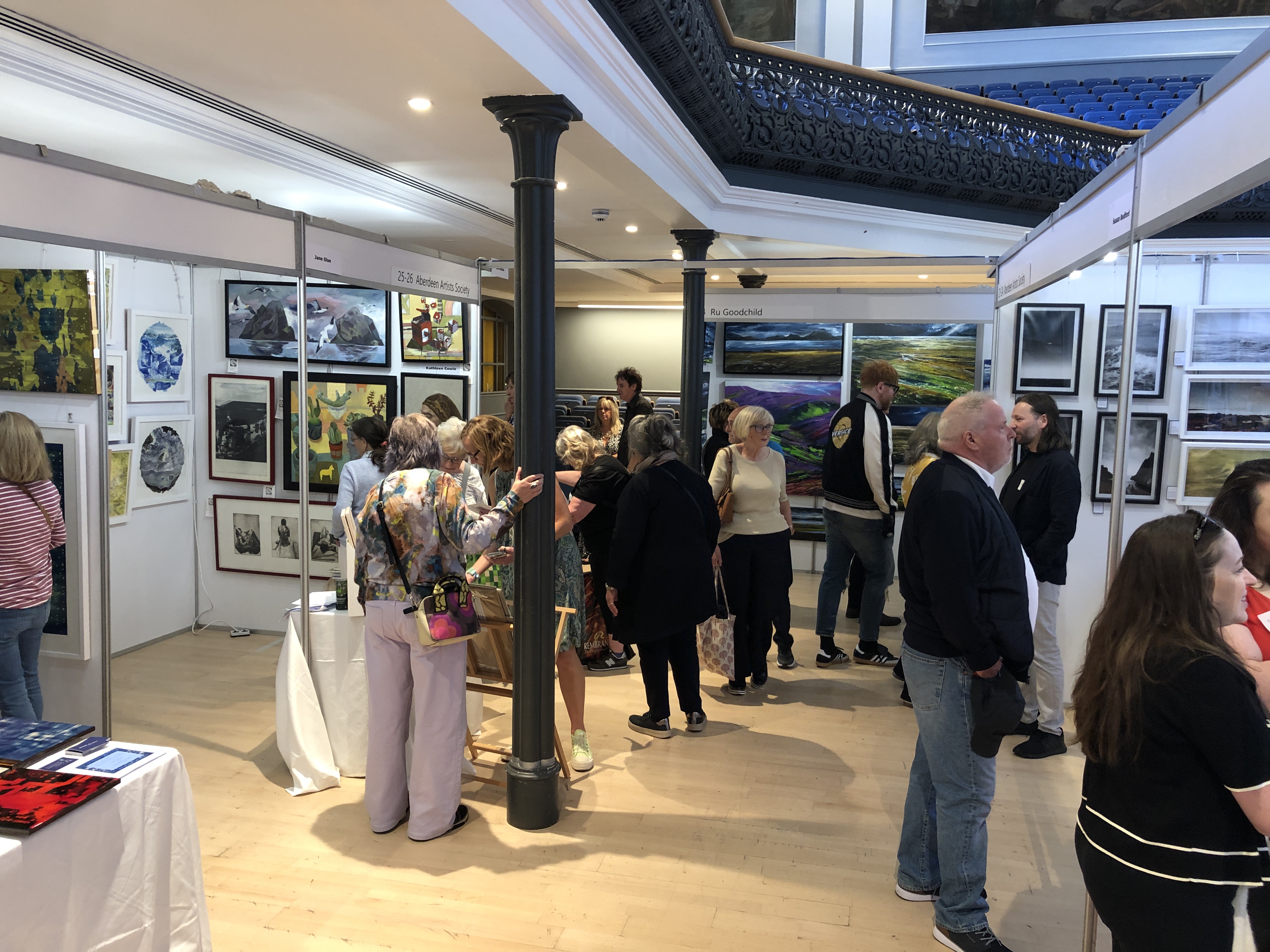
My L-shaped 3m space (2m + 1m) was adjacent to a 2m stand jutting out at a right angle – which made the space ridiculously tight – effectively walled on three sides. It made putting up and taking down the artworks difficult because we were in each other’s way. This, coupled with my neighbour having a table at the mouth of our pitches – and who seemed to know everyone – and they all stopped for a nice long chat – meant that my pod was practically completely blocked a lot of the time…
I sold some pieces – including one to a former art curator (who said quietly to me “…this is the best work here…”) – so that was very nice.
The genuine deep fascination of some people, very close inspection (by those who could get through!), and the very kind words – like “…these are absolutely incredible…”, “…it’s really made my day to come out and see your work…”, “…this is the best stand…”, “…this is my favourite stand…” – was incredibly, and indelibly, nice to hear – and extremely encouraging. I felt my artwork brought a little joy and thought-provocation to some of the people…
It was also really nice to share the experience with my fellow exhibiting artists, and to share stories of our journeys, trials, and tribulations. For so long I have worked in complete isolation of other artists – and so it was especially good to get feedback from my peers…
(Catalogue #100_5644-5730: 44” x 66” – edition of 100)
The human eye is an amazing gift, tool, and experience. The power of the brain behind it takes seeing to mesmerizing capabilities. Take focusing for example. That part of the image in the centre of our field of vision is in sharp focus (excepting for long- and short- sightedness), and the rest of the image gets progressively out of focus – the further away from the centre we go. But we are usually not aware of this. Anything we scan our eyes over becomes instantly sharp. The fact is we are constantly re-focusing as we scan a scene. If we are looking at one part of a scene it is in sharp focus. We may not even be aware that the rest is out of focus, because no sooner have we moved our eyes to something else, then that new part becomes immediately in focus.
Focus has a few noteworthy properties. The closer we try to focus, the shallower the depth of focus is. If you hold your hand in front of your face and focus on it, even things just in front of it (try placing a finger of your other hand in front of your hand without looking directly at it), and things immediately behind it will be out of focus – i.e. blurred. This is a “shallow” depth of focus – or depth of field as it is more commonly known in photography. The further away the subject is the greater is the focus depth – the region from the nearest to the furthest part in focus. The focus range is invariably perpendicular to our eye view.
The camera acts like a static eye in that it can capture one static scene and its inherent depth of field. It is unlike the eye in one important respect: we focus on a narrow zone where our two eyes converge, and outside this area – left, right, up or down – but at the same distance from our eyes – things become progressively more out of focus the further away from the centre of our gaze they are. The camera on the other hand focuses on planes. Think of double glazing: the zone between the two pieces of glass is in focus, everything in front and behind are out of focus. As always with focus, there are no sharp boundaries between in and out of focus – just very sharp to progressively less sharp. However, there is a general area where most people would agree is an acceptable level of sharpness – enough to say it’s in focus.
Depth of field can be controlled by the diameter of the iris or aperture: the smaller the aperture the greater is the depth of field. But the aperture can only affect depth of field to a small degree. What also applies to the camera is the phenomenon that the closer the subject is, the shallower the depth of field. There are special cameras/lenses that offer a tilting mechanism that allow you to literally tilt the plane of focus, but these are only effective with flat surfaces – like a road or a lake. Anything in the foreground sticking up or down – rising above or below the narrow horizontal plane of focus – like my tulips – would appear out of focus.
Why am I rambling on about depth of field? When you are confronted with a real life scene you can survey it at your leisure, and it is something we all seem to enjoy. We seem to love being able to see a long way, and climbing/driving to the top of a hill or mountain to see a great view is a common goal we nearly all like to do. Taking a static image of such a scene – from our toes to the horizon – is virtually impossible, especially if there is fast movement in the scene as well.
What has all this got to do with art? If art is about enhancing the viewer’s experience of life, getting the viewer to think about their surroundings, and their perceptions and pre-conceptions of it, then “Depth Of Tulip Field” is very much art.
I use photography a great deal because I’m so moved by reality, and a lot of what I want to convey about my perceptions, pre-conceptions, and ideas about reality I feel are best expressed by being as realistic as possible. I’m completely in awe of vision – it is the most amazing gift. When I see a beautiful scene I’m frustrated as an artist that I cannot transport you there to see it also. So much art is about non-reality, disfiguring reality, or making attempts at copying reality – with varying degrees of success. But reality cannot be faithfully copied – it has near and far properties, and we can interact with it in almost an infinite number of ways – moving to different parts of it, zooming in to any level of detail. And reality’s main quality is, I feel, the freedom we have to look at it in any way we choose.
At a scene we can scan and focus on anything we please, and that is the real delight I want to capture. Conventional photography pre-focuses for you on a static focal plane. The photographer has to decide what he/she wants you to focus on – that is what he/she wants to focus on themselves, and they capture that in stone as it were. You are not free to focus on what you want. That is not necessarily a criticism – indeed it may well be the intention. But in this case my intention is that you should be free to look at any part of the picture in great detail – as I had the pleasure of doing.
The conventional artist – oil painter for example – is severely limited by the materials she uses, and by time. Whilst she doesn’t have the same limitations of depth of field, close up daubs of paint look like daubs of paint. And what would the point of meticulously copy reality anyway in this day and age of photography? The best you’ll ever achieve is a photograph. If Vermeer or Ingres (two of the best detailed artist I know of) were around today, would they reject photography and paint? Was it the process of painting they enjoyed or were they trying to capture something they considered beautiful, captivating, worthy of putting on a pedestal…?
In Depth Of Tulip Field I have gone to enormous lengths to share the freedom of focus I enjoyed on a fateful trip in Norfolk, England. It was early morning, the date was spring 2004, I was driving along and suddenly this amazing field of tulips appeared. The field was huge and the rows ran perpendicular to the road. A striking feature was the bands of brilliant colours. The sun was not out fully (it was burning up the morning mist), and it was at the wrong angle anyway (aesthetically) – so I decided to come back later in the afternoon (the forecast was for sun).
When I returned I went to the far end of the field with the sun shining at me – I love the sun shinning through plants – it really brings out their colour. I spent quite a while admiring the scene and wondering how best to shoot it – how to do it justice. I had all the main types of cameras, numerous lenses, and other equipment with me – so I had very few technical limitations on what I could do. The field was wonderfully long. I didn’t want to crop it. I didn’t want to focus on one part of it. I wanted it all. Eventually I came up with an idea and proceeded to execute it…
There are a lot of different types of birds, insects, and other animals in this picture, but that is only to draw your attention to the fact that there were none! This field – due to modern chemically assisted intensive farming methods – was a veritable desert of life! Everything was either dead (killed by “pesticides” – implying they are pests – probably a propaganda ploy by the agrichemical companies) or the wildlife stays away – perhaps because there is no natural food there and/or because it is such an alien landscape to them and they have no natural cover. I did actually see the hare and the deer running through the field – sadly they were fleeing from a near by gun shot blast – I don’t think it was their natural choice to be there. But it gave me an idea…
Most landscape paintings don’t depict this level of detail, and many animals in the wild are very elusive – indeed a lot of the time their survival depends on them not being seen. So often they are there but you just don’t see them. But for me this is what is fascinating about Nature: it is everywhere. The more you look, the more you see. And the closer you look the more detail you see. You can start with looking at a whole landscape (even my depiction of the tulip field is a small section of the whole), and you can zoom in on a field, then a flower in the field, then an insect on a flower in the field, and see the amazing detail of it. Zooming in still further, you can see the hairs on its body, its compound eye, the structure of its wings. Zooming in on the eye reveals its conical hexagonal lens structure. You can go on to see the structure of the cones, the cells that make it, the internal structure of the cells, the structure of its proteins, the atoms that make up the molecules, the structure of the atom – its subatomic particles. And who knows where this journey ends in ever smaller worlds…?
I have kept the detail in the picture to what you could see with the naked eye, but I hope I’ve got my point across about the detail in Nature.
Sometimes we come across a scene so beautiful that we stop what we’re doing. We stop and stare, remain silent, and enter into a trance-like state. It’s fascinating that our mind should respond so strongly to what are after all just images. It is also fascinating that the vast majority of us will respond in a similar way to the same scenes… I, as a contemporary artist, feel just the same (possibly more?) about such scenes – but I want to respond to them in a very personal and unique way, and to sometimes use them as a vehicle to express certain ideas I’m interested in.
Really this is many photographs (circa 80) combined into one, with a great deal of digital editing – including much freehand work. But it is essentially what I saw. I have spent more time on this “photograph” than I have ever spent on a real painting or drawing. (No, I haven’t attempted to break any world records – some artists will have spent longer on their paintings.) My goal was to try to break the limits of photography, to highlight our wonderful, amazing, delighting, gift of vision; to produce something beautiful – or something I consider beautiful. The result is not perfect, but I’m happy it goes a long way to depicting what I saw and the ideas I wanted to convey. It gives me immense pleasure to be able to share that experience.
Nature is not always what it seems, and in Nature reproduction is a vital force…
16/05/2004
Exhibited at Royal Academy Summer Exhibition 2006
This YouTube video is using a new video-from-photo technique I developed.

 That part of the image in the centre of our field of vision is in sharp focus (excepting for long- and short- sightedness), and the rest of the image gets progressively out of focus – the further away from the centre we go. But we are usually not aware of this. Anything we scan our eyes over becomes instantly sharp. The fact is we are constantly re-focusing as we scan a scene. If we are looking at one part of a scene it is in sharp focus. We may not even be aware that the rest is out of focus, because no sooner have we moved our eyes to something else, then that new part becomes immediately in focus.
 The photographer has to decide what he/she wants you to focus on – that is what he/she wants to focus on themselves, and they capture that in stone as it were. You are not free to focus on what you want. That is not necessarily a criticism – indeed it may well be the intention. But in this case my intention is that you should be free to look at any part of the picture in great detail – as I had the pleasure of doing.
 Was it the process of painting they enjoyed or were they trying to capture something they considered beautiful, captivating, worthy of putting on a pedestal…?
 I did actually see the hare and the deer running through the field – sadly they were fleeing from a near by gun shot blast – I don’t think it was their natural choice to be there. But it gave me an idea…
