Category: Jigsaw Puzzle

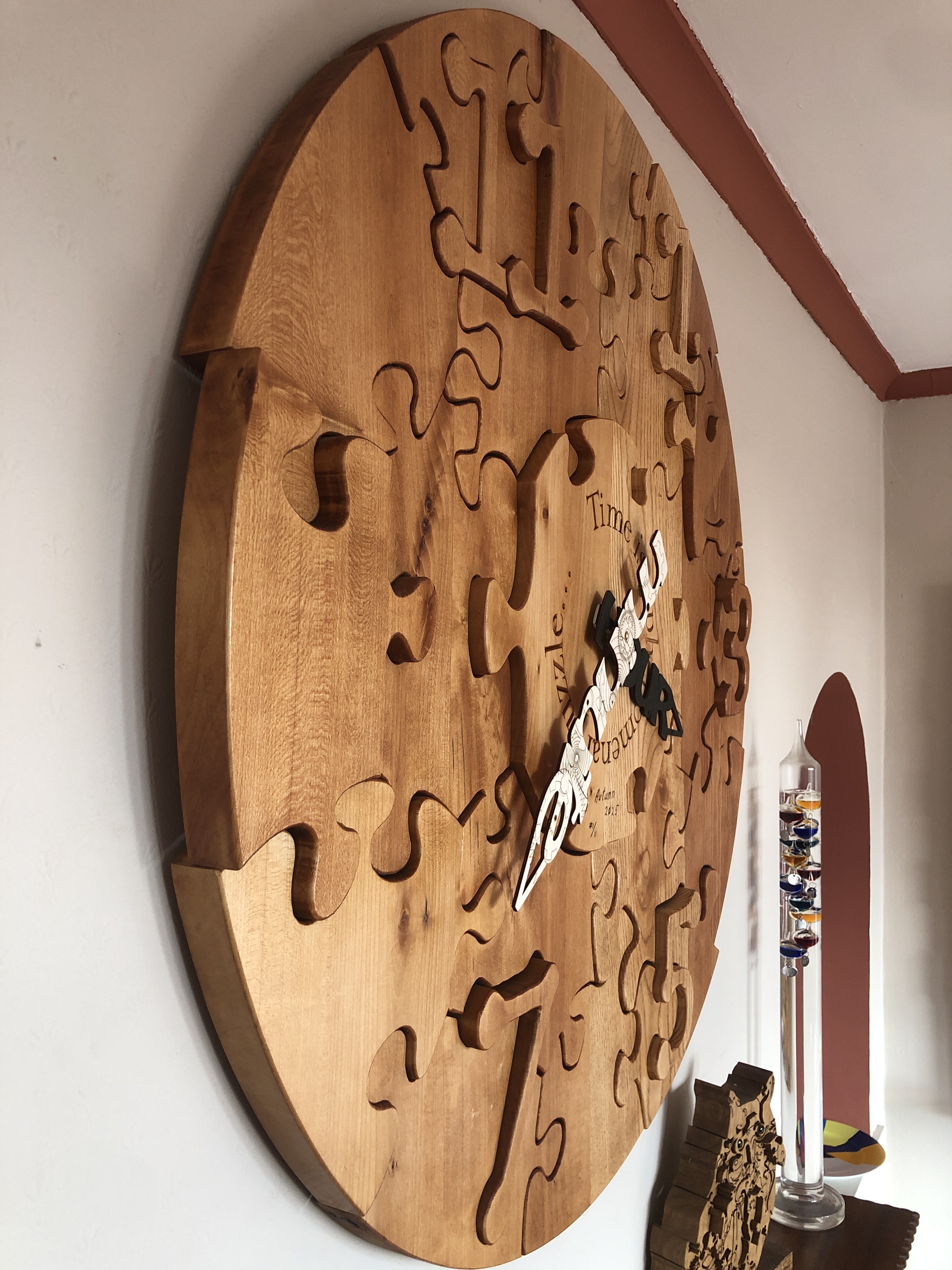
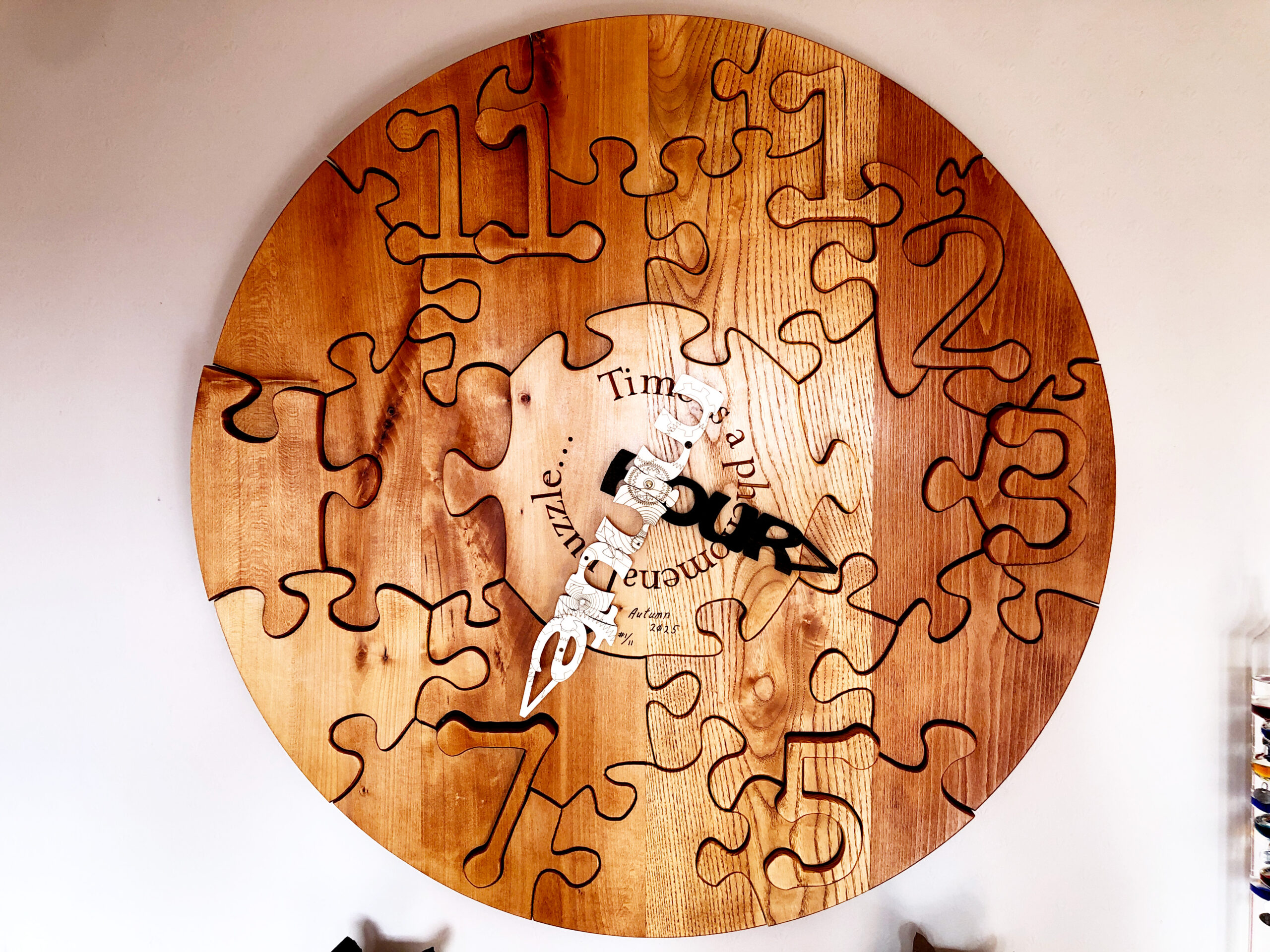
  • Time is a phenomenal puzzle…(Clock and Art Puzzle)

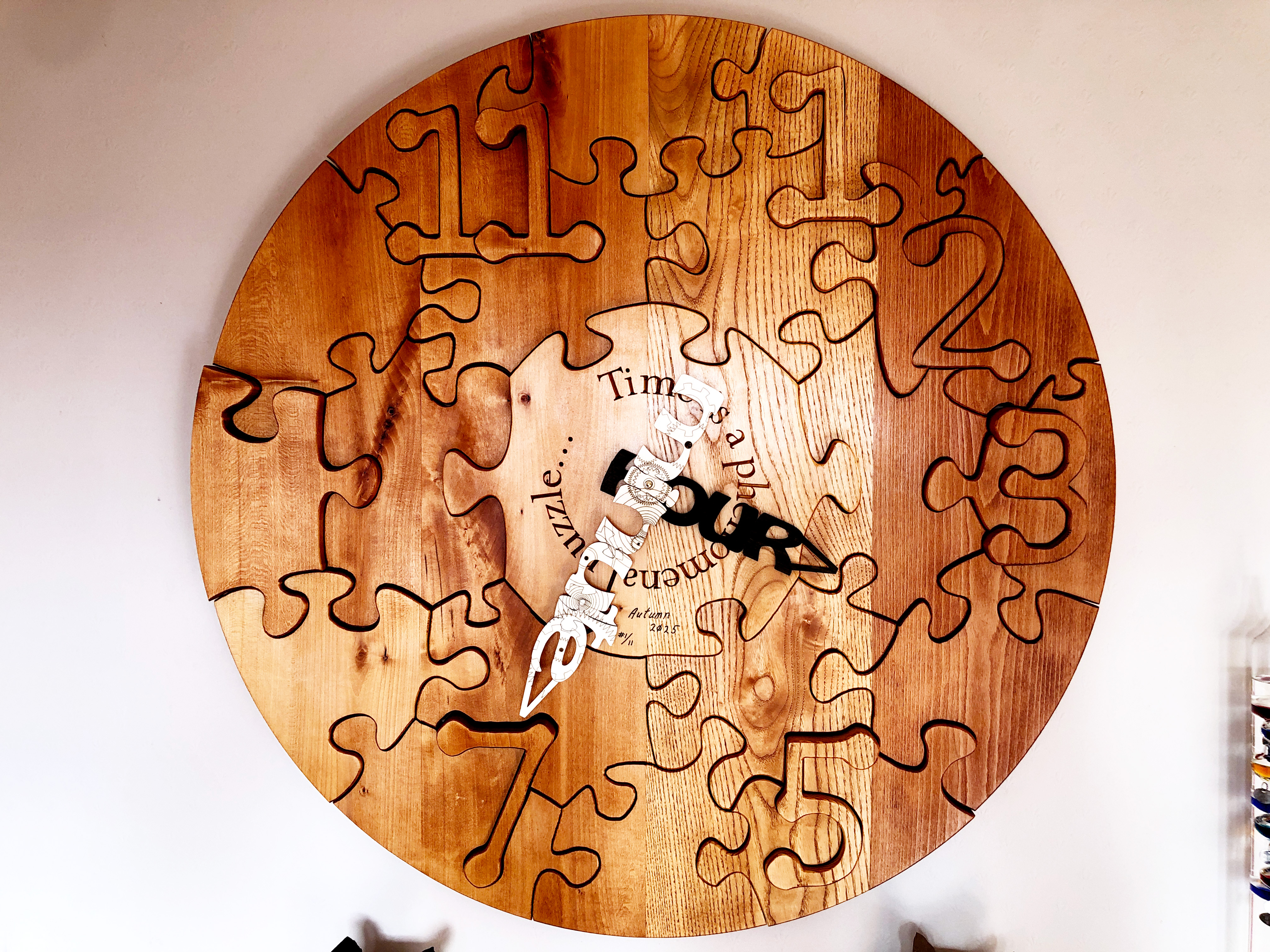
    Time is a phenomenal puzzle…(Clock and Art Puzzle)

    Title: โ€œTime is a phenomenal puzzle…(Clock and Art Puzzle)โ€
    Artist: Michael Autumn
    Medium: Oak wood clock face and plywood hands. Working clock movement.
    Size: 95cm (W) x 95cm (H)
    Edition: 11 (only made to order)
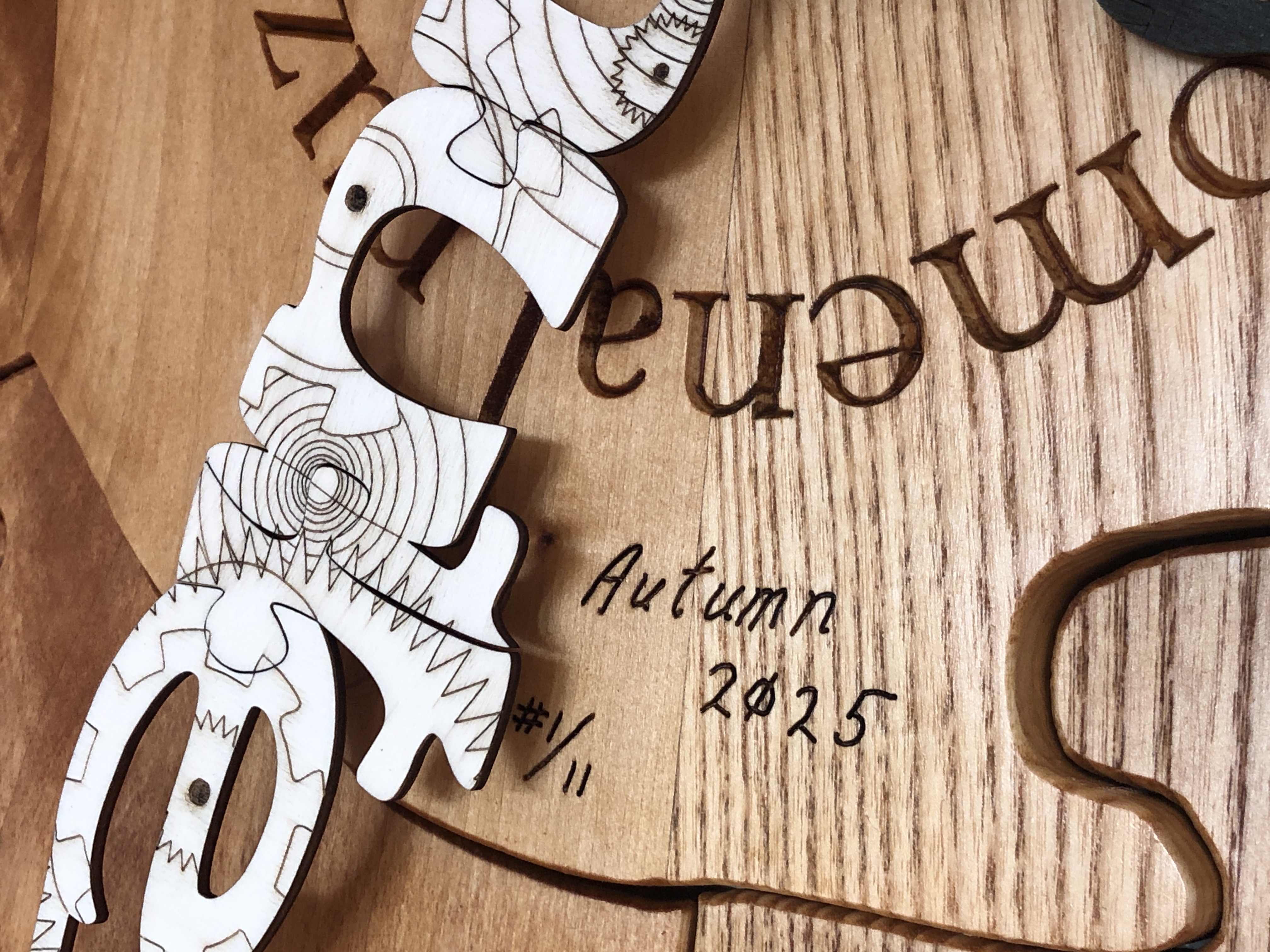
    Authenticity: Hand-engraved (bottom, center of main central piece).
    Date: 03/2025


    This is an artwork primarily about time โ€“ that eternal puzzle in human minds – mine included – and what better way to depict time than by a clockโ€ฆ? However, during my journey in creating this piece I realised that it is also about gravity โ€“ because without gravity this clock would simply fall apart โ€“ because there is nothing else holding it togetherโ€ฆ! And this ties in nicely with Einsteinโ€™s Theory of Relativity โ€“ where gravity deflects time (gravitational time dilation) in what is known as โ€œspacetimeโ€โ€ฆ

    But this is not a normal clock (as you might expect from me!?): it is in fact two puzzles โ€“ and it was quite a technical challenge or puzzle to design and make both of themโ€ฆ! There is nothing holding the clock face or clock hands jigsaw pieces together – other than gravity โ€“ i.e. their own weight. There is no glue, screws, or nails โ€“ all the pieces are gravity-defying wooden joints!
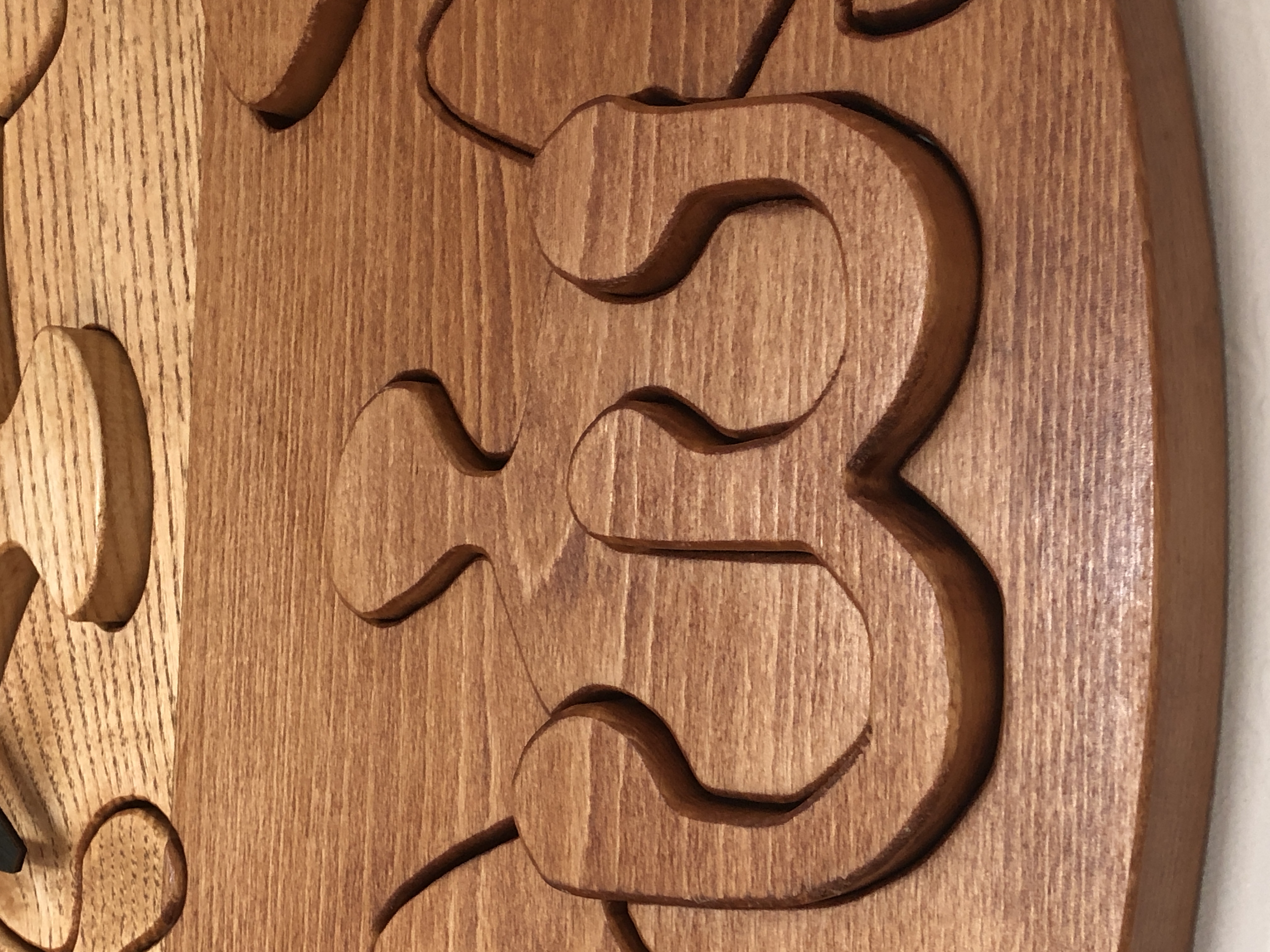
    Close-up of some face pieces – they are all loose.
    I vary the depth of some pieces to make them stand out…

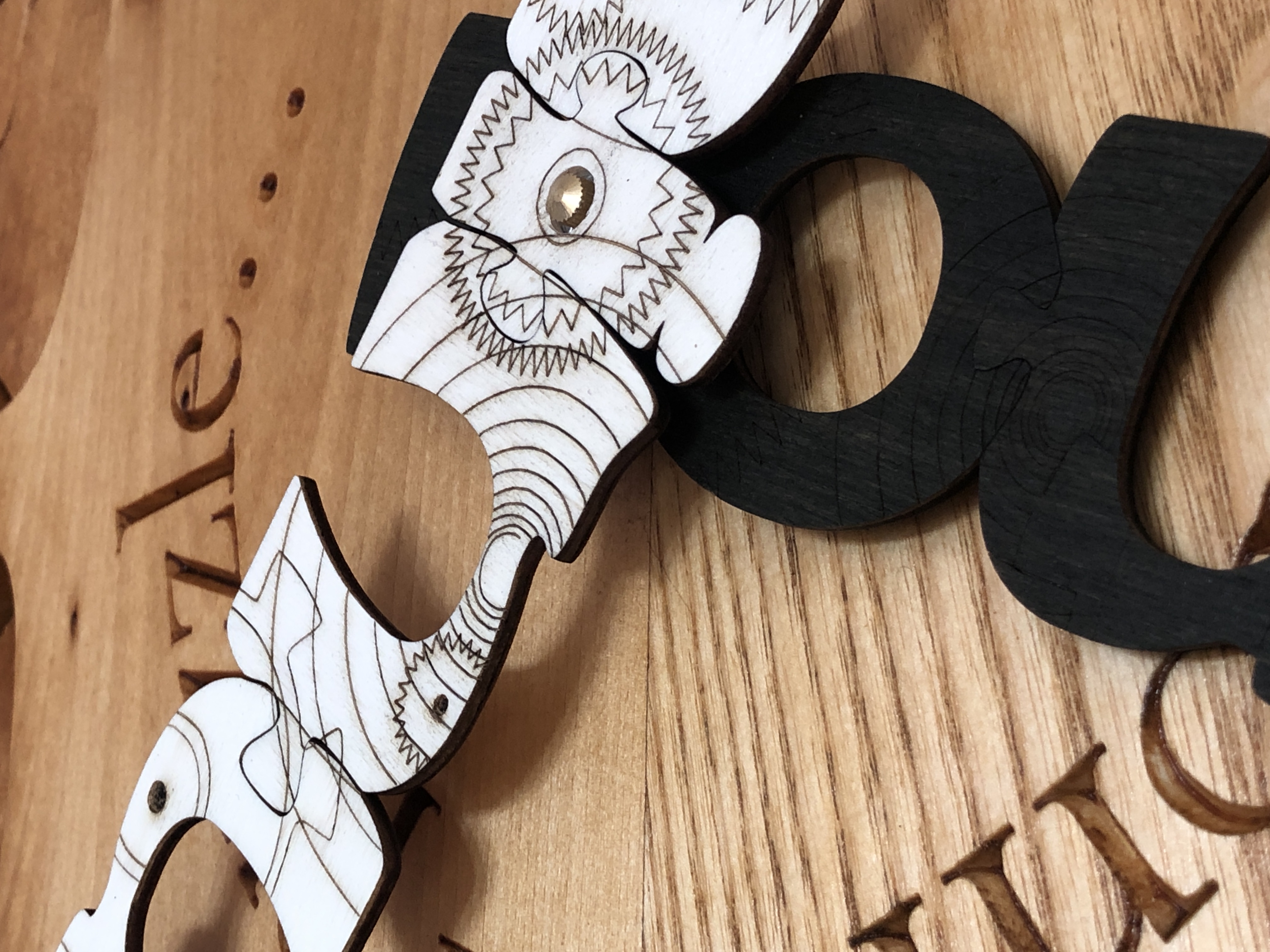
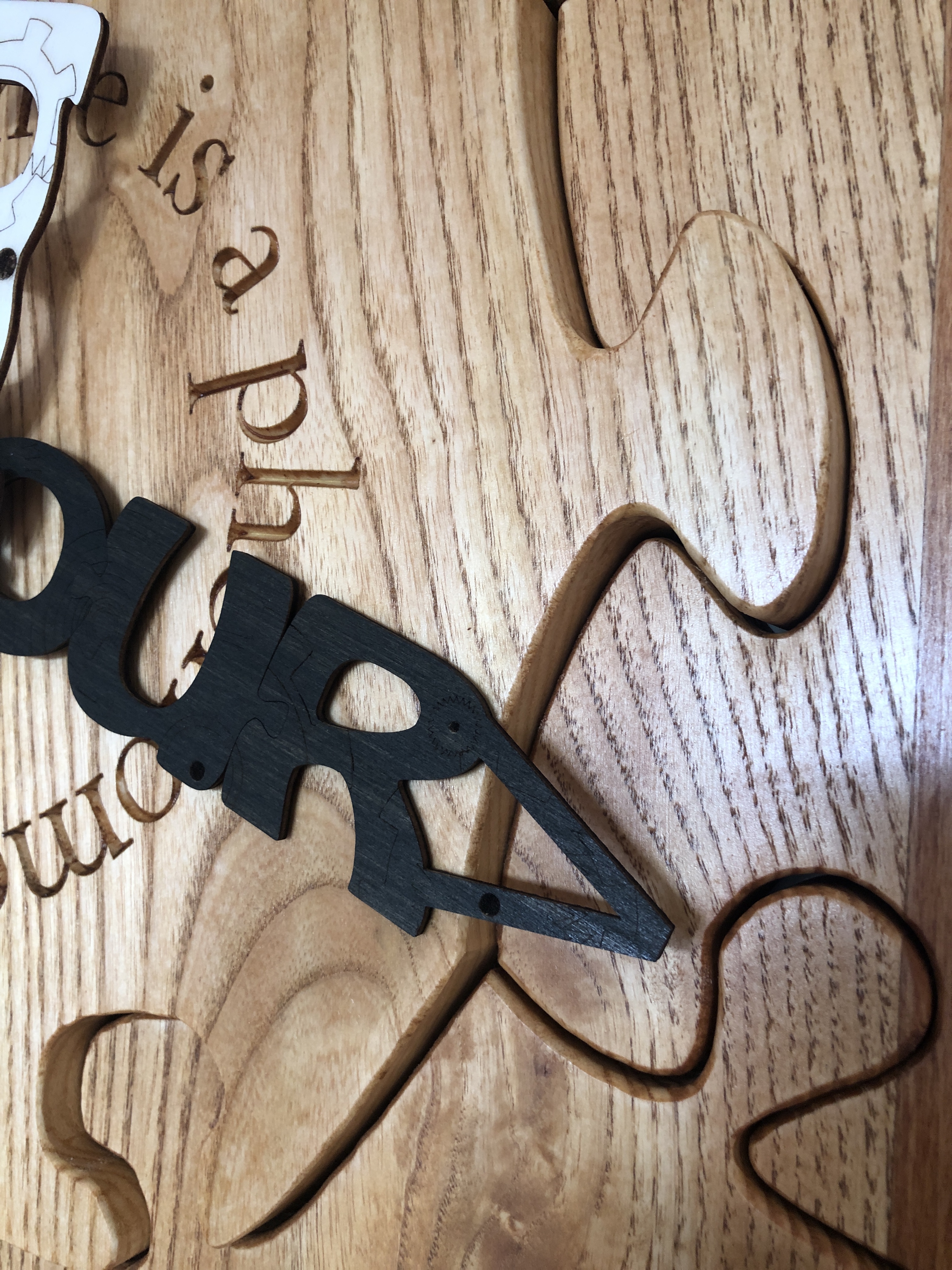
    The clock face is a large (950mm or 37 ยฝ โ€ diameter) thick circular wooden jigsaw puzzle โ€“ where all the pieces are solid oak โ€“ about 32mm (1 ยผ โ€) thick. The clock hands are very strong but light plywood jigsaw puzzle pieces 3mm (about an โ…› โ€) thick โ€“ spelling out the words โ€œhourโ€ and โ€œminuteโ€. They have a steampunk motif engraving of cogs, wheels, springs, shafts, and screws โ€“ as if they were word-shaped windows revealing the inner workings of the clock inside.
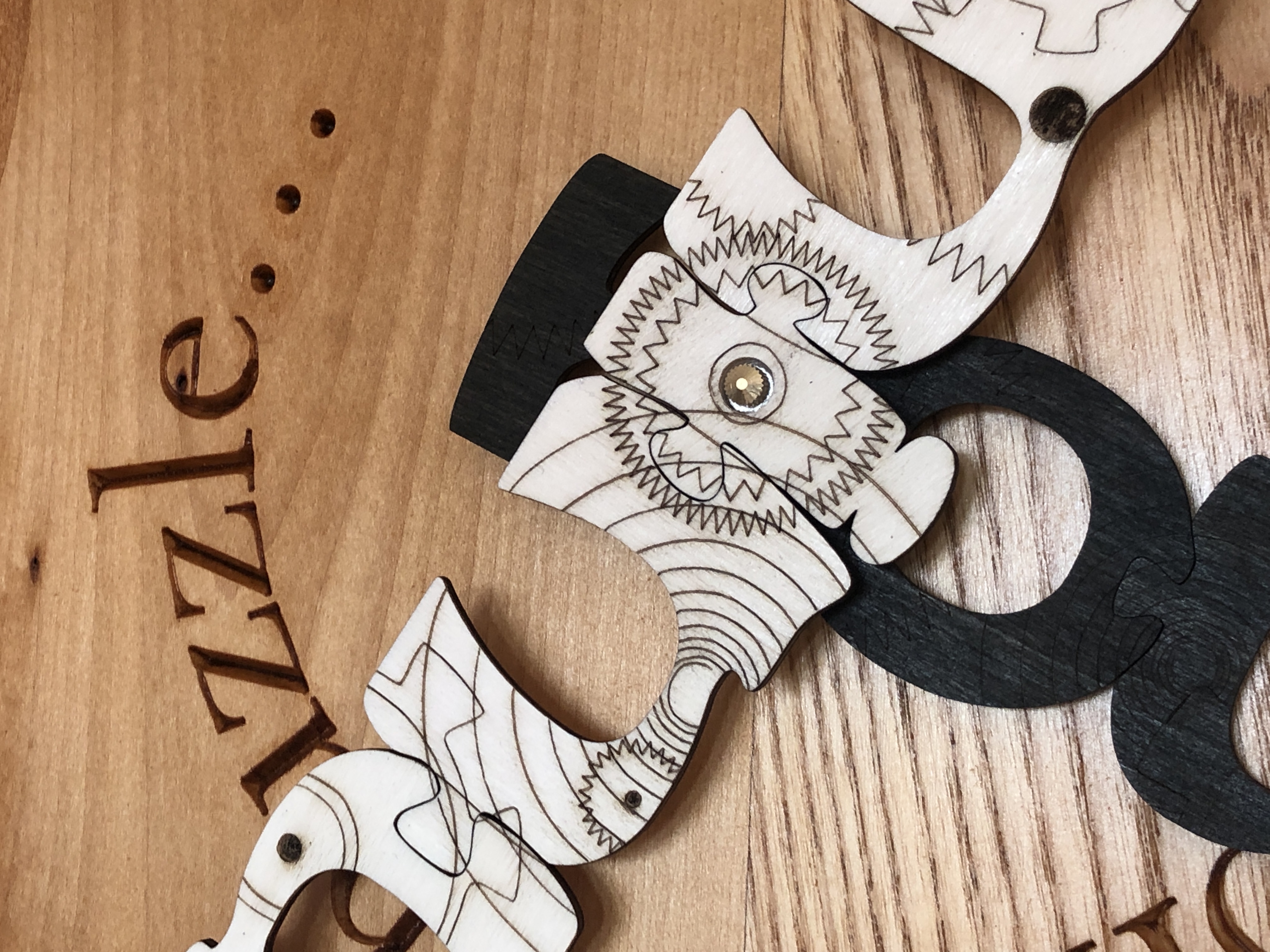
    Close-up of steampunk motif engraving of cogs, wheels, springs, shafts, and screws

    I designed and made the puzzle clock face about three years ago (December 2021) (albeit a โ€œsmallโ€ one โ€“ about 500mm โ€“ 20โ€ โ€“ in diameter), but I couldnโ€™t think of a design I was happy with for the clock hands. This proved really difficult because I wanted the clock hands to be puzzles in themselves โ€“ so the pieces had to reliably and tightly fit together โ€“ each as a rigid unit, be fully rotatable, and fit securely on a conventional working clock movement. The latter was an interesting technical challenge, but I really struggled with a suitable aesthetic design for them. What would look appropriate or conforming with the theme of a time puzzle? What would look aesthetically pleasing (to me at least!)?

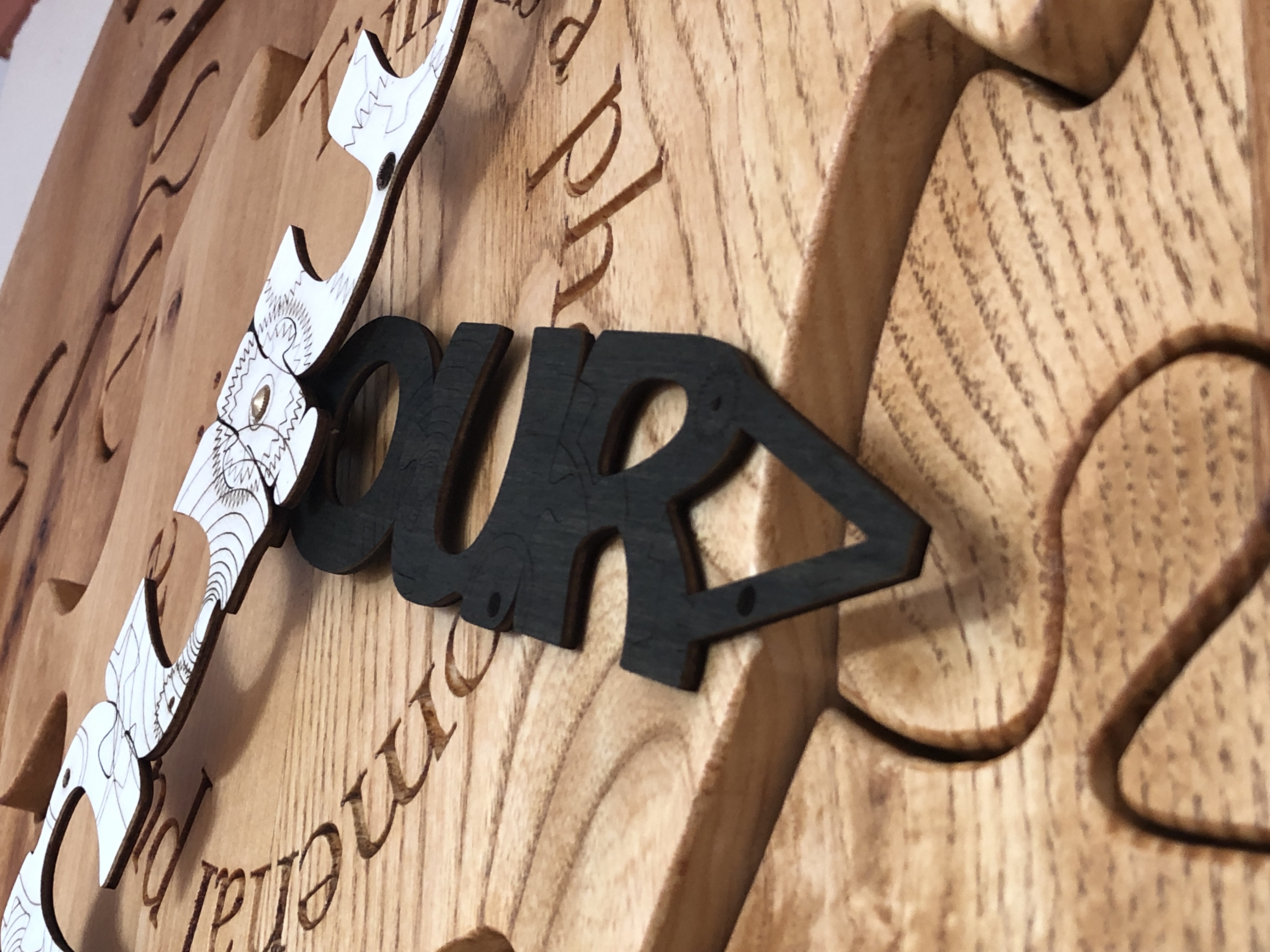
    I toyed with several ideas and made prototypes โ€“ most of which failed โ€“ but recently I came up with the idea of a steampunk motif on the words โ€œhourโ€ and โ€œminuteโ€ โ€“ and I figured out how to make them into actual jigsaw puzzle pieces. It involved the use of an extremely precise laser (you could be forgiven for thinking all lasers were equally precise, but that would be very wrongโ€ฆ), choosing extremely flat, strong, very light, and knife-edge-holding, material – with very careful preparation and handling. The hands have been dyed โ€“ not stained or painted โ€“ to give good contrast with each other and the clock face.
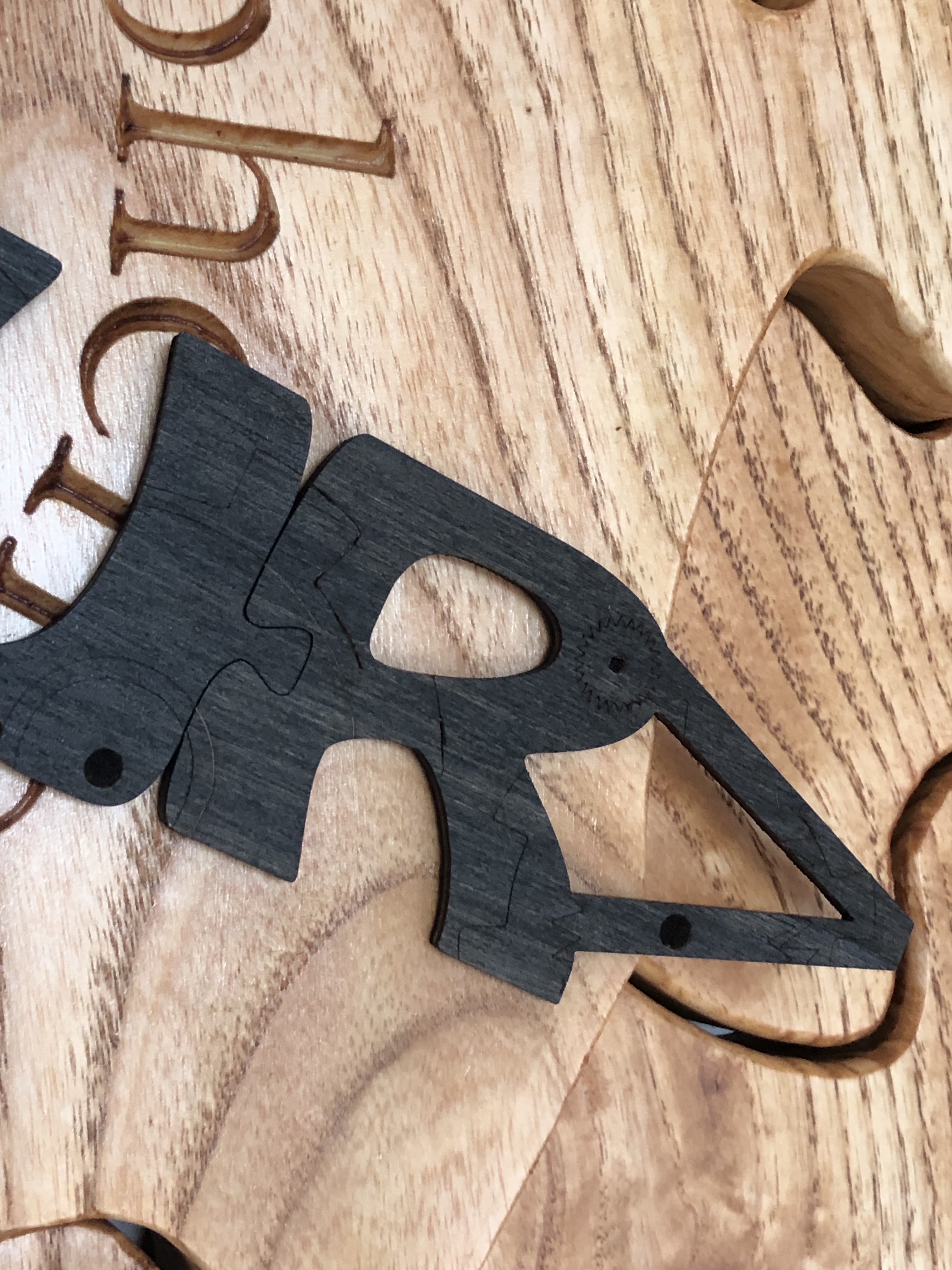
    Close-up of the “R” of the HOUR hand. Note the join with the “U”.

    The final artwork has been 95% made by hand, my hands, using the best tools at every stage (as the making-video shows). Iโ€™m very pleased to reference, and hope to provoke thought into, two fundamental and very puzzling concepts in physics and philosophy โ€“ time and gravityโ€ฆ

    Why are some of the numbers missing on my clock face?

    The keen-eyed amongst you might notice that the only numbers Iโ€™ve used are prime numbers. Having a penchant for prime numbers, when designing the clock face, I felt that putting on all the numbers – one to twelve – would make it look too crowded. Also, my goal was to design a clock puzzle โ€“ i.e. with interlocking puzzle pieces. Interlocking puzzle pieces are where two or more distinct puzzle pieces structurally hold together โ€“ and each piece connects with two or more other distinct puzzle pieces.

    It is surely a coincidence that whoever came up with the shape of the Hindu-Arabic numbers we use today, all the single-digit prime numbers have no holes โ€“ or negative spaces – in them, whereas the non-prime numbers have holes. This means that the non-prime numbers โ€“ 4, 6, 8, and 9 โ€“ cannot be single, whole, puzzle pieces. They are two or more pieces โ€“ with one or more smaller (hole) pieces fully enclosed. These โ€œholeโ€ pieces โ€“ or negative spaces – are attachable to only one other piece โ€“ the positive space of the enclosing main digit shape – whereas the prime single digit numbers are all simple single puzzle piecesโ€ฆ

    The negative spaces of the even numbers do not meet the criterion of a puzzle piece – each piece connects with two or more other distinct puzzle pieces – and were excluded from the design.

    This clockface design is using only prime numbers because it is a proper structural puzzle โ€“ all the pieces meet the criteria of proper puzzle pieces โ€“ and, most importantly, this appeals to my aesthetic and numerophile senses (in fact I did originally call this artwork โ€œPrime Jigsaw Clockโ€, but later changed my mind). A clock face is so familiar to modern people that numbers are not strictly necessary โ€“ and many clockface designs have no numbers at all. So, to be provided with six very special prime numbers, is six more than strictly necessary โ€“ and adds to the mystique of what this clock is all aboutโ€ฆ


  • Long-eared Owl with Oak Foliage (Art Puzzle)

    Long-eared Owl with Oak Foliage (Art Puzzle)

    Title: โ€œLong-eared Owl with Oak Foliage (Art Puzzle)โ€

    Artist: Michael Autumn

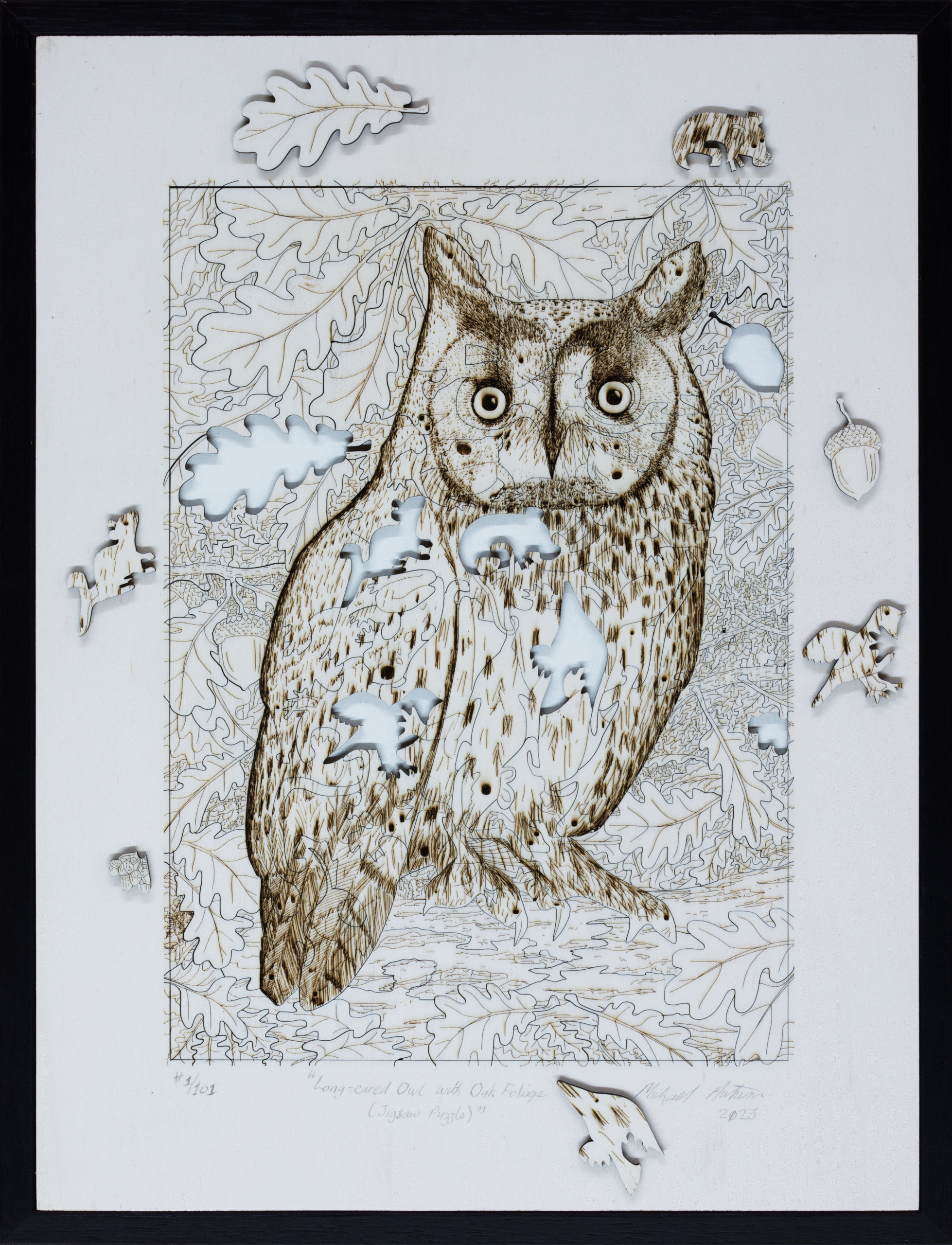
    The complete framed art jigsaw puzzle with some pieces set to the side - to highlight that this is a jigsaw puzzle as well as being a detailed drawing piece of art.

    Available to purchase on Etsy

    Medium: Hand-drawing – laser cut & engraved premium 3mm AB/AB Italian Panguaneta Poplar plywood
    Size: 48cm (H) x 38cm (W) (including the frame)
    Date: 2023
    Country: UK

    Description: The idea behind this artwork was to have a tactile, life-sized, long-eared owl, and to toy with the idea โ€“ โ€œYou are what you eatโ€. Long-eared owls are ferocious predators (as are all owls) โ€“ and will basically eat anything that moves that is smaller than them. They often swallow their prey whole, and regurgitate a large pellet of the undigestible parts โ€“ such as bones, teeth, hair, feathers. Indeed, examining their pellets is how ornithologists know so much about what they eat.

    This is a very high (in the case of the unlimited edition), and extremely high (in the case of the limited edition), quality laser-cut โ€œartโ€ jigsaw puzzle – directly cut (and scored) from an original digital hand-drawing. The design is a specially modified drawing of his original hand-cut thick solid oak artwork entitled โ€œLong-eared Owl (Jigsaw Puzzle) (You are what you eat)โ€ (2022) (see https://michaelautumn.wordpress.com/2023/05/03/long-eared-owl-jigsaw-puzzle-you-are-what-you-eat/ and https://youtu.be/jWsK6TFEevk).

    Jigsaw Puzzle?

    This is not a jigsaw puzzle in the conventional sense of the word: it is not simply a print stuck on card or wood – and cut into puzzle pieces โ€“ where the jigsaw puzzle was never envisioned by the artist (or photographer). Most jigsaw puzzles are a commercial after-design afterthought. However, this artwork was designed from the outset, and from the ground up, as a jigsaw puzzle. This is an artwork where every single line drawn was specifically designed to be cut as interlocking puzzle pieces. This is not a cut-up picture โ€“ there are only completely intentional cuts/joints – to make a work of art.

    The โ€œartโ€ side of this artwork is where I have designed the owl to show that it is literally made of many of the wide variety of creatures that it eats. I used the simple jigsaw-puzzle you-are-what-you-eat metaphor to illustrate this puzzling (pun intended!) transformation of lots of small animals making up an owl. My hope is that interacting with art like this will make you think more about the message in it than if it was a normal drawing or paintingโ€ฆ

    This is a line drawing โ€“ where the strong lines are cut through the wood (to form the jigsaw puzzle pieces), and the weaker lines are scored and engraved on to the surface of the wood (to add extra detail) โ€“ by the use of a very high quality laser.

    This laser-cut artwork has considerable extra detail compared to the aforementioned artwork, and has a rich oak foliage background โ€“ to take full advantage of the extra cutting and scoring precision achievable with a very high quality laser โ€“ compared to hand-cutting and scoring. Also I wanted to produce much more affordable art โ€“ compared to my very laborious (and strenuous!), hand-cut, hand-finished, original artworks.

    Laser-cut

    This is not ordinary laser cutting: this is laser-cutting pushed to its limits. The usual flaws of laser cutting – scorching, burn marks, unsharp, brittle and crumbling edges, poor detail โ€“ might be acceptable to most people, but wasnโ€™t acceptable to me โ€“ a self-confessed perfectionist with OCD! So over several months I exhaustedly researched the problems, tried various solutions, found some to be too labour intensive, thought outside the box, made a special tool, and eventually came up with a workflow of pre-, and post-, production, specially selected materials, and using special techniques. Now Iโ€™m very happy with the results: near perfection and consistency โ€“ I think itโ€™s the best you are likely to see – or feelโ€ฆ

    Editions: Available in both limited and unlimited editions (see respectively named sections below).

    Material: finest quality 3mm hardwood plywood

    • sustainably produced wood
    • specially treated (protected against frequent handling, moisture, water spills, saliva, dirt)
      • non-cracking, non-peeling, non-flaking
      • (the limited edition has a higher specification โ€“ see โ€œLimited Editionโ€ section below)

    Number of pieces in puzzle: 156

    Jigsaw puzzle size: 297mm (H) x 210mm (W)

    Size with extended mat (for unlimited editions): 400mm (H) x 300mm (W)

    Custom Frame size (available for unlimited editions): 480mm (H) x 380mm (W) x 47mm (D)

    N.B. Not suitable for young children due to the very small size of some of the pieces (the smallest are approximately 10mm x 5mm), however, the varnish meets child safety standards (EN 71.3).

    Limited Edition

    Details of the edition are hand-written by the artist in pencil on the special mat below the artwork in the following form :-

    Edition number (left), title of artwork & year (middle), signature (right).

    Edition Size: 101

    Edition numbering format: #[space][edition number]/[edition size] โ€“ e.g. โ€œ# 23/101โ€ (the โ€œ#โ€ is to prevent any additional digits being added to the left).

    While made from the same wood, the limited edition differ from the unlimited edition in the following important ways :-

    Comparing pieces from unlimited (left) and limited (right)
    • Are lighter in colour (with staining) so that the design stands out more clearly.
    • The wood is specially treated for maximum UV protection, to minimise colour change, and to virtually eliminate yellowing, darkening, and radiation damage that normally occurs in unprotected wood after many years.
    • Are cut with a much finer laser to virtually eliminate the gap between pieces and to give even tighter joints than the unlimited edition. The laser cutting takes three times longer than normal โ€“ taking over three hours for each artwork.
    • They come with the outer perimeter wood (known as the โ€œmatโ€) from which they were cut โ€“ with the design bleeding 2mm into it – making a natural-looking border. The mat is intended to be framed, and it provides space for the all-important hand-written edition number, the work title, the year, and the artistโ€™s signature.
    • Available with the optional special bespoke museum-grade archival frame. Not everyone is concerned about protecting their investment and their art staying in excellent condition for hundreds of years – or they possibly are, but donโ€™t want to spend the extra money on this – which is why the special framing offered is optional. The limited edition art jigsaw puzzle can be purchased unframed (it still comes with the aforementioned mat).

      The frame has been specially designed and made by me. I am an experienced framer (and general carpenter/joiner), but I donโ€™t relish framing! I only make special frames because unfortunately some of the types of frames I want canโ€™t be made by most professional framers โ€“ they can need special joints, special and very exacting moulding, interlocking double frames with very precise features.

      Most art is only for show – it is not meant to be touched at all – and is shielded behind a completely sealed frame and/or covered in layers of varnish. The custom frame made for this artwork is very special because I wanted the ability for the artwork to be hung on the wall โ€“ with all the pieces remaining in place(!) โ€“ whilst also being easily opened – so that the jigsaw puzzle can actually be solved as often as desired. How to achieve this, whilst at the same time providing the maximum level of protection so that the artwork lasts hundreds of yearsโ€ฆ? The answer was to make a two- part museum-grade frame – where one part fits snugly inside the other. The front (outer) part has the highest quality, clearest, anti-reflective, museum glass – that virtually eliminates all harmful UV radiation and naturally protects the artwork from dirt, dust, etc. The back (inner) part holds the mat of the artwork jigsaw puzzle completely flat to a museum-grade, acid-neutral, non-VOC, non-staining, 100% cotton rag mount board – which in turn is mounted on a very thick, very rigid, acid-free, non-VOC, non-staining, backing board – all using museum-grade adhesives, hinges, and tapes. The front (outer) frame is made from a customised precision moulding – because the required specifications are such that it is not available off-the-shelf.

      The end result is a fabulous frame โ€œsandwichโ€ that can be put on the wall – like normal framed artwork โ€“ and can be taken down any time so you can attempt to solve it. The front part can easily be lifted off (by sliding open the clasps at the back), and the jigsaw puzzle pieces can be tipped out โ€“ ready to be solved. Afterwards, the front can be replaced, the clasps at the back closed, and the whole frame can be hung back on the wall.

      This frame design is museum grade in all but one inevitable respect: it is designed to be opened – and is therefore not completely and permanently sealed. This is a very minor concession – that is obviously required for the ability to solve the jigsaw puzzle as often as required. However, obviously it can very easily be sealed at the back (preferably with readily available archival backing tape) if required โ€“ needing no special tools or skill. When sealed at the back like this, it would be 100% museum grade. But even without being sealed, it is 99% museum grade โ€“ and should last in pristine condition for hundreds of years.

    Unlimited Edition

    The unlimited edition is a very high quality laser-cut wooden product – probably the highest quality wooden jigsaw puzzle available anywhere – as of 2023 (apart from the limited edition version of course). These are not mass-produced: they are individually produced on a very fine laser – taking over an hour each – and the post-production is individually inspected and counted to guarantee quality control. The unlimited edition is not available framed.


  • Oak Tree (Art Puzzle)

    Oak Tree (Art Puzzle)

    Title: โ€œOak Tree (Art Puzzle)โ€
    Medium: Hand-drawn, hand-cut and engraved solid European Oak art puzzle (Limited Edition of 7).
    Size: 60cm (H) x 61cm (W) x 4.4cm (depth) @ 11.8kg weight
    Date: 2022

    It started out as a clock!

    I canโ€™t remember why, but this started out as a design for a clock! But after a short while I decided I should make a clock jigsaw puzzle and an oak tree jigsaw puzzle โ€“ as completely separate works.

    My Favourite Tree

    The oak (English Oak – Quercus robur) – is probably my favourite English tree, and Iโ€™ve wanted for many years to pay homage to them. Iโ€™ve travelled quite a bit over the UK, and often it has been to get somewhere lovely by sunrise โ€“ or close to it โ€“ and often Iโ€™ve driven home at sundown โ€“ because I donโ€™t particularly like driving in the dark (for the simple reason I canโ€™t see anything). So I have seen a lot of sun rises and sunsets (sometimes both in the same day) โ€“ and the visions that stand out most in my memory are oak trees with the sun rising or setting behind them. Many an oak I have seen with blood red skies, blazing yellow and orange skies, gloomy slate skies, fresh cold blue skies, stiflingly hot blue skies.

    A great irony of the massive plunder we have done of the natural oak forests in the UK is that the very few trees that remain really stand out alone in the landscape. Often you will see a solitary great oak forming part of a hedge, or standing proud in the middle of a field. And so we can probably see and appreciate them much better now than if we were to go back a thousand years or more โ€“ when the country was blanketed in them โ€“ and you literally couldnโ€™t see the tree for the forests.

    I particularly like to see oak trees in winter โ€“ when you can see their gnarly cauliflower-shaped fractal trunks, branches, and twigs โ€“ and the great silhouettes formed by the trees and the ubiquitous chocking parasitic ivy.

    How to capture the essence of an Oak Tree?

    A 2D photograph doesnโ€™t do an oak tree justice because there is so much to them. But as a starting point, what better way to depict an oak tree than by carving an oak tree from a big chunk oakโ€ฆ?

    How to capture an oak tree in all of its many different guises? Among other things, I wanted to try to depict their status as a keystone species. So many species of mammals (like squirrels, mice, bats), insects (like moths, butterflies (and their caterpillars), and flies), most woodland birds (like owls, tree creepers, nuthatches, tits, finches, warblers, pigeons, doves) – depend on the oak as a place to live. Birds and bats live, rest, and/or nest in the branches, holes bored into the wood, or simply cracks in the bark. Insects shelter on, and in, the bark and leaves (often highly camouflaged). Many parasitic plants like ivy and mosses live on it, as do many species of lichens and fungi.

    Many species depend on oak trees directly or indirectly for food: fungi have a symbiotic relationship with them, bees and wasps pollenate its flowers in spring, insects eat its leaves, bark, and wood. Moths prey on its flies, bats prey on its moths.

    Birds eat the oak treeโ€™s caterpillars (of the butterflies and moths) โ€“ indeed many, like tits, specifically time their breeding to coincide with the huge glut of the caterpillars in spring โ€“ and most warblers in the UK travel all the way from Africa in early spring specifically to do this. Jays, squirrels, and some wasps and bees feed on the acorns, but it is the Jays and squirrels that actually hugely benefit the oak tree by spreading its acorns (seeds) far from where they fall. Without these, the oak tree would depend on the very poor and unreliable mechanical dispersal of acorns rolling downhill or being washed by rain water away from its canopy – in order to spread far and away, and stand a good chance of survival (often there are no plants on the ground under an oak treeโ€™s canopy because of its very dense leaf cover and the competition for nutrients โ€“ so this is a very hostile place for the oak treeโ€™s own seedlings to grow).

    The oak tree is a keystone species even when it is dead (or killed). Fungi, lichen, mosses, and insects will eat and/or digest them, many insects will lay their eggs in them (which in turn will eat the dead wood), and homo sapiens have built navies, buildings, used them as firewood and in the smelting of metal ores and in metals for thousands of years.

    So in a very small way I have tried to capture some of this ecological complexity…

    Fractals

    I also wanted to capture something about the oak treeโ€™s fractal appearance. Small branches resemble a whole tree, and so do large branches. If they are pollarded, what look like whole trees grow out of their stump.

    Seasonality

    I also wanted to capture something about the oakโ€™s seasonal differences โ€“ specifically that they have two distinct personalities: one with leaves and one without leaves. Most of the leaf clumps (summer) in the work can be removed โ€“ leaving exposed branches (winter).

    Oakโ€™s Fruit

    I wanted to capture something about the fruit of the tree โ€“ the humble acorn โ€“ and how that tiny thing can grow into a monster of a plant โ€“ with the chance of living five hundred years or more โ€“ and itโ€™s dead body โ€“ timber โ€“ in the right conditions capable of surviving a thousand years or more.

    Why a Jigsaw Puzzle?

    A jigsaw puzzle seemed a very apt way to represent or capture some the complexity and interconnectedness of the oak tree – which is very interesting because this is proving to be a very fruitful visual communication medium phase I am going through at the moment (I have worked in many art mediums)…

    A jigsaw puzzle is, among other things, a metaphor for my appreication of the wonder of Nature and its mysteries. It is my (very feeble) 2D representation of the 4D (3D + time = 4D) complexties and variaties of some of the huge number of spieces’ interconnectedness – where jigsaw pieces and carved lines are symbolic of some of Nature’s species, camouflage, and its mixed uses.

    Naturally, with this jigsaw puzzle being made of quite chunky oak, the hard, heavy, wood directly communicates oakness to the viewer. So in some unique, and perhaps mysterious, way, the material and the original whole subject – the oak tree – express each other…

    Texture

    Finally I wanted to capture the texture of the tree โ€“ particularly its very rough bark. Iโ€™ve tried to do this by the tactile nature of the puzzle pieces and the engraving on the work.

    “Limited Edition” of 7

    The phrase limited edition in this case is a bit of a misnomer. These are all individually handmade by me from my original design. I really wish there was, but there is no mechanical or chemical process I know of by which these can be reproduced – like screen printing, lithographs, card puzzles (using a die and jigsaw press), etc.

  • Artist Anxiety

    Artist Anxiety

    There are many different types of artist and many types of journeys in creating a work of art. Much art in the last century is what I call utter rubbish – slipshod, slapdash – made within minutes to a few hours or a day or two. And it shows. For example Pollockโ€™s drip โ€œpaintingsโ€, or Hirstโ€™s โ€œspinโ€ โ€œpaintingsโ€. Most of it is utter contemptible rubbish in my humble opinion. Even many of the Impressionistโ€™s work was done in a day – often outside with a portable easel and done in a single sitting (however, purely aesthetically, I do like a lot of work from that period from that art movement).

    Iโ€™m certainly not saying that the more time and effort spent on an art work the better it will be – and vice se versa. I’m saying that the more effort an artist puts into their work the more I will respect it and the more I will try to understand and appreciate it – and the better quality it is likely to be. This seems obvious to me…?

    Consider a book of a handful of words compared to one of 100,000 words… The latter usually is expressing much more than the former. But a 100,000-word book is not necessarily saying more that a 10,000-word book. The former could be very waffly and poorly structured. Whatever one is trying to express there is usually some minimum or ideal way of expressing it (for the target audience)… My general point is that something expressed very briefly or quickly is usually not expressing very much – compared to something where a lot more time and effort has gone into it…

    Iโ€™ve been working on a piece called โ€œGolden Plover with Eggโ€ (Jigsaw puzzle) for over ten weeks now, and Iโ€™m coming to the final stages – where things are finally starting to take shape – and, at last, Iโ€™m beginning to feel good about it. Often through the long arduous hours – many of which have been physically very demanding – Iโ€™ve been deeply anxious. Why am I doing this? Why is it taking so long? Am I wasting my time? Will anyone appreciate it?

    Not that I am doing it for money (more on this later), but will the work be worth anything? Will it have a value that is reflective of the effort I have put into it ? Iโ€™ve worked in I.T. for many years where I was paid quite a high hourly rate. What I would earn in three months (because I have about another two weeks work to go on my current piece) was a not inconsiderable sum. What might my hourly rate be for this piece…? (Not that I will sell it, but I will hopefully sell other editions of it…)

    The peculiar thing about art is that some art created in a slapdash fashion sells for thousands, if not tens – or even hundreds – of thousands, of pounds (ยฃ) – making the hourly rate absolutely ridiculous. Picasso made about 46,000 works of art in his lifetime – many of which were created well within a day. So his hourly rate was in excess of ยฃ100,000!

    Some art takes hundreds of hours – and sells for a pittance – making the paid hourly rate utterly pitiful – and puts a contemptible value on the artistโ€™s time/life. Clearly there is no relationship between an art workโ€™s value and the amount of time and effort that went into making it. Yet, for most other goods in society, the more time taken to make them the more expensive they are. Itโ€™s a very strange world we live in…?

    Why do I do art – I keep asking myself?! I donโ€™t have to. Unlike some artists, there are plenty of other things I could do – and have done – for a living. The simple answer is: I donโ€™t really know! I just know that I like making things and commenting on things that interest me.

    Yesterday, while working on โ€œGolden Plover with Eggโ€, I was thinking why I do art – and this piece in particular? Itโ€™s so much work, effort, and cost (the raw materials and special tools are expensive)?! Mahlerโ€™s beautiful Symphony No. 4 was playing in the background, and I thought of the effort he must have put into composing that sublime masterpiece – the trials and revisions that it must have gone through. I wonder what emotions and motivation drove him to do it, the frustrations he experienced, the ups and downs he went through, the anxiety he felt of what others might think of it…? He was a fellow artist, so I thought I must share some of his emotions and anxieties…?

    Malher didnโ€™t have to compose that symphony. No one asked him to do it (as far as I know). Possibly something inspired him, but, like many great works or inventions, inspiration is one thing, implementing it is quite another… Something in his deep psyche drove him to do it. No one told him how long it must take. He just set about doing it, and didnโ€™t stop until he was satisfied with it. And all through the journey he will have applied his skills as a musician, and his heart and sense of aesthetics to evaluate and refine it. He would have been striving for a level of quality acceptable to him – and only him.

    There are no rights and wrongs with art – so there are no objective ways to judge it, or to know if the objective has been achieved. Well thatโ€™s not strictly true. In each form of art there are usually a few ground rules. Like music for Mahler, I guess he ruled out discordances, wanted to use (or felt he should use) certain instruments, and he possibly wanted four movements – because that was the standard Western classic symphonic tradition he was raised in?

    He had to figure out how to make the sounds he wanted – or at least make sure it was practically possible – i.e. playable and audible. So finding a practical solution to each and every note, phrase, passage – were upmost in his mind. He possibly followed other music rules that we donโ€™t know about (because he didnโ€™t write them down), and those Iโ€™m not competent to know or understand.

    However, the vast majority of the huge number of decisions that go into the artistic creative process are entirely subjective. Do I like everything? Do all the pieces โ€œgoโ€ together? Do they โ€œgelโ€ together and create some form of harmony? If not, what can I change so that they do? Is it good enough? How can I improve it? What am I trying to say or communicate with this? Is what I want to communicate interesting and/or important? Have I achieved my goal/s? Is it finished? (I certainly donโ€™t believe all, or even most, artists think like this – but the best ones do…)

    I think Edisonโ€™s phrase: โ€œGenius is 1% inspiration and 99% perspirationโ€ is a gross understatement. I think itโ€™s much more like 0.0001% inspiration – or even less – and the rest perspiration!

    Back to my thoughts yesterday and Mahlerโ€™s Symphony No 4. While listening to all four movements, I thought how each was utterly sublime, perfect, and complete on their own – yet Mahler created a unified whole with them all. A staggering and wonderful achievement that enhances and enriches anyone who listens to it. It occurred to me that possibly only artists fully appreciate other artists – because they will have some insight into, or empathy for, the effort and emotion that has gone into the creative process…

    I donโ€™t know what drives artists to create unnecessary, uncalled for, unusable, works of art, but listening to Mahlerโ€™s Symphony No 4 I thought: โ€œthank god they doโ€…

    I think back to my last piece – โ€œGuillemot with Eggโ€ (http://michaelautumn.wordpress.com/2020/03/01/guillemot-with-egg-jigsaw-puzzle/) – which took a similar amount of time and effort as my current piece – and I forget all the effort, trials and tribulations that went into designing and making it. It may seem strange, but I love to look it, and Iโ€™m just so glad I did it! Itโ€™s such a huge sense of achievement – of fulfilling something that was such a tall order. If it was easy many people would do it – and it wouldn’t be such a sense of achievement…?

    Itโ€™s very nice that other people seem to like it, but thatโ€™s not why I did it. And they will have no idea of the amount of work, sacrifice, and emotion that went into it. But hopefully it communicates something to them – about the ideas I was trying to express – that no other form of expression could achieve…

    But why, oh why…? And does anybody apart from me really care…?