Much, though by no means all, of my art is large and photo-realistic – and is intentionally made to look like photographs (although they are not simple photos – very far from it). In relation to this genre of art, you could say that I attempt to make photos – rather than simply take photos. Unlike photos, I didn’t want my art to fade – I wanted it to last as long as possible – hundreds of years – hence why I got interested in giclée printing and museum framing techniques.
I’ve been doing this form of art for quite a long time – since the noughties in fact (prior to that I was doing high-end conventional analogue photography – and I’ve always drawn and painted as a separate passion). It seemed like a god-given opportunity to me of the then new digital age – and, with my background in computing and photography, I took to it like a duck to water.
Some twenty years ago I bought what was then the best large format 44″ giclée (pronounced “zhee-clay“) printer (a very high quality printer that uses archival pigment inks on archival papers and canvases – and produces superb prints that will keep their pristine colours and vibrancy for at least 200 years under normal indoor lighting conditions). I started producing and framing largescale, highly detailed, and archival artworks (using museum-grade inks, materials and framing techniques) – some of which were accepted by the Royal Academy of Art in London (although I never got around to other galleries or outlets at the time).
My life took an absolutely terrible turn (details of which I needn’t go into) and effectively my creativity was put on hold for about a decade and a half. After fifteen years in the wilderness, I am largely recovered, re-motivated, and re-energised.
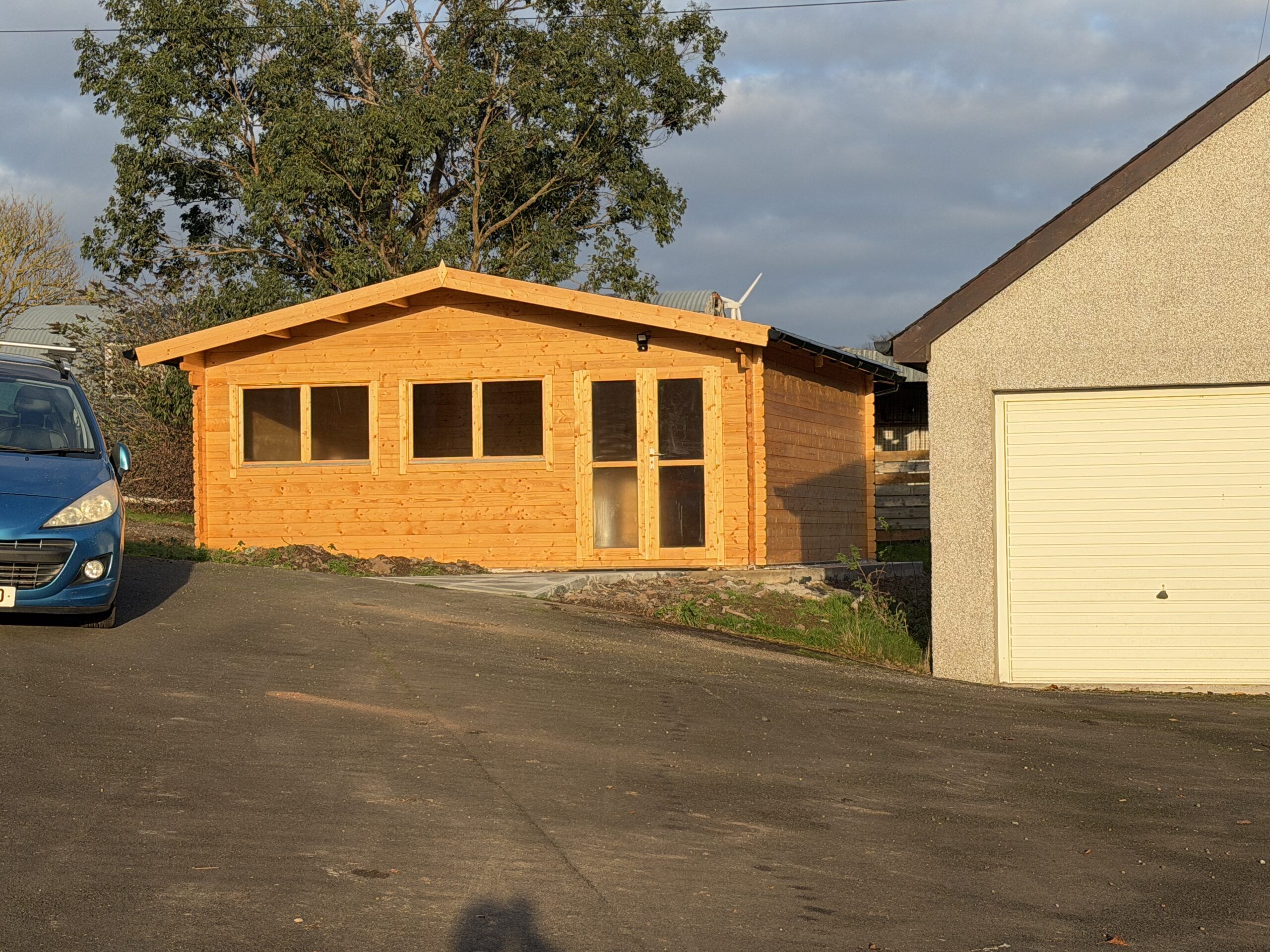
At the beginning of this year (2025) when I decided to get what is widely regarded (by those in the know) as the best large format 64″ giclée printer, the first obstacle to overcome was where on earth was I going to put it?! At 3.5m wide, 1.5m deep, just over 1m high, and weighing about 250kg – there was no room in my house (in any case it would be impossible to get it in the house because no doors are wide enough!). Also there was not enough room in my far-from-small studio/workshop because it was maxed out with tools, lasers, a CNC machine, and workbenches – besides, I wanted somewhere very clean and free of dust for highest quality printing. Building an extension to the house would have been far too expensive (and slow), so I decided to get a log cabin (that wouldn’t require a lengthy and expensive planning application).
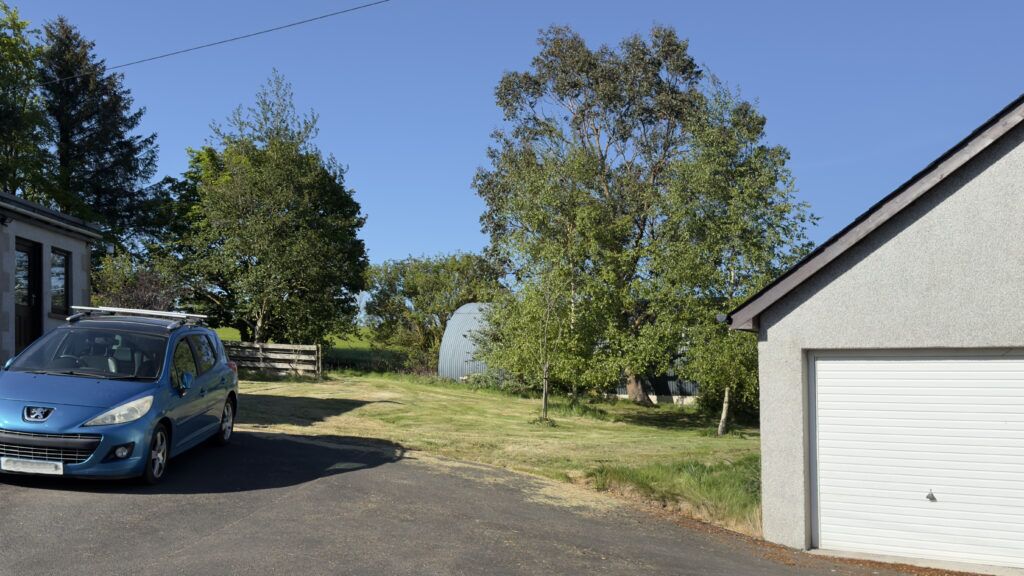
Originally I naively hoped to get something like a 12m x 8m building, but after much searching for a good quality log cabin supplier, and the shock of how little square meterage you get for your money(!), I plumped for a 6m x 6m x 2.5m unit – that being the minimum I could usefully use and could just about afford (allowing for the fact I had a very expensive printer to buy – along with the also very expensive inks, archival printing canvas, very large workbenches, etc.). Next, I had to decide where to put it. The patch of land between the studio and the workshop seemed the best option.
The site where the log cabin is going – between studio and workshop, and just off the driveway
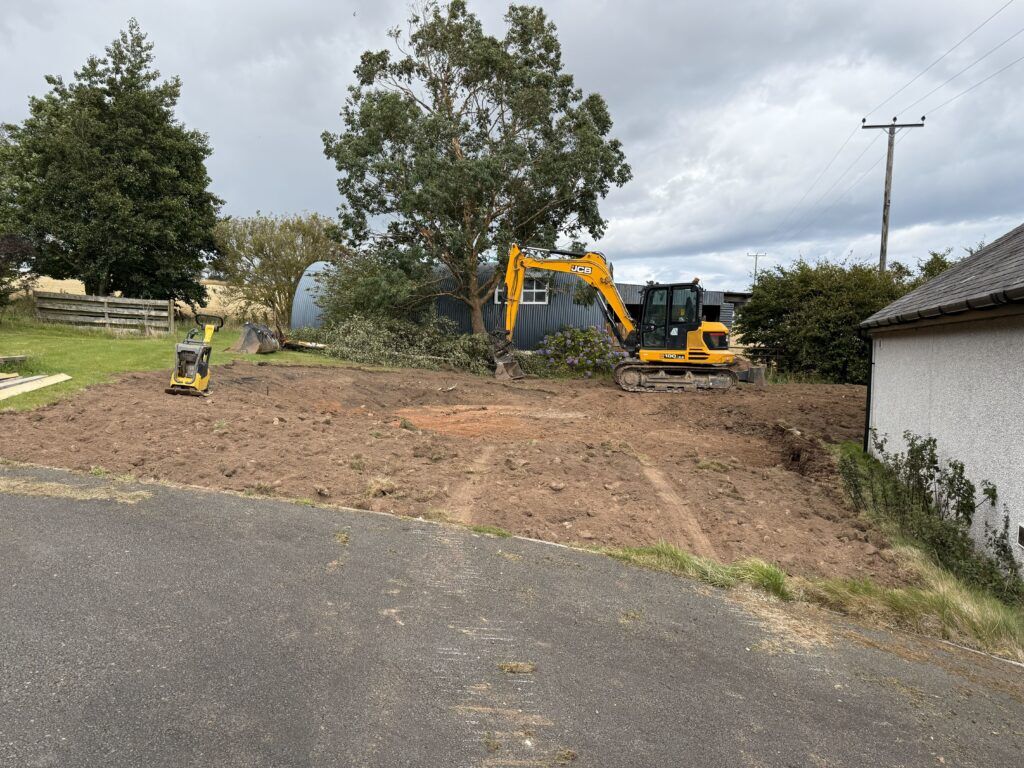
I ran the proposal past the county council planning department – just to make sure it came under “Permitted Development” – which it did – so I didn’t need planning permission. I had to get the base area firstly excavated and then get a concrete base put down (this I couldn’t do myself so I used a contractor).
Contractor levelled and prepared the ground for the log cabin
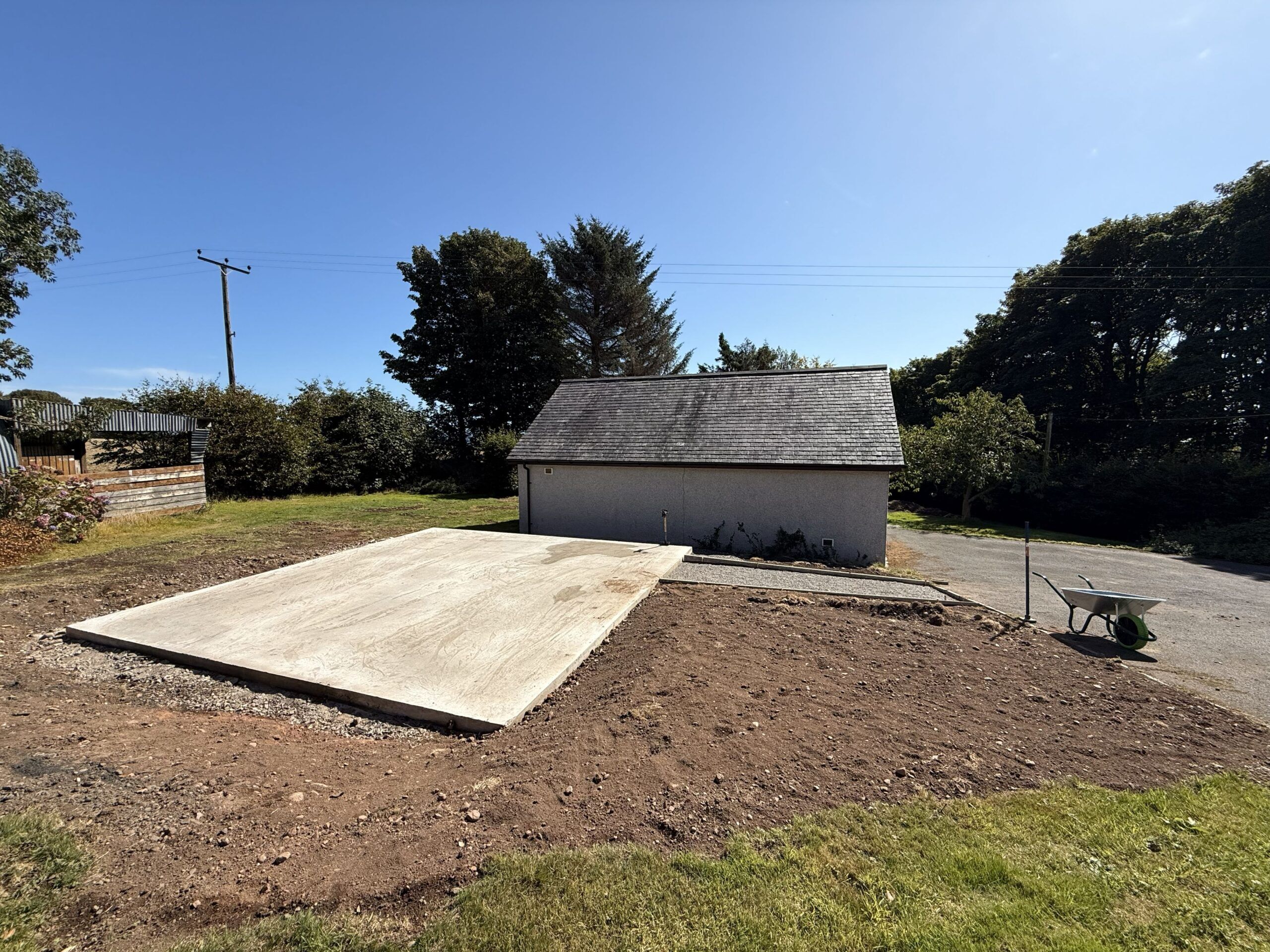
If I wasn’t watching the concrete base being built, only half of the base would have had a dampproof membrane – until I insisted…!
The completed concrete base (100mm thick on 100mm hardcore) (done by a contractor)
I left the ordering of the log cabin (which comes in kit form) until the base was finished. Then I (re-)looked extensively for the best quality and deal I could find. When I came to a decision it was mid August. I wanted to go with a local supplier but they couldn’t deliver until mid October. The thought of putting up the log cabin in mid autumn – with the high probability of rain, frosts, strong winds – put me off. So I checked the delivery estimate of my second choice. They said three weeks. Decision made.
Undaunted by such challenges, I decided to build the log cabin myself (from a kit) – both to save money, but also to be in total control of the quality of the build and the materials used. From quite a lot of experience, I have little faith in “handymen” – who often cut corners, do things as quickly and as cheaply as possible. I’m quite practical, patient, have some common sense, and can seek advice and/or find out anything I want to know.
I took my time – doing everything as best as I could, and using the best materials and techniques I either knew or researched. The September weather was absolutely gorgeous – sometimes too gorgeous (too hot)! I had a large tarpaulin to cover the timber over night and when it rained (which wasn’t often).
I lost quite a lot of time during the log cabin build because of receiving visitors over the North East Open Studios (NEOS) ten open days in early September (which I committed to back in January). But I like/liked meeting people interested in my art. It’s what art all about…? So whenever visitors turned up, I just downed tools, was probably filthy and stinking of sweat(!) – and gave them as much time as they wanted (which was often quite a lot).
The build was enjoyable for the most part. The instructions weren’t as clear as they could have been, the timber pieces weren’t labelled, and because many were very similar (but subtly different)- and there were unspecified spare pieces – it was very confusing at times. The most difficult part was the path leading from the drive to the log cabin – getting big and heavy concrete paving slabs to slope in two planes from level to the steep slope of the drive. But I got there in the end. It was very satisfying…
Ever since submissions of works for consideration to the annual Summer Exhibition have had to be done solely by photographs of the works – rather than sending in the actual works – I have felt very uncomfortable and uneasy about the selection process.
Firstly, judging an artwork by a relatively small photograph on a small computer screen (of who-knows what quality…?) is a very disingenuous way of seeing art. This disproportionately disadvantages large works compared with smaller ones. Also it disproportionately disadvantages colourful, compared with monochrome, works. And the quality of the photographs may not do the image justice… I imagine some of the widely established best works of art in history would be rejected based on up to three 1920 x 1080 pixel photographs seen on a computer screen…
Secondly, I am especially concerned by the request for certain pieces of information on the application forms – information that should have absolutely no bearing whatsoever on the selection process. Whether this seemingly irrelevant information is used in the selection process or not is simply not know, but the mere fact that it is requested – and with the process not being transparent – leaves this open to question…
Why do you need to know if we have exhibited at the Summer Exhibition before?!
Why do you need to know if we are a Friend of the Royal Academy?!
Why do you need to know the price of the work (you can ask for this if the work is selected)?
The trouble of this covert digital selection process is that we have no way of even knowing if our photos are reviewed at all – or whether they are simply filtered out as rejects based on arbitrary, but irrelevant, information – or due to some other covert agenda… Who knows if preference is given to Friends of the RA…? Who knows if preference is given to people who have (or haven’t) exhibited before…? Who knows if decisions are based on the price of the work, or expected revenue from sales of the work…?
I am not casting aspersions or making accusations about the selection process, I am merely highlighting that it is not transparent at all, it is far from the ideal way to see art, and it is certainly open to abuse. If you persist with this selection process you should make every effort to make it transparent – and not ask for irrelevant information on the application form. Some information is only relevant if the work is selected – not before…
I mourn the days of simple transparency – when work was physically submitted and paraded in front of the selection panel – and it was sometimes filmed for all to see. This assured us that the visual impact of the whole work – with no irrelevant information – was the only selection criterion. In those halcyon days of knowing the selection panel were seeing the works in the flesh – and with no prior knowledge of the artist or the work – only then did we know that this was the most objective and honest way of a panel of RA artists making a collective subjective decision…
I fully understand that during COVID-19 there was no alternative other than to submit photographs of artwork, but now there is absolutely no excuse not to go back to the tried and tested physically present ways – the method the RA used for nearly 250 years prior to COVID. The reduced cost of using photographs and the sending of emails has considerably reduced costs to the RA Summer Exhibition, but it is to the great detriment of the exhibitors…
The Summer Exhibition is a hugely profitable source of revenue for the RA, but it relies entirely on the trust and support of artists. I will not be submitting any more works to future Summer Exhibitions unless we go back to the tried and tested way of doing it, or until the issues of transparency are completely addressed, and I urge other artists to seriously consider their position…
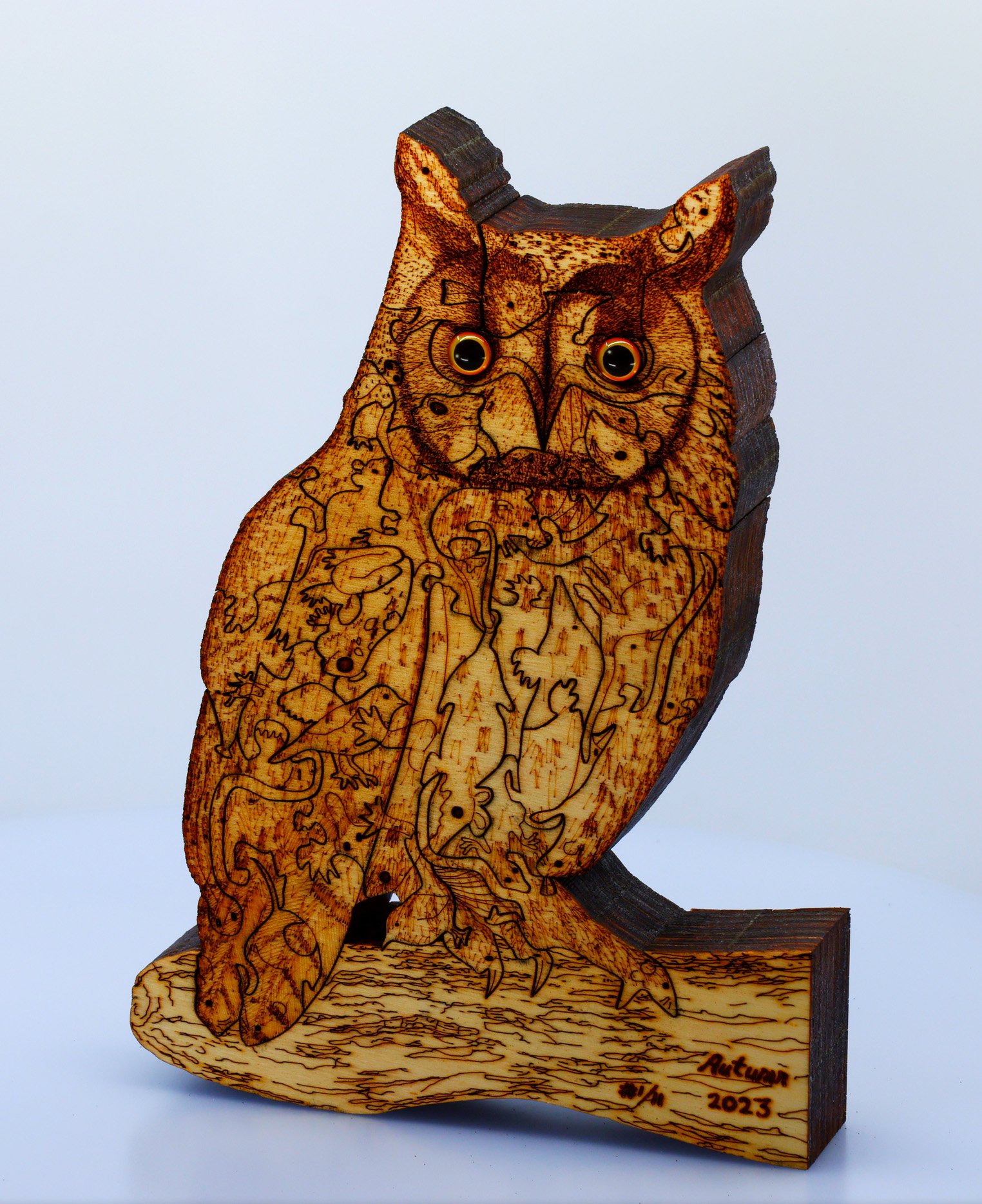
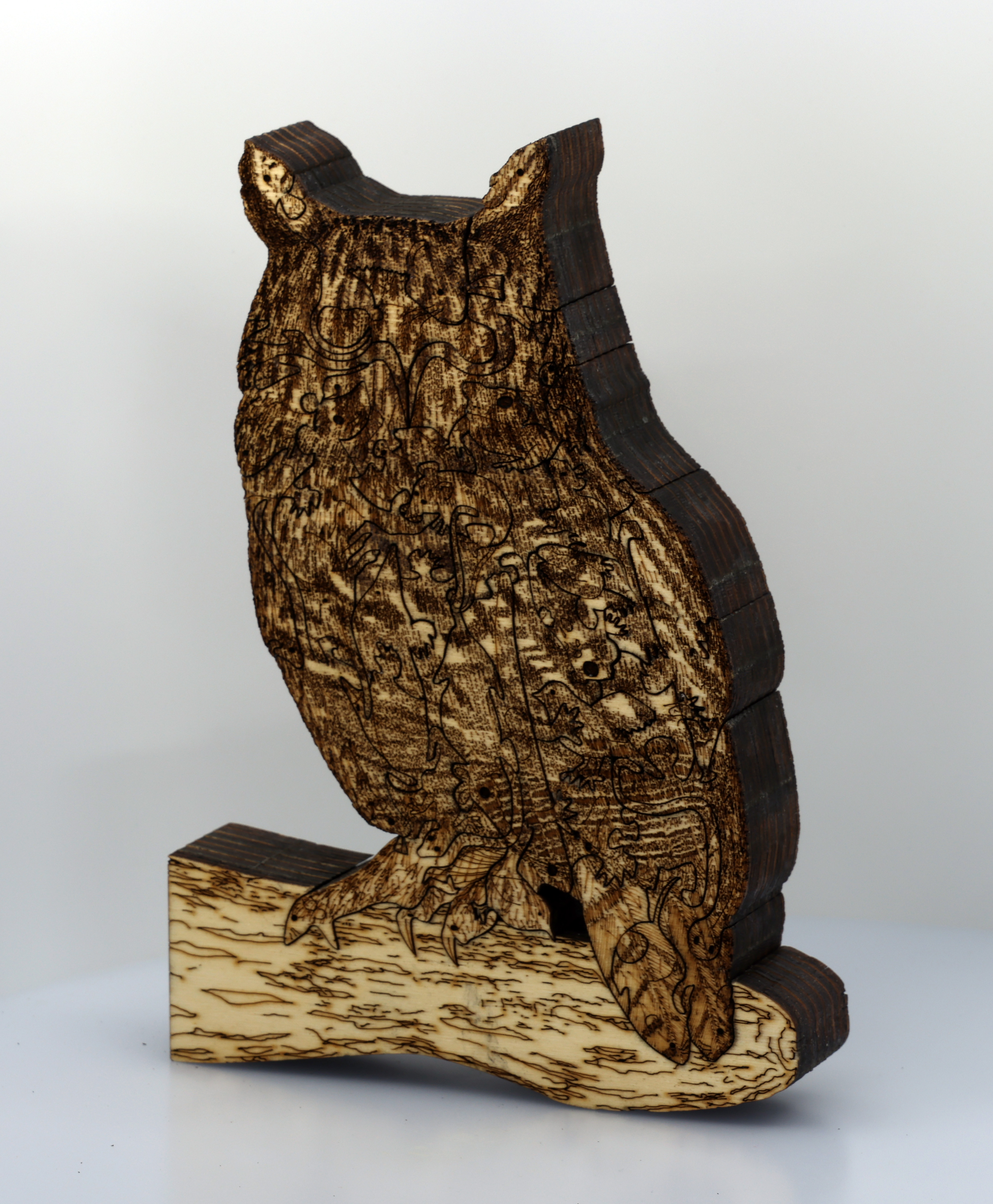
Title: “Long-eared Owl (Art Puzzle) (You Are What You Eat)” – laminated Artist: Michael Autumn Life-sized part-handmade, part laser-cut & engraved, two-sided, laminated plywood art puzzle (Limited Edition of 11)
Long-eared Owl (Art Puzzle) – Laminated: Full image – front
Size: 20cm (W) x 30cm (H) x 4cm (depth) @ 0.65kg weight Medium: 7 laminated layers of 6mm AB/AB Italian Panguaneta Poplar plywood + acrylic eyes. Date: 2023Rear of the laminated version
This is the culmination of three years of trying to find an engineering solution to making the incredibly intricate thick oak art puzzles I used to very laboriously (and painstakingly!) cut by hand using an electronic scroll (fret) saw. I tried waterjet cutting (that blasts away intricate areas and requires continuous cuts – totally wrong!). I bought and tried CNC routing (for about six months) with the smallest router bits available – but the bits that had the required diameter (1/32″) kept breaking and couldn’t reliably cut the depth required. And it require cutting at such small depths at each pass that even if the router bits didn’t keep breaking (and the whole job having to be restarted!) then it would have taken literally weeks to complete a single design!
The problem with conventional laser cutting (which I spent the best part of a year trying – with three different bought lasers) is that the deeper the material is, the more power is required – and therefore the wider the laser beam is. This results in an unacceptably wide kerf – gap between cuts. The kerf (gap) I managed by scroll-sawing – was about 0.7mm – which is the minimum I can accept. A laser that can cut through 42mm of plywood would ordinarily have a kerf of well over 1mm. So that is out of the question.
I pondered this dilemma for months, and tried various ideas – none of which worked. Eventually I can up with the idea of not trying to cut such thick material all at once – but to cut it much more finely in several thin layers – and then bond them together. This has (had) a number of issues and challenges in and of itself, however, I’m extremely please and relieved that I worked out solutions to the problems. And when I first produced the first fully acceptable complete version I was on cloud nine for several days…!
Suffice to say that the part hand-, part laser-, cut laminated version of my Long-eared Owl (Art Puzzle), is far more accurate, better fitting, and more reproducible – without causing RSI/hand arthritis! Having said all that, it takes about the same amount of time in total as hand-cutting(!) – about a week for each edition – because of all the part-laser cutting of multiple layers, doing the rear design – and quite a lot hand-finishing. But at least if is much less of a strain on my hands – and infinitely less daunting…!
It’s been a really long journey, I got lost in the blackest wilderness for a very long time, but I’m finally back on the right track – heading in my chosen direction… Art is not something where you can say you’ve achieved your goal: it’s the exploratory journey that is the pleasure and ambition. Yes, we may enjoy some wonderful sights and places along the way, but there is no particular destination…
When I left university – after failing in my academic ambitions (principally due to a complete change in interests from economics to philosophy and psychology – but not being allowed to change course) – I tried to make a living from my life-long creative passion – art. But I had no capital or support, and prostituted myself – doing mundane commissions and speculative commercial work – for a full year. I decided this extremely insecure, hand-to-mouth, existence, was no life for me, and I promised myself I would never financially rely on art again – or prostitute my art again – instead I would focus on doing the kind of art I wanted to do – for myself (in the first instance)…
After the brief encounter with “professional art” I stumbled into computing (IT) – something that came very naturally to me (I got engrossed with programming at university), and I thrived on it. In a very real sense computer programming is the complete opposite to art: programming is mostly convergent and objective thinking to solve very specific, precise, objective, mathematical and logical problems – using nothing but a Qwerty keyboard and VDU – and producing computer code – but it has no direct permanent artifacts. Whereas art is mostly divergent and subjective thinking – and a lot of manual dexterity and very skilled manipulation of physical materials – and is not trying to solve any problems at all – it is most often purely for beauty’s sake. And an artifact is always the end result.
During a long career in IT, I continued art (and photography – once I could afford it) on my own terms… (In the early years I took out – what was for me – a huge loan to buy professional photographic equipment – that cost about a year’s average salary.) I started entirely with analogue art and photographic equipment, and later evolved with the digital revolutions in both. My IT background helped considerably in this regard, and I was able to do more and more exciting things –making creative use of the extensive opportunities digital technology offered…
Eighteen years ago (at the time of writing this) I got married, and my wife and I bought a house together – with the main ambition being to develop our art interests and to start earning money from it (on own terms). I built a large studio (from a large barn), a workshop, a framing workshop, and a digital office. I converted a van for the safe transport of large framed glazed artworks. I was able to produce digital art to museum archival standards, and submitted work to the Royal Academy Summer Exhibitions – and sold some limited edition work at a good price. Things started to look up.
But no sooner had I started to get established, and it all collapsed due to a most heinous, psychopathic, sociopathic, attack by my insecure, irrationally and intensely jealous, (ex-)wife… The art-making complex I created, all my artworks, every photograph I have ever taken, every print I have ever made – over decades – have all gone. But that was as nothing compared to the unfathomable pain of not seeing the children, feeling their pain and confusion of not seeing me; a catastrophic breakdown, the utter terror, despair, hopelessness, blackness, I suffered – and suffer still to this day – thirteen years on… Indeed, if it were not for my son – and wanting him to learn the truth of what happened to him (and me) some day (when he becomes an adult?) – I would not be here now…
Some very intelligent women psychopaths (like Cleopatra and Livia Drusilla – and my ex), being physically weaker, are sociopaths as well – and often resort to coldly and completely selfishly manipulating others to achieve their nefarious ends – completely oblivious to the harm and pain they inflict along the way. This can magnify their powers enormously. Indeed, I would go so far as to suggest that such women are invariably very intelligent because they have to be to – to pull the wool over so many people’s eyes – often for years… They lead a web of lies and deceit that has to be very convincingly and consistently acted out – and so they have to be great actresses as well…
Years of depression and PTSD followed (I will never be the person I was, but I struggle on), with no creative output whatsoever for years. Most men suffer trauma like this on their own. For me, talking about it only made me feel worse. So-called “professionals”– who’ve probably never dealt with such cases before – asking naïve questions – is no help whatsoever. They are of the simple-mindedness of thinking that talking about pain helps – when in fact it doesn’t: it makes you feel worse. Re-living trauma is not any help for trauma…!
I could have produced some of the most melancholic and distressing art imaginable, but I hate depressive and dark art, and I chose not to inflict that on the world… Art for me always has been, and always will be, something positive and beautiful – something to bring light and joy into people’s lives, and preferably thought-provoking…
I look back now on those darkest years and wonder where the time went. I frequently see TV programmes, films, music, and sport from this period – but don’t remember anything about them – as if they happened before I was born – or I was in a coma all that time. For example, I recently (this late summer 2023) saw cricket documentaries about England winning the Ashes in 2015 and the world cup in 2019. I am a very keen follower of cricket (and played a huge amount in my youth: played for four different teams each week, and captained the school team), but I have absolutely no recollection of either of these momentous achievements…!
Such trauma, as I have suffered, either kills you – or you very slowly learn to live with it and slowly turn you attention to other things. Very slowly the blackness gives way to light. Very gradually the light started to come back into my life. IT has been good to me (and hopefully I to it), and it has many synergies in art and photography that I have been keen to explore. Among other things, IT has given me the financial opportunity to re-assess my life and prioritise what is important to me. Art is important to me, but I don’t want to be financially dependent on it. So in late 2021 (and largely due to melancholia) I decided to liquidate my assets, downsize, and find a suitable home in Scotland – with good art workshop/studio potential, close to the mountains, sea, and rivers (which I love) – and concentrate on art… Yes, I’d like to get my art “out there”, and sell non-originals – but I don’t want to be financiallydependent on it…
I’m finally getting back unto my stride. I’ve built a reasonably sized workshop and studio (adapted from an empty outbuilding) and fully equipped it. I’ve had the budget to buy and try just about everything I’ve wanted, and have fully resumed my art journey. This time I have seen to it that there will be no disruptions…
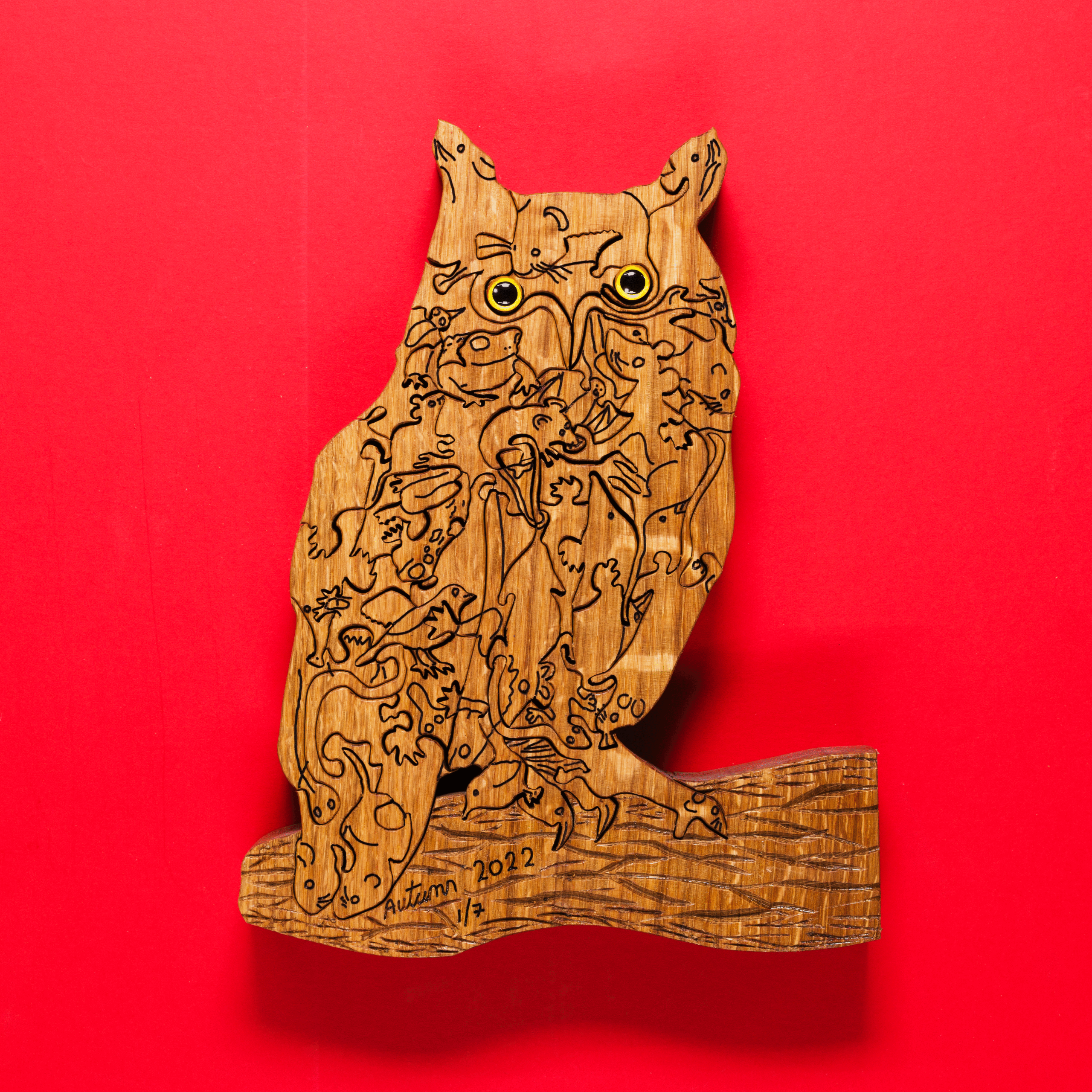
Title: “Long-eared Owl (Art Puzzle) (You Are What You Eat)” Artist: Michael Autumn Life-sized handmade solid oak jigsaw puzzle (Limited Edition of 7)
Long-eared Owl (Art Puzzle): Full image Size: 20cm (W) x 30cm (H) x 4cm (depth) @ 1.5kg weight Medium: Solid European Oak, hand-cut, hand-engraved, hand-carved, art puzzle + acrylic eyes. Date: 2022
Long-eared Owl
The story behind this art piece was to have a free-standing, tactile, life-sized long-eared owl, and to toy with the idea – “You are what you eat“. These birds are ferocious predators (as are all owls) – and will basically eat anything that moves that is smaller than them. They often swallow their prey whole, and regurgitate a large pellet of the undigestible parts – such as bones, teeth, hair, feathers. Indeed, examining their pellets is how ornithologists know so much about what they eat.
I often think about predator-prey relationships – perhaps being a veggie has something to do with this… All animals have to get their energy and material they are made of by consuming specific things – protiens, carbohydrates, and fats. Herbivores obviously get this material directly and indirectly from plants – which is often widely available (they don’t usually eat fats directly, but make them from carbohydrates). However, they usually have to eat a lot of plant material in relation to their size because it is a low concentrated source of food – requiring long, slow, complex digestion. Predators usually don’t eat plants – instead they prefer much more concentrated and complex food in the form of other animals.
I have designed the owl to show that it is literally made of many of the wide variety of creatures that it eats. From the moment of conception – where it starts as a single egg – it literally takes parts of smaller animals – and its amazing body chemistry converts them into material to make (and maintain) it’s growing body – and energy. I used the simple jigsaw-puzzle you-are-what-you-eat metaphor to illustrate this puzzling (pun intended!) transformation of lots of small animals making up an owl.
Owls typically eat 2-4 mice-sized animals per day – so about a thousand a year. Without owls, goodness know how many mice, moles, voles, rats, small birds, newts, etc. there would be…!
(I have to confess this was originally intended to be a tawny owl! I haven’t been lucky enough to actually see a wild long-eared owl, and as I got a long way into designing this piece I felt it would look better with ears – and, of course, a tawny owl doesn’t have visible “ears“… So I thought, okay, I’ll change it to a long-eared owl – they have great “ears” (well they look like ears, but they’re actually not – they’re just tufts of feathers!). The two species are quite similar in many respects – so the change was easy!)
The phrase limited edition in this case is a bit of a misnomer. These are all individually handmade by me from my original design. I really wish there was, but there is no mechanical or chemical process I know of by which these can be reproduced – like screen printing, lithographs, card puzzles (using a die and jigsaw press), etc. (for more details please see the aforementioned post).
Life-sized handmade solid oak art puzzle (Limited Edition of 7)
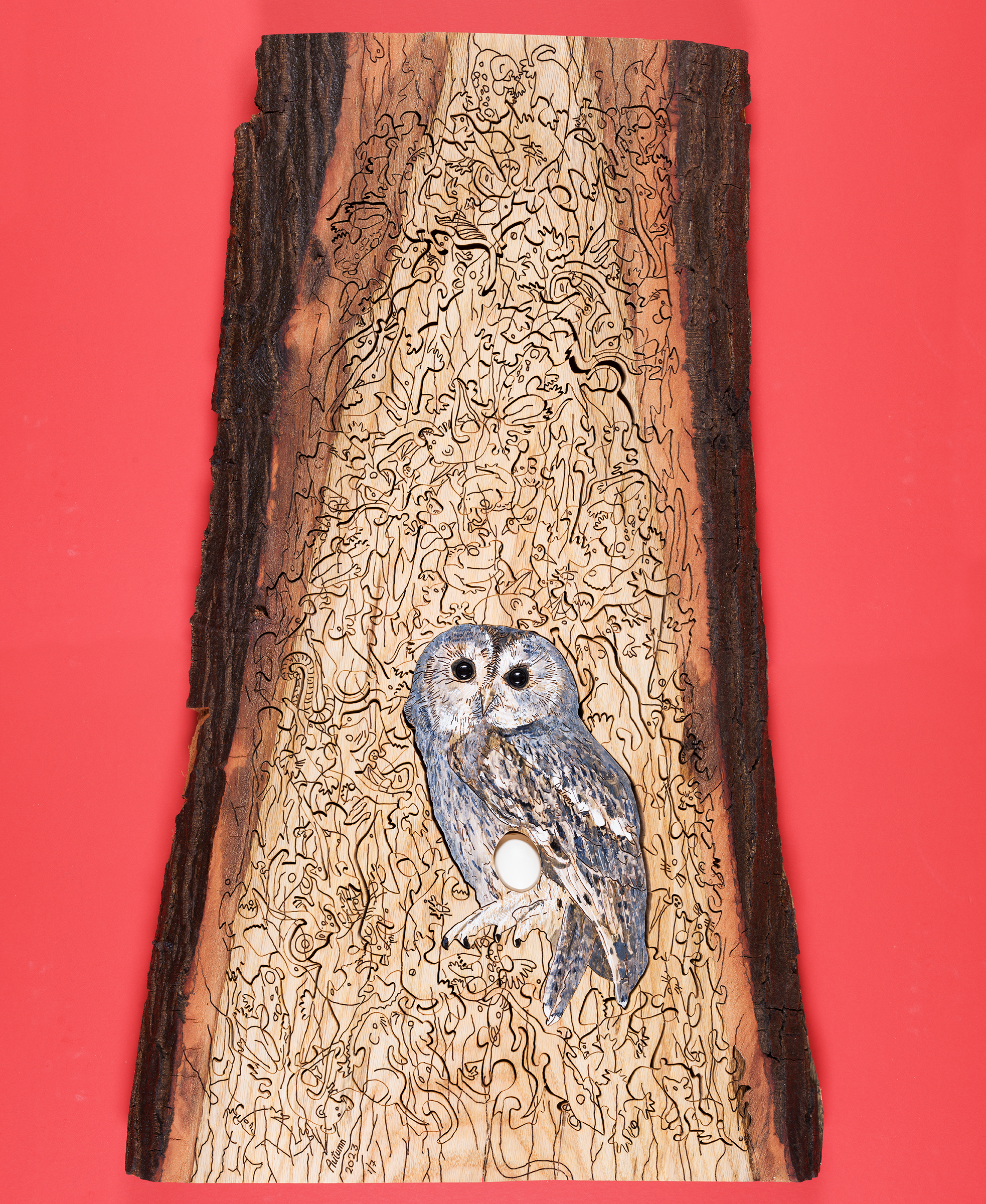
Tawny Owl with Egg (Art Puzzle): Full image Size: 50cm (W) x 82cm (H) x 8cm (depth) @ 20kg weight Medium: A single piece of waney-edged European Oak, hand-cut, hand-engraved, art puzzle with inset full-size replica tawny owl egg and acrylic eyes. Date: 2023
First and foremost I want to mention that the eggs used in my work are not real – for obvious ethical reasons (it is also illegal to take wild birds eggs). They are life-size replicas made of a plaster resin composite and hand-painted – not by me, but by a very reputable leading replica birds eggs maker.
Tawny Owl
Following on from Guillemot with Egg (Jigsaw Puzzle) (see https://michaelautumn.wordpress.com/2020/03/01/guillemot-with-egg-art-puzzle/), I thought I would pay homage to another favourite bird of mine – the Tawny Owl (Strix aluco). These, like all owls, are very mysterious – especially the noctornal ones (which tawnies are) – because they do things the opposite to us: they sleep/rest during the daylight, and come out – and hunt – at night. They are supremely designed and adapted to this lifestyle: they have excellent hearing and eyesight, they fly almost silently, and their hunting strategy is to hunt in the darkness – when other small nocturnal animals think it’s safe to come out…!
Mice, voles, shrews, moles – in fact any small rodent up to the size of a rat – are largely nocternal to avoid daylight predators – like kestrels, buzzards, merlin, sparrowhawks. But while rummaging for food and going about their normal lives – in what they think is the relative safety of darkness – a tawny owl – alerted to their presence by their quiet, but inevitable, sounds – can swoop undetected near to the unwitting little creatures. From close by the tawny can watch their prey’s every move – until they decide to pounce, crush and puncture them with their razor-sharp tallons – and then invariably swallow them whole…
Little birds could be roosting or sleeping in trees or bushes, but if they make any sounds in their sleep – even just quietly snooring or sleep-calling/singing – they are easy game for these owls… Frogs, toads, newts – in fact any small reptile – making any kind of sound at night – are likely to court the deadly attention of a tawny owl. Even fish splashing about at the water’s surface, or in the shallows, are fair game for these owls…
Suffice to say that if it is small and it makes a noise, it is on the menu…! So I thought I would play with this idea and illustrate as many of the small creatures tawny owls eat – as jumbled up jigsaw pieces surrounding the main protagonist. The whole design slightly resembles a huge regurgitated pellet of the tawny owl, and the small prey animals are all jumbled up – like fragments in a pellet.
I like art in the form of a jigsaw puzzle because it is interactive, and by careful design of the shapes and carving on the pieces, I can get the puzzle-solver to look at, and think very carefully about, them – in a way that is simply not possible with non-interactive art. Indeed, someone could look at a piece of art like this and not even notice the small creatures surrounding the main owl – let alone have any understanding why they are there – and why these particular animals. However, trying to solve a puzzle like this is a very different matter – they will definitely think more about what it is they are looking at…!
I have deliberately made the jigsaw puzzle very subtle because Nature is very subtle. These creatures are very difficult to see because of their camouflage and because they mainly come out at night – and it is precisely because they are so difficult to see that the owls rely on the noise they make to home in on them… The puzzle metaphor lets me toy with the idea that these small creatures think they are invisible – or out of harm’s way – but to a tawny owl, in the dead calm of night, their sounds makes them highly visible…
Owls typically eat 2-4 mice-sized animals per day – so about a thousand a year. Without owls, goodness know how many mice, moles, voles, rats, small birds, newts, etc. there would be…! If all the creatures a tawny own ate over the course of its lifetime were put into a 30cm diameter (about the width of this jigsaw puzzle) very tall clear tube – I wonder how high the pile of eaten animals would be…
Close-up of the life-sized tawny owl with replica eggSome of the art puzzle pieces laid out
The phrase limited edition in this case is a bit of a misnomer. These are all individually handmade by me from my original design. I really wish there was, but there is no mechanical or chemical process I know of by which these can be reproduced – like screen printing, lithographs, card puzzles (using a die and jigsaw press), etc. (for more details please see the aforementioned post).
Title: “Oak Tree (Art Puzzle)” Medium: Hand-drawn, hand-cut and engraved solid European Oak art puzzle (Limited Edition of 7). Size: 60cm (H) x 61cm (W) x 4.4cm (depth) @ 11.8kg weight Date: 2022
It started out as a clock!
I can’t remember why, but this started out as a design for a clock! But after a short while I decided I should make a clock jigsaw puzzle and an oak tree jigsaw puzzle – as completely separate works.
My Favourite Tree
The oak (English Oak – Quercus robur) – is probably my favourite English tree, and I’ve wanted for many years to pay homage to them. I’ve travelled quite a bit over the UK, and often it has been to get somewhere lovely by sunrise – or close to it – and often I’ve driven home at sundown – because I don’t particularly like driving in the dark (for the simple reason I can’t see anything). So I have seen a lot of sun rises and sunsets (sometimes both in the same day) – and the visions that stand out most in my memory are oak trees with the sun rising or setting behind them. Many an oak I have seen with blood red skies, blazing yellow and orange skies, gloomy slate skies, fresh cold blue skies, stiflingly hot blue skies.
A great irony of the massive plunder we have done of the natural oak forests in the UK is that the very few trees that remain really stand out alone in the landscape. Often you will see a solitary great oak forming part of a hedge, or standing proud in the middle of a field. And so we can probably see and appreciate them much better now than if we were to go back a thousand years or more – when the country was blanketed in them – and you literally couldn’t see the tree for the forests.
I particularly like to see oak trees in winter – when you can see their gnarly cauliflower-shaped fractal trunks, branches, and twigs – and the great silhouettes formed by the trees and the ubiquitous chocking parasitic ivy.
How to capture the essence of an Oak Tree?
A 2D photograph doesn’t do an oak tree justice because there is so much to them. But as a starting point, what better way to depict an oak tree than by carving an oak tree from a big chunk oak…?
How to capture an oak tree in all of its many different guises? Among other things, I wanted to try to depict their status as a keystone species. So many species of mammals (like squirrels, mice, bats), insects (like moths, butterflies (and their caterpillars), and flies), most woodland birds (like owls, tree creepers, nuthatches, tits, finches, warblers, pigeons, doves) – depend on the oak as a place to live. Birds and bats live, rest, and/or nest in the branches, holes bored into the wood, or simply cracks in the bark. Insects shelter on, and in, the bark and leaves (often highly camouflaged). Many parasitic plants like ivy and mosses live on it, as do many species of lichens and fungi.
Many species depend on oak trees directly or indirectly for food: fungi have a symbiotic relationship with them, bees and wasps pollenate its flowers in spring, insects eat its leaves, bark, and wood. Moths prey on its flies, bats prey on its moths.
Birds eat the oak tree’s caterpillars (of the butterflies and moths) – indeed many, like tits, specifically time their breeding to coincide with the huge glut of the caterpillars in spring – and most warblers in the UK travel all the way from Africa in early spring specifically to do this. Jays, squirrels, and some wasps and bees feed on the acorns, but it is the Jays and squirrels that actually hugely benefit the oak tree by spreading its acorns (seeds) far from where they fall. Without these, the oak tree would depend on the very poor and unreliable mechanical dispersal of acorns rolling downhill or being washed by rain water away from its canopy – in order to spread far and away, and stand a good chance of survival (often there are no plants on the ground under an oak tree’s canopy because of its very dense leaf cover and the competition for nutrients – so this is a very hostile place for the oak tree’s own seedlings to grow).
The oak tree is a keystone species even when it is dead (or killed). Fungi, lichen, mosses, and insects will eat and/or digest them, many insects will lay their eggs in them (which in turn will eat the dead wood), and homo sapiens have built navies, buildings, used them as firewood and in the smelting of metal ores and in metals for thousands of years.
So in a very small way I have tried to capture some of this ecological complexity…
Fractals
I also wanted to capture something about the oak tree’s fractal appearance. Small branches resemble a whole tree, and so do large branches. If they are pollarded, what look like whole trees grow out of their stump.
Seasonality
I also wanted to capture something about the oak’s seasonal differences – specifically that they have two distinct personalities: one with leaves and one without leaves. Most of the leaf clumps (summer) in the work can be removed – leaving exposed branches (winter).
Oak’s Fruit
I wanted to capture something about the fruit of the tree – the humble acorn – and how that tiny thing can grow into a monster of a plant – with the chance of living five hundred years or more – and it’s dead body – timber – in the right conditions capable of surviving a thousand years or more.
Why a Jigsaw Puzzle?
A jigsaw puzzle seemed a very apt way to represent or capture some the complexity and interconnectedness of the oak tree – which is very interesting because this is proving to be a very fruitful visual communication medium phase I am going through at the moment (I have worked in many art mediums)…
A jigsaw puzzle is, among other things, a metaphor for my appreication of the wonder of Nature and its mysteries. It is my (very feeble) 2D representation of the 4D (3D + time = 4D) complexties and variaties of some of the huge number of spieces’ interconnectedness – where jigsaw pieces and carved lines are symbolic of some of Nature’s species, camouflage, and its mixed uses.
Naturally, with this jigsaw puzzle being made of quite chunky oak, the hard, heavy, wood directly communicates oakness to the viewer. So in some unique, and perhaps mysterious, way, the material and the original whole subject – the oak tree – express each other…
Texture
Finally I wanted to capture the texture of the tree – particularly its very rough bark. I’ve tried to do this by the tactile nature of the puzzle pieces and the engraving on the work.
“Limited Edition” of 7
The phrase limited edition in this case is a bit of a misnomer. These are all individually handmade by me from my original design. I really wish there was, but there is no mechanical or chemical process I know of by which these can be reproduced – like screen printing, lithographs, card puzzles (using a die and jigsaw press), etc.
Life-sized handmade solid oak art puzzle (Limited Edition of 7)
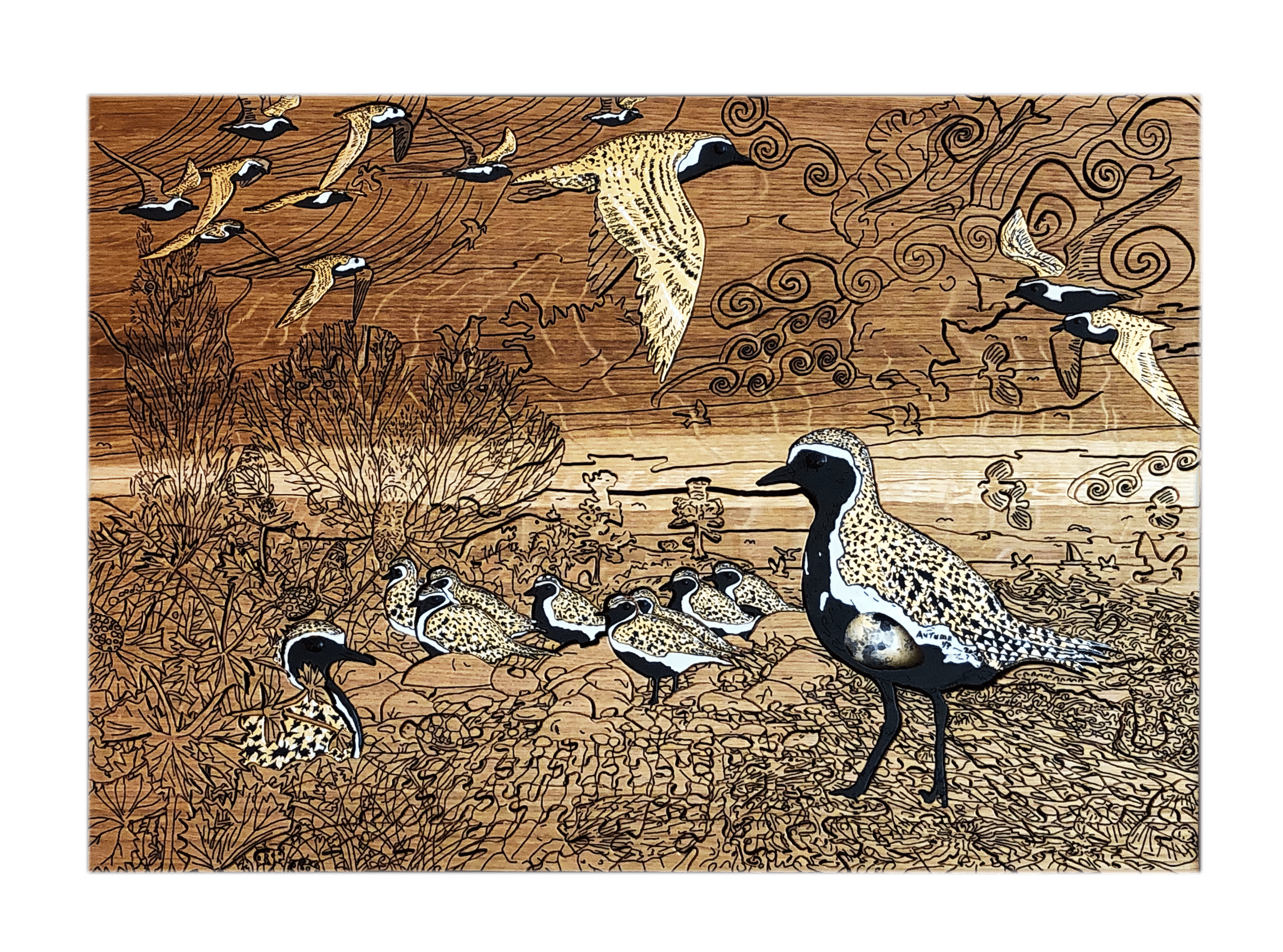
Golden Plover with Egg (Art Puzzle): Full image Size: 59cm (W) x 41.5cm (H) x 4.4cm (depth) @ 9kg weight Medium: Solid European Oak, hand-cut, hand-engraved, jigsaw puzzle with inset full-size replica golden plover egg. Date: 2020Golden Plover in artist’s dining room (click on image to see artists’ home studio, workshop, and gallery).
First and foremost I want to mention that the eggs used in my work are not real – for obvious ethical reasons (it is also illegal to take wild birds eggs). They are life-size replicas made of a plaster resin composite and hand-painted – not by me, but by a very reputable leading replica birds eggs maker.
Golden Plover
Following on from Guillemot with Egg (Jigsaw Puzzle) (see https://michaelautumn.wordpress.com/2020/03/01/guillemot-with-egg-art-puzzle/), I thought I would pay homage to another favourite bird of mine – the Golden Plover (Pluvialis apricaria). In winter plumage these birds are lovely, but unremarkable. However, in summer plumage they are absolutely stunning. The males are slightly more outstanding than the females, however, both are very distinctive and eye-catching. The spring transformation of the Golden Plover from winter to summer plumage is one of the most extreme, and beautiful, I know of. The word “dandy” comes to mind. They become the most striking of all the waders I know of.
Golden Plover in summer plumage
In summer their coal black bellies and faces, fringed with a slim cotton white mantle or fringe, and their “golden” upper parts – are a bold, brilliant sight to behold. But golden they are not! They are “buff”, ochre, or sandy brown – like most wading birds – who feed predominantly on mudflats and shorelines – and thus gain good overhead camouflage – so as not to draw attention to predators such as peregrine falcons, marsh harriers, etc.
To highlight this golden misnomer I thought it would be fun to actually make them golden – 24 carat gold gilt to be precise! Gold is an incredibly beautiful and mysterious metal – mysterious both in terms of its physical properties and appearance, and its hold over us. Gold, with its density of 19.3 (over 19 times that of water), is the absolute nemesis of flight! Gold, with it strikingly bright, mirroring, shimmering sheen – is the nemesis of camouflage!
24 carat gold gilded Golden Plover
I hope the metallic gold of the Golden Plover in the above pictures is clear. Being metallic the light reflects differently according to the angle being viewed and the available light.
Migration
In summer Golden Plover breed in the tundra – countries such as Iceland, Greenland, Scandinavia, and northern Russia – where the days are very long indeed – and over-winter in warmer climes – and where there isn’t perpetual winter darkness – such as here in the UK (some go as far south as northern Africa). The migration to and from Iceland is no mean feat for such a small bird. The main bird in the picture is life-sized: they are approximately 20cm tall, and 28cm long. Many bird migrations follow land masses with hops over the shortest water expanses. For example many of our summer visitors, like the warblers, coocoos, hobbys, etc. come from Africa – where the largest stretch of water they have to fly continuously across is the English Channel – a mere 20-odd miles – less than a hour’s flight (the Straights of Gibraltar – the sea hop from Morocco to southern Spain is less than ten miles).
In contrast, the non-stop shortest bird flight distance from Iceland to the UK is 850 miles. Golden Plover can fly at speeds up to 60 mph, but for long distances they are more likely to cruise at speeds more like 40 mph. So the non-stop flight from Iceland to the UK would take them a minimum of 21 hours. To salute this feat I have added an Icelandic reference in the picture – see if you can find it…
The phrase limited edition in this case is a bit of a misnomer. These are all individually handmade by me from my original design. I really wish there was, but there is no mechanical or chemical process I know of by which these can be reproduced – like screen printing, lithographs, card puzzles (using a die and jigsaw press), etc. (for more details please see the aforementioned post).
Life-sized handmade solid oak jigsaw puzzle (Limited Edition of 6)
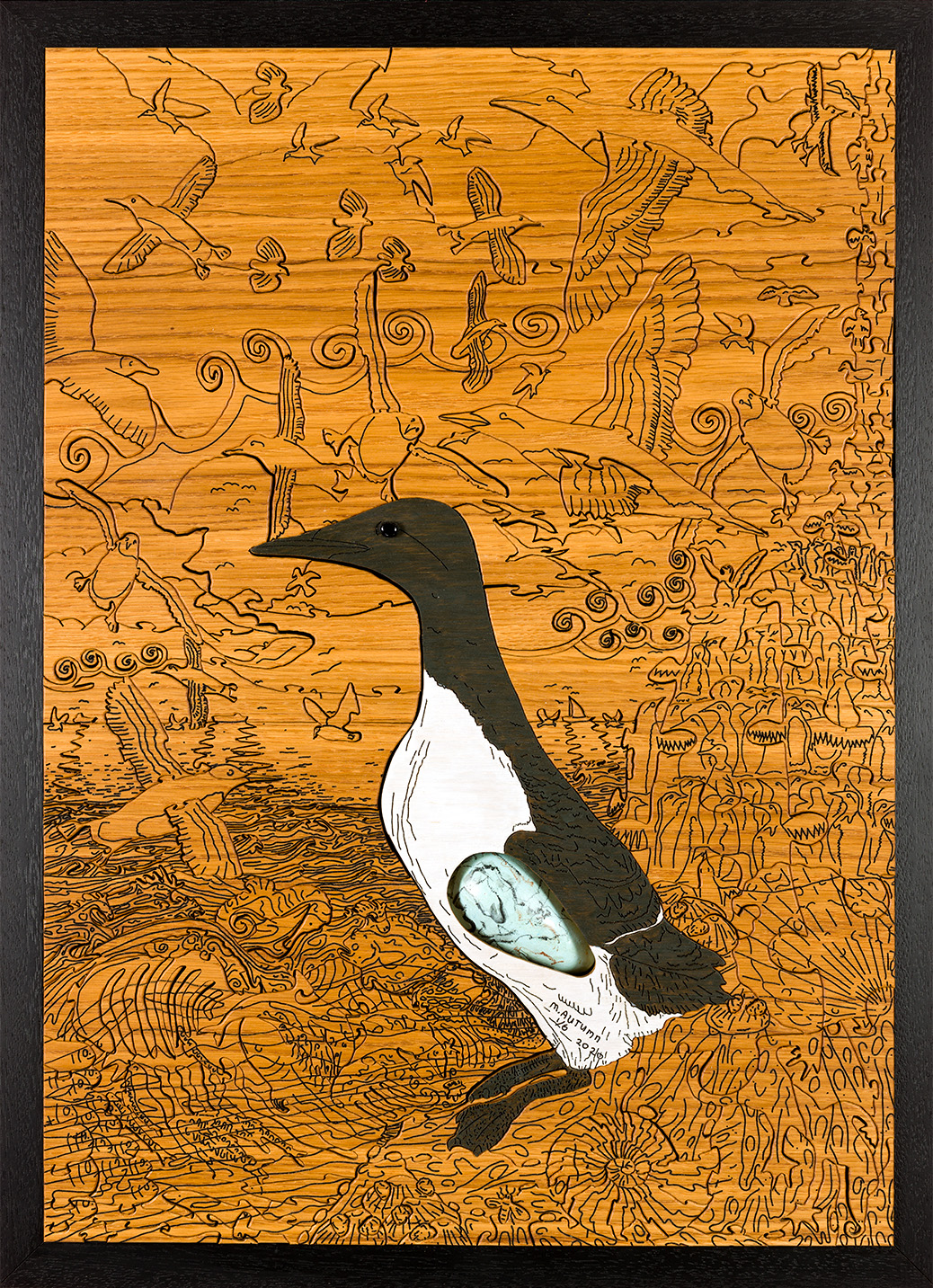
Guillemot with Egg (Art Puzzle): Full image Size: 59cm (H) x 42cm (W) x 4.4cm (depth) @ 8kg weight Medium: Solid European Oak, hand-cut, hand-engraved, art puzzle with inset full-size replica guillemot egg. Date: 2020 Guillemot with Egg in artist’s dining room (click on image to see artists’ home studio, workshop, and gallery).
First and foremost I want to mention that the eggs used in my work are not real – for obvious ethical reasons (it is also illegal to take wild birds eggs). They are life-size replicas made of a plaster resin composite and hand-painted – not by me, but by a very reputable leading replica birds eggs maker.
“Limited Edition” of 6
The phrase limited edition in this case is a bit of a misnomer. These are all individually handmade by me from my original design. I really wish there was, but unfortunately there is no mechanical or chemical process by which these can be reproduced – like screen printing, lithographs, card puzzles (using a die and jigsaw puzzle press), etc.
I never intended to make this jigsaw puzzle myself! I researched for weeks into using CNC (Computer Number Controlled) engineering techniques, laser, and waterjet cutting. For my puzzle design I wanted 1 ½” – 2” (40 – 50mm) thick oak wood, and I wanted the thickness of the wood cut to be less than 1mm – ideally about ½mm. I realised that CNC would not work because the drill bits would be too weak to cut that deep – something less than 1mm to cut through very hard oak nearly 2” deep using side pressure alone – no way.
I don’t like the idea of laser cutting because it burns and leaves the edges of the cuts black – something very unappealing – and very un-puzzle like! Indeed there is a very real risk that a wooden puzzle this thick could catch fire if cut by laser!
For a long time I thought I had found the solution in waterjet cutting. From fairly extensive research I believed it could have a cutting width of about ½mm. So I went ahead and designed the most intricate puzzle drawing – down to about 1mm curves and circles! I thought I could use shallow cut lines to show extra detail – like a drawing or carving on top of a puzzle – and full cut-through lines obviously for the jigsaw puzzle pieces. I, extremely naively, thought all I had to do was to supply the design to a waterjet cutting company and they would do the rest! And I could have hundreds produced. If only…!
What I don’t want is to have just one of these. I want one for myself and I need to make a living… I have invested a considerable amount of time and effort into this and would like to be able to continue to create work of this standard or better.
At the moment I am not famous enough to make and sell just one of these and earn enough money to make it worth my while – so I have to make a few. Six feels like a reasonable compromise – and not so many that I become a sweatshop jigsaw maker…!
Birds
My love of birds dates back to my mid-teens – after a new boy arrived at school whom I befriended and who happened to be a “twitcher” (a fanatical bird ticker-off-er!). I went with him on many trips and continued my interest after we went our separate ways (we went to different universities to study different subjects). As time has gone by, I have become more and more enthralled by bird’s beauty, abilities, resilience, and tenacity. I have photographed birds, filmed them (I built a special camera incorporating a telescope specifically for this purpose and I built a bird hide in my garden!), recorded their sounds with and without film (see my YouTube video channel – https://www.youtube.com/channel/UCcNBRvK_RcVoj6WFm2z8GRg), and have painted some.
As an artist I realise I can’t compete with photography (including film) in terms of capturing the beauty and detail of birds, and I don’t want to even try to compete with the likes of Audubon and other great bird artist and illustrators (Peter Hayman for example). However, I have been hoping to do something different and personal with them – something that I hope will show off some of their majesty, beauty, surroundings, habitat – and hopefully to do them justice.
Chunky Wood JigsawPuzzles
My interest in chunky wooden puzzles (well over an inch thick and that can stand up on their own) arose from a simple tree puzzle I stumbled on in a Swiss airport souvenir shop about twenty years ago. (When I travel I like to buy at least one nice item of art from the country.) I loved it’s smoothness, heaviness, tactileness, simplicity, beauty, and it’s differentness. It was expensive (about an average person’s day’s pay (£200 in today’s money)), but I just had to have it. I still have it to this day. I also just love solving puzzles of any kind. I liked the way the tree puzzle had unexpected shapes – that, when taken out of context, you had no way of knowing what part of the tree they occupied! About two years ago (2018) I had the idea of trying to design and make my own wooden puzzles and started to look into how to make them and to see what others had done…
M.C. Escher Influence
About two years ago I had the idea of trying to design and make my own puzzles. This coincided with my renewed interest in M.C. Escher’s work. As an artist, I don’t want to copy anyone and wondered if I could blend my interest in chunky wooden puzzles with Nature – and include ideas that fascinate me – like camouflage – particularly shape and textural camouflage – and the geometry of the line… I share this interest of the line with Escher, and he has most definitely inspired me.
Lines
For most practical purposes the visual world consists entirely of coloured dots (or pixels). Lines are a fundamental visual unit. They are a two-sided shape. (We can’t see a one-sized shape because it would have no length or depth – and so it is invisible.) Even a dot is a line – albeit a very short one! A triangle is obviously three lines, and all 2 & 3D shapes can be made from triangles. A square is four lines (or two triangles), and a circle is a line that changes direction in a precise and regular way. A circle is also an infinite number of very narrow triangles (I deduced a formula for pi from this simple idea as a mathematical thought experiment/exercise many year ago). 2D becomes 3D by simply adding the height dimension in the form of lines or triangles sticking out from a flat shape. But the central raw material for any shape is always the line.
What have lines got to do with puzzles? Well they are the cuts in the wood and any additional detail in the form of those that appear in the picture the puzzle is printed on, or any carved lines on the puzzle. My main interest is to only use lines – cut or carved – in my puzzles – as opposed to conventional puzzles where an image stuck to wood or board is cut with a puzzle cutter (known as a puzzle dye).
Boundaries
Real things have boundaries. In a sense that is what makes them a thing. An apple is a plump, sphere-like collection of organised cells with an outer red, green, or red and greed outer skin. We can see the apple because we have learned that a tennis-ball sized smooth green, red, or green and red thing is very likely to be an apple. It’s not just its’ colour that is key to our identifying it, it is it’s shape or boundary as well. We would not think that a sheet of apple-coloured paper or item of clothing was an apple – we might say it is apple-coloured – but that is not sufficient to categorised it as an apple. Likewise, we would not think that an outline of an apple was an apple if it didn’t look three-dimensional and wasn’t apple coloured.
Lines and Perception
Lines are the primary means by which we detect or perceive things. In Nature or reality there are very few actual lines – as in a thin strip of different colour or shade compared to the background – i.e. a simple pencil line. From a distance a tree without leaves can look like a series of lines. And the horizon between sea and sky can look like a line. A line can simply be a colour change boundary. A green leaf against a blue sky (or any other colour sky) can be thought to have a line around the edges of the leaf. But green leaves against other green leaves still have a boundary – or lines – because there is a perceptible difference between them. In fact it is fair to say that if there isn’t a perceptible difference between two edges then there is no line. If we were to put a cut-out of a green leaf onto an exact same green piece of paper it would appear to disappear.
Animal senses seem pre-disposed to detecting changes or boundaries. Visually that means detecting colour boundaries and movement (movement is just changes in colour boundaries over time). This is what vital to animals’ survival. The things that matter to them have to be detected and acted on. Changes in the animals’ visual environment can mean a threat – like a predator or dangerous boundary – like a cliff or fire – or simply something to avoid – like not to walk or run into. Other changes in the animal’s environment can be positively sough after – like food, a mate, somewhere to safe shelter and sleep.
Eyes have evolved to convert a vast stream of a narrow spectrum of electromagnetic radiation into a stream of real-time pixelated colour data to the brain from coloured rays of light. Light from the animal’s environment enters through the cornea (lens) and excites the rods and cones in the retina – which in turn transmit electro-chemical signals about the light rays to the visual cortex and beyond into other parts of the brain. But it is the mind that makes sense (pun intended) of all this data. The mind seems predisposed to “see” patterns and forms – especially from boundaries – because these are highly suggestive of something different and potentially important and/or useful.
Visual perception is an amazing feat of form recognition from lines and colours (texture as well – but this is a form of line and/or colour). This incredible capability can sometimes be mistaken but my interest is to highlight this by having some fun with it. We “see” elephants in the sky, horses in the sea, etc. – but of course no such things exist!
The brain is always looking for patterns to match up with its growing database to quickly identify things in the environment.
A line (or boundary) can be represented as something drawn – what I call a positive line (because something has been deliberately added) – or is can be a cut or carved – what I call a negative line. A line is anything that shows a boundary (including simply a colour change).
I decided to have some fun with this puzzle. With just cuts and carved lines I wanted to capture a busy seabird colony with a life-sized guillemot (Uria aalge) as the central focus. I mixed carving and cuts because if everything was a cut the pieces would be too small and would be nearly impossible to make them to join together – as real puzzle pieces – i.e. with interlocking lugs.
Art (Jigsaw) Puzzle
What is a jigsaw puzzle? Classical wooden/cardboard jigsaw puzzles are usually pictures cut up into small interlocking pieces – where the puzzle is more of a challenge or exercise, and the picture is the end goal. So in a sense the puzzle is a journey and the picture is the destination. In my case, in the case of this work, the puzzle is both the journey and the destination. The puzzle is the picture.
Classical wooden/cardboard jigsaw puzzle pieces usually have two to four structurally interlocking lugs to hold it together. The number of lugs usually depends on where the piece is: corner pieces usually interconnect with two other pieces, the side pieces usually interconnect with three other pieces; and the inside pieces usually interconnect with up to four other pieces.
This work is a jigsaw puzzle within a jigsaw puzzle.
Showing some jigsaw puzzle pieces
It is in part a camouflaged jigsaw puzzle. It starts at the right more or less as a conventional puzzle (the “cliff”) – albeit I’m using the size and angle of the pieces as a perspective device – but as the scene progresses to the left I slowly morph the puzzle shapes into natural shapes (animals, fish, waves, etc) to camouflage the lines of the puzzle pieces themselves.
I use a plethora of shapes and sizes of puzzle pieces and lug and devices – and many decoys and deflections – to make a picture-less jigsaw puzzle naturalistic and fun…! 🙂
All birds are amazing, but guillemots (Uria aalge) are among the most amazing. The Guillemot chick’s first and only time of leaving the “nest” – a few square inches of bare rock(!) where it’s parents incubated it on their feet – could be as much as a 300m plunge off the ragged cliff edge – into the sea (hopefully!). The chick can “fly” on this maiden voyage, but obviously they are not proficient, and it is more of a clumsy glide. Often it is not a straight flight/glide into the sea. If the chick crashes into rocks before it reaches the sea – and if it survives that – it has to navigate over what is often very hostile terrain – and it may encounter predators en route to the sea – where it’s parents will be calling from. A small chick can be quite feisty and hold it’s own against common predators like artic fox (but many do fall prey).
East coast of the UK Guillemot chicks, if and when they reach the sea on their maiden flight, swim with their parents all the way to Norway – a considerable task in and of itself.
Other fascinating facts about guillemots. They are one of the few animals that can inhabit land, air, sea surface, and underwater (a bit of a misnomer?!). They can swim underwater practically as well as they can fly in the air – and that means they can swim as well as most fish! Indeed they swim after fish to catch them – this is their primary source of food. It could be said that they fly underwater. They can dive up to 150m – indeed the deepest known dive by any bird is Brünnich’s guillemot (Uria lomvia) at 210m!
The Life-sized Guillemot
Detail of life-size guillemot
Why life-sized? I have a penchant for life-sized natural history art because it does the subject justice, it is honest, and most people don’t know the size of many animals because they never get close enough to them. Perhaps a better question is: why not life-sized…?
Working journey of the making of the main guillemot jigsaw piece…
The guillemot is not painted. I love oak – and wood in general – and think it sacrilegious to paint it. I only allowed myself to use a light and a dark wood stain to achieve the hopefully realistic coloured effect of the main bird. The whole work has had two coats of Danish oil to bring out the wood grain, give it a warmth, and to give it protection. It should last hundreds, if not thousands, of years…
Another challenge was to try to capture the smoothness and aerodynamism of this most perfect of birds – supremely designed for flight in the air and flight “under” water. I hope that by placing the main guillemot in the centre of the jigsaw puzzle as single smooth life-sized piece among dozens of other smaller pieces – accentuates it’s majestic shape and form…
I had a eureka moment for the eye (albeit after thinking about it for days!). A key visible feature of any animal are it’s eyes. They give so much of the essence of the personality and behaviour of the animal, they give it life and vitality. I thought long and hard how I could bring my guillemot life – and am extremely pleased with the solution I came up with.
Guillemot eye detail
The Embedded Life-size Egg
Birds eggs are extraordinarily beautiful, the shells are extremely strong (relative to the amount of material they consist of), and they are amazingly complex, but highly functional, creations that have their own lifecycle and incredible journey. For example, when the shell-less egg growing inside the parent reaches full size the hard shell is slowly secreted around it from calcium carbonate (CaCO3) crystals from the parent (who has to have enough of this in their diet otherwise the eggs will be soft and break).
Eggs have a complex structure, but obviously the main function is to protect and facilitate the growth and birth of a young bird. All the nutrients the growing foetus requires are contained within the egg, however, the egg has to be strong enough to protect the embryo through all the knocks and bumps – and being stood or sat on by the parents; it has to be porous to allow oxygen in and carbon dioxide (poisonous waste) out; and has to protect from bacterial infection. If the egg is laid, and spends time, on bear rock– as is the case with guillemots – then the shells have to be particularly strong. However, near the time of hatching an amazing metamorphosis takes place: the embryo absorbs some of the calcium of the eggshell to form an egg tooth. This is a double strategy to help the young emerge from the shell: after the shell has fulfilled it’s purpose it is weakened by the young bird absorbing some of it, and at the same time the young bird gains a sharp hard tool by which to chop itself out.
The blunt end of the egg is the weaker part of the egg (that is due to mechanical geometric properties: the shallower the curve the weaker it is). The embryo’s position in the egg seems designed to exploit this weakness when it comes to hatching. The orientation of the developing embryo is such that the legs are usually at the “pointed” end and the head is usually at the “blunt” end – so the head is in the ideal position to start the hatching in what is obviously a very tight space…
With the main interest of this work being a life-sized guillemot in it’s busy natural surroundings, and working with thick oak, it occurred to me from the outset of this long project that I could incorporate a life-size egg into the design somewhere. I bought some eggs to test the idea and after several trials I worked out how I could do it.
Eggs are generally developed in the parent “pointed” side down and are rotated prior to laying so they emerge “blunt” side first. It seems unclear why this is so, but I wanted to highlight this phenomenon in the work.
I wanted to create a mystery of how the egg got into the body of the guillemot – and how it comes out – hence I made the egg opening (front and back) smaller than the egg itself – with no way for the egg to have got in or out… The Guillemots’ eggs are relatively large in proportion to the mother’s size, and I wanted to highlight the fact that the mother has to fly and dive with this huge thing inside her abdomen. I have made a guestimate of where the egg would be in the mother (which, as mentioned above, has to be turned in situ before it is laid).
Full-size egg inside the main Guillemot puzzle piece
Epilogue
It has been an enormous relief to finish this work(!) – so much so that I needed a few days to recuperate. The intense concentration and sheer physical effort in handling this 8kg block of solid oak wood for highly accurate cutting through the most intricate and precise twists and turns – has taken it’s toll on my arms, back, eyes, and brain. (It measures 59cm x 42cm x 4.4cm thick. This work is two pieces of oak I have hopefully invisibly joined. I would have used one piece if I could have sourced such a wide piece of oak.)
Design – 6 weeks (plus many tests, trials and errors!) over a 16 months period; carving the approximately 2mm deep detail black “lines” – four days; cutting the 44mm (1 ¾”) deep oak jigsaw pieces – 4 days – both with a full face mask most of the time and with the noise of an air filter (industrial hoover) running all the time (I used ear plugs); 1 day to carve out the egg opening and incorporate the full-size egg into the body of the main central guillemot (and the stress and strain associated with that!); 1 day finishing – this included rounding off jigsaw pieces (front), sanding (back), and applying finishing oil to all the convoluted surfaces; 1 day framing.
Work in progress
This project started back in September 2018 and finished (under a great deal of time pressure (largely due to the non-arrival of a faster-cutting fret saw ordered on 3rd January)!) on 17th February 2020 – just in time for submission to the 2020 Royal Academy Summer Exhibition…
(Catalogue #100_5644-5730: 44” x 66” – edition of 100)
The human eye is an amazing gift, tool, and experience. The power of the brain behind it takes seeing to mesmerizing capabilities. Take focusing for example. That part of the image in the centre of our field of vision is in sharp focus (excepting for long- and short- sightedness), and the rest of the image gets progressively out of focus – the further away from the centre we go. But we are usually not aware of this. Anything we scan our eyes over becomes instantly sharp. The fact is we are constantly re-focusing as we scan a scene. If we are looking at one part of a scene it is in sharp focus. We may not even be aware that the rest is out of focus, because no sooner have we moved our eyes to something else, then that new part becomes immediately in focus.
Focus has a few noteworthy properties. The closer we try to focus, the shallower the depth of focus is. If you hold your hand in front of your face and focus on it, even things just in front of it (try placing a finger of your other hand in front of your hand without looking directly at it), and things immediately behind it will be out of focus – i.e. blurred. This is a “shallow” depth of focus – or depth of field as it is more commonly known in photography. The further away the subject is the greater is the focus depth – the region from the nearest to the furthest part in focus. The focus range is invariably perpendicular to our eye view.
The camera acts like a static eye in that it can capture one static scene and its inherent depth of field. It is unlike the eye in one important respect: we focus on a narrow zone where our two eyes converge, and outside this area – left, right, up or down – but at the same distance from our eyes – things become progressively more out of focus the further away from the centre of our gaze they are. The camera on the other hand focuses on planes. Think of double glazing: the zone between the two pieces of glass is in focus, everything in front and behind are out of focus. As always with focus, there are no sharp boundaries between in and out of focus – just very sharp to progressively less sharp. However, there is a general area where most people would agree is an acceptable level of sharpness – enough to say it’s in focus.
Depth of field can be controlled by the diameter of the iris or aperture: the smaller the aperture the greater is the depth of field. But the aperture can only affect depth of field to a small degree. What also applies to the camera is the phenomenon that the closer the subject is, the shallower the depth of field. There are special cameras/lenses that offer a tilting mechanism that allow you to literally tilt the plane of focus, but these are only effective with flat surfaces – like a road or a lake. Anything in the foreground sticking up or down – rising above or below the narrow horizontal plane of focus – like my tulips – would appear out of focus.
Why am I rambling on about depth of field? When you are confronted with a real life scene you can survey it at your leisure, and it is something we all seem to enjoy. We seem to love being able to see a long way, and climbing/driving to the top of a hill or mountain to see a great view is a common goal we nearly all like to do. Taking a static image of such a scene – from our toes to the horizon – is virtually impossible, especially if there is fast movement in the scene as well.
What has all this got to do with art? If art is about enhancing the viewer’s experience of life, getting the viewer to think about their surroundings, and their perceptions and pre-conceptions of it, then “Depth Of Tulip Field” is very much art.
I use photography a great deal because I’m so moved by reality, and a lot of what I want to convey about my perceptions, pre-conceptions, and ideas about reality I feel are best expressed by being as realistic as possible. I’m completely in awe of vision – it is the most amazing gift. When I see a beautiful scene I’m frustrated as an artist that I cannot transport you there to see it also. So much art is about non-reality, disfiguring reality, or making attempts at copying reality – with varying degrees of success. But reality cannot be faithfully copied – it has near and far properties, and we can interact with it in almost an infinite number of ways – moving to different parts of it, zooming in to any level of detail. And reality’s main quality is, I feel, the freedom we have to look at it in any way we choose.
At a scene we can scan and focus on anything we please, and that is the real delight I want to capture. Conventional photography pre-focuses for you on a static focal plane. The photographer has to decide what he/she wants you to focus on – that is what he/she wants to focus on themselves, and they capture that in stone as it were. You are not free to focus on what you want. That is not necessarily a criticism – indeed it may well be the intention. But in this case my intention is that you should be free to look at any part of the picture in great detail – as I had the pleasure of doing.
The conventional artist – oil painter for example – is severely limited by the materials she uses, and by time. Whilst she doesn’t have the same limitations of depth of field, close up daubs of paint look like daubs of paint. And what would the point of meticulously copy reality anyway in this day and age of photography? The best you’ll ever achieve is a photograph. If Vermeer or Ingres (two of the best detailed artist I know of) were around today, would they reject photography and paint? Was it the process of painting they enjoyed or were they trying to capture something they considered beautiful, captivating, worthy of putting on a pedestal…?
In Depth Of Tulip Field I have gone to enormous lengths to share the freedom of focus I enjoyed on a fateful trip in Norfolk, England. It was early morning, the date was spring 2004, I was driving along and suddenly this amazing field of tulips appeared. The field was huge and the rows ran perpendicular to the road. A striking feature was the bands of brilliant colours. The sun was not out fully (it was burning up the morning mist), and it was at the wrong angle anyway (aesthetically) – so I decided to come back later in the afternoon (the forecast was for sun).
When I returned I went to the far end of the field with the sun shining at me – I love the sun shinning through plants – it really brings out their colour. I spent quite a while admiring the scene and wondering how best to shoot it – how to do it justice. I had all the main types of cameras, numerous lenses, and other equipment with me – so I had very few technical limitations on what I could do. The field was wonderfully long. I didn’t want to crop it. I didn’t want to focus on one part of it. I wanted it all. Eventually I came up with an idea and proceeded to execute it…
There are a lot of different types of birds, insects, and other animals in this picture, but that is only to draw your attention to the fact that there were none! This field – due to modern chemically assisted intensive farming methods – was a veritable desert of life! Everything was either dead (killed by “pesticides” – implying they are pests – probably a propaganda ploy by the agrichemical companies) or the wildlife stays away – perhaps because there is no natural food there and/or because it is such an alien landscape to them and they have no natural cover. I did actually see the hare and the deer running through the field – sadly they were fleeing from a near by gun shot blast – I don’t think it was their natural choice to be there. But it gave me an idea…
Most landscape paintings don’t depict this level of detail, and many animals in the wild are very elusive – indeed a lot of the time their survival depends on them not being seen. So often they are there but you just don’t see them. But for me this is what is fascinating about Nature: it is everywhere. The more you look, the more you see. And the closer you look the more detail you see. You can start with looking at a whole landscape (even my depiction of the tulip field is a small section of the whole), and you can zoom in on a field, then a flower in the field, then an insect on a flower in the field, and see the amazing detail of it. Zooming in still further, you can see the hairs on its body, its compound eye, the structure of its wings. Zooming in on the eye reveals its conical hexagonal lens structure. You can go on to see the structure of the cones, the cells that make it, the internal structure of the cells, the structure of its proteins, the atoms that make up the molecules, the structure of the atom – its subatomic particles. And who knows where this journey ends in ever smaller worlds…?
I have kept the detail in the picture to what you could see with the naked eye, but I hope I’ve got my point across about the detail in Nature.
Sometimes we come across a scene so beautiful that we stop what we’re doing. We stop and stare, remain silent, and enter into a trance-like state. It’s fascinating that our mind should respond so strongly to what are after all just images. It is also fascinating that the vast majority of us will respond in a similar way to the same scenes… I, as a contemporary artist, feel just the same (possibly more?) about such scenes – but I want to respond to them in a very personal and unique way, and to sometimes use them as a vehicle to express certain ideas I’m interested in.
Really this is many photographs (circa 80) combined into one, with a great deal of digital editing – including much freehand work. But it is essentially what I saw. I have spent more time on this “photograph” than I have ever spent on a real painting or drawing. (No, I haven’t attempted to break any world records – some artists will have spent longer on their paintings.) My goal was to try to break the limits of photography, to highlight our wonderful, amazing, delighting, gift of vision; to produce something beautiful – or something I consider beautiful. The result is not perfect, but I’m happy it goes a long way to depicting what I saw and the ideas I wanted to convey. It gives me immense pleasure to be able to share that experience.
Nature is not always what it seems, and in Nature reproduction is a vital force…
16/05/2004
Exhibited at Royal Academy Summer Exhibition 2006
This YouTube video is using a new video-from-photo technique I developed.












 That part of the image in the centre of our field of vision is in sharp focus (excepting for long- and short- sightedness), and the rest of the image gets progressively out of focus – the further away from the centre we go. But we are usually not aware of this. Anything we scan our eyes over becomes instantly sharp. The fact is we are constantly re-focusing as we scan a scene. If we are looking at one part of a scene it is in sharp focus. We may not even be aware that the rest is out of focus, because no sooner have we moved our eyes to something else, then that new part becomes immediately in focus.
 The photographer has to decide what he/she wants you to focus on – that is what he/she wants to focus on themselves, and they capture that in stone as it were. You are not free to focus on what you want. That is not necessarily a criticism – indeed it may well be the intention. But in this case my intention is that you should be free to look at any part of the picture in great detail – as I had the pleasure of doing.
 Was it the process of painting they enjoyed or were they trying to capture something they considered beautiful, captivating, worthy of putting on a pedestal…?
 I did actually see the hare and the deer running through the field – sadly they were fleeing from a near by gun shot blast – I don’t think it was their natural choice to be there. But it gave me an idea…
