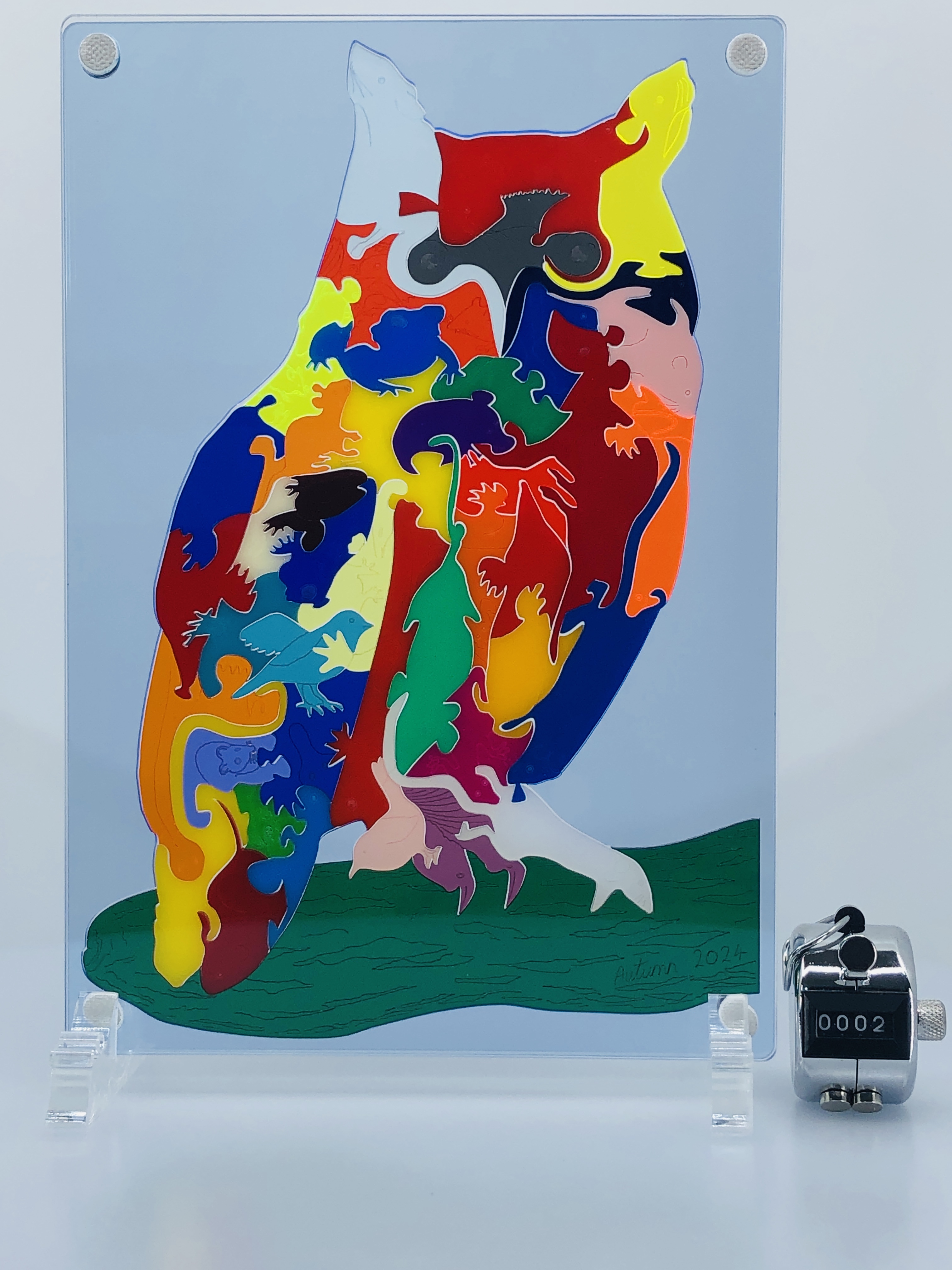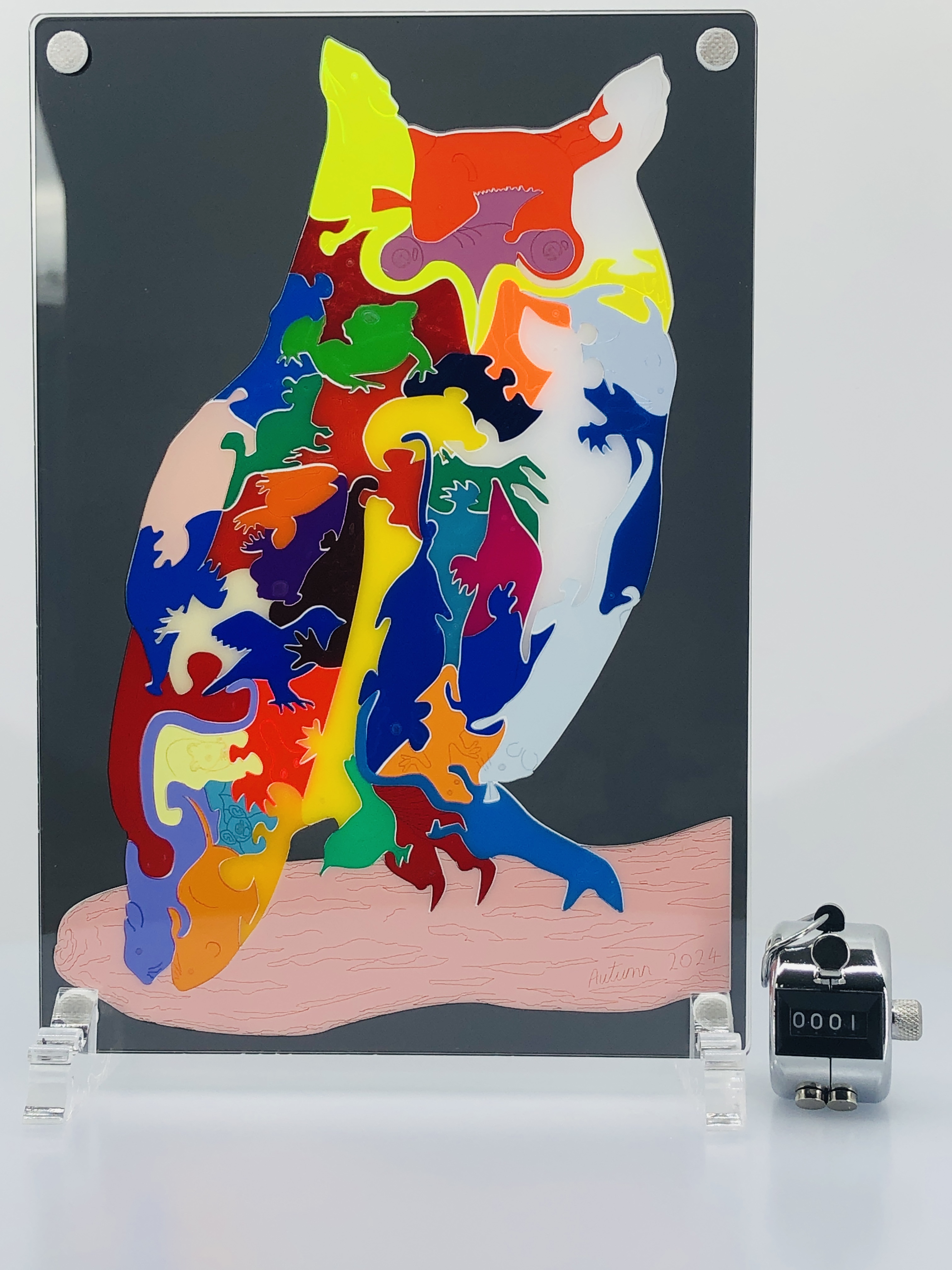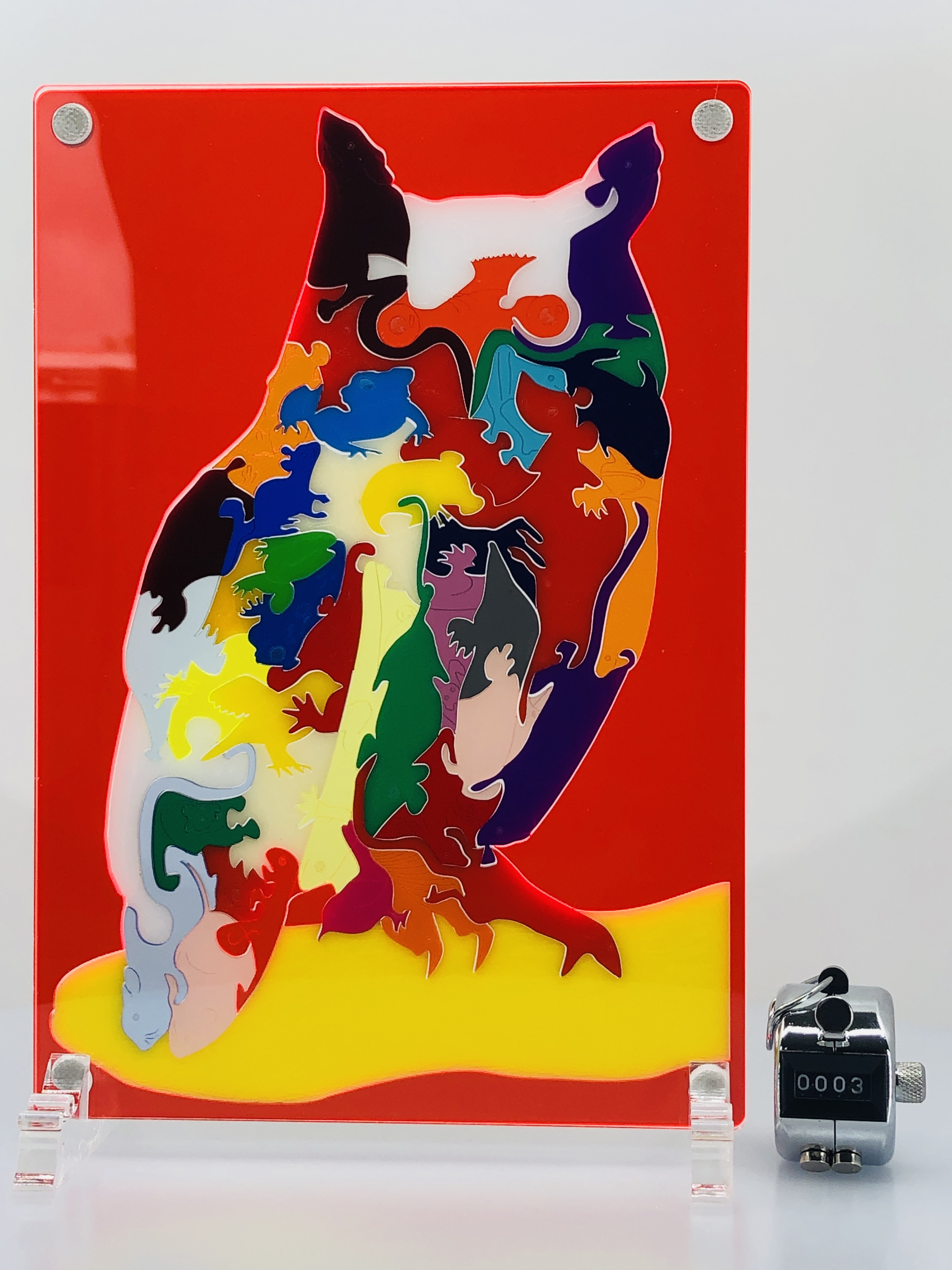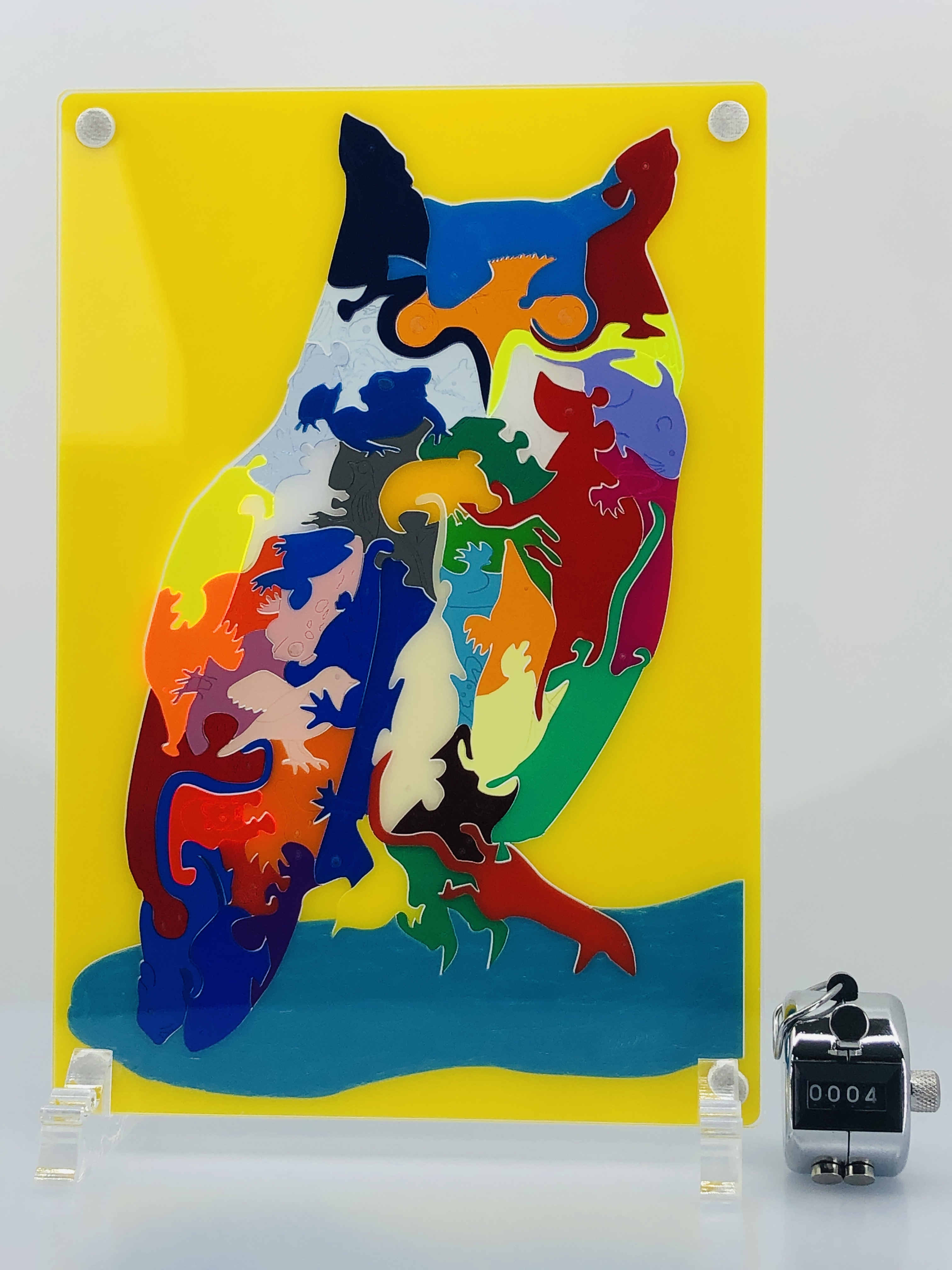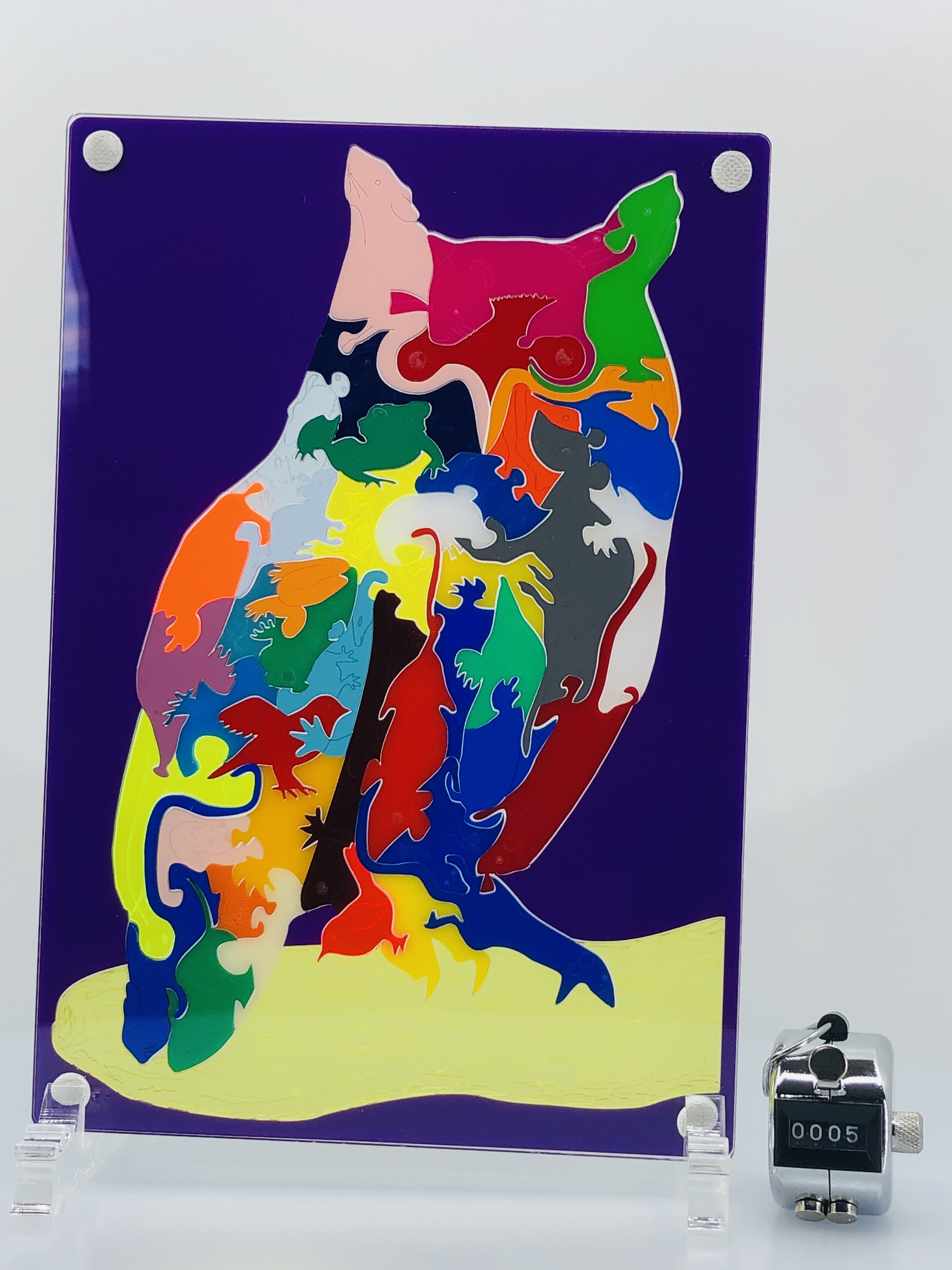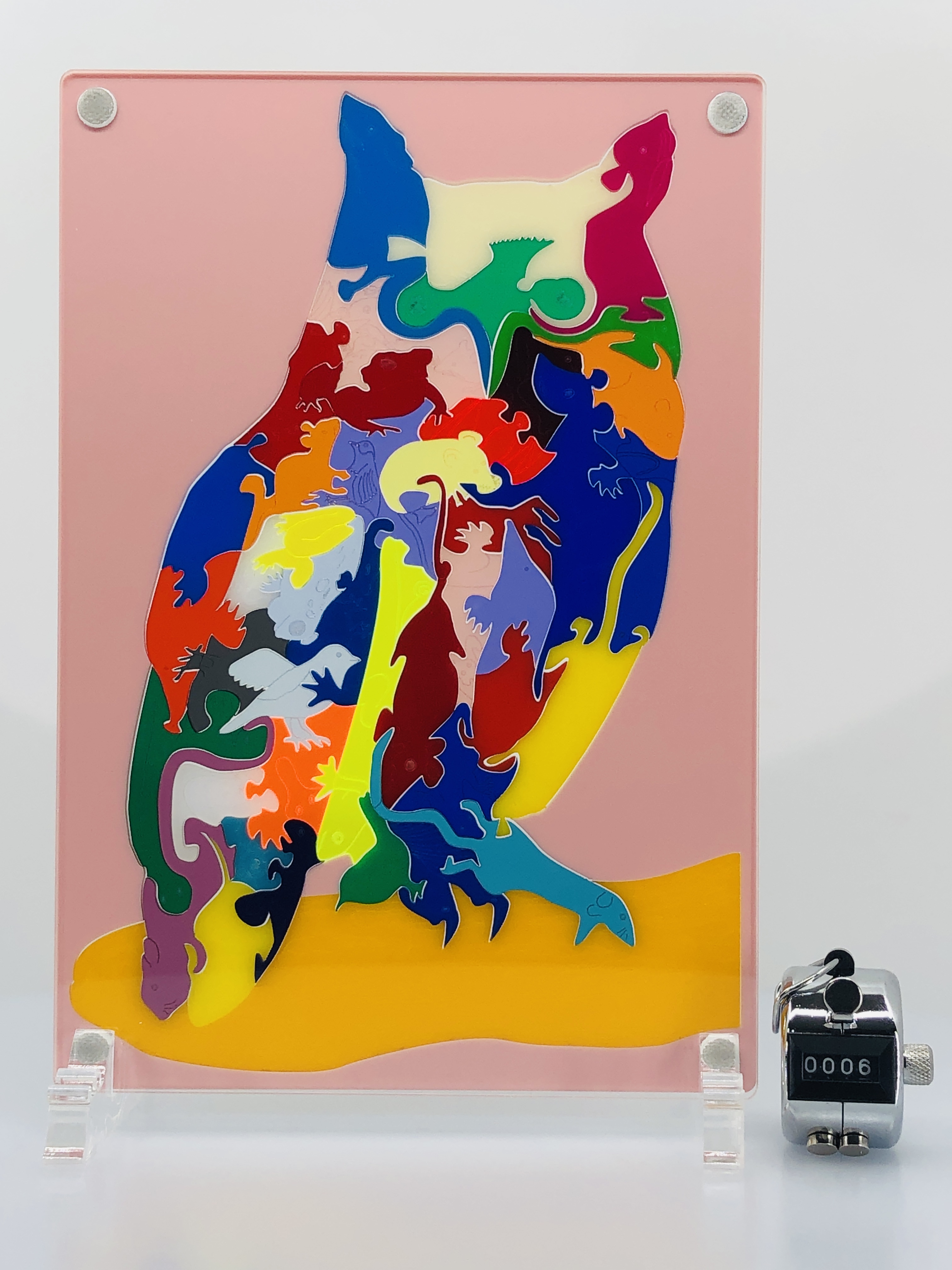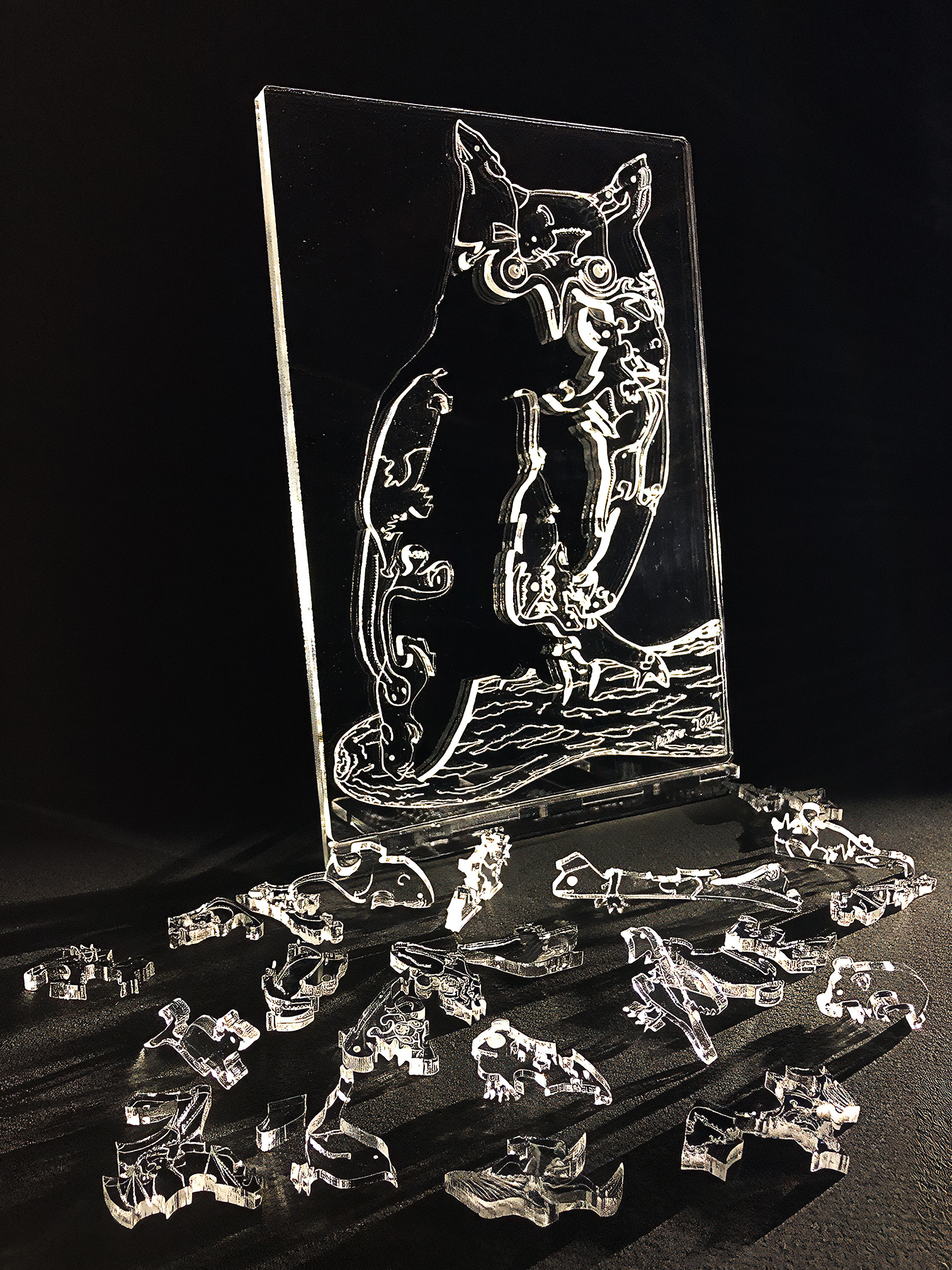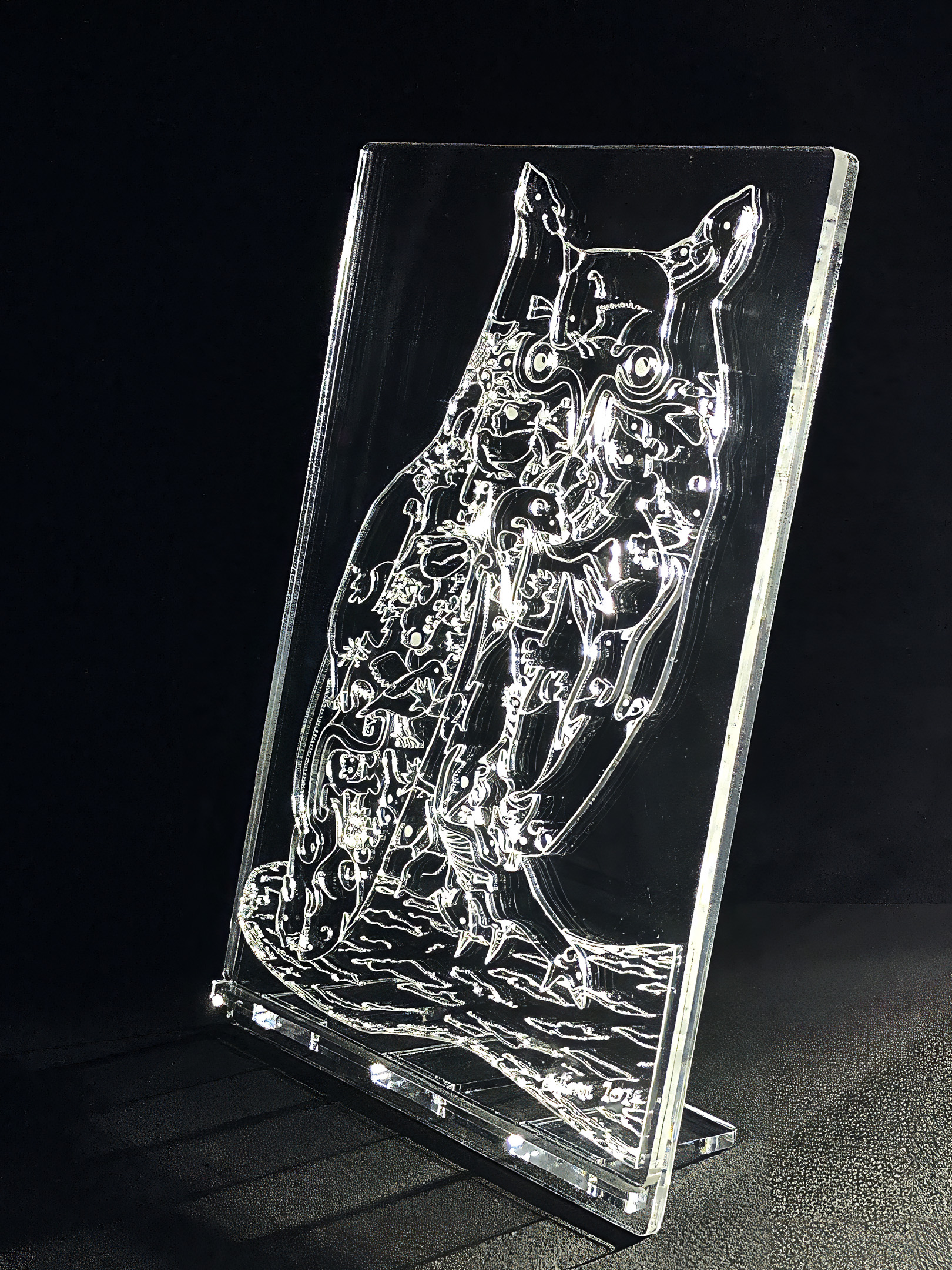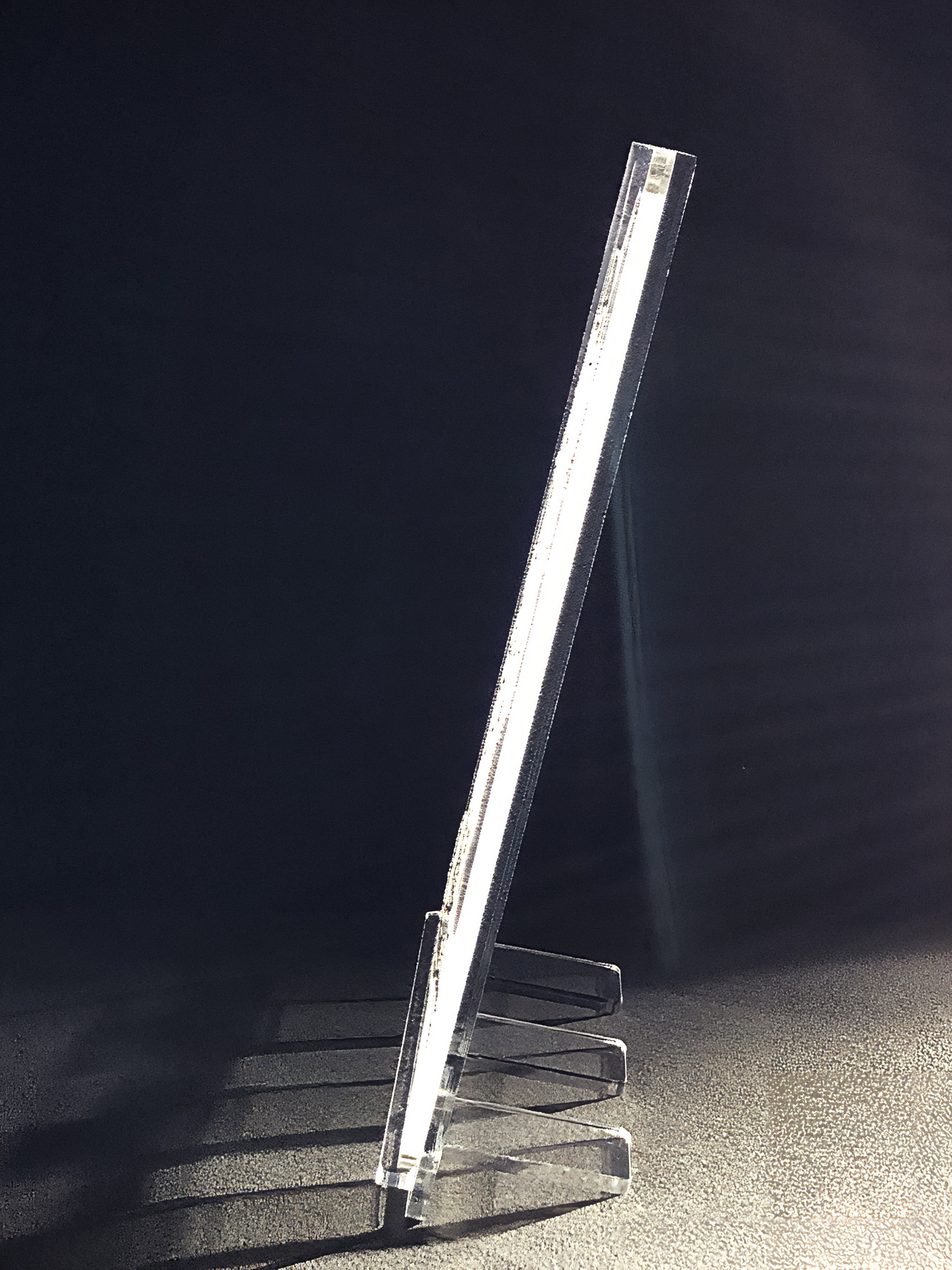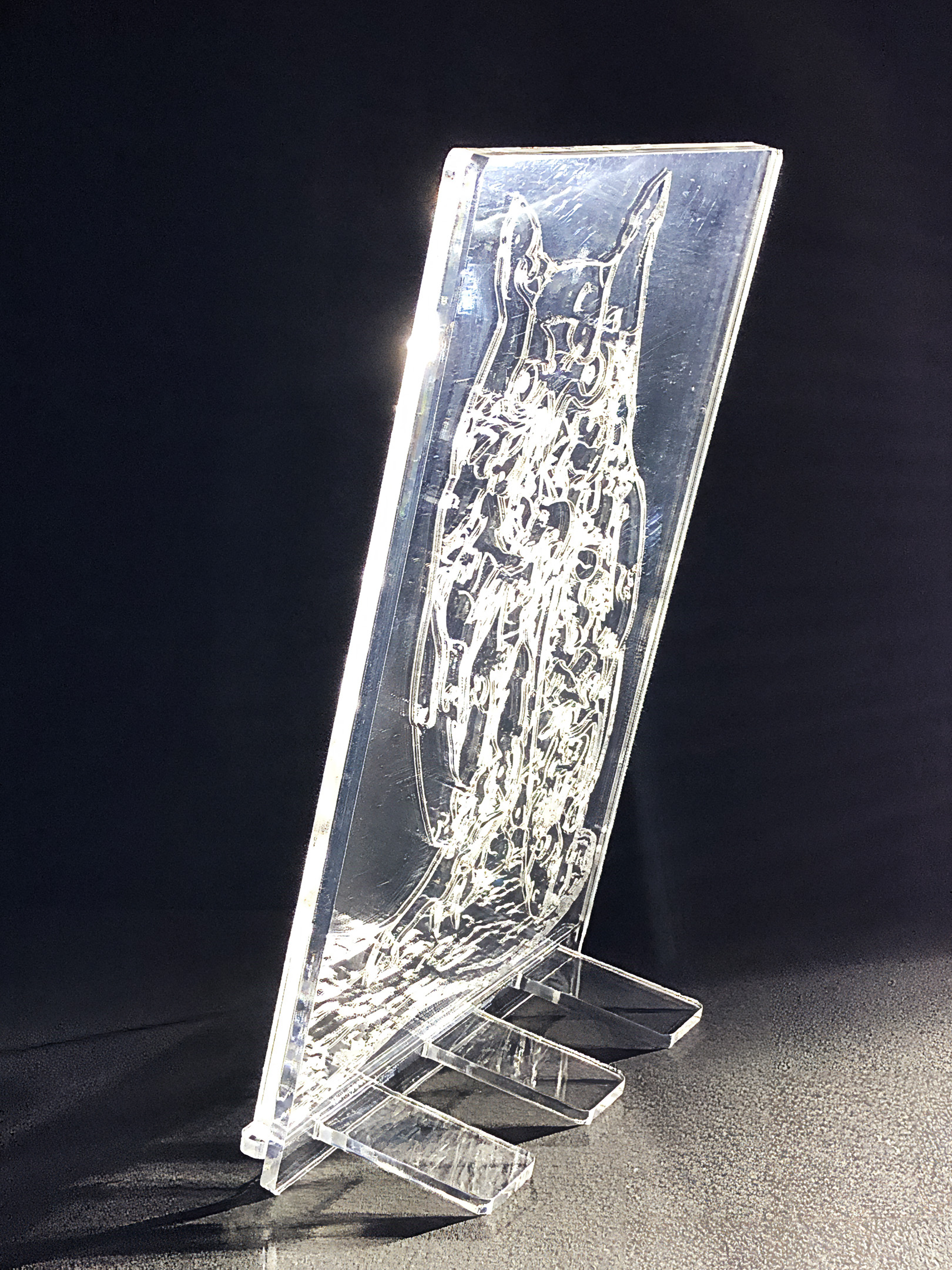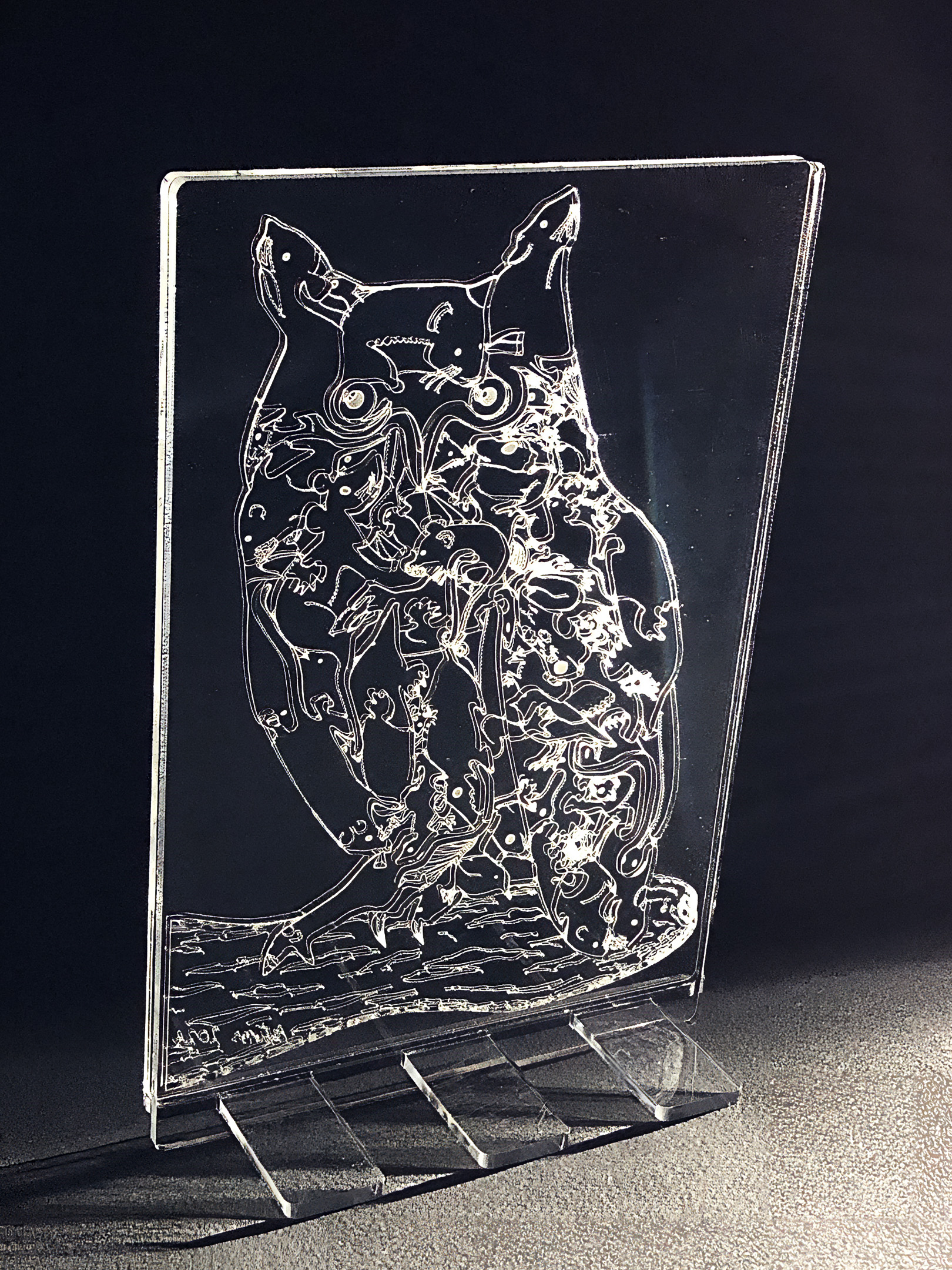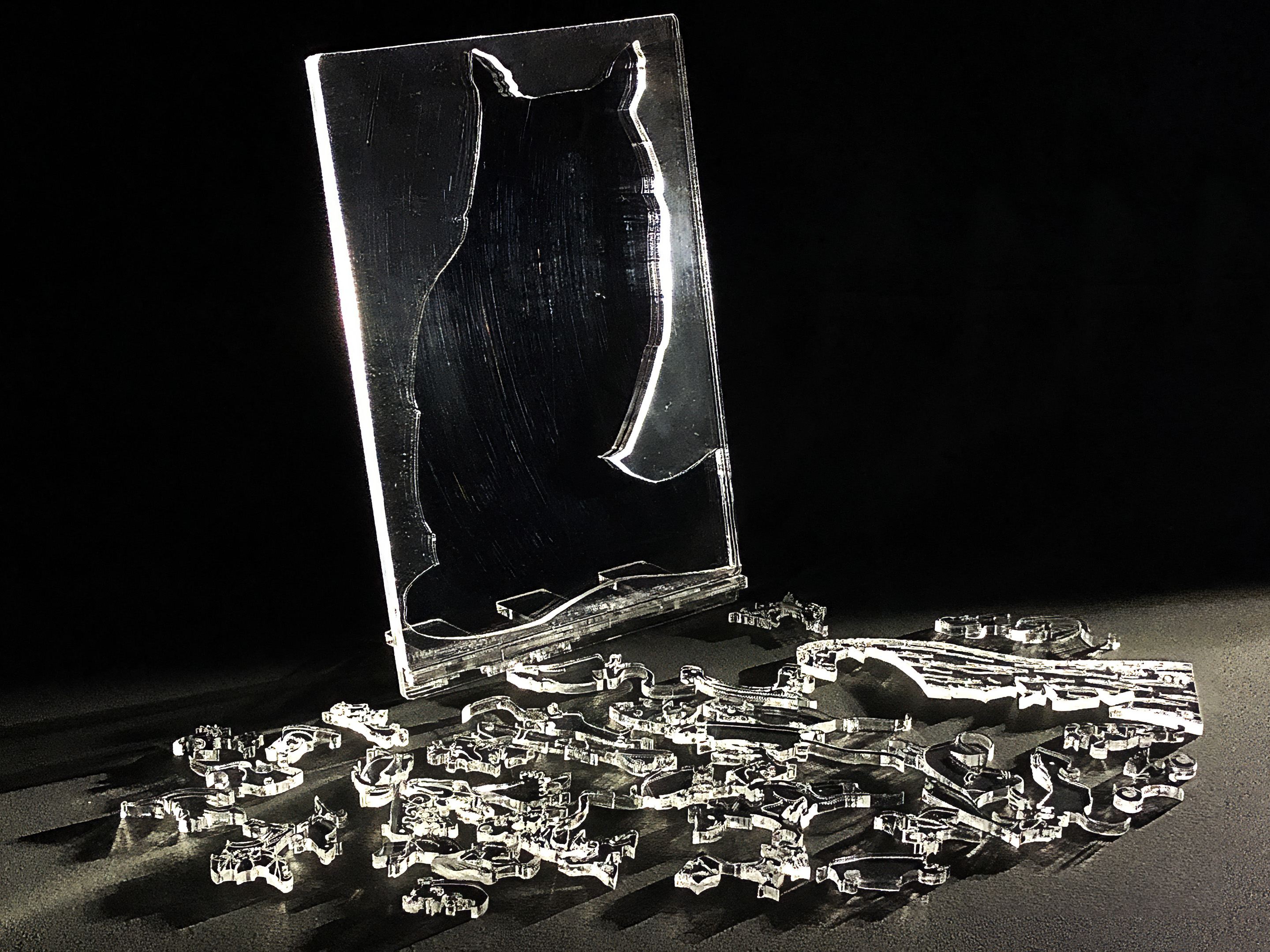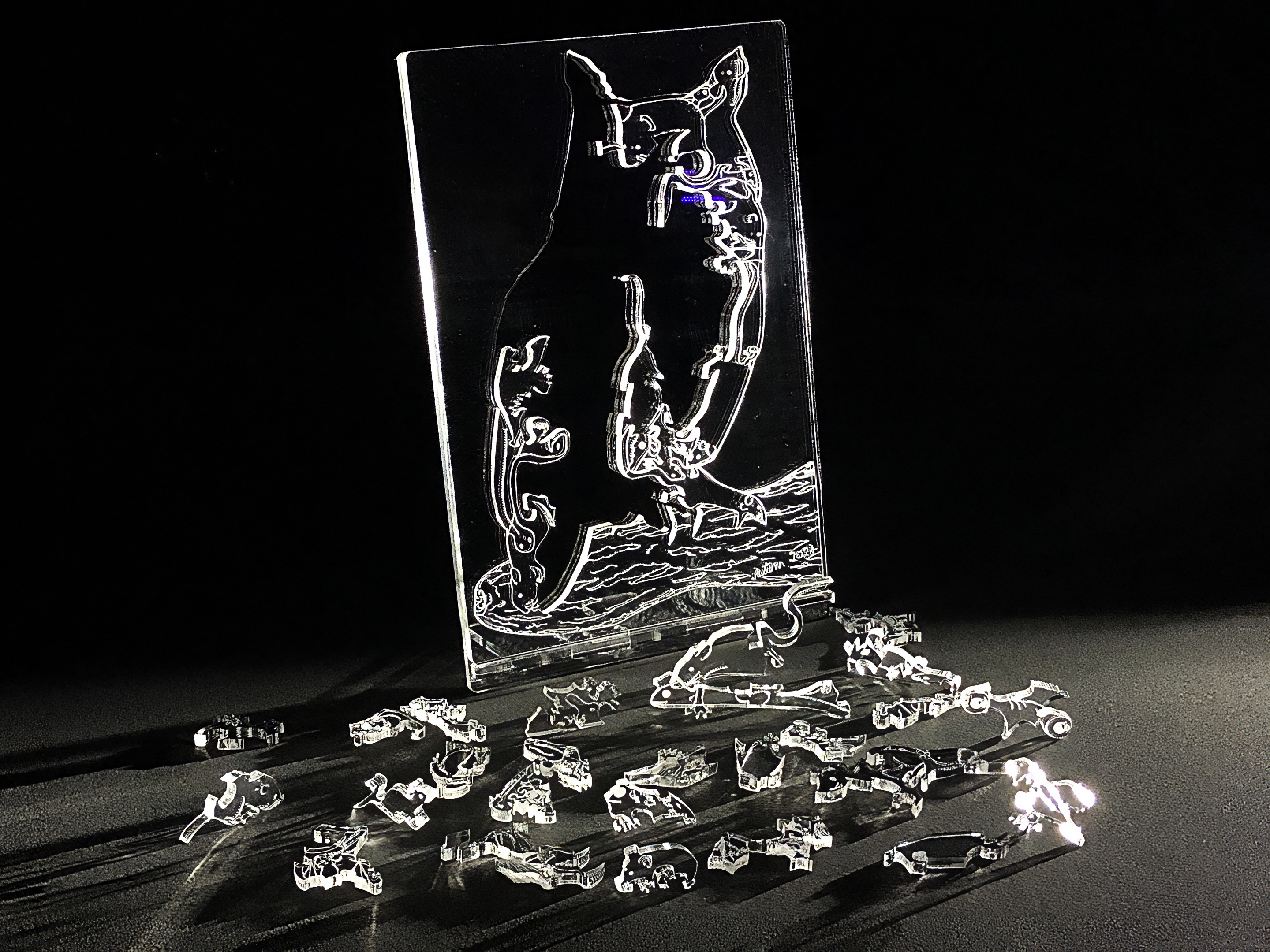
Artist: Michael Autumn
Medium: Tinted/transparent/translucent/frosted/fluorescent, and opalescent cast 3mm Perspex® – laser cut & engraved from a hand-drawn digital design (with 3mm and 5mm crystal clear magnetised support panels)
Size: 19cm (W) x 29cm (H)
Edition: Unlimited
Date: 07/2024
Country: UK
For sale: A selection of colour variations is available to buy on Etsy – https://michaelautumnart.etsy.com
TL;DR
Using coloured acrylics for creating stained glass effects offers a great number of opportunities and there seems to be nothing that cannot be achieved using it compared to conventional stained glass techniques and real glass. I’m very encouraged by the future possibilities of using coloured acrylics, and have several designs already in mind. Watch this space…
Description: The idea behind this artwork was to have a tactile, life-sized, long-eared owl, and to toy with the idea – “You are what you eat”. This is my first foray into using coloured acrylics as a modern stained glass substitute. Stained glass (windows) is a really beautiful medium – not least because, unlike most other art forms, it constantly changes with light and the colour of the (sun)light shining through it. However, just like buildings today don’t have to be made from the same building materials and techniques used by the cathedral-building Normans in the mediaeval period, stained glass windows don’t have to be made with silica, lime, and soda, coloured with metallic salts – and held together with strips of lead.

By Vassil – Own work, Public Domain, Link
I personally don’t see the point in replicating materials and techniques that have been used – and mastered – for centuries. I don’t live in the past; I live in the present. Some artists and artisans of the past can, at best (and with extreme effort), be matched – but it’s exceedingly unlikely that they can be surpassed. I’m talking about the likes of Grinling Gibbons, Ingres, Peter Bruegel the Elder, Jan van Eyke, Albrecht Dürer, Gian Lorenzo Bernini (sculptor) – not to mention the often anonymous mediaeval stained-glass window artists.
I can learn from the past, but learning is not the same a replicating. As an artist, I’m always looking to create something new – or say something new. And a constant challenge is to create something different – something that stands out from the crowd, and hasn’t been done before. In my opinion, in the art world it’s a waste of time to do what someone has done before… That is what an artisan does – not an artist…

By Template:Unknown 13th century Stained Glass artists – TTaylor, photo 2005, put together from two photos, and ajusted. Wikimedia Commons, Public Domain, Link
Glass is a truly wonderful, diverse, and lovely material – particularly with its ability to be coloured (tinted) – but it has its limitations. The old severe limitations of cutting it have been completely overcome by the use of modern day lasers, but it’s very brittle, sharp, and dangerous! This leaves one with the option to work within glass’s limitations, resort to cast moulding (and its limitations), or look for alternative materials that achieve similar results…
Poly(methyl methacrylate) (PMMA) is the synthetic polymer derived from methyl methacrylate. It is used as an engineering plastic, and it is a transparent thermoplastic. PMMA is also known as acrylic, acrylic glass, as well as by the trade names and brands Crylux, Hesalite, Plexiglas, Acrylite, Lucite, and Perspex, among several others (see below). This plastic is often used in sheet form as a lightweight or shatter-resistant alternative to glass. It can also be used as a casting resin, in inks and coatings, and for many other purposes.
Wikipedia
It is often technically classified as a type of glass, in that it is a non-crystalline vitreous substance—hence its occasional historic designation as acrylic glass.
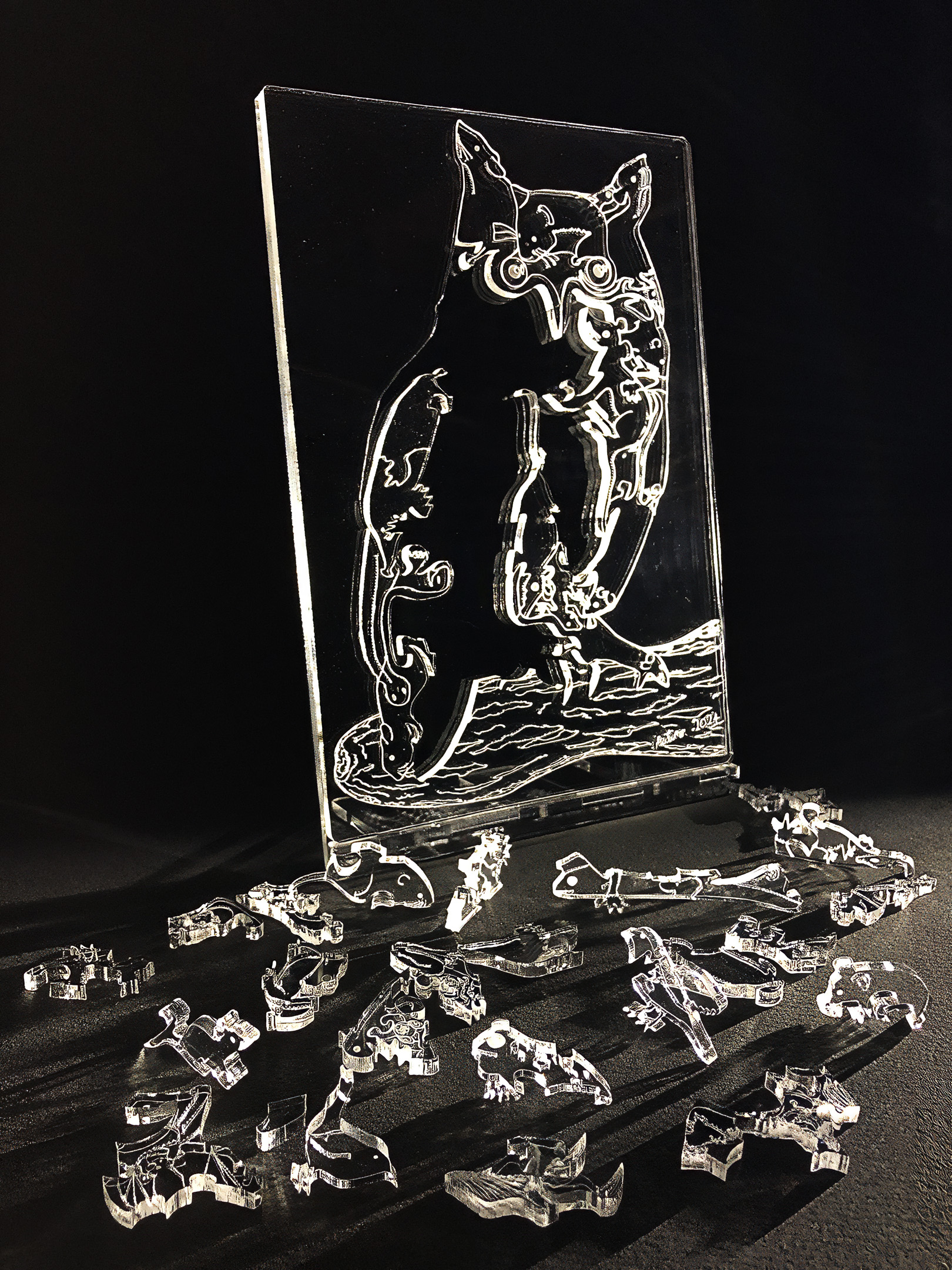
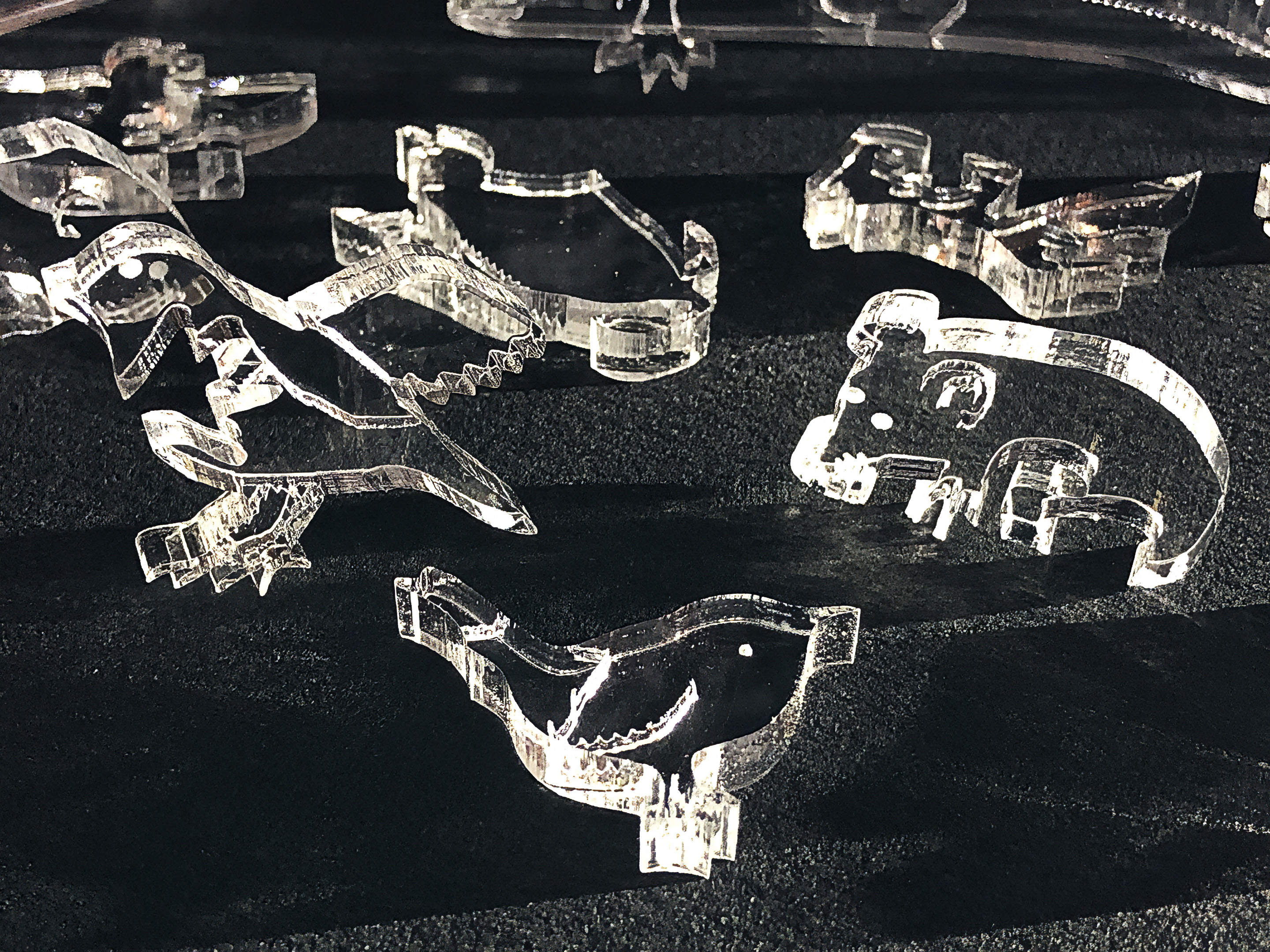
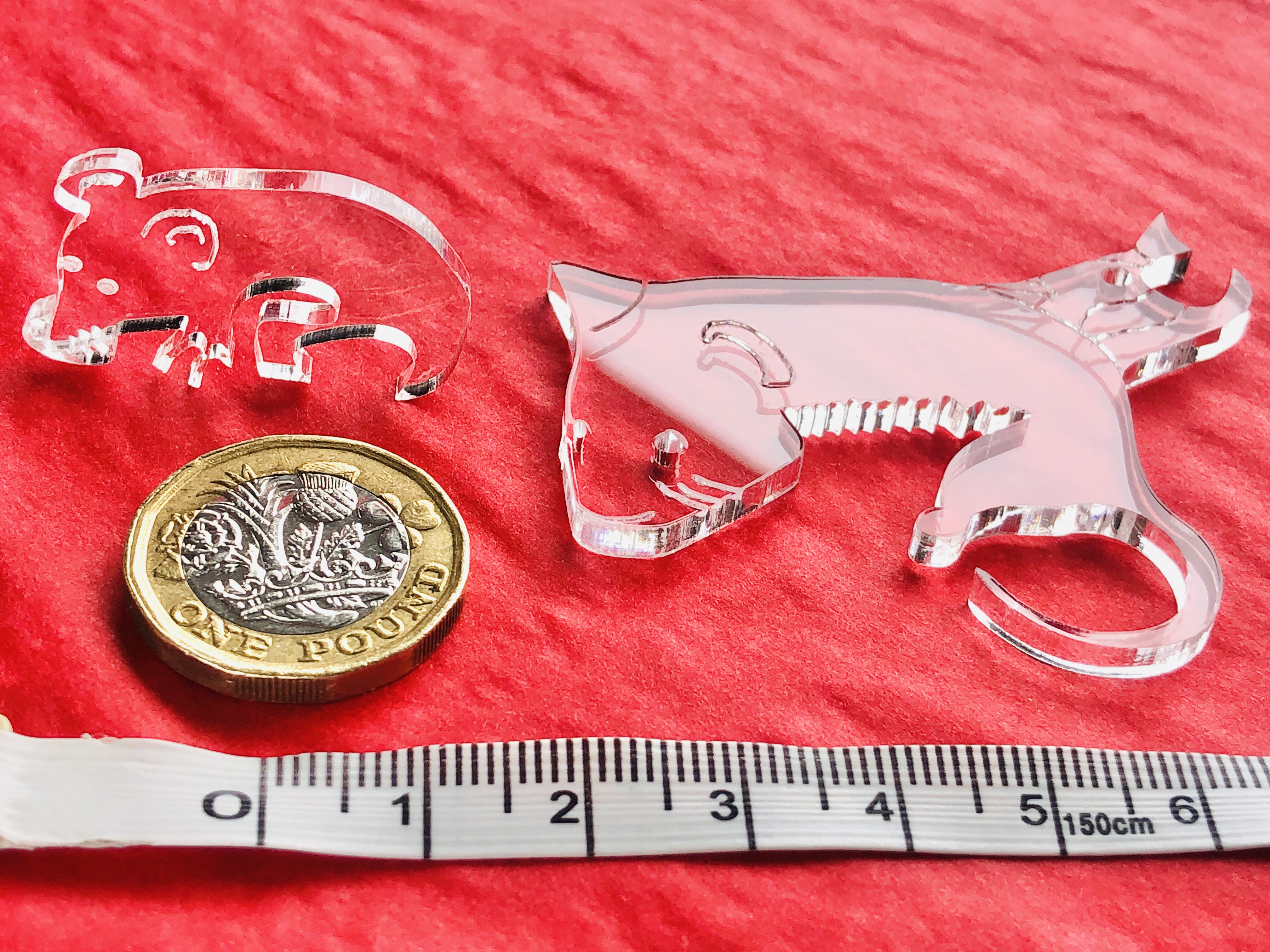
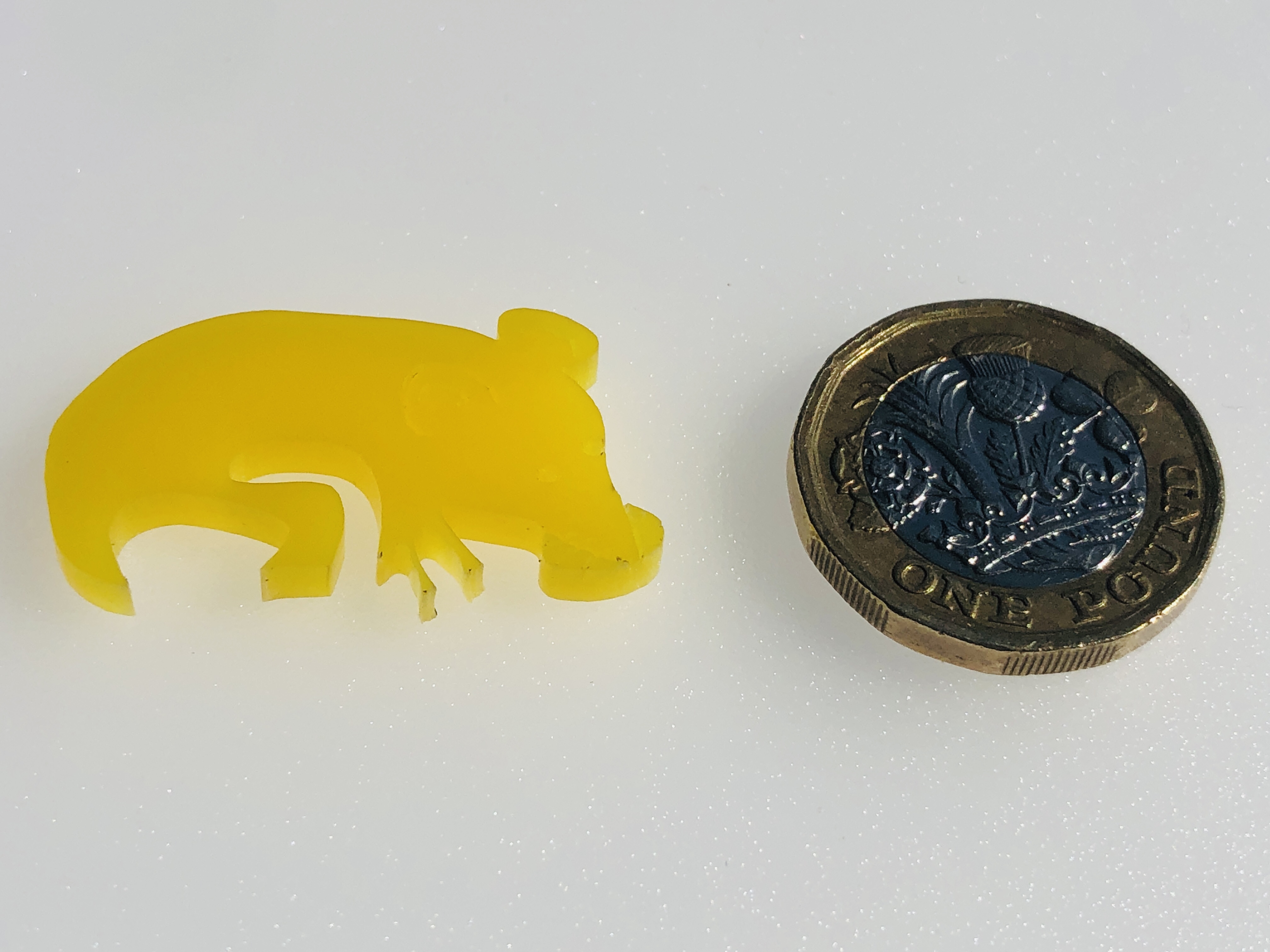
Clear cast acrylic already matches conventional glass in many respects – and in some cases surpasses it. Clear acrylic can transmit up to 97% of light passing through it (compared to more like 90% in normal glass), it’s less dense (and therefore lighter for the same volume) than glass (but up to 20 times stronger), doesn’t shatter like glass, is nowhere near as sharp – and therefore much safer to handle. Acrylic, like glass, can be cut with a laser. This last point is extremely important because the laser literally vaporises the acrylic in its very narrow path. This allows for extremely intricate cutting. I’ve achieved approximately 1mm wide cuts in a 3mm thick sheet – see below :-
I do quite a lot of museum-level picture framing, and it’s noteworthy that acrylic glass is the “glass” of choice for practically every museum. Like glass, it can be painted on, and it’s naturally more UV blocking than glass. So the only downside to using acrylic that I can think of is that it’s much softer, and therefore more easily scratched, than glass – and so it needs to be handled very carefully (but so does glass…!).
After successfully managing to very intricately and smoothly cut and engrave clear 3mm & 5mm acrylic in this artwork –
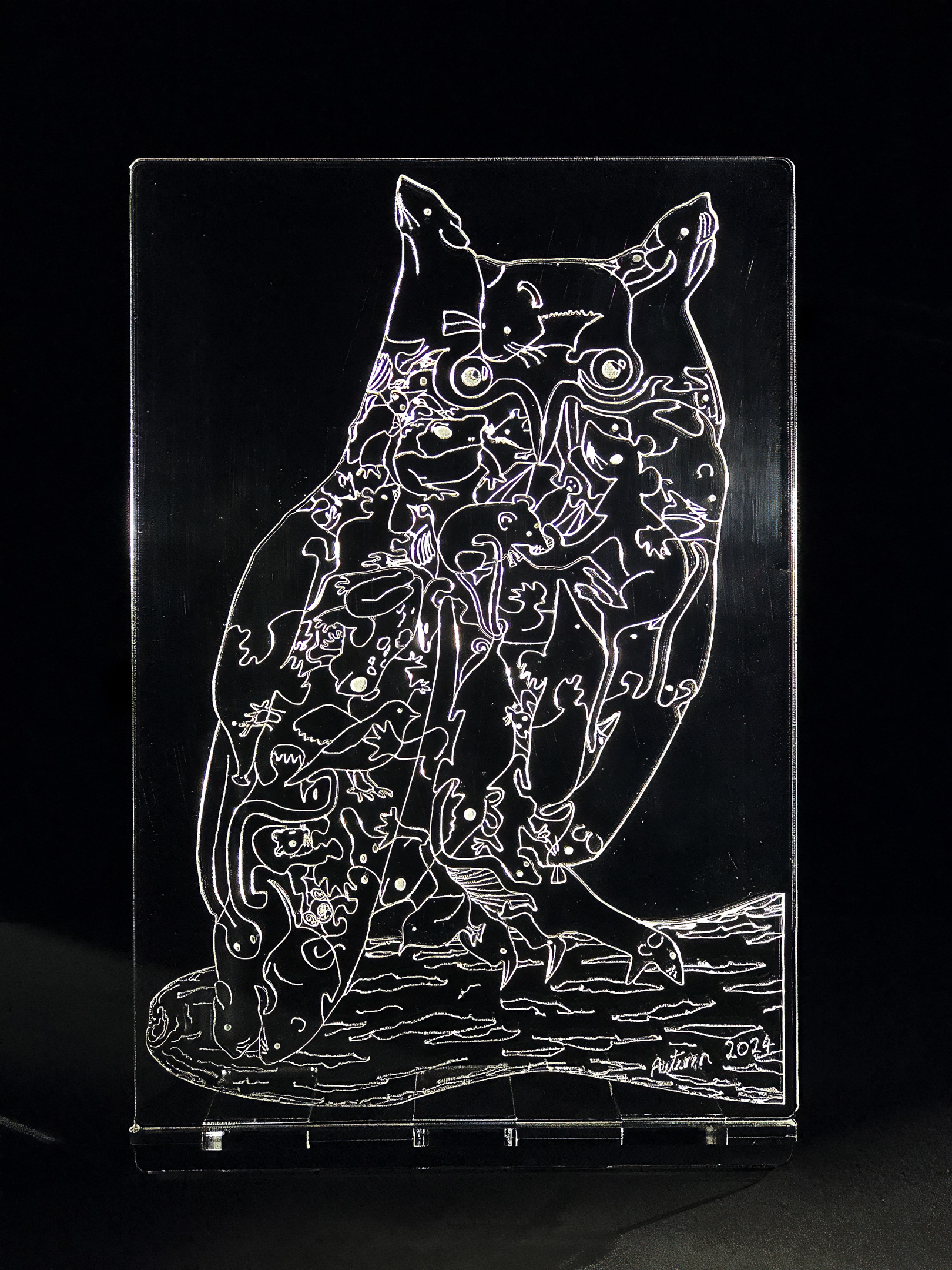
…I thought it would be extremely interesting to try cutting and engraving coloured 3mm acrylic sheets (this is the thickness with the widest range of colours available) – to see how it performs as a stained glass substitute.
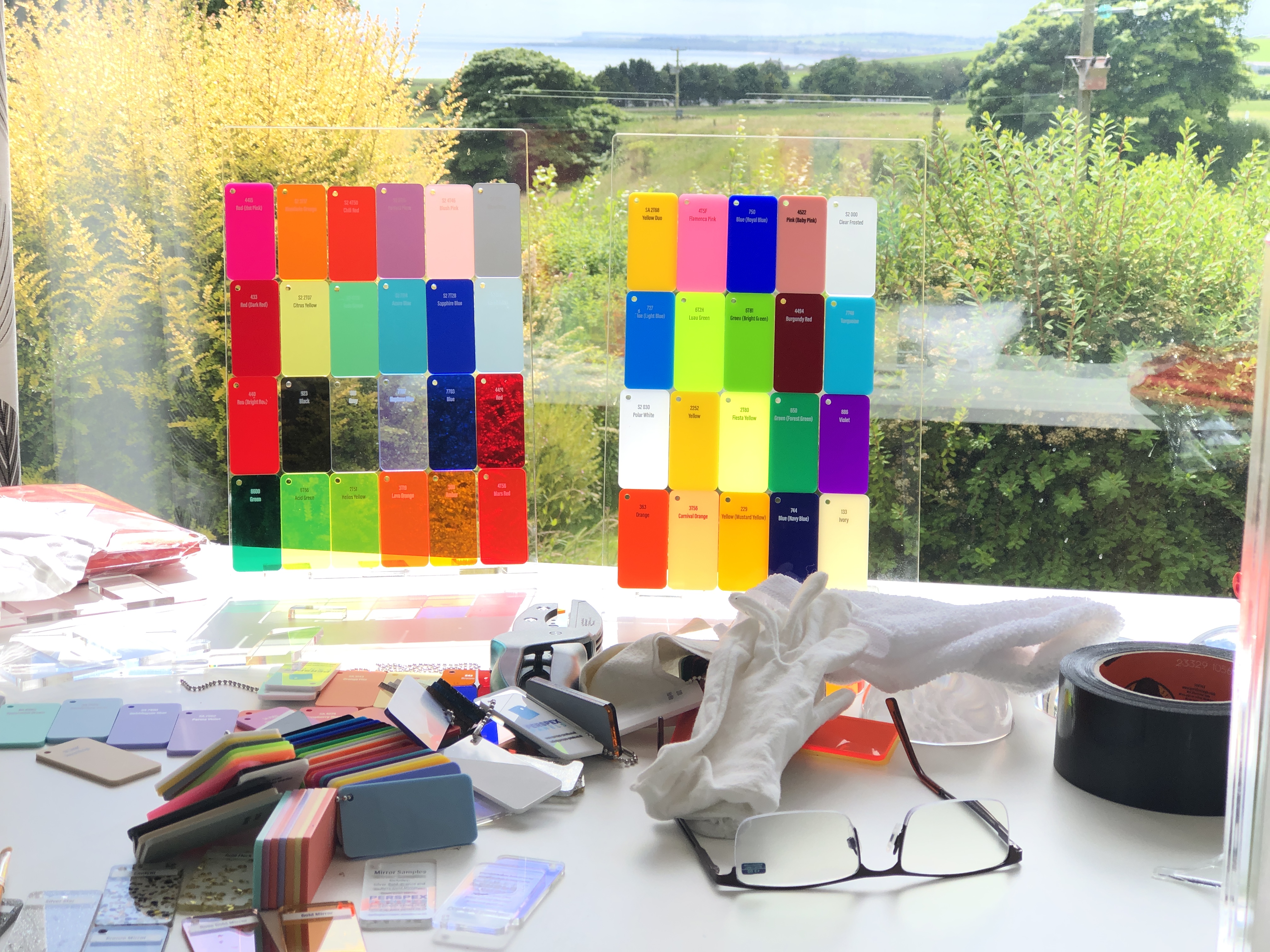
I didn’t envisage any problems – except perhaps that some colours may require more cutting power than others (greater reflectance of bright colours verses albedo effect of dark colours). But this turned out not to be the case, and the cutting was a breeze.
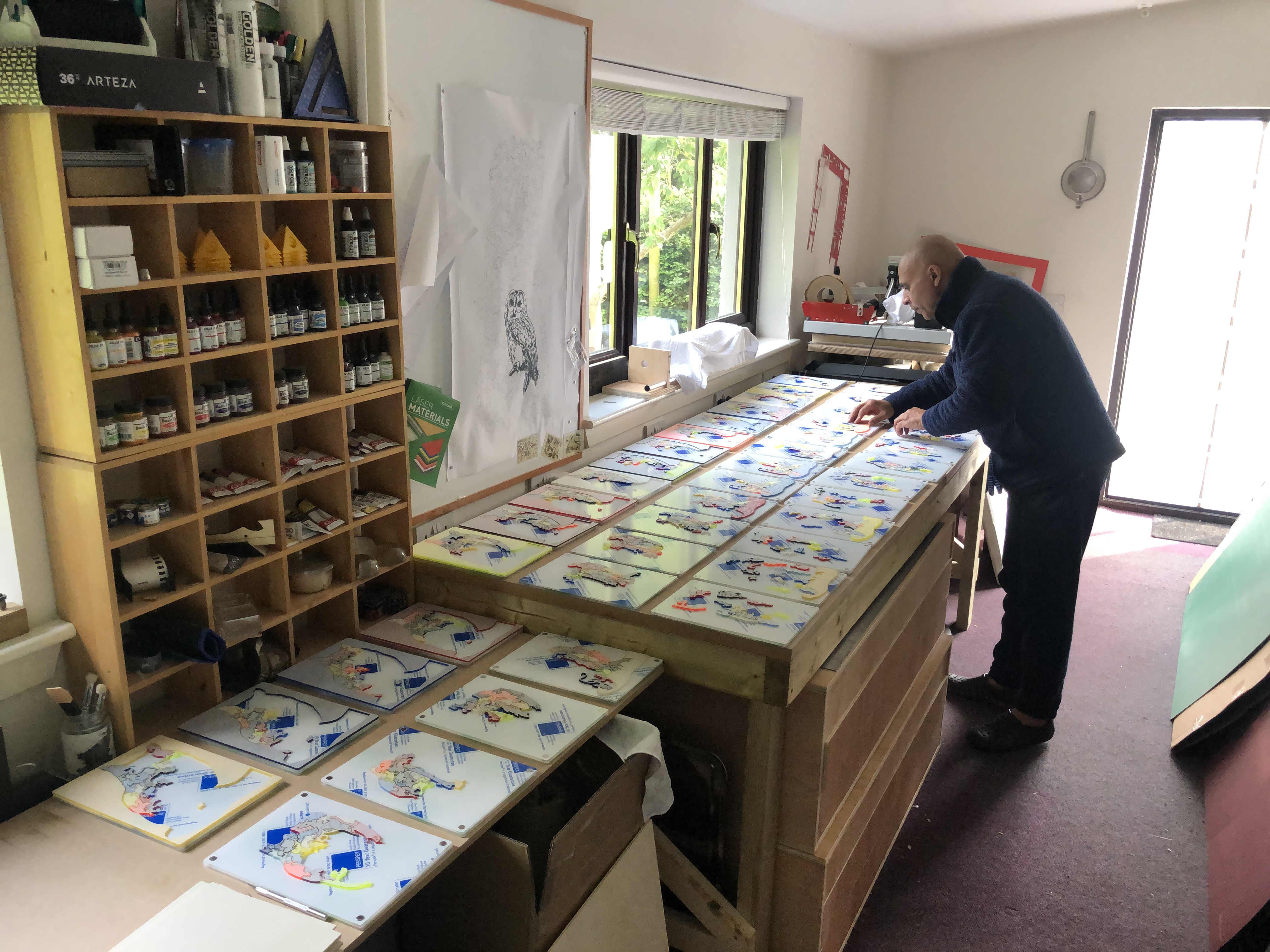
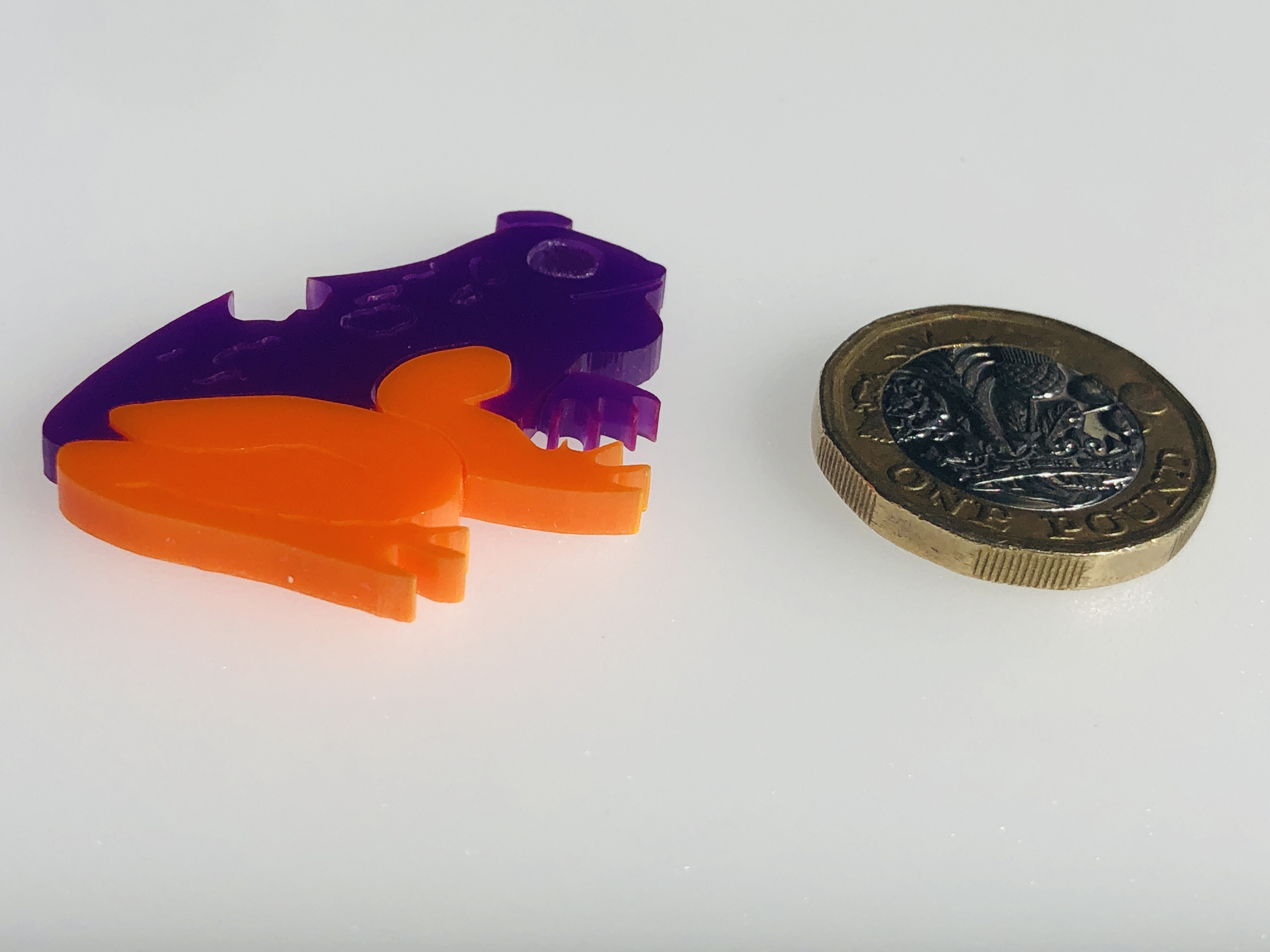
In fact I was confident enough that cutting coloured acrylic would be doable (having gotten comfortable with cutting 3 & 5mm clear acrylic), that I decided to go full in, and bought 44 different colour/tint/frost/florescence/opalescence sheets (at not inconsiderable expense) – one for each of the pieces of the long-eared owl art puzzle!
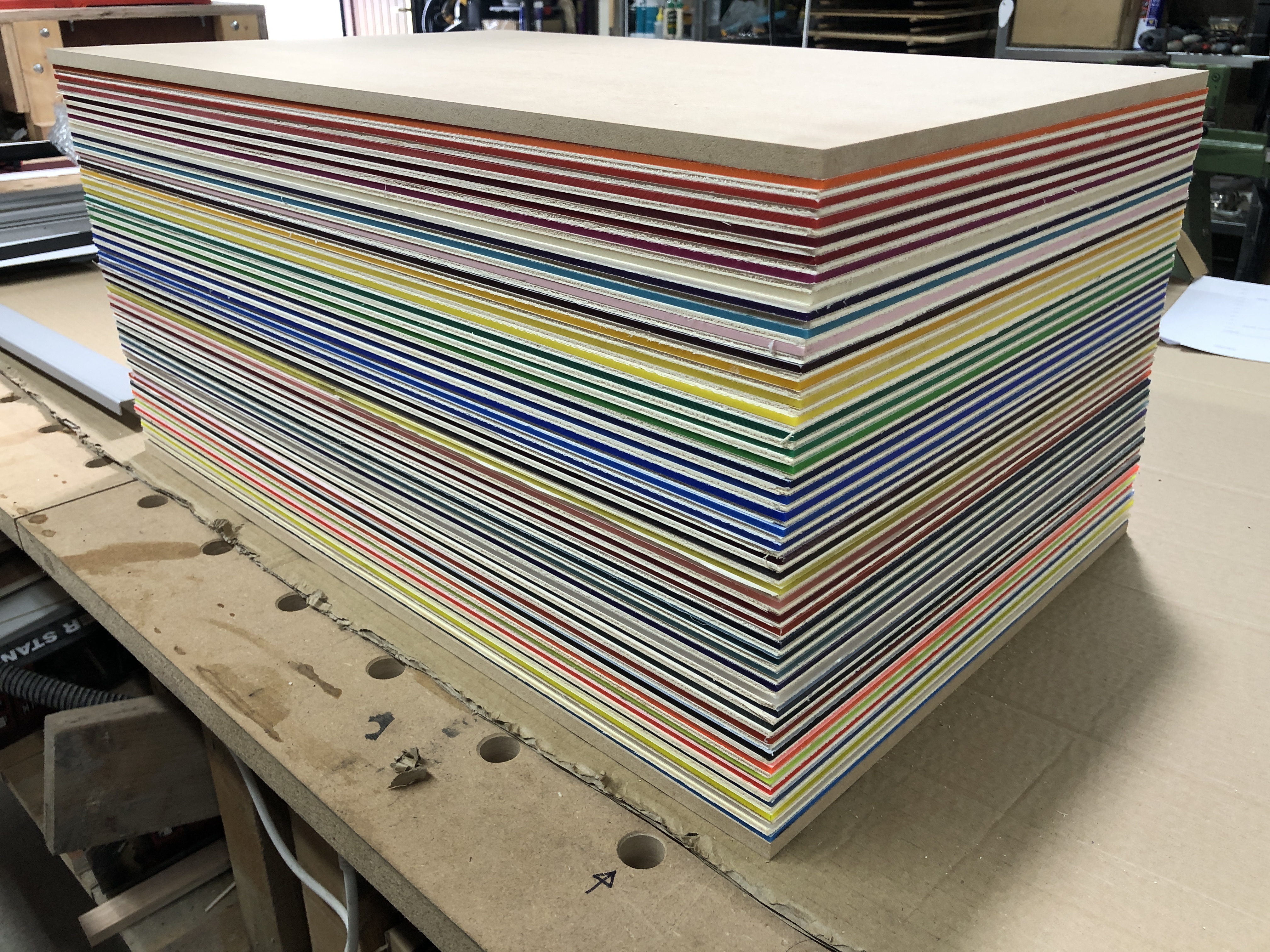
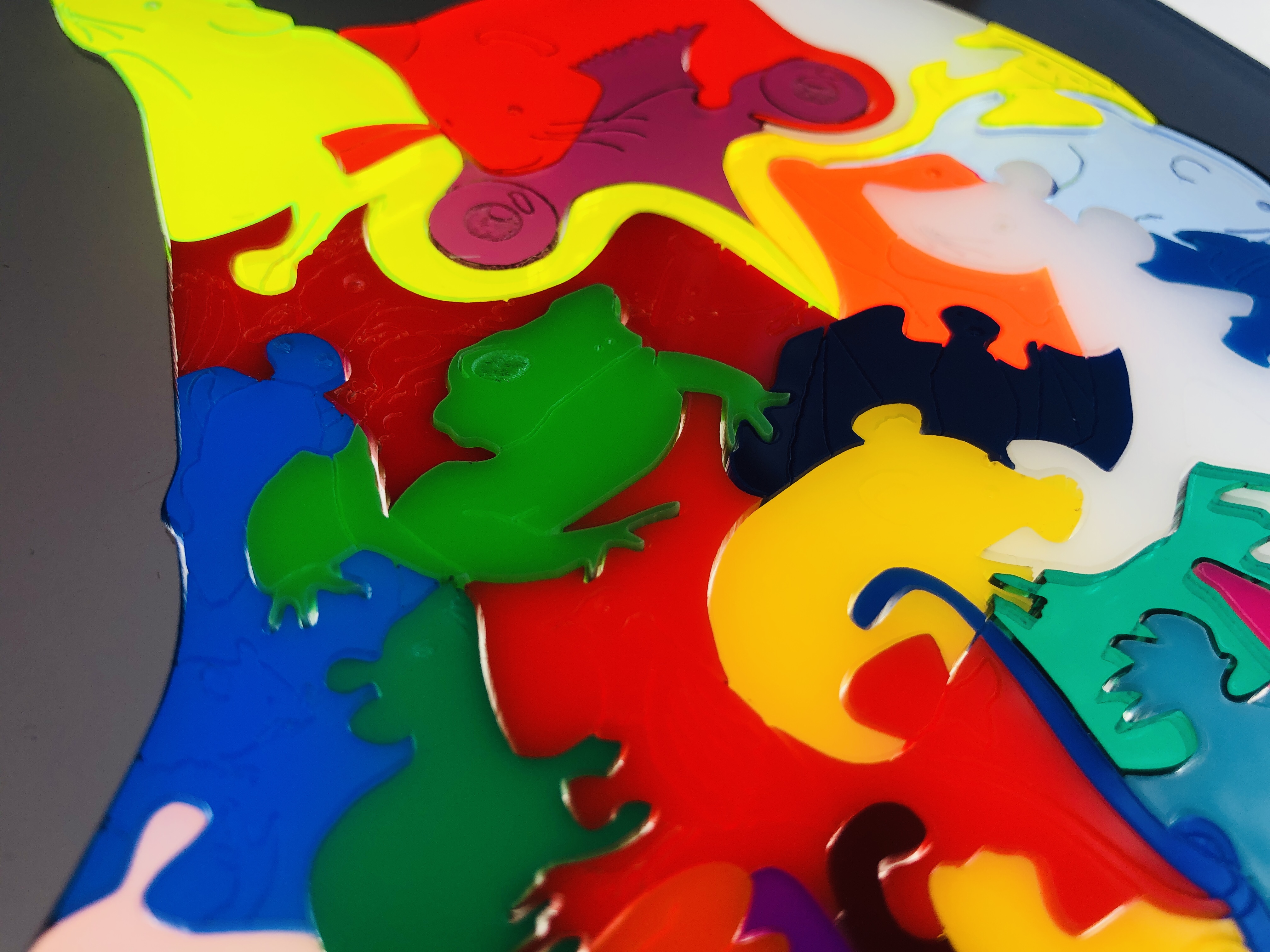
I thought it would make a great artwork for each of the 44 pieces to be a different colour and/or opacity. And I would be able to make 44 random-coloured/effects art puzzles… (I had to make do with some opaque colours because there simply weren’t enough transparent/translucent colours available – but I thought the variety of translucency in itself could be very different and interesting…)
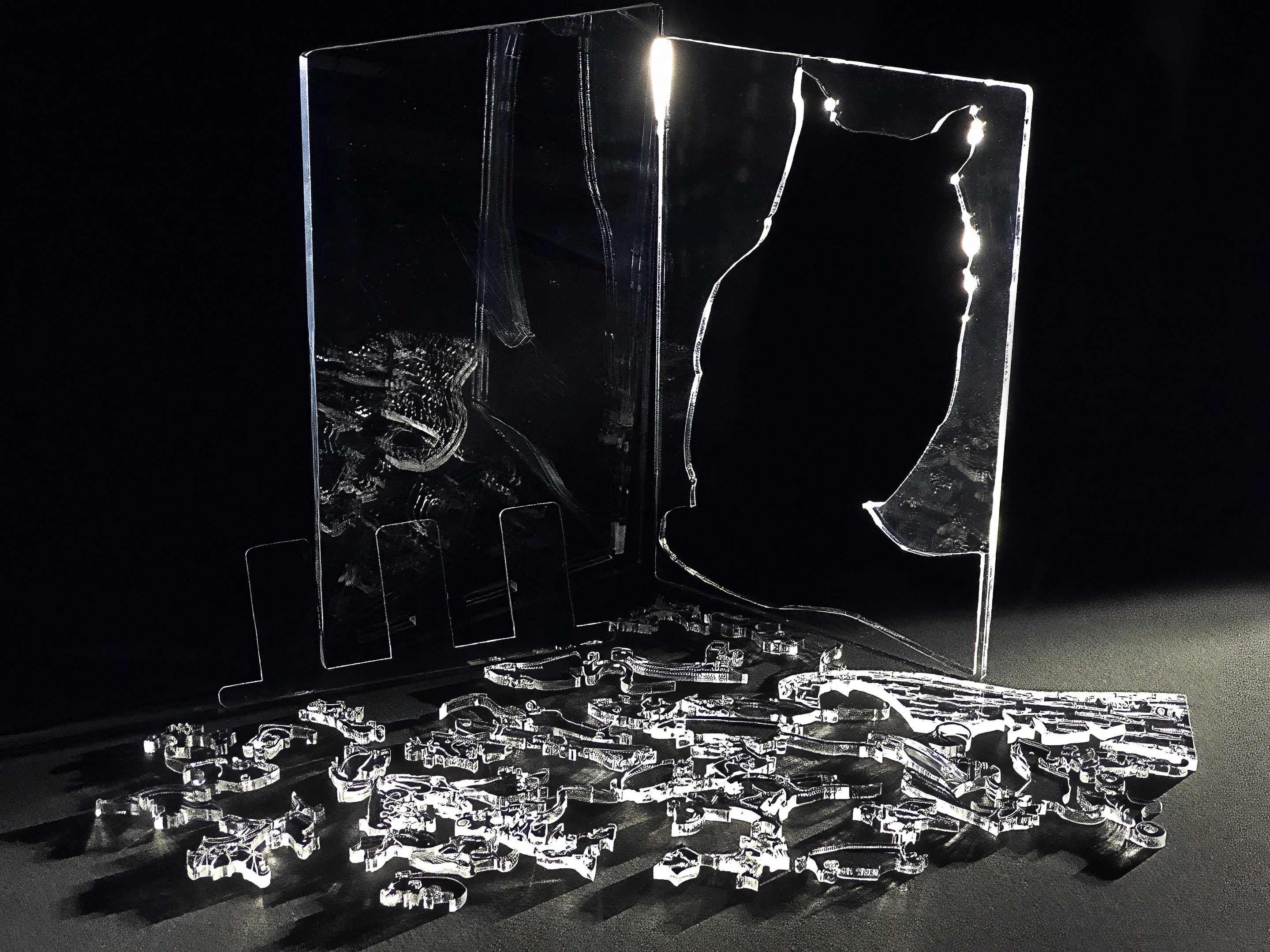
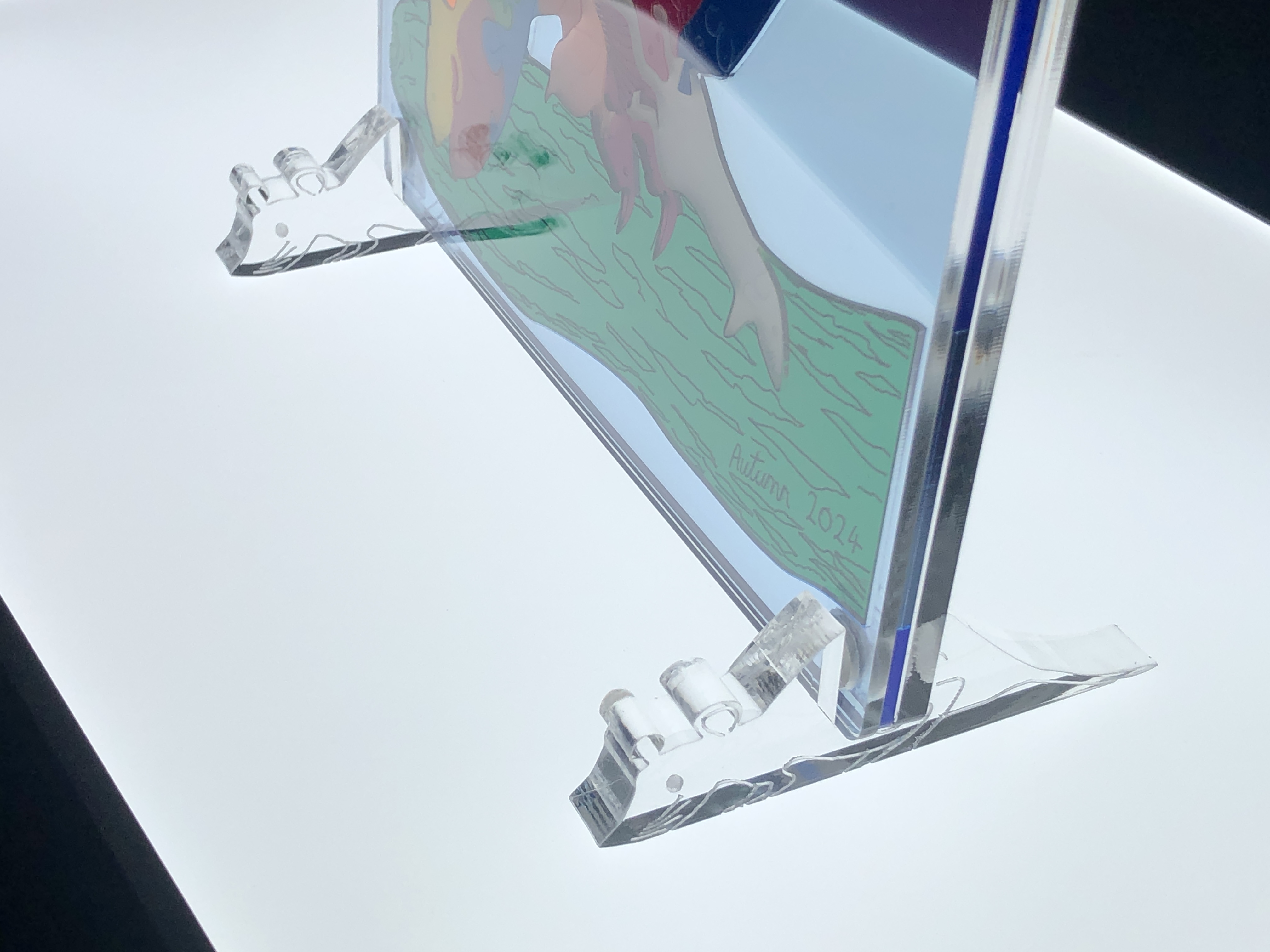
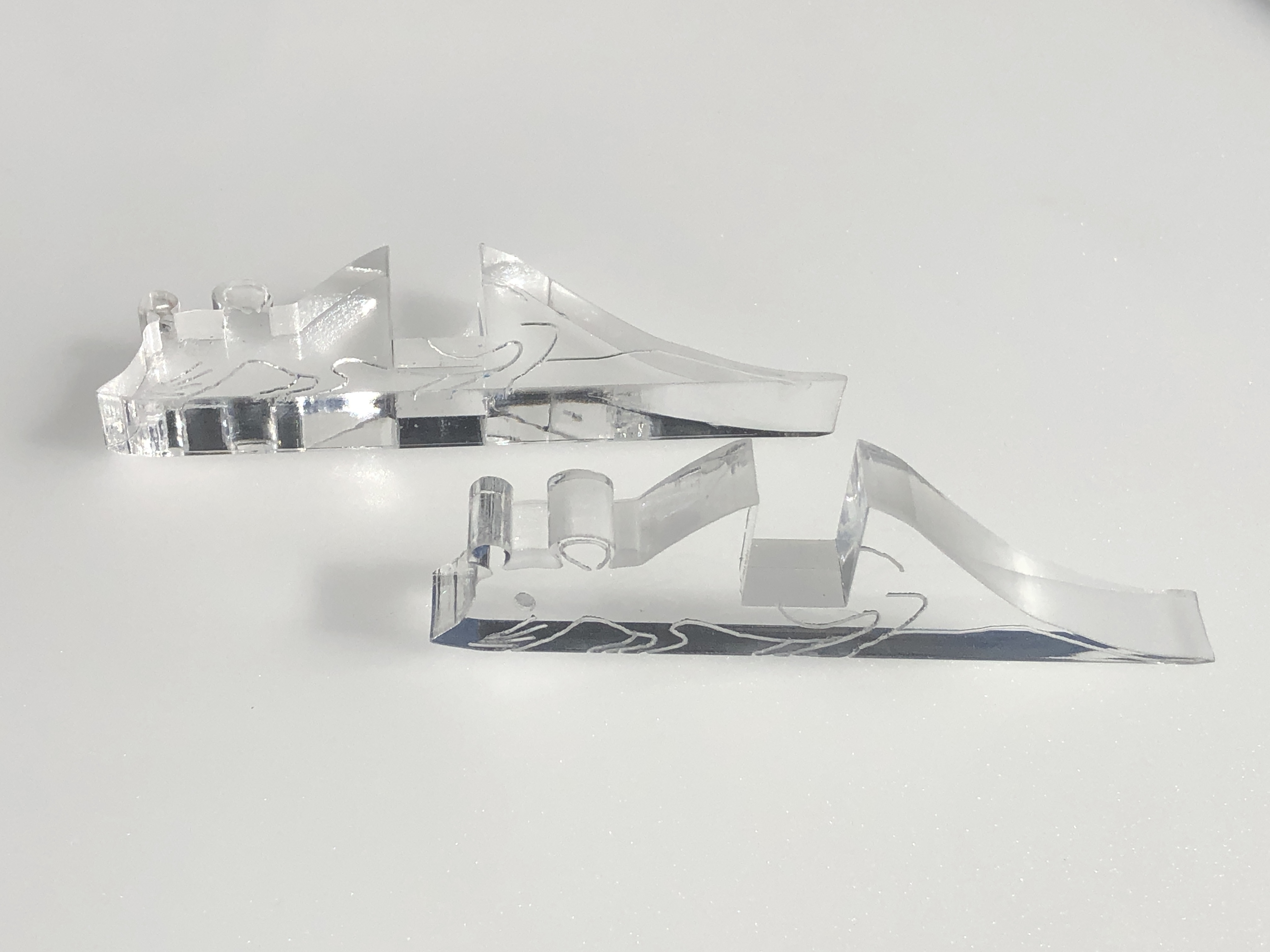
I envisioned that the “stained glass” art puzzle would look best on a windowsill (or similar), so I planned that the art puzzle(s) should be sandwiched between two sheets of magnetised clear panels (3mm for the front and 5mm for the back – the latter for greater stiffness), and stood on 10mm thick (for better stability) mice “feet” – so I also ordered in enough clear cast acrylic for these.
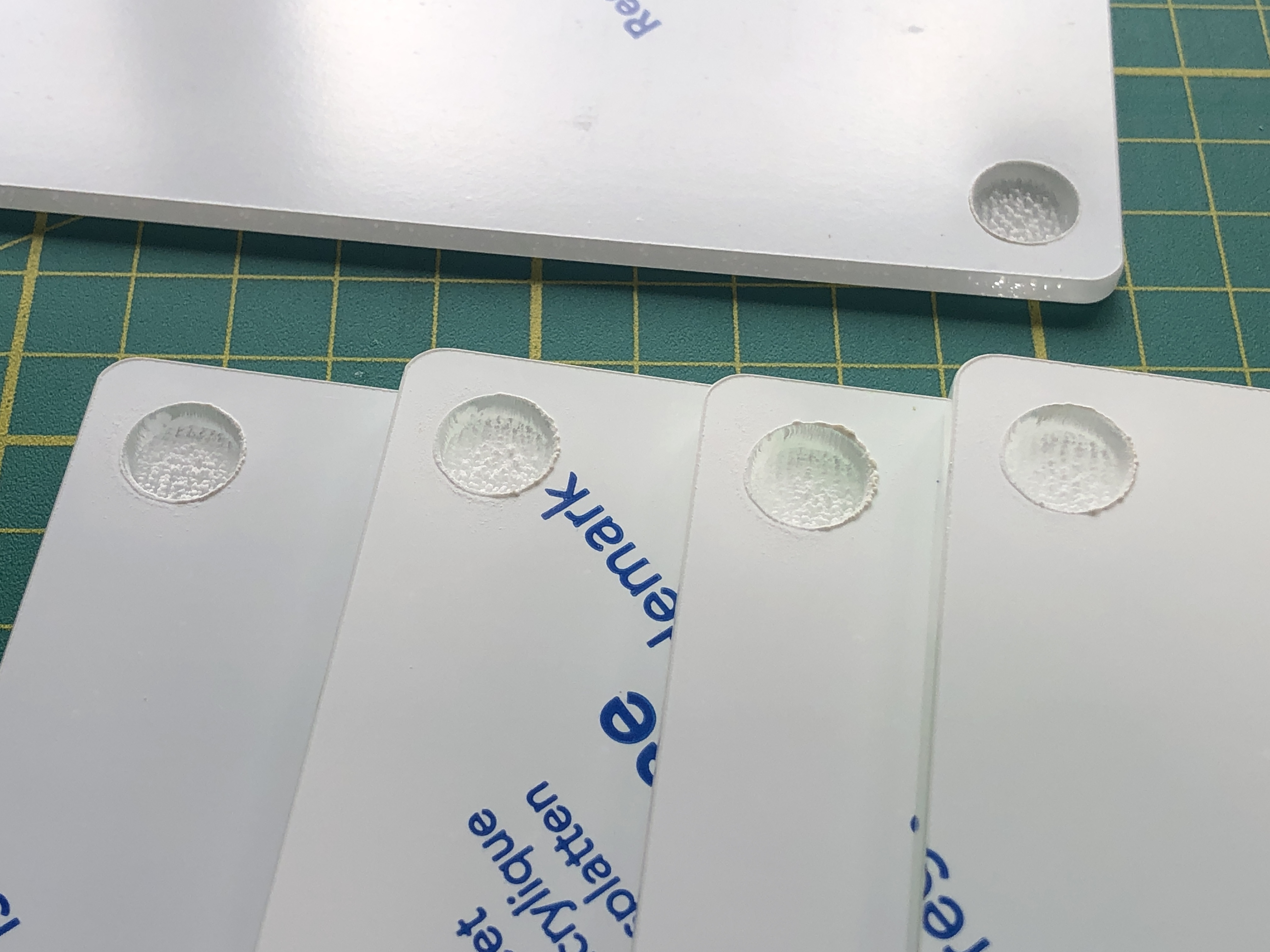
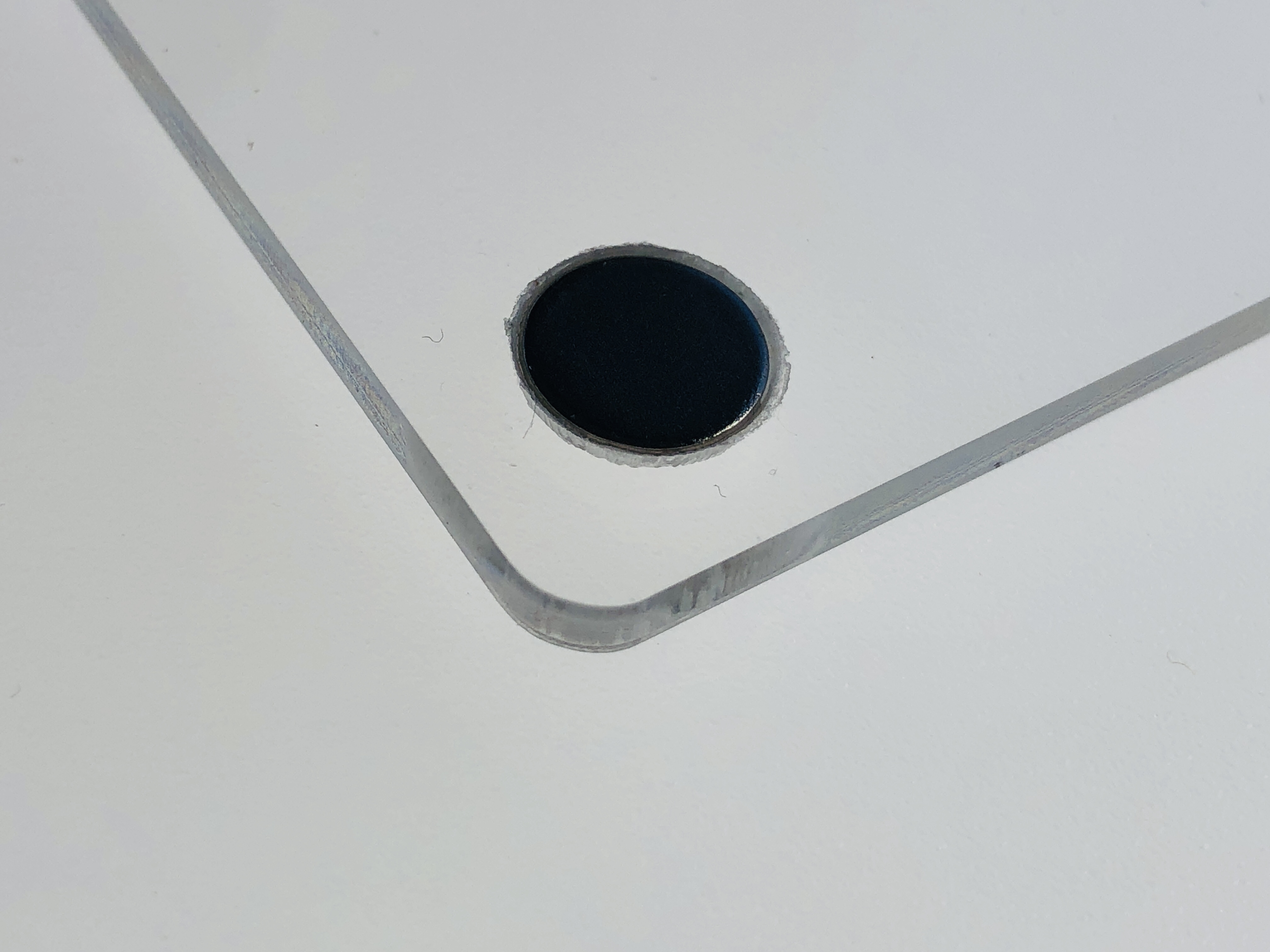
Cutting the circular recesses in both the sandwiching clear sheets of acrylic to snugly fit the 10mm diameter x 2mm thick neodymium magnets took a bit of working out and experimentation – particularly given that I was drilling into 3mm material and had to leave 0.5mm for glue – leaving only 0.5mm material left! I originally tried to use a bench drill and a positioning jig for the acrylic pieces, but that seemed too risky, and with 352 recesses to cut (2 x 4 x 44) – too time-consuming. I then tried to use a CNC router and a positioning jig. But that wasn’t accurate enough across all four corners – and getting perfect registration of the sunken recesses across two different thickness of acrylic seemed problematic. In the end I thought the easiest and most accurate way to bore out the recesses was to engrave them with the laser. This took a bit of experimentation to get the correct depth, but I got there in the end. Also, the rough bottoms made a good biting surface for the glue used to fix the magnets in place.
Conventional stained glass windows have to be strong enough to hold their own weight and withstand the worst weather they are likely to face, and to achieve this there is a great deal of strength built into, and around, them. All the individual glass pieces are welded together in the form of soldered H-sectioned lead strips. This relatively flimsy carcass is supported by being fixed to metal and/or masonry frame/s.

By GFreihalter – Wikimedia Commons, CC BY-SA 3.0, Link
However, the approximately 10mm wide lead H-section strips are what on the one hand give conventional stained glass it’s traditional thick wire-frame look, but on the other hand means the stained glass pieces themselves are very basic and simple shapes. This low resolution can be largely overcome by over-painting, but the pronounced wire-frame effect of the lead strips is a given. Some people may like this effect, and, to be fair, the further away you stand away, the less intrusive it looks.

By Ariane Corisande – Own work, CC BY-SA 3.0, Link
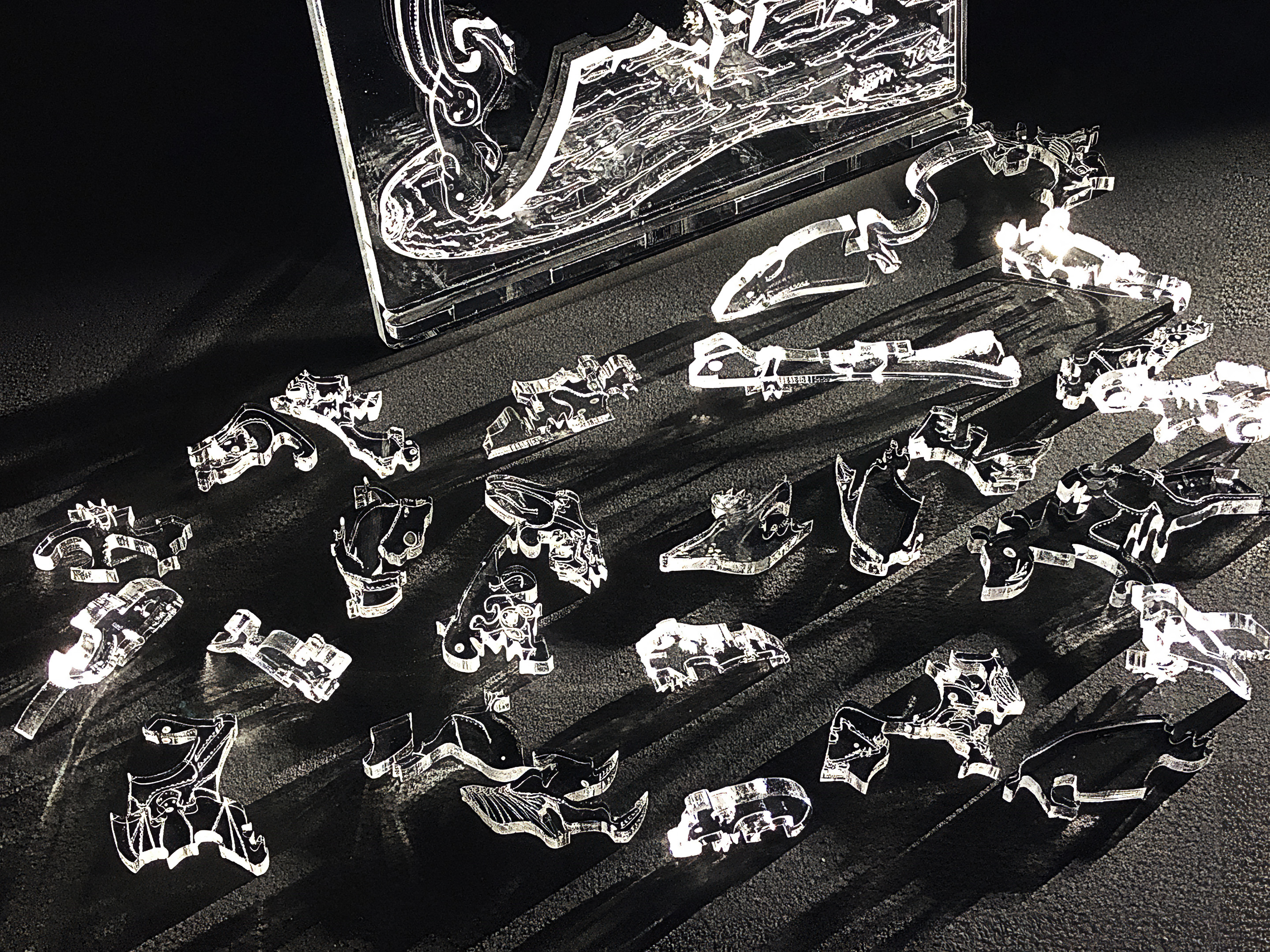
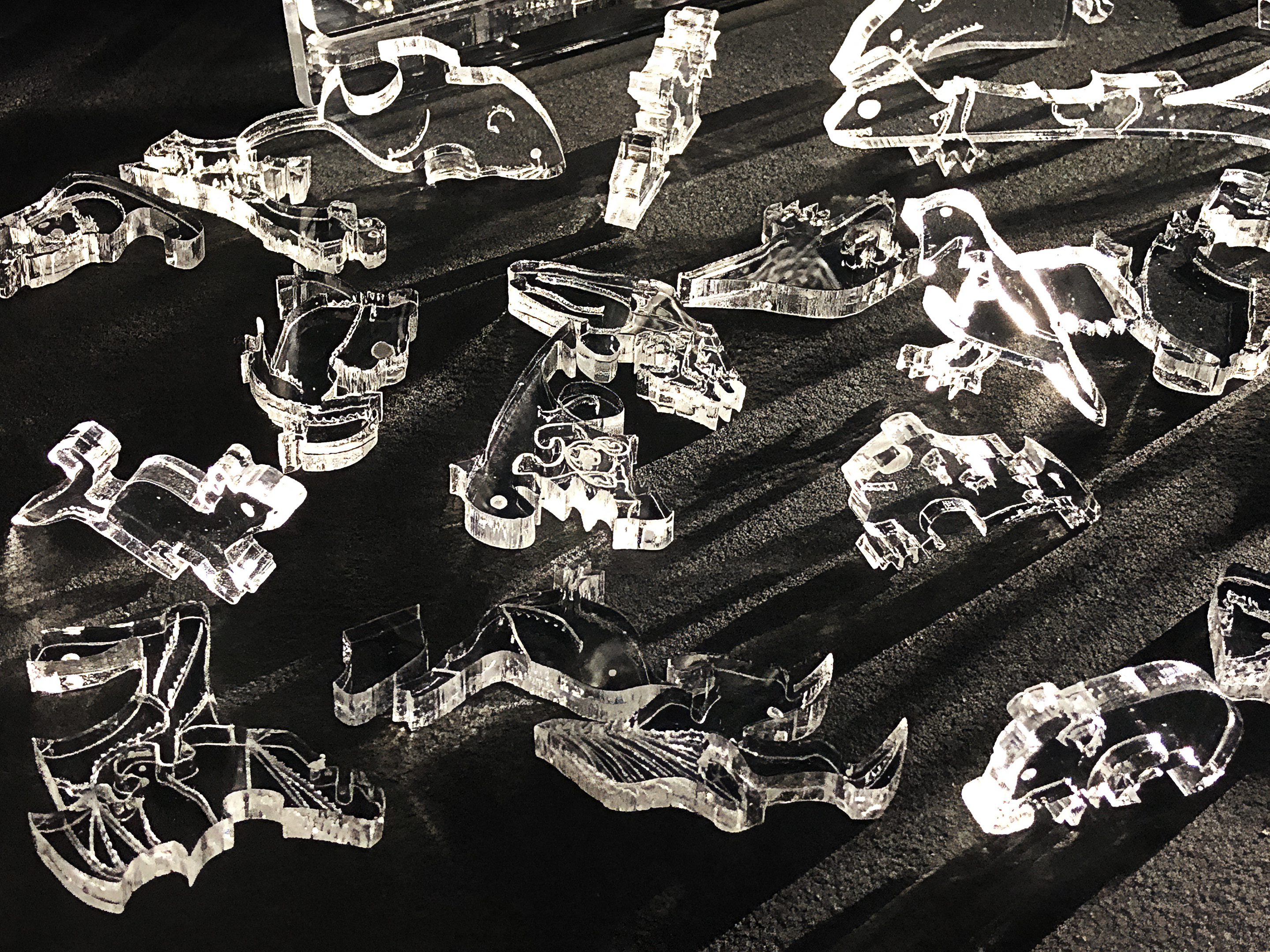
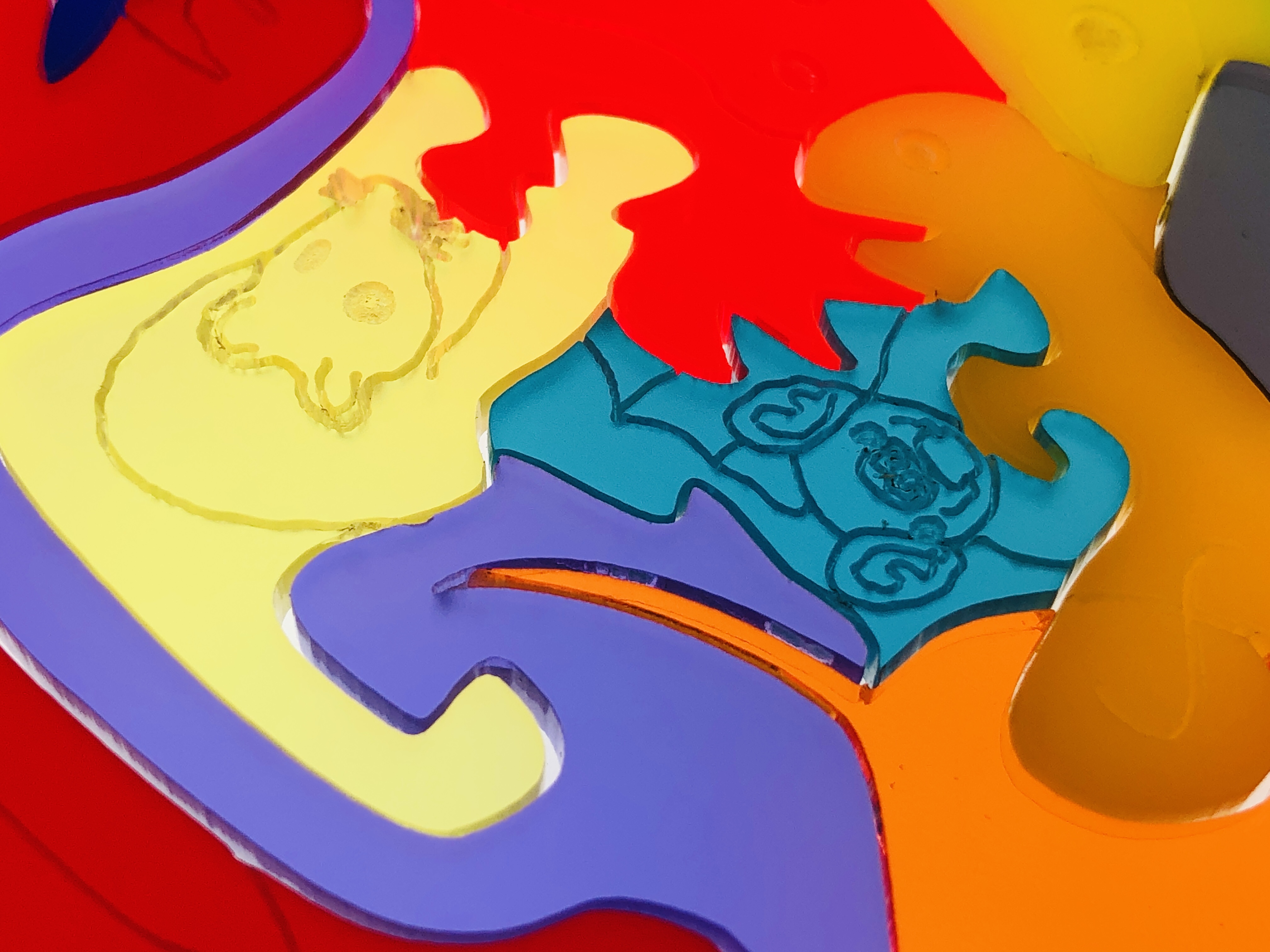
Coloured acrylic provides a completely alternative modern approach. The “stained glass” can be sandwiched between two clear sheets of acrylic (or glass), and optionally the whole design can be fixed in a frame and placed anywhere… There is no need for leading – or faux leading – at all. For practical purposes it’s useful to have a small gap between the pieces – if, for no other reason, to be able to assemble (and optionally disassemble) the pieces. This can be quite advantageous because on close inspection it provides for a halo of a thin gap of light between and around the pieces – see photo below :-
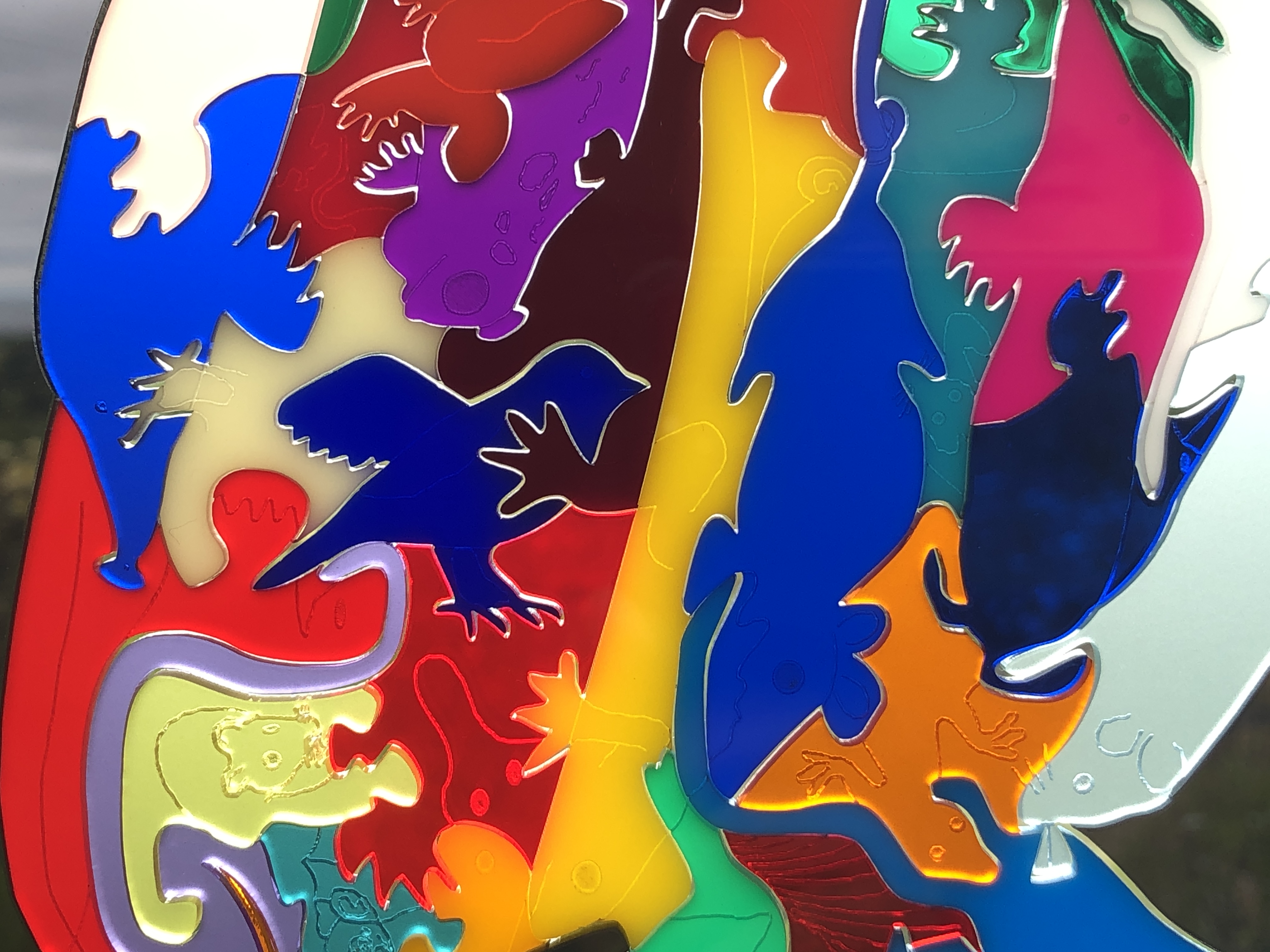
What’s more, unlike welded-in stained glass pieces, because the acrylic pieces are not fixed in position (they cannot move if supported around the sides), the whole design lends itself to be a (jigsaw) puzzle as well as a decorative beautiful “stained glass” artwork… This simply requires that there be some way to easily open the framed sandwich – hence why I chose to use simple magnets to hold the three panels together…
Not having leading means literally more light comes through, but, on the positive side, leading more clearly defined the edges of shapes – and so may be preferred for that reason. However, there is nothing to stop you using leading, faux leading, piping, or indeed a purpose-cut lattice of opaque black (or any other colour) acrylic – if a shape-outlining effect is desired…
In conclusion, using coloured acrylics for creating stained glass effects offers a great number of opportunities and there is seems to be nothing that cannot be achieved using it compared to conventional stained glass techniques and real glass. I’m very encouraged by the future possibilities of using coloured acrylics, and have several designs already in mind. Watch this space…
Long-eared owls are ferocious predators (as are all owls) – and will basically eat anything that moves that is smaller than them. They often swallow their prey whole, and regurgitate a large pellet of the undigestible parts – such as bones, teeth, hair, feathers. Indeed, examining their pellets is how ornithologists know so much about what they eat.
This is a precision laser-cut and engraved “art” puzzle – directly cut and engraved in premium 3mm coloured cast acrylic from an original digital hand-drawing. The design is a specially modified version of my original hand-cut 40mm thick solid oak artwork entitled “Long-eared Owl (Art Puzzle) (You are what you eat)” (2022)

(see https://michaelautumn.wordpress.com/2023/05/03/long-eared-owl-jigsaw-puzzle-you-are-what-you-eat/ and https://youtu.be/jWsK6TFEevk).
Gallery
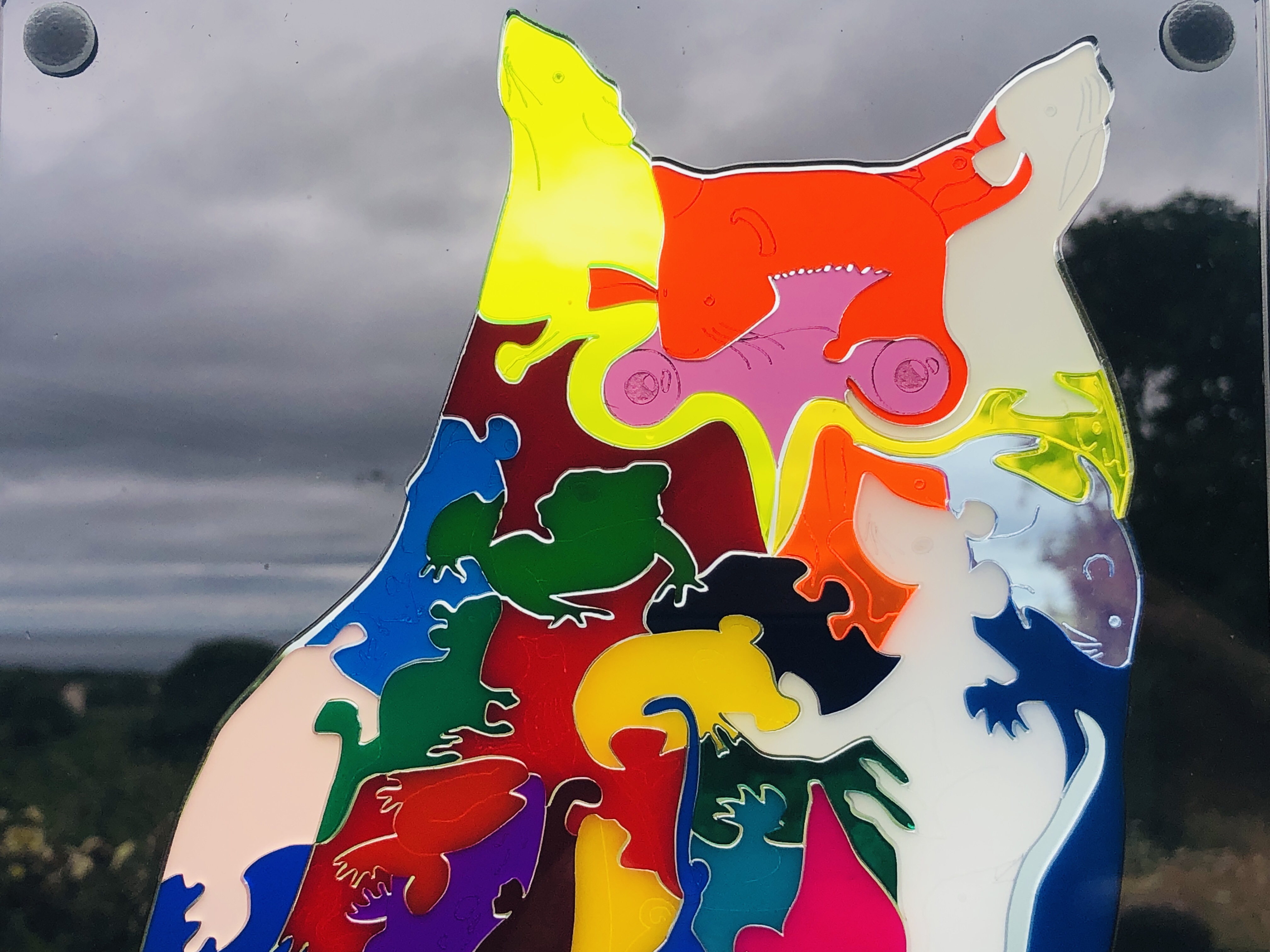
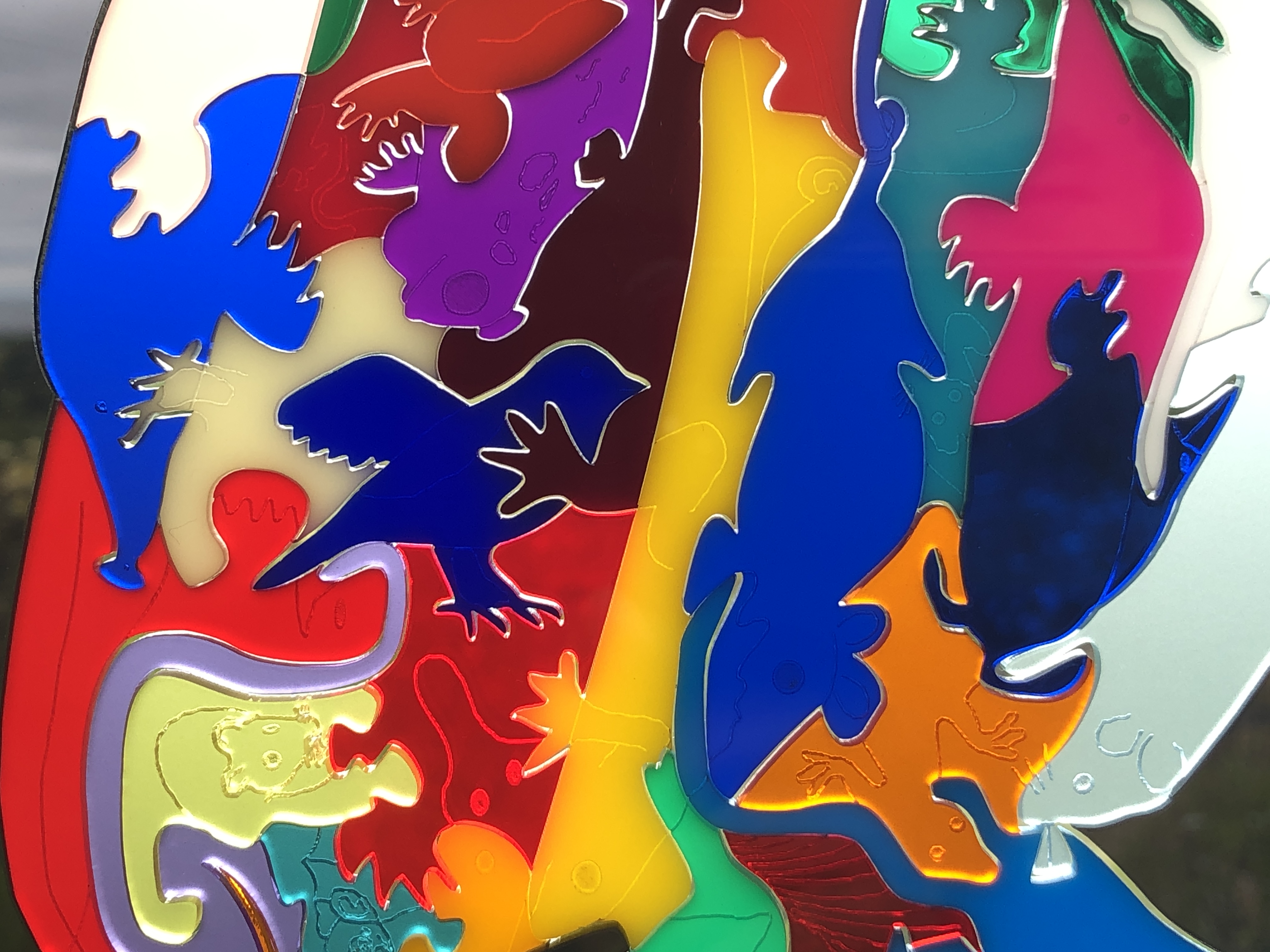
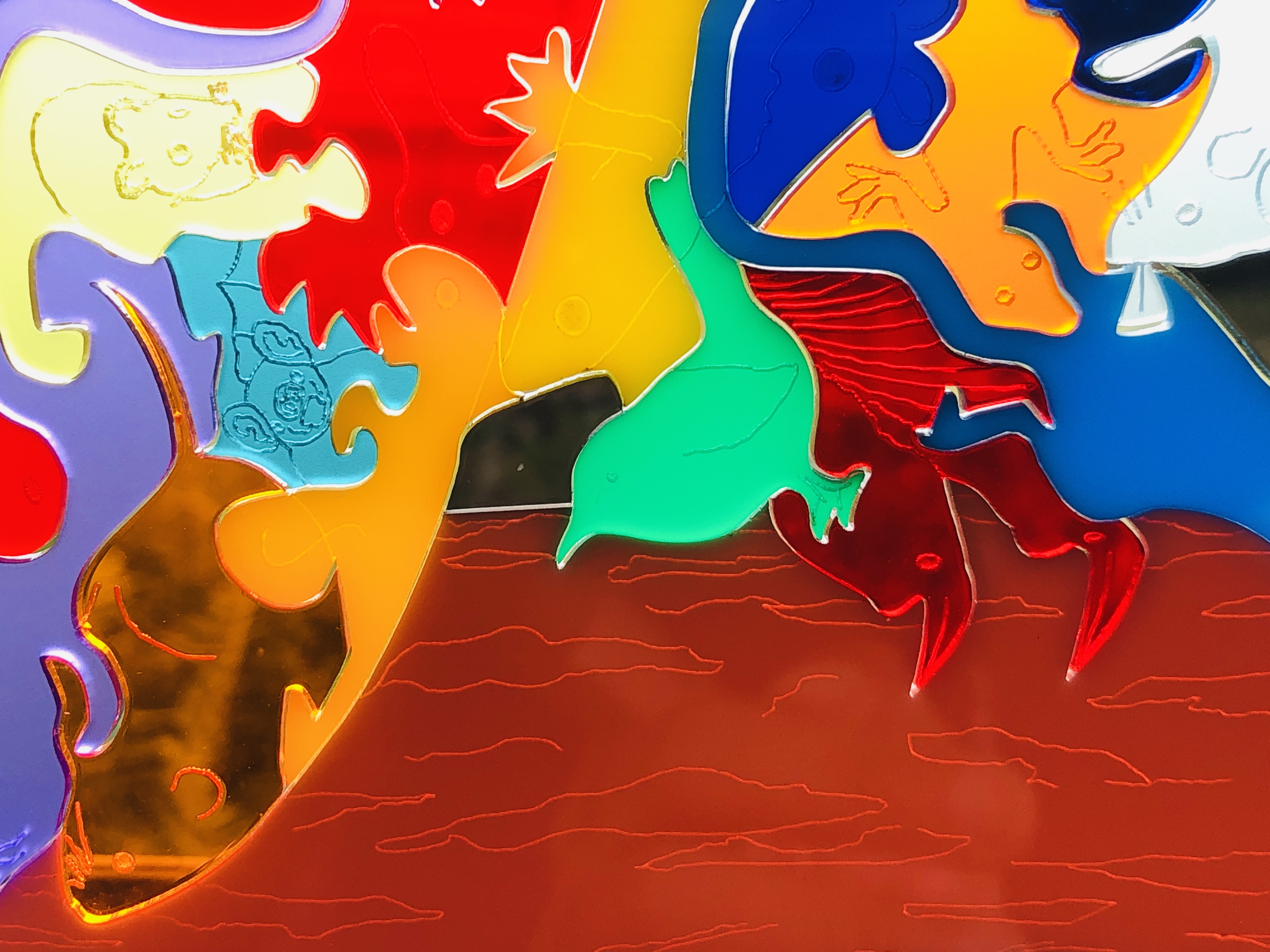
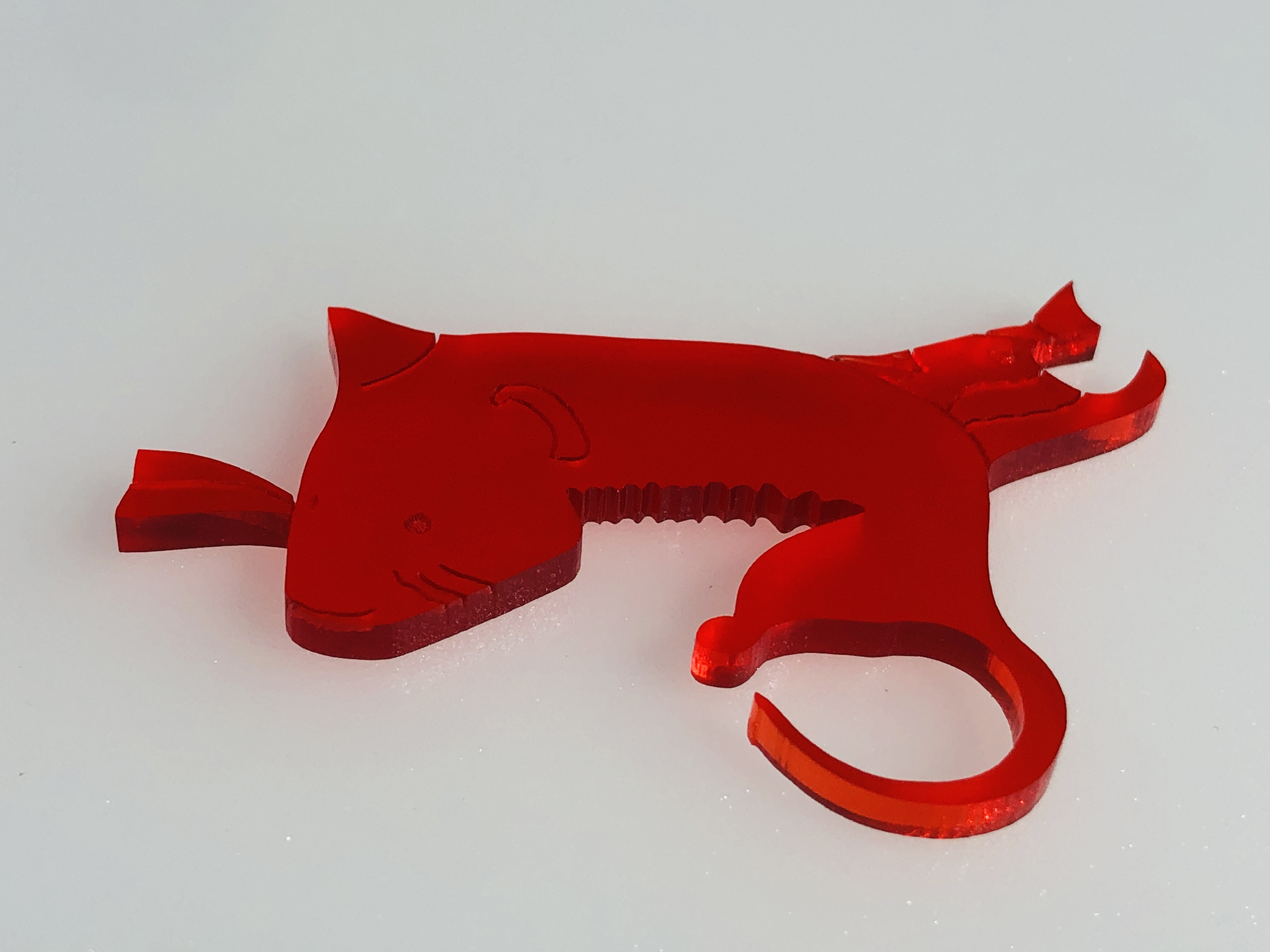
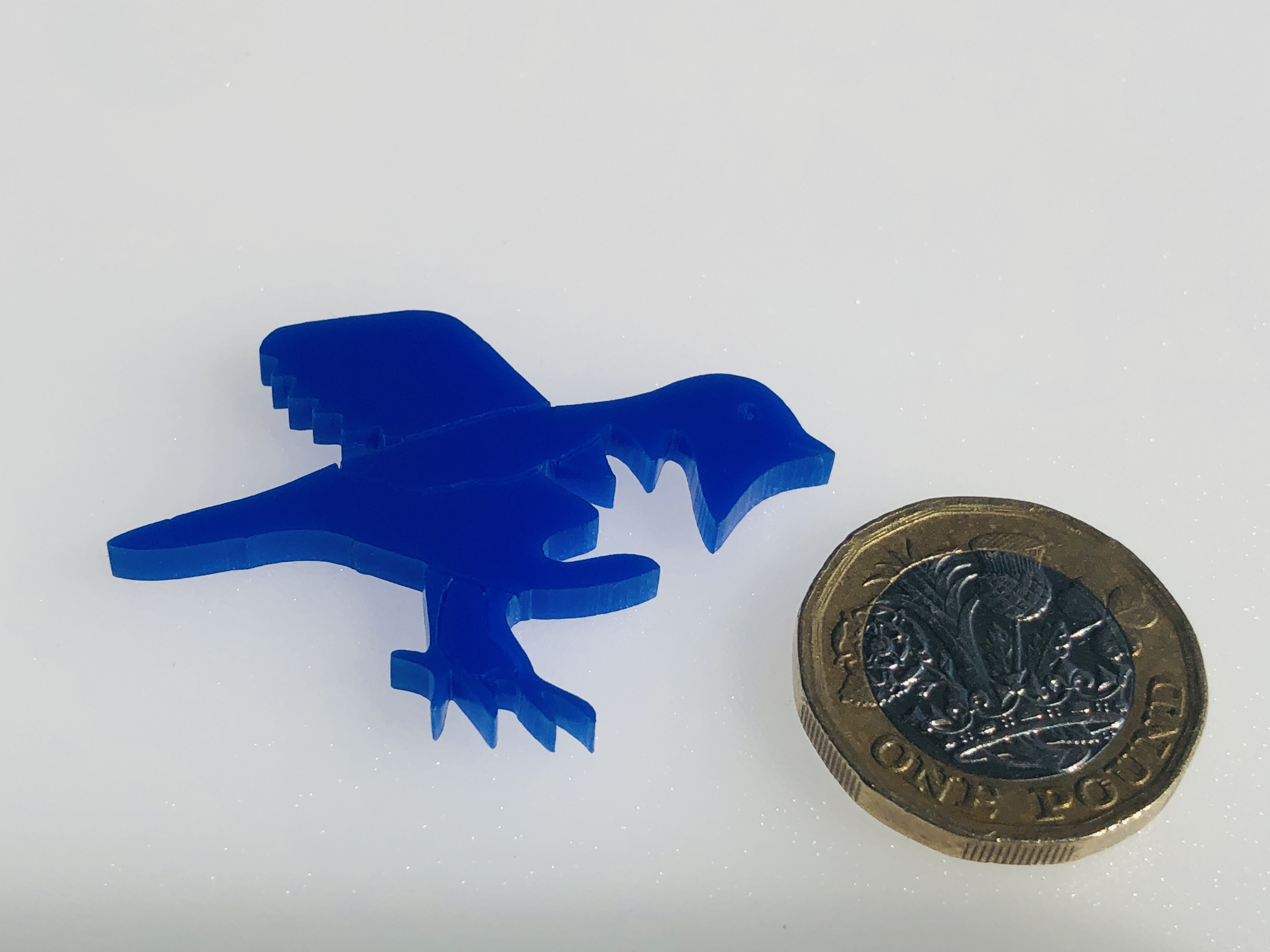
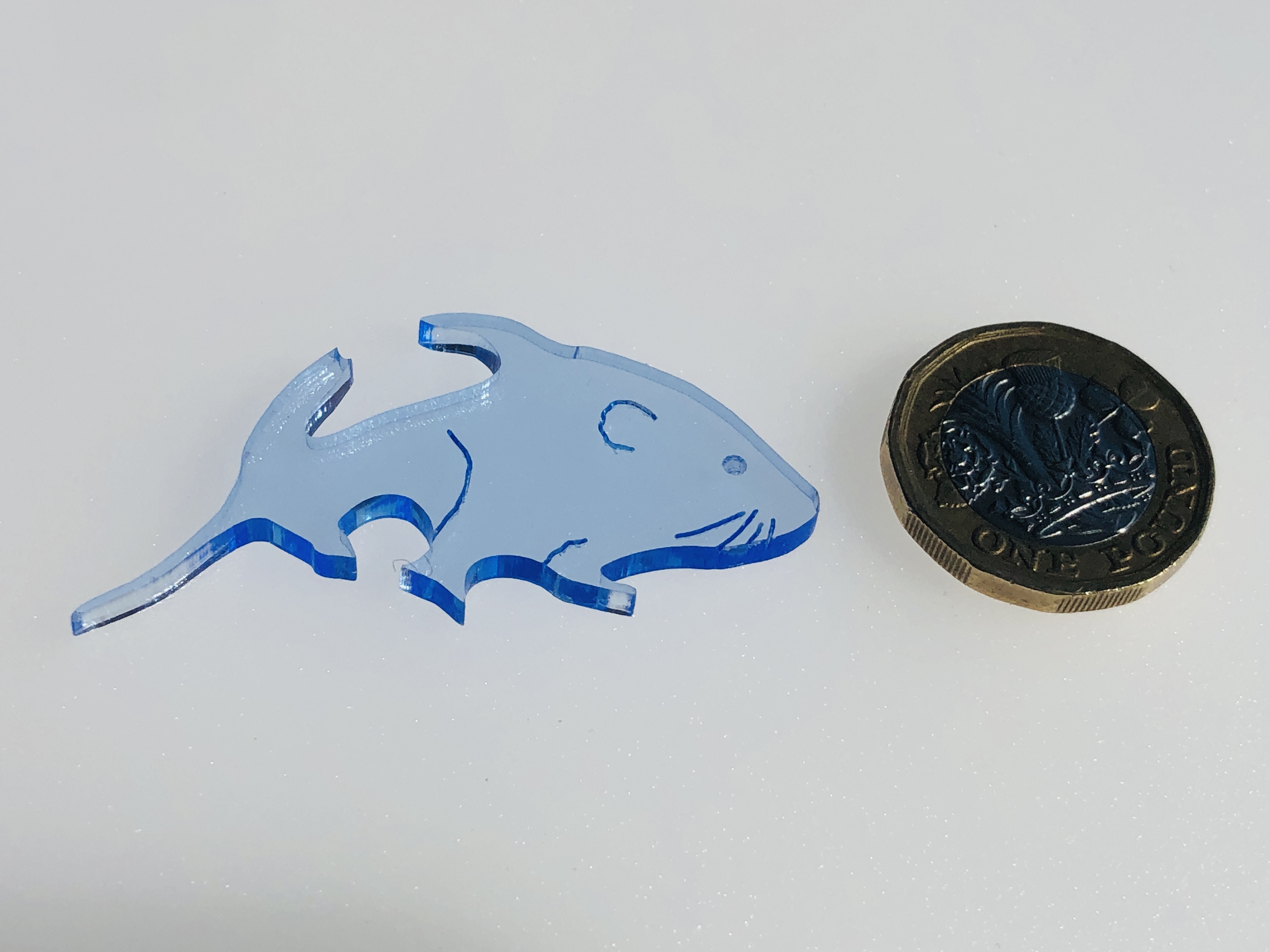
I have created a few stained glass designs in the past – using stick-on lead piping and coloured glass inks. At the time I was happy enough with them, but they weren’t very good. The solidity of the colours wasn’t there, and the colours faded over time. I do find there is something magical about transparent materials – as well as them being beautiful because their appearance changes dramatically from different angles, and by the changing light falling on them.
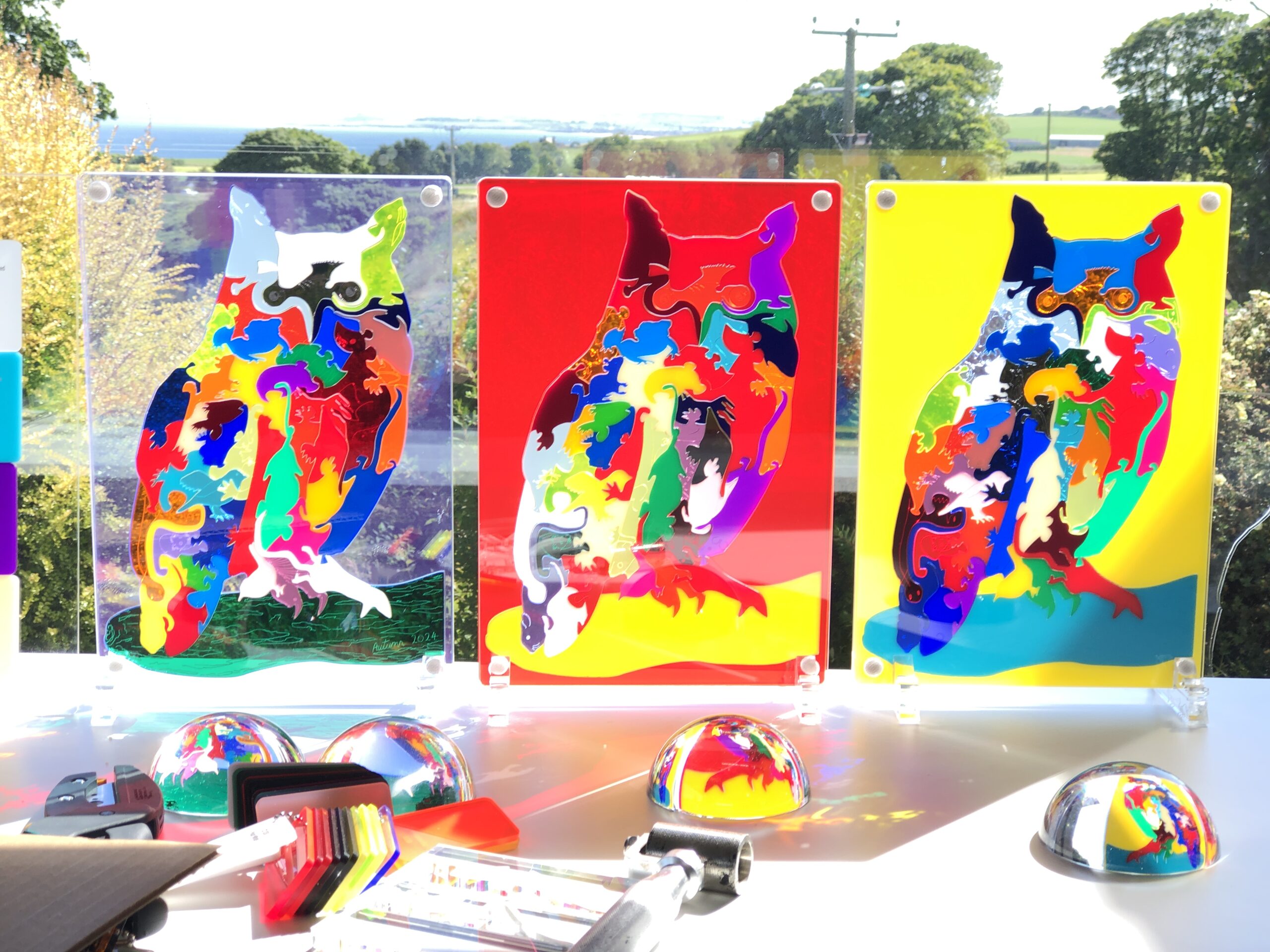
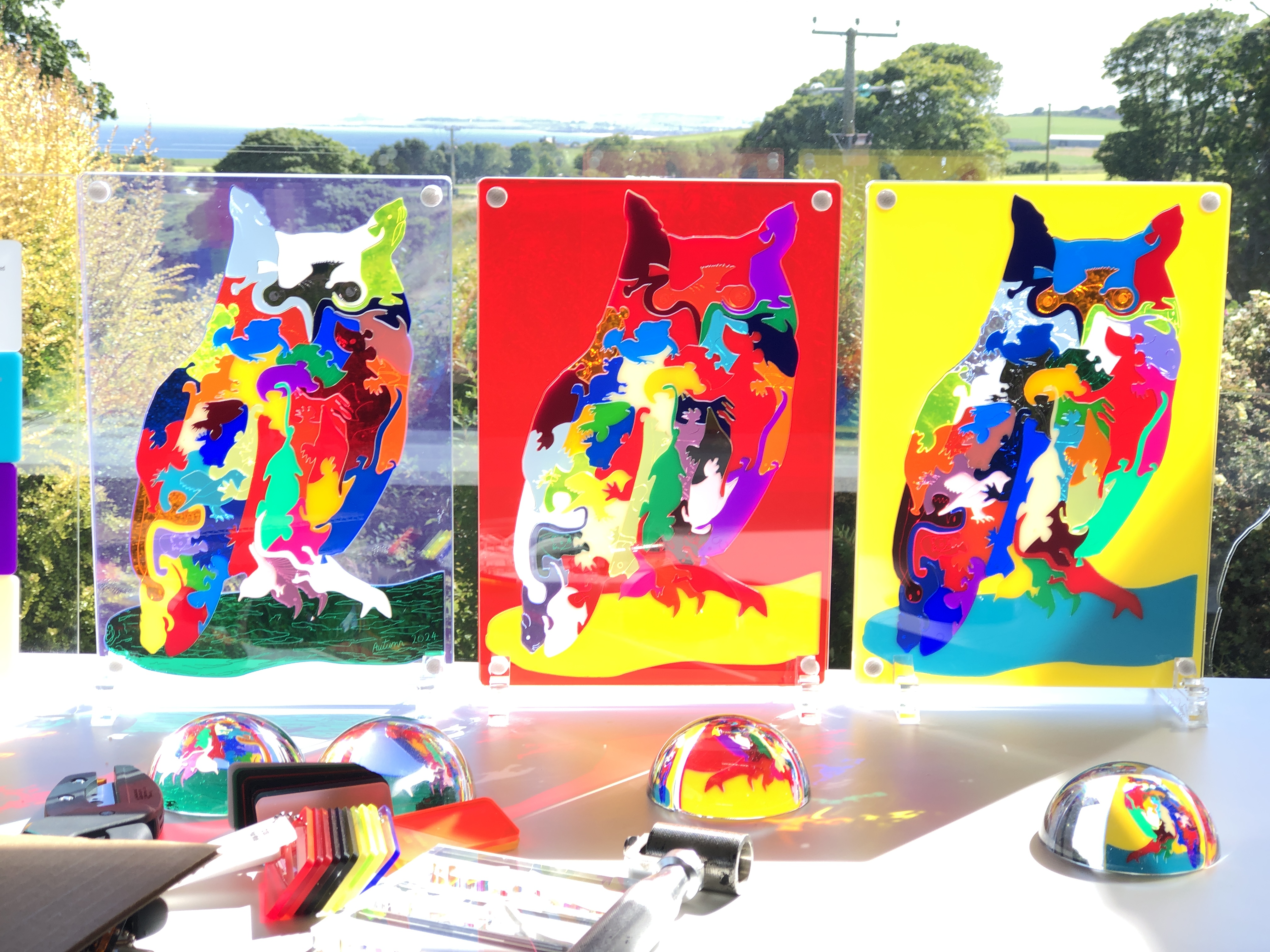
Here are a few of the many varieties I have made :-