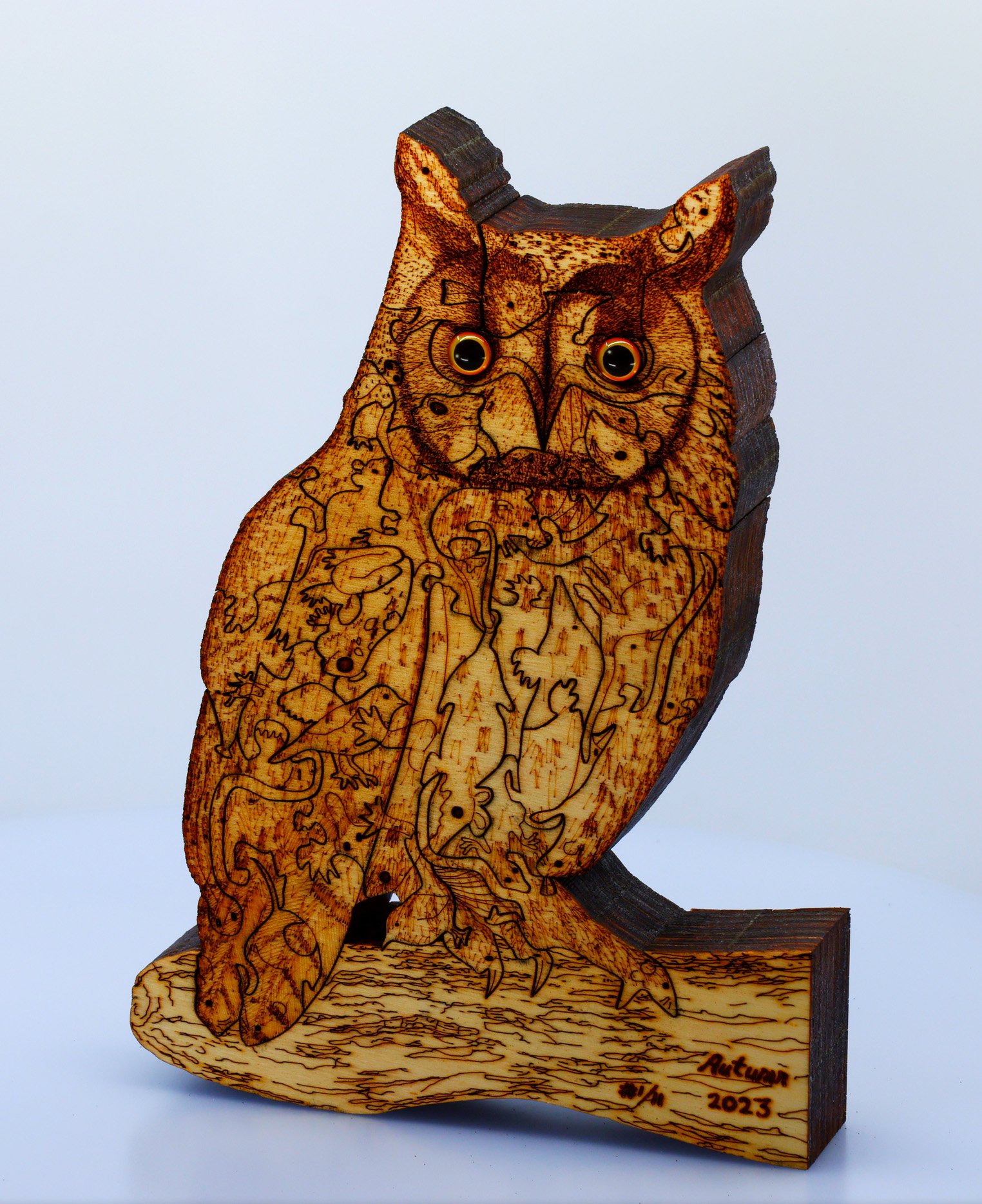
Title: “Long-eared Owl (Art Puzzle) (You Are What You Eat)” – laminated Artist: Michael Autumn Life-sized part-handmade, part laser-cut & engraved, two-sided, laminated plywood art puzzle (Limited Edition of 11)
Long-eared Owl (Art Puzzle) – Laminated: Full image – front
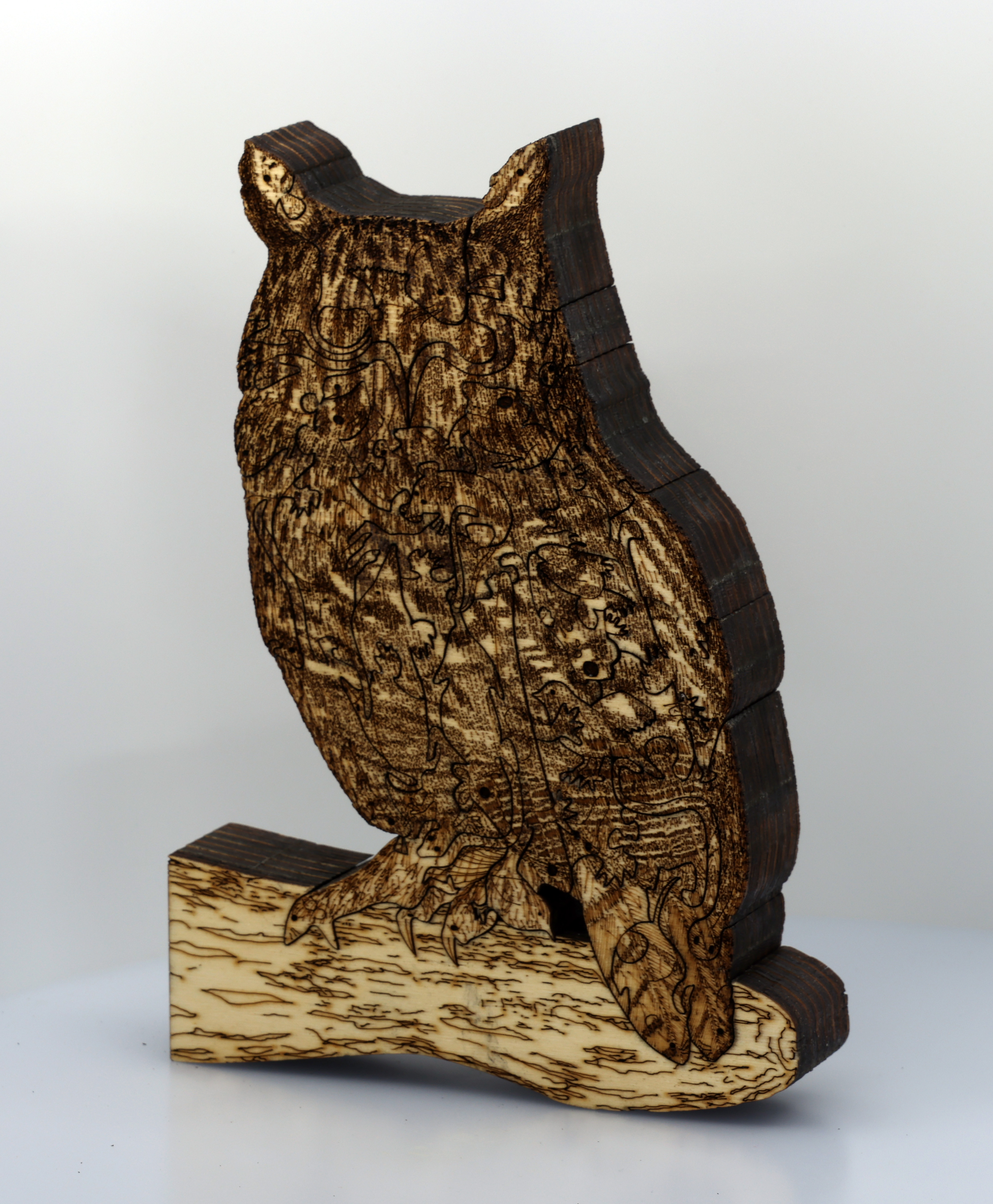
Size: 20cm (W) x 30cm (H) x 4cm (depth) @ 0.65kg weight Medium: 7 laminated layers of 6mm AB/AB Italian Panguaneta Poplar plywood + acrylic eyes. Date: 2023Rear of the laminated version
This is the culmination of three years of trying to find an engineering solution to making the incredibly intricate thick oak art puzzles I used to very laboriously (and painstakingly!) cut by hand using an electronic scroll (fret) saw. I tried waterjet cutting (that blasts away intricate areas and requires continuous cuts – totally wrong!). I bought and tried CNC routing (for about six months) with the smallest router bits available – but the bits that had the required diameter (1/32″) kept breaking and couldn’t reliably cut the depth required. And it require cutting at such small depths at each pass that even if the router bits didn’t keep breaking (and the whole job having to be restarted!) then it would have taken literally weeks to complete a single design!
The problem with conventional laser cutting (which I spent the best part of a year trying – with three different bought lasers) is that the deeper the material is, the more power is required – and therefore the wider the laser beam is. This results in an unacceptably wide kerf – gap between cuts. The kerf (gap) I managed by scroll-sawing – was about 0.7mm – which is the minimum I can accept. A laser that can cut through 42mm of plywood would ordinarily have a kerf of well over 1mm. So that is out of the question.
I pondered this dilemma for months, and tried various ideas – none of which worked. Eventually I can up with the idea of not trying to cut such thick material all at once – but to cut it much more finely in several thin layers – and then bond them together. This has (had) a number of issues and challenges in and of itself, however, I’m extremely please and relieved that I worked out solutions to the problems. And when I first produced the first fully acceptable complete version I was on cloud nine for several days…!
Suffice to say that the part hand-, part laser-, cut laminated version of my Long-eared Owl (Art Puzzle), is far more accurate, better fitting, and more reproducible – without causing RSI/hand arthritis! Having said all that, it takes about the same amount of time in total as hand-cutting(!) – about a week for each edition – because of all the part-laser cutting of multiple layers, doing the rear design – and quite a lot hand-finishing. But at least if is much less of a strain on my hands – and infinitely less daunting…!
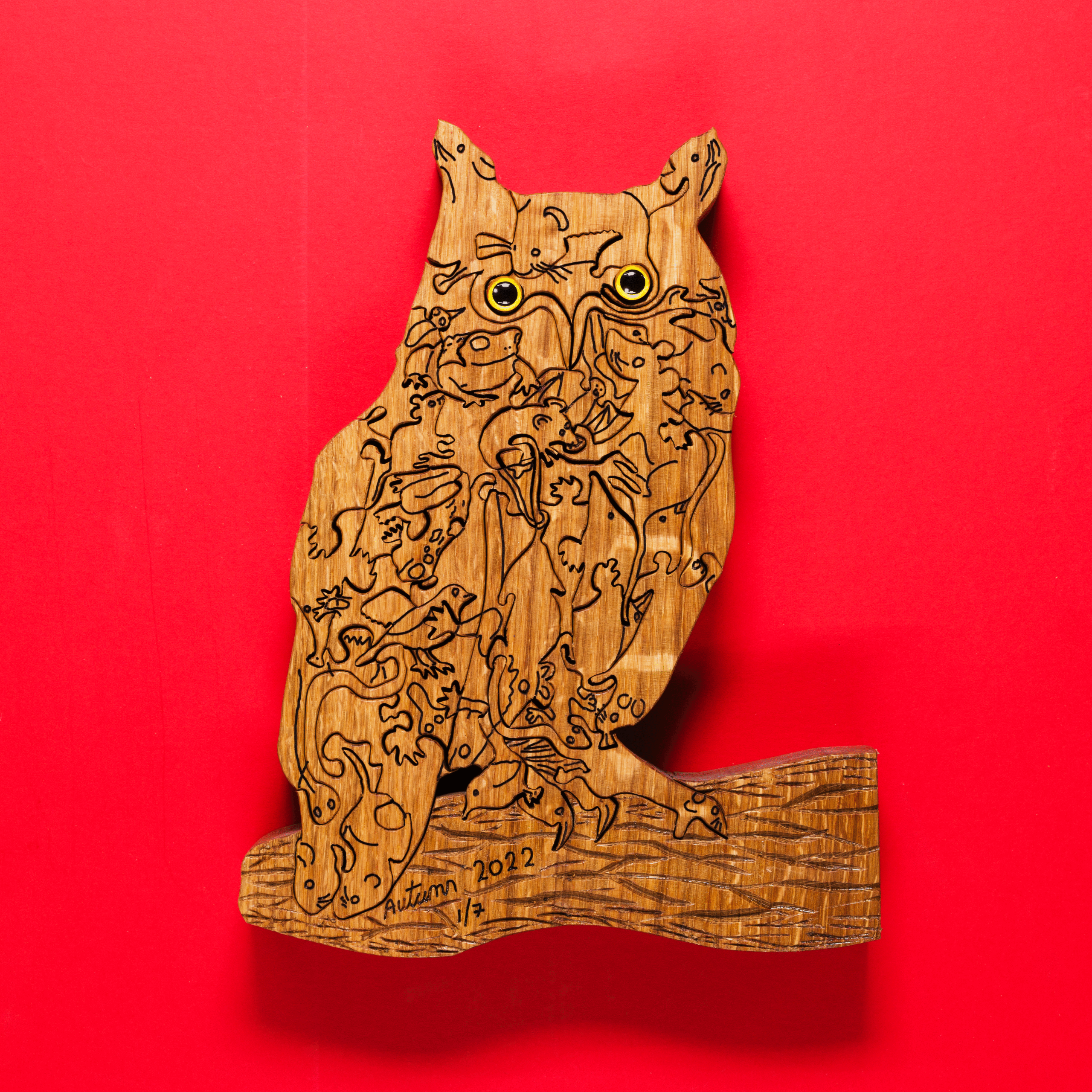
Title: “Long-eared Owl (Art Puzzle) (You Are What You Eat)” Artist: Michael Autumn Life-sized handmade solid oak jigsaw puzzle (Limited Edition of 7)
Long-eared Owl (Art Puzzle): Full image Size: 20cm (W) x 30cm (H) x 4cm (depth) @ 1.5kg weight Medium: Solid European Oak, hand-cut, hand-engraved, hand-carved, art puzzle + acrylic eyes. Date: 2022
Long-eared Owl
The story behind this art piece was to have a free-standing, tactile, life-sized long-eared owl, and to toy with the idea – “You are what you eat“. These birds are ferocious predators (as are all owls) – and will basically eat anything that moves that is smaller than them. They often swallow their prey whole, and regurgitate a large pellet of the undigestible parts – such as bones, teeth, hair, feathers. Indeed, examining their pellets is how ornithologists know so much about what they eat.
I often think about predator-prey relationships – perhaps being a veggie has something to do with this… All animals have to get their energy and material they are made of by consuming specific things – protiens, carbohydrates, and fats. Herbivores obviously get this material directly and indirectly from plants – which is often widely available (they don’t usually eat fats directly, but make them from carbohydrates). However, they usually have to eat a lot of plant material in relation to their size because it is a low concentrated source of food – requiring long, slow, complex digestion. Predators usually don’t eat plants – instead they prefer much more concentrated and complex food in the form of other animals.
I have designed the owl to show that it is literally made of many of the wide variety of creatures that it eats. From the moment of conception – where it starts as a single egg – it literally takes parts of smaller animals – and its amazing body chemistry converts them into material to make (and maintain) it’s growing body – and energy. I used the simple jigsaw-puzzle you-are-what-you-eat metaphor to illustrate this puzzling (pun intended!) transformation of lots of small animals making up an owl.
Owls typically eat 2-4 mice-sized animals per day – so about a thousand a year. Without owls, goodness know how many mice, moles, voles, rats, small birds, newts, etc. there would be…!
(I have to confess this was originally intended to be a tawny owl! I haven’t been lucky enough to actually see a wild long-eared owl, and as I got a long way into designing this piece I felt it would look better with ears – and, of course, a tawny owl doesn’t have visible “ears“… So I thought, okay, I’ll change it to a long-eared owl – they have great “ears” (well they look like ears, but they’re actually not – they’re just tufts of feathers!). The two species are quite similar in many respects – so the change was easy!)
The phrase limited edition in this case is a bit of a misnomer. These are all individually handmade by me from my original design. I really wish there was, but there is no mechanical or chemical process I know of by which these can be reproduced – like screen printing, lithographs, card puzzles (using a die and jigsaw press), etc. (for more details please see the aforementioned post).
Life-sized handmade solid oak art puzzle (Limited Edition of 7)
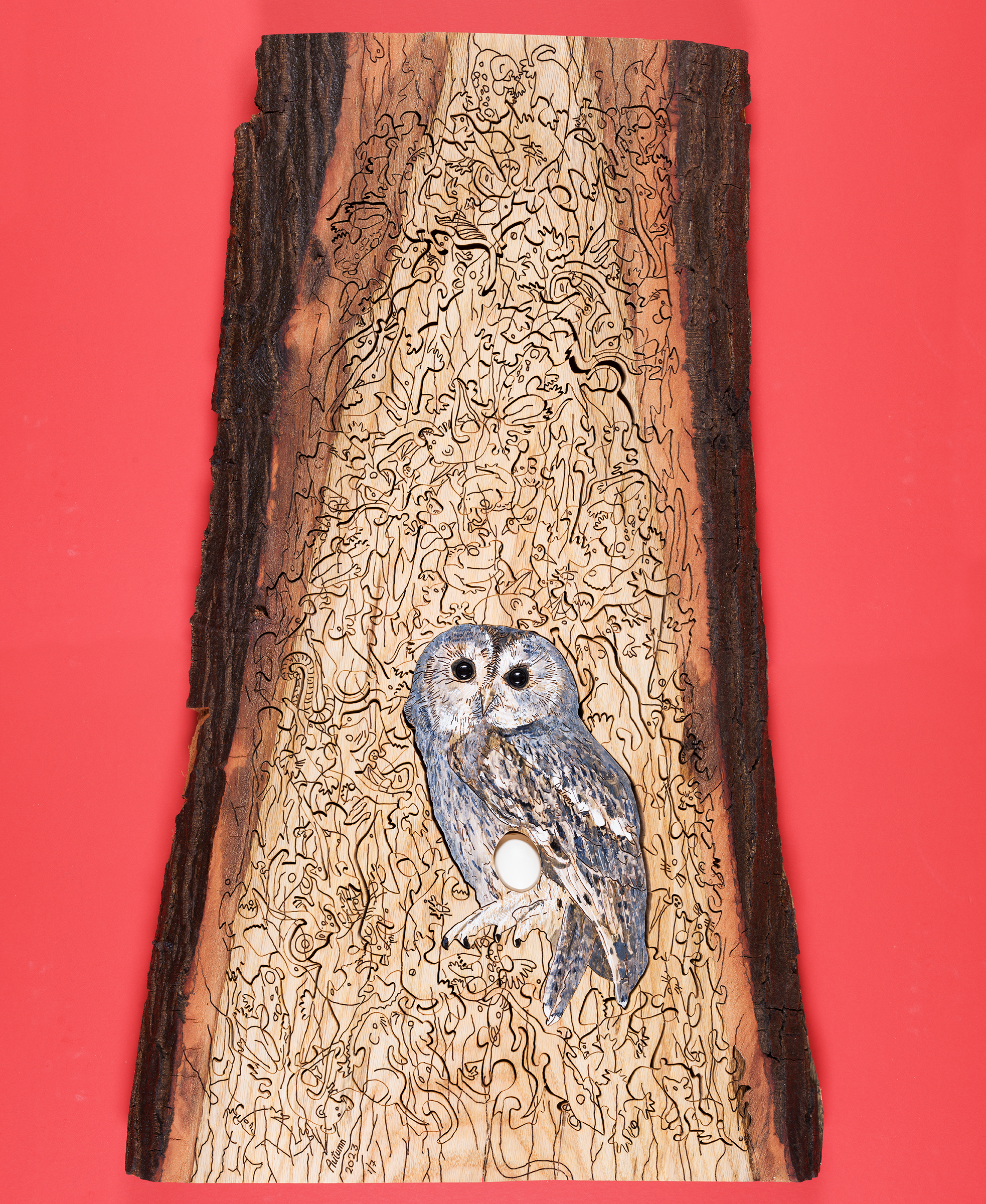
Tawny Owl with Egg (Art Puzzle): Full image Size: 50cm (W) x 82cm (H) x 8cm (depth) @ 20kg weight Medium: A single piece of waney-edged European Oak, hand-cut, hand-engraved, art puzzle with inset full-size replica tawny owl egg and acrylic eyes. Date: 2023
First and foremost I want to mention that the eggs used in my work are not real – for obvious ethical reasons (it is also illegal to take wild birds eggs). They are life-size replicas made of a plaster resin composite and hand-painted – not by me, but by a very reputable leading replica birds eggs maker.
Tawny Owl
Following on from Guillemot with Egg (Jigsaw Puzzle) (see https://michaelautumn.wordpress.com/2020/03/01/guillemot-with-egg-art-puzzle/), I thought I would pay homage to another favourite bird of mine – the Tawny Owl (Strix aluco). These, like all owls, are very mysterious – especially the noctornal ones (which tawnies are) – because they do things the opposite to us: they sleep/rest during the daylight, and come out – and hunt – at night. They are supremely designed and adapted to this lifestyle: they have excellent hearing and eyesight, they fly almost silently, and their hunting strategy is to hunt in the darkness – when other small nocturnal animals think it’s safe to come out…!
Mice, voles, shrews, moles – in fact any small rodent up to the size of a rat – are largely nocternal to avoid daylight predators – like kestrels, buzzards, merlin, sparrowhawks. But while rummaging for food and going about their normal lives – in what they think is the relative safety of darkness – a tawny owl – alerted to their presence by their quiet, but inevitable, sounds – can swoop undetected near to the unwitting little creatures. From close by the tawny can watch their prey’s every move – until they decide to pounce, crush and puncture them with their razor-sharp tallons – and then invariably swallow them whole…
Little birds could be roosting or sleeping in trees or bushes, but if they make any sounds in their sleep – even just quietly snooring or sleep-calling/singing – they are easy game for these owls… Frogs, toads, newts – in fact any small reptile – making any kind of sound at night – are likely to court the deadly attention of a tawny owl. Even fish splashing about at the water’s surface, or in the shallows, are fair game for these owls…
Suffice to say that if it is small and it makes a noise, it is on the menu…! So I thought I would play with this idea and illustrate as many of the small creatures tawny owls eat – as jumbled up jigsaw pieces surrounding the main protagonist. The whole design slightly resembles a huge regurgitated pellet of the tawny owl, and the small prey animals are all jumbled up – like fragments in a pellet.
I like art in the form of a jigsaw puzzle because it is interactive, and by careful design of the shapes and carving on the pieces, I can get the puzzle-solver to look at, and think very carefully about, them – in a way that is simply not possible with non-interactive art. Indeed, someone could look at a piece of art like this and not even notice the small creatures surrounding the main owl – let alone have any understanding why they are there – and why these particular animals. However, trying to solve a puzzle like this is a very different matter – they will definitely think more about what it is they are looking at…!
I have deliberately made the jigsaw puzzle very subtle because Nature is very subtle. These creatures are very difficult to see because of their camouflage and because they mainly come out at night – and it is precisely because they are so difficult to see that the owls rely on the noise they make to home in on them… The puzzle metaphor lets me toy with the idea that these small creatures think they are invisible – or out of harm’s way – but to a tawny owl, in the dead calm of night, their sounds makes them highly visible…
Owls typically eat 2-4 mice-sized animals per day – so about a thousand a year. Without owls, goodness know how many mice, moles, voles, rats, small birds, newts, etc. there would be…! If all the creatures a tawny own ate over the course of its lifetime were put into a 30cm diameter (about the width of this jigsaw puzzle) very tall clear tube – I wonder how high the pile of eaten animals would be…
Close-up of the life-sized tawny owl with replica eggSome of the art puzzle pieces laid out
The phrase limited edition in this case is a bit of a misnomer. These are all individually handmade by me from my original design. I really wish there was, but there is no mechanical or chemical process I know of by which these can be reproduced – like screen printing, lithographs, card puzzles (using a die and jigsaw press), etc. (for more details please see the aforementioned post).
Life-sized handmade solid oak art puzzle (Limited Edition of 7)
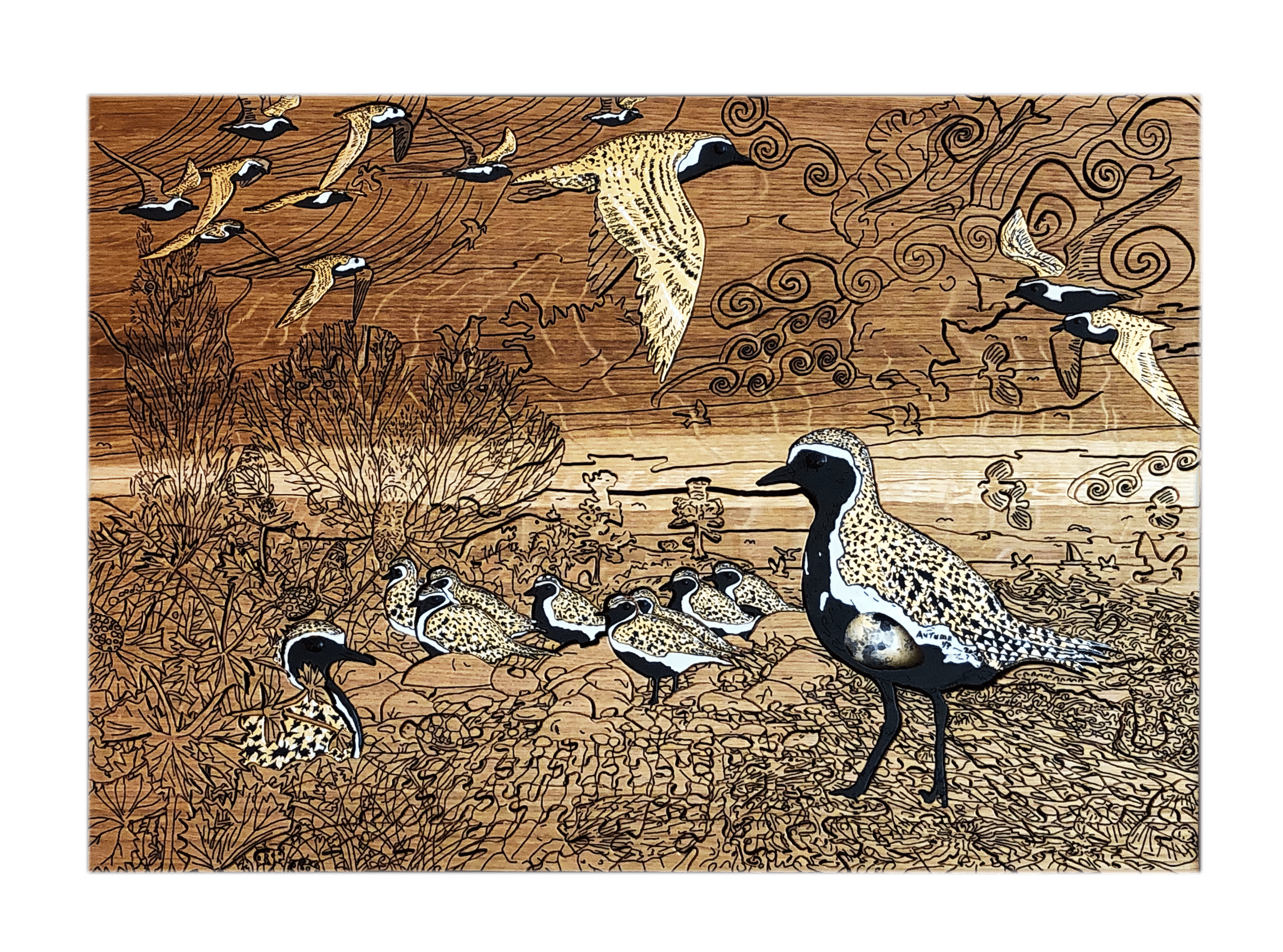
Golden Plover with Egg (Art Puzzle): Full image Size: 59cm (W) x 41.5cm (H) x 4.4cm (depth) @ 9kg weight Medium: Solid European Oak, hand-cut, hand-engraved, jigsaw puzzle with inset full-size replica golden plover egg. Date: 2020Golden Plover in artist’s dining room (click on image to see artists’ home studio, workshop, and gallery).
First and foremost I want to mention that the eggs used in my work are not real – for obvious ethical reasons (it is also illegal to take wild birds eggs). They are life-size replicas made of a plaster resin composite and hand-painted – not by me, but by a very reputable leading replica birds eggs maker.
Golden Plover
Following on from Guillemot with Egg (Jigsaw Puzzle) (see https://michaelautumn.wordpress.com/2020/03/01/guillemot-with-egg-art-puzzle/), I thought I would pay homage to another favourite bird of mine – the Golden Plover (Pluvialis apricaria). In winter plumage these birds are lovely, but unremarkable. However, in summer plumage they are absolutely stunning. The males are slightly more outstanding than the females, however, both are very distinctive and eye-catching. The spring transformation of the Golden Plover from winter to summer plumage is one of the most extreme, and beautiful, I know of. The word “dandy” comes to mind. They become the most striking of all the waders I know of.
Golden Plover in summer plumage
In summer their coal black bellies and faces, fringed with a slim cotton white mantle or fringe, and their “golden” upper parts – are a bold, brilliant sight to behold. But golden they are not! They are “buff”, ochre, or sandy brown – like most wading birds – who feed predominantly on mudflats and shorelines – and thus gain good overhead camouflage – so as not to draw attention to predators such as peregrine falcons, marsh harriers, etc.
To highlight this golden misnomer I thought it would be fun to actually make them golden – 24 carat gold gilt to be precise! Gold is an incredibly beautiful and mysterious metal – mysterious both in terms of its physical properties and appearance, and its hold over us. Gold, with its density of 19.3 (over 19 times that of water), is the absolute nemesis of flight! Gold, with it strikingly bright, mirroring, shimmering sheen – is the nemesis of camouflage!
24 carat gold gilded Golden Plover
I hope the metallic gold of the Golden Plover in the above pictures is clear. Being metallic the light reflects differently according to the angle being viewed and the available light.
Migration
In summer Golden Plover breed in the tundra – countries such as Iceland, Greenland, Scandinavia, and northern Russia – where the days are very long indeed – and over-winter in warmer climes – and where there isn’t perpetual winter darkness – such as here in the UK (some go as far south as northern Africa). The migration to and from Iceland is no mean feat for such a small bird. The main bird in the picture is life-sized: they are approximately 20cm tall, and 28cm long. Many bird migrations follow land masses with hops over the shortest water expanses. For example many of our summer visitors, like the warblers, coocoos, hobbys, etc. come from Africa – where the largest stretch of water they have to fly continuously across is the English Channel – a mere 20-odd miles – less than a hour’s flight (the Straights of Gibraltar – the sea hop from Morocco to southern Spain is less than ten miles).
In contrast, the non-stop shortest bird flight distance from Iceland to the UK is 850 miles. Golden Plover can fly at speeds up to 60 mph, but for long distances they are more likely to cruise at speeds more like 40 mph. So the non-stop flight from Iceland to the UK would take them a minimum of 21 hours. To salute this feat I have added an Icelandic reference in the picture – see if you can find it…
The phrase limited edition in this case is a bit of a misnomer. These are all individually handmade by me from my original design. I really wish there was, but there is no mechanical or chemical process I know of by which these can be reproduced – like screen printing, lithographs, card puzzles (using a die and jigsaw press), etc. (for more details please see the aforementioned post).
Life-sized handmade solid oak jigsaw puzzle (Limited Edition of 6)
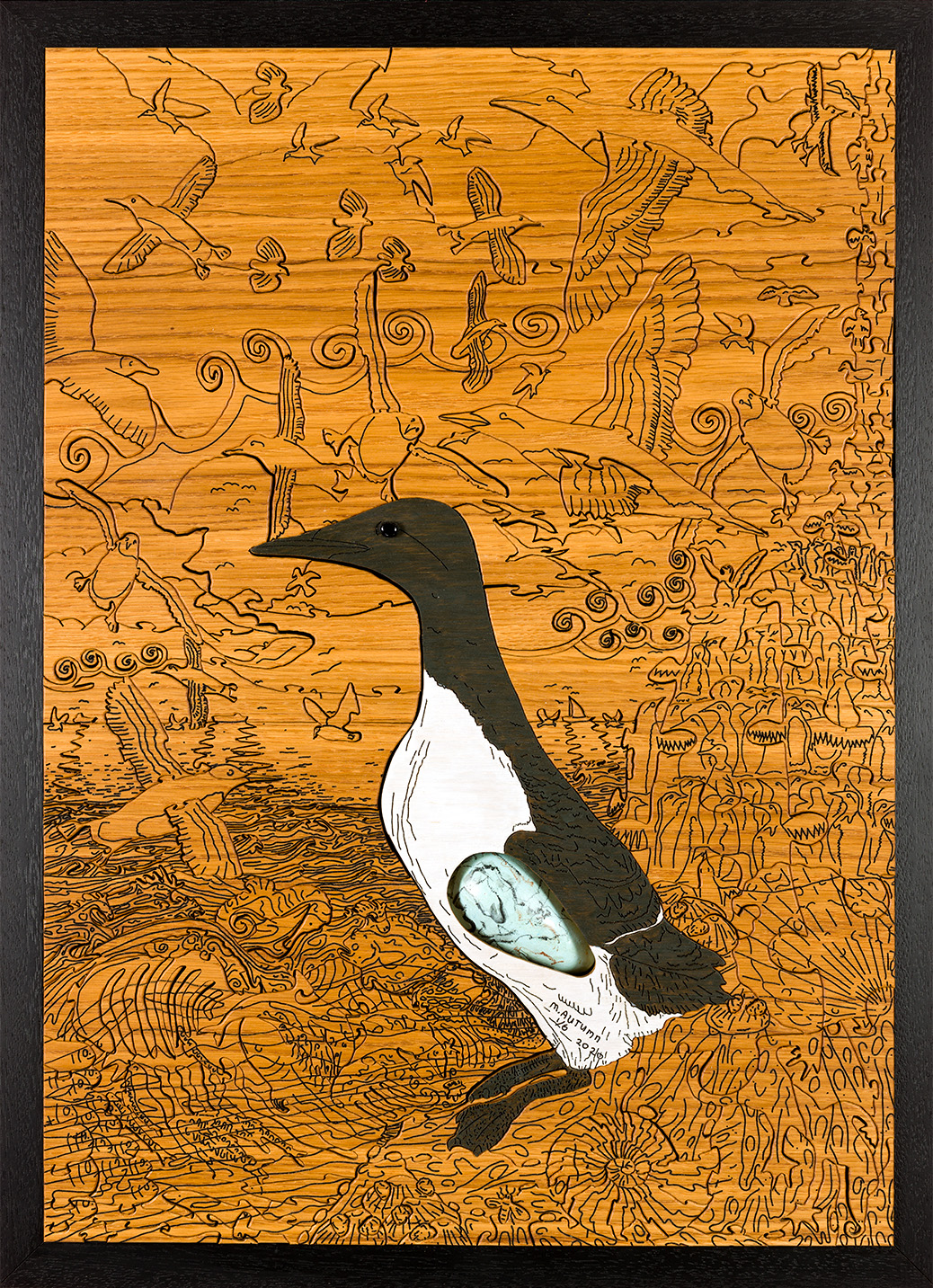
Guillemot with Egg (Art Puzzle): Full image Size: 59cm (H) x 42cm (W) x 4.4cm (depth) @ 8kg weight Medium: Solid European Oak, hand-cut, hand-engraved, art puzzle with inset full-size replica guillemot egg. Date: 2020 Guillemot with Egg in artist’s dining room (click on image to see artists’ home studio, workshop, and gallery).
First and foremost I want to mention that the eggs used in my work are not real – for obvious ethical reasons (it is also illegal to take wild birds eggs). They are life-size replicas made of a plaster resin composite and hand-painted – not by me, but by a very reputable leading replica birds eggs maker.
“Limited Edition” of 6
The phrase limited edition in this case is a bit of a misnomer. These are all individually handmade by me from my original design. I really wish there was, but unfortunately there is no mechanical or chemical process by which these can be reproduced – like screen printing, lithographs, card puzzles (using a die and jigsaw puzzle press), etc.
I never intended to make this jigsaw puzzle myself! I researched for weeks into using CNC (Computer Number Controlled) engineering techniques, laser, and waterjet cutting. For my puzzle design I wanted 1 ½” – 2” (40 – 50mm) thick oak wood, and I wanted the thickness of the wood cut to be less than 1mm – ideally about ½mm. I realised that CNC would not work because the drill bits would be too weak to cut that deep – something less than 1mm to cut through very hard oak nearly 2” deep using side pressure alone – no way.
I don’t like the idea of laser cutting because it burns and leaves the edges of the cuts black – something very unappealing – and very un-puzzle like! Indeed there is a very real risk that a wooden puzzle this thick could catch fire if cut by laser!
For a long time I thought I had found the solution in waterjet cutting. From fairly extensive research I believed it could have a cutting width of about ½mm. So I went ahead and designed the most intricate puzzle drawing – down to about 1mm curves and circles! I thought I could use shallow cut lines to show extra detail – like a drawing or carving on top of a puzzle – and full cut-through lines obviously for the jigsaw puzzle pieces. I, extremely naively, thought all I had to do was to supply the design to a waterjet cutting company and they would do the rest! And I could have hundreds produced. If only…!
What I don’t want is to have just one of these. I want one for myself and I need to make a living… I have invested a considerable amount of time and effort into this and would like to be able to continue to create work of this standard or better.
At the moment I am not famous enough to make and sell just one of these and earn enough money to make it worth my while – so I have to make a few. Six feels like a reasonable compromise – and not so many that I become a sweatshop jigsaw maker…!
Birds
My love of birds dates back to my mid-teens – after a new boy arrived at school whom I befriended and who happened to be a “twitcher” (a fanatical bird ticker-off-er!). I went with him on many trips and continued my interest after we went our separate ways (we went to different universities to study different subjects). As time has gone by, I have become more and more enthralled by bird’s beauty, abilities, resilience, and tenacity. I have photographed birds, filmed them (I built a special camera incorporating a telescope specifically for this purpose and I built a bird hide in my garden!), recorded their sounds with and without film (see my YouTube video channel – https://www.youtube.com/channel/UCcNBRvK_RcVoj6WFm2z8GRg), and have painted some.
As an artist I realise I can’t compete with photography (including film) in terms of capturing the beauty and detail of birds, and I don’t want to even try to compete with the likes of Audubon and other great bird artist and illustrators (Peter Hayman for example). However, I have been hoping to do something different and personal with them – something that I hope will show off some of their majesty, beauty, surroundings, habitat – and hopefully to do them justice.
Chunky Wood JigsawPuzzles
My interest in chunky wooden puzzles (well over an inch thick and that can stand up on their own) arose from a simple tree puzzle I stumbled on in a Swiss airport souvenir shop about twenty years ago. (When I travel I like to buy at least one nice item of art from the country.) I loved it’s smoothness, heaviness, tactileness, simplicity, beauty, and it’s differentness. It was expensive (about an average person’s day’s pay (£200 in today’s money)), but I just had to have it. I still have it to this day. I also just love solving puzzles of any kind. I liked the way the tree puzzle had unexpected shapes – that, when taken out of context, you had no way of knowing what part of the tree they occupied! About two years ago (2018) I had the idea of trying to design and make my own wooden puzzles and started to look into how to make them and to see what others had done…
M.C. Escher Influence
About two years ago I had the idea of trying to design and make my own puzzles. This coincided with my renewed interest in M.C. Escher’s work. As an artist, I don’t want to copy anyone and wondered if I could blend my interest in chunky wooden puzzles with Nature – and include ideas that fascinate me – like camouflage – particularly shape and textural camouflage – and the geometry of the line… I share this interest of the line with Escher, and he has most definitely inspired me.
Lines
For most practical purposes the visual world consists entirely of coloured dots (or pixels). Lines are a fundamental visual unit. They are a two-sided shape. (We can’t see a one-sized shape because it would have no length or depth – and so it is invisible.) Even a dot is a line – albeit a very short one! A triangle is obviously three lines, and all 2 & 3D shapes can be made from triangles. A square is four lines (or two triangles), and a circle is a line that changes direction in a precise and regular way. A circle is also an infinite number of very narrow triangles (I deduced a formula for pi from this simple idea as a mathematical thought experiment/exercise many year ago). 2D becomes 3D by simply adding the height dimension in the form of lines or triangles sticking out from a flat shape. But the central raw material for any shape is always the line.
What have lines got to do with puzzles? Well they are the cuts in the wood and any additional detail in the form of those that appear in the picture the puzzle is printed on, or any carved lines on the puzzle. My main interest is to only use lines – cut or carved – in my puzzles – as opposed to conventional puzzles where an image stuck to wood or board is cut with a puzzle cutter (known as a puzzle dye).
Boundaries
Real things have boundaries. In a sense that is what makes them a thing. An apple is a plump, sphere-like collection of organised cells with an outer red, green, or red and greed outer skin. We can see the apple because we have learned that a tennis-ball sized smooth green, red, or green and red thing is very likely to be an apple. It’s not just its’ colour that is key to our identifying it, it is it’s shape or boundary as well. We would not think that a sheet of apple-coloured paper or item of clothing was an apple – we might say it is apple-coloured – but that is not sufficient to categorised it as an apple. Likewise, we would not think that an outline of an apple was an apple if it didn’t look three-dimensional and wasn’t apple coloured.
Lines and Perception
Lines are the primary means by which we detect or perceive things. In Nature or reality there are very few actual lines – as in a thin strip of different colour or shade compared to the background – i.e. a simple pencil line. From a distance a tree without leaves can look like a series of lines. And the horizon between sea and sky can look like a line. A line can simply be a colour change boundary. A green leaf against a blue sky (or any other colour sky) can be thought to have a line around the edges of the leaf. But green leaves against other green leaves still have a boundary – or lines – because there is a perceptible difference between them. In fact it is fair to say that if there isn’t a perceptible difference between two edges then there is no line. If we were to put a cut-out of a green leaf onto an exact same green piece of paper it would appear to disappear.
Animal senses seem pre-disposed to detecting changes or boundaries. Visually that means detecting colour boundaries and movement (movement is just changes in colour boundaries over time). This is what vital to animals’ survival. The things that matter to them have to be detected and acted on. Changes in the animals’ visual environment can mean a threat – like a predator or dangerous boundary – like a cliff or fire – or simply something to avoid – like not to walk or run into. Other changes in the animal’s environment can be positively sough after – like food, a mate, somewhere to safe shelter and sleep.
Eyes have evolved to convert a vast stream of a narrow spectrum of electromagnetic radiation into a stream of real-time pixelated colour data to the brain from coloured rays of light. Light from the animal’s environment enters through the cornea (lens) and excites the rods and cones in the retina – which in turn transmit electro-chemical signals about the light rays to the visual cortex and beyond into other parts of the brain. But it is the mind that makes sense (pun intended) of all this data. The mind seems predisposed to “see” patterns and forms – especially from boundaries – because these are highly suggestive of something different and potentially important and/or useful.
Visual perception is an amazing feat of form recognition from lines and colours (texture as well – but this is a form of line and/or colour). This incredible capability can sometimes be mistaken but my interest is to highlight this by having some fun with it. We “see” elephants in the sky, horses in the sea, etc. – but of course no such things exist!
The brain is always looking for patterns to match up with its growing database to quickly identify things in the environment.
A line (or boundary) can be represented as something drawn – what I call a positive line (because something has been deliberately added) – or is can be a cut or carved – what I call a negative line. A line is anything that shows a boundary (including simply a colour change).
I decided to have some fun with this puzzle. With just cuts and carved lines I wanted to capture a busy seabird colony with a life-sized guillemot (Uria aalge) as the central focus. I mixed carving and cuts because if everything was a cut the pieces would be too small and would be nearly impossible to make them to join together – as real puzzle pieces – i.e. with interlocking lugs.
Art (Jigsaw) Puzzle
What is a jigsaw puzzle? Classical wooden/cardboard jigsaw puzzles are usually pictures cut up into small interlocking pieces – where the puzzle is more of a challenge or exercise, and the picture is the end goal. So in a sense the puzzle is a journey and the picture is the destination. In my case, in the case of this work, the puzzle is both the journey and the destination. The puzzle is the picture.
Classical wooden/cardboard jigsaw puzzle pieces usually have two to four structurally interlocking lugs to hold it together. The number of lugs usually depends on where the piece is: corner pieces usually interconnect with two other pieces, the side pieces usually interconnect with three other pieces; and the inside pieces usually interconnect with up to four other pieces.
This work is a jigsaw puzzle within a jigsaw puzzle.
Showing some jigsaw puzzle pieces
It is in part a camouflaged jigsaw puzzle. It starts at the right more or less as a conventional puzzle (the “cliff”) – albeit I’m using the size and angle of the pieces as a perspective device – but as the scene progresses to the left I slowly morph the puzzle shapes into natural shapes (animals, fish, waves, etc) to camouflage the lines of the puzzle pieces themselves.
I use a plethora of shapes and sizes of puzzle pieces and lug and devices – and many decoys and deflections – to make a picture-less jigsaw puzzle naturalistic and fun…! 🙂
All birds are amazing, but guillemots (Uria aalge) are among the most amazing. The Guillemot chick’s first and only time of leaving the “nest” – a few square inches of bare rock(!) where it’s parents incubated it on their feet – could be as much as a 300m plunge off the ragged cliff edge – into the sea (hopefully!). The chick can “fly” on this maiden voyage, but obviously they are not proficient, and it is more of a clumsy glide. Often it is not a straight flight/glide into the sea. If the chick crashes into rocks before it reaches the sea – and if it survives that – it has to navigate over what is often very hostile terrain – and it may encounter predators en route to the sea – where it’s parents will be calling from. A small chick can be quite feisty and hold it’s own against common predators like artic fox (but many do fall prey).
East coast of the UK Guillemot chicks, if and when they reach the sea on their maiden flight, swim with their parents all the way to Norway – a considerable task in and of itself.
Other fascinating facts about guillemots. They are one of the few animals that can inhabit land, air, sea surface, and underwater (a bit of a misnomer?!). They can swim underwater practically as well as they can fly in the air – and that means they can swim as well as most fish! Indeed they swim after fish to catch them – this is their primary source of food. It could be said that they fly underwater. They can dive up to 150m – indeed the deepest known dive by any bird is Brünnich’s guillemot (Uria lomvia) at 210m!
The Life-sized Guillemot
Detail of life-size guillemot
Why life-sized? I have a penchant for life-sized natural history art because it does the subject justice, it is honest, and most people don’t know the size of many animals because they never get close enough to them. Perhaps a better question is: why not life-sized…?
Working journey of the making of the main guillemot jigsaw piece…
The guillemot is not painted. I love oak – and wood in general – and think it sacrilegious to paint it. I only allowed myself to use a light and a dark wood stain to achieve the hopefully realistic coloured effect of the main bird. The whole work has had two coats of Danish oil to bring out the wood grain, give it a warmth, and to give it protection. It should last hundreds, if not thousands, of years…
Another challenge was to try to capture the smoothness and aerodynamism of this most perfect of birds – supremely designed for flight in the air and flight “under” water. I hope that by placing the main guillemot in the centre of the jigsaw puzzle as single smooth life-sized piece among dozens of other smaller pieces – accentuates it’s majestic shape and form…
I had a eureka moment for the eye (albeit after thinking about it for days!). A key visible feature of any animal are it’s eyes. They give so much of the essence of the personality and behaviour of the animal, they give it life and vitality. I thought long and hard how I could bring my guillemot life – and am extremely pleased with the solution I came up with.
Guillemot eye detail
The Embedded Life-size Egg
Birds eggs are extraordinarily beautiful, the shells are extremely strong (relative to the amount of material they consist of), and they are amazingly complex, but highly functional, creations that have their own lifecycle and incredible journey. For example, when the shell-less egg growing inside the parent reaches full size the hard shell is slowly secreted around it from calcium carbonate (CaCO3) crystals from the parent (who has to have enough of this in their diet otherwise the eggs will be soft and break).
Eggs have a complex structure, but obviously the main function is to protect and facilitate the growth and birth of a young bird. All the nutrients the growing foetus requires are contained within the egg, however, the egg has to be strong enough to protect the embryo through all the knocks and bumps – and being stood or sat on by the parents; it has to be porous to allow oxygen in and carbon dioxide (poisonous waste) out; and has to protect from bacterial infection. If the egg is laid, and spends time, on bear rock– as is the case with guillemots – then the shells have to be particularly strong. However, near the time of hatching an amazing metamorphosis takes place: the embryo absorbs some of the calcium of the eggshell to form an egg tooth. This is a double strategy to help the young emerge from the shell: after the shell has fulfilled it’s purpose it is weakened by the young bird absorbing some of it, and at the same time the young bird gains a sharp hard tool by which to chop itself out.
The blunt end of the egg is the weaker part of the egg (that is due to mechanical geometric properties: the shallower the curve the weaker it is). The embryo’s position in the egg seems designed to exploit this weakness when it comes to hatching. The orientation of the developing embryo is such that the legs are usually at the “pointed” end and the head is usually at the “blunt” end – so the head is in the ideal position to start the hatching in what is obviously a very tight space…
With the main interest of this work being a life-sized guillemot in it’s busy natural surroundings, and working with thick oak, it occurred to me from the outset of this long project that I could incorporate a life-size egg into the design somewhere. I bought some eggs to test the idea and after several trials I worked out how I could do it.
Eggs are generally developed in the parent “pointed” side down and are rotated prior to laying so they emerge “blunt” side first. It seems unclear why this is so, but I wanted to highlight this phenomenon in the work.
I wanted to create a mystery of how the egg got into the body of the guillemot – and how it comes out – hence I made the egg opening (front and back) smaller than the egg itself – with no way for the egg to have got in or out… The Guillemots’ eggs are relatively large in proportion to the mother’s size, and I wanted to highlight the fact that the mother has to fly and dive with this huge thing inside her abdomen. I have made a guestimate of where the egg would be in the mother (which, as mentioned above, has to be turned in situ before it is laid).
Full-size egg inside the main Guillemot puzzle piece
Epilogue
It has been an enormous relief to finish this work(!) – so much so that I needed a few days to recuperate. The intense concentration and sheer physical effort in handling this 8kg block of solid oak wood for highly accurate cutting through the most intricate and precise twists and turns – has taken it’s toll on my arms, back, eyes, and brain. (It measures 59cm x 42cm x 4.4cm thick. This work is two pieces of oak I have hopefully invisibly joined. I would have used one piece if I could have sourced such a wide piece of oak.)
Design – 6 weeks (plus many tests, trials and errors!) over a 16 months period; carving the approximately 2mm deep detail black “lines” – four days; cutting the 44mm (1 ¾”) deep oak jigsaw pieces – 4 days – both with a full face mask most of the time and with the noise of an air filter (industrial hoover) running all the time (I used ear plugs); 1 day to carve out the egg opening and incorporate the full-size egg into the body of the main central guillemot (and the stress and strain associated with that!); 1 day finishing – this included rounding off jigsaw pieces (front), sanding (back), and applying finishing oil to all the convoluted surfaces; 1 day framing.
Work in progress
This project started back in September 2018 and finished (under a great deal of time pressure (largely due to the non-arrival of a faster-cutting fret saw ordered on 3rd January)!) on 17th February 2020 – just in time for submission to the 2020 Royal Academy Summer Exhibition…