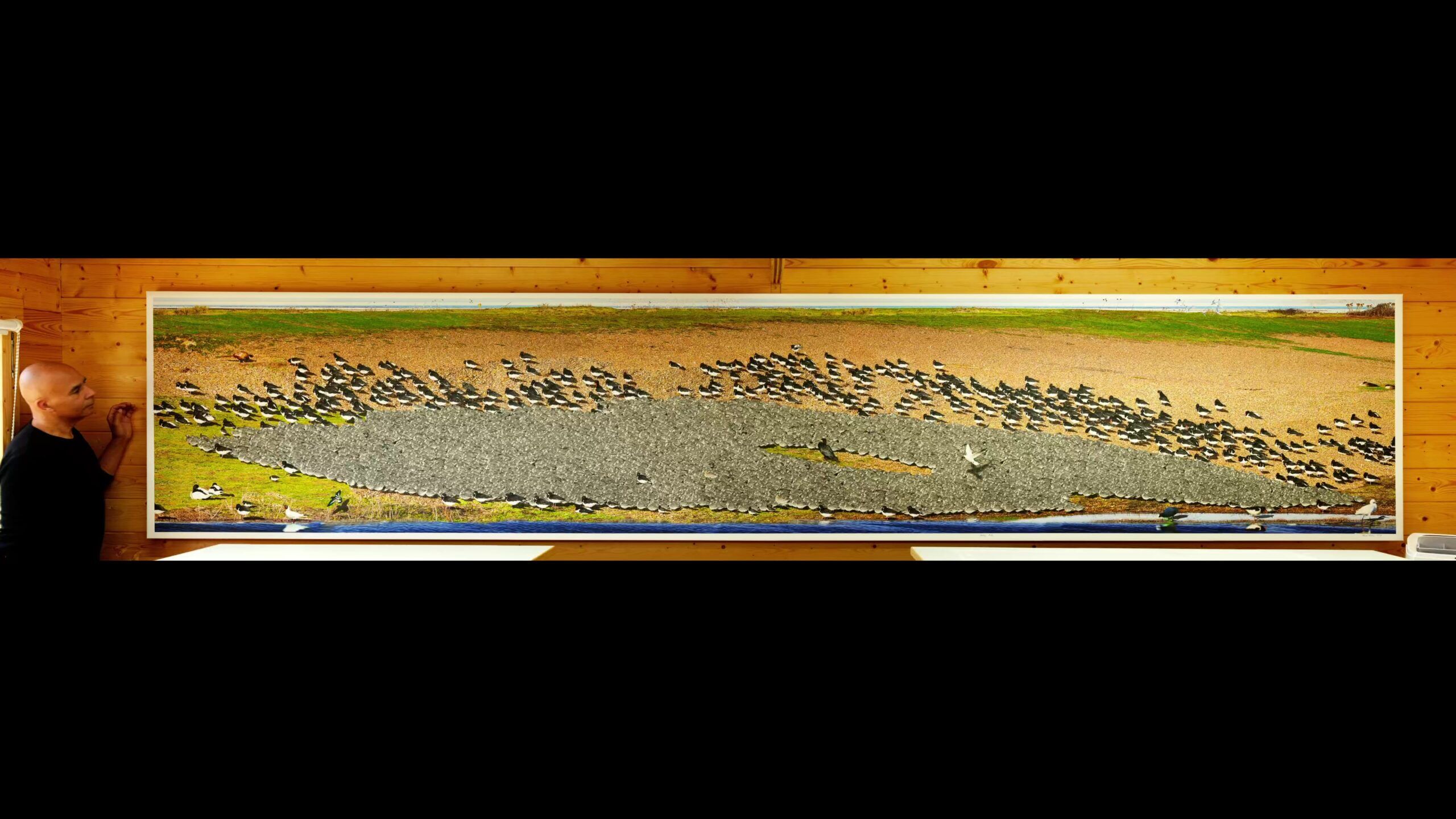

(Catalogue #100_1970-1982: 194” x 36.7” (5m x 1.1m), limited edition of 11)
TL;DR
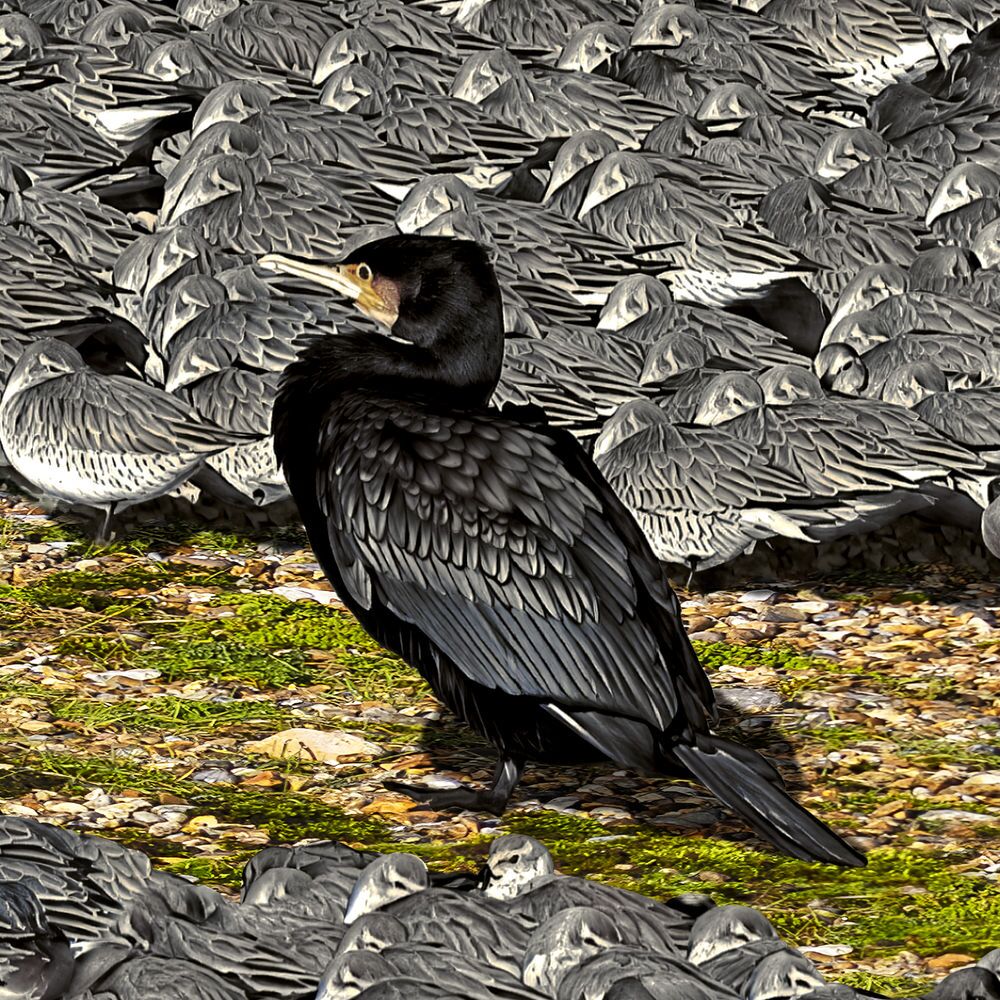
This is a painstakingly reproduced scene (with some artistic licence) of a natural phenomena at Snettisham (U.K.) (the south-eastern part of The Wash – between Norfolk and Lincolnshire) of hundreds of various species of birds roosting on a cold winter’s day – waiting for the tide to go out to resume feeding. The birds are predominantly waders – mudflat/shoreline-foraging, and migratory. What strikes me most about this mass gathering is the different behaviour of the various species – in particular how close they get to their own species and to other species… Each species must have some notion of each of the other species – and form notions about them – such as are they a threat…? One thing for sure is that they all have a concept of others and their own identity… The lone cormorant in the middle of the main flock is a predator (mainly of fish), and wouldn’t normally prey on any of these birds. However, predators usually have similar aggressive, threatening, features – forward-looking eyes, big, sharp, beaks, and are relatively large. The empty space around the cormorant – which would be more or less circular in shape from above – belies what the surrounding birds (knot) think about it…
I’m deeply intrigued, and spellbound, by Nature, and spend a lot of time watching, being mesmerised, and photographing/filming it. Every once in a while I come across something even more amazing than normal…
This scene is as authentic as I saw it, but I have had to overcome the limitations of photography. I have gone to great lengths to faithfully reproduce what I saw in all its detail. It was a very sharp, cold, blustery, early spring morning. The tide was high and these birds were roosting – unable to feed on the mudflats. They were waiting for the tide to go out.
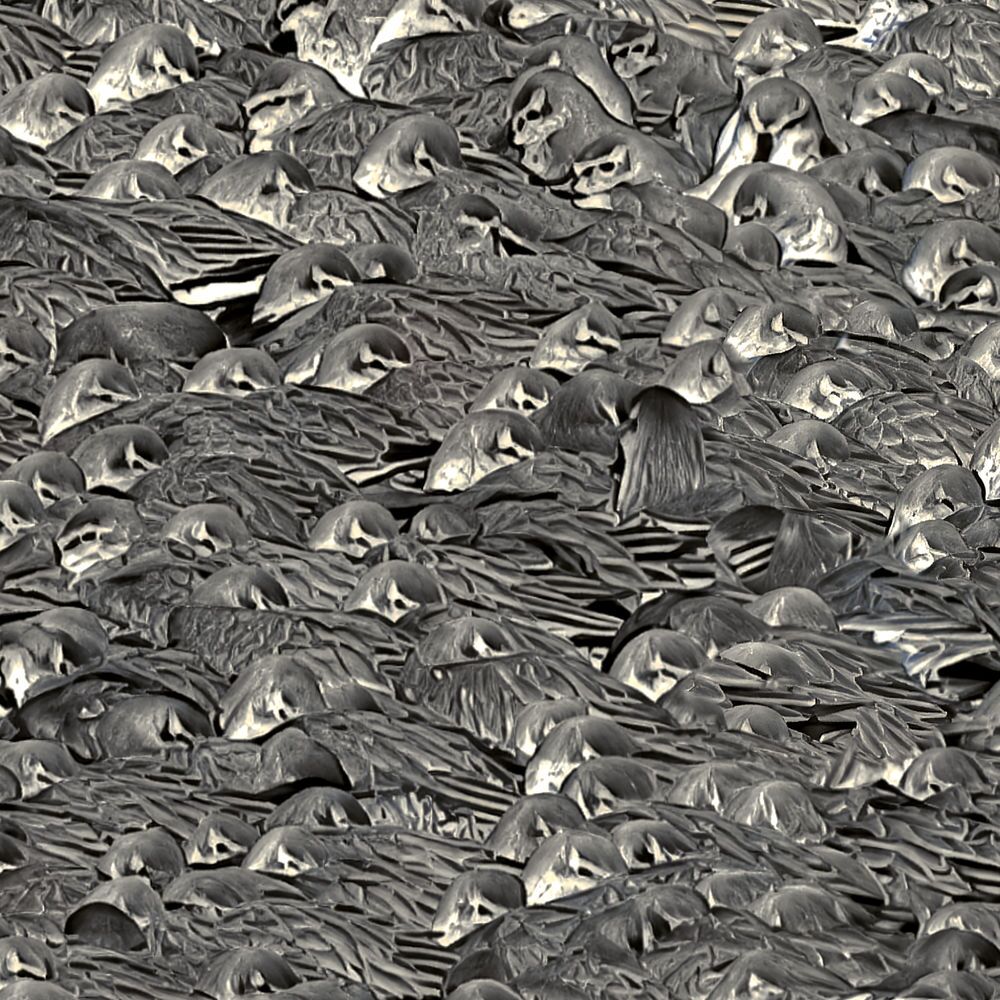
Some species like the knot (the predominant grey birds in the 8-10,000 strong central flock) huddle together to keep warm, whereas others don’t. Huddling together to keep warm is perfectly understandable, so why don’t the other species in the scene do it…? Generally in the animal kingdom, the smaller something is, the harder it is for it to keep warm – because its surface area – where warmth escapes – in proportion to size (e.g. height) increases the smaller the animal is (this is simple maths). So in theory this should lead to smaller animals huddling together…? But it’s not as simple as this because there are smaller sized species than the knot that don’t huddle – for example the turnstone (the smallest in the scene). Also, the only slightly larger black and white birds – the oystercatchers – don’t huddle together…
The few individuals of different species engulfed in the sea of knot – the few lone oystercatchers (big black and white birds with bright red beaks) and the bar-tailed godwits (the long-legged buff-coloured birds with long straight beaks) – almost certainly didn’t land in the middle of all the knot. Instead, they were probably slowly engulfed by them as the numbers of knot coming off the mudflats to roost gradually swelled.
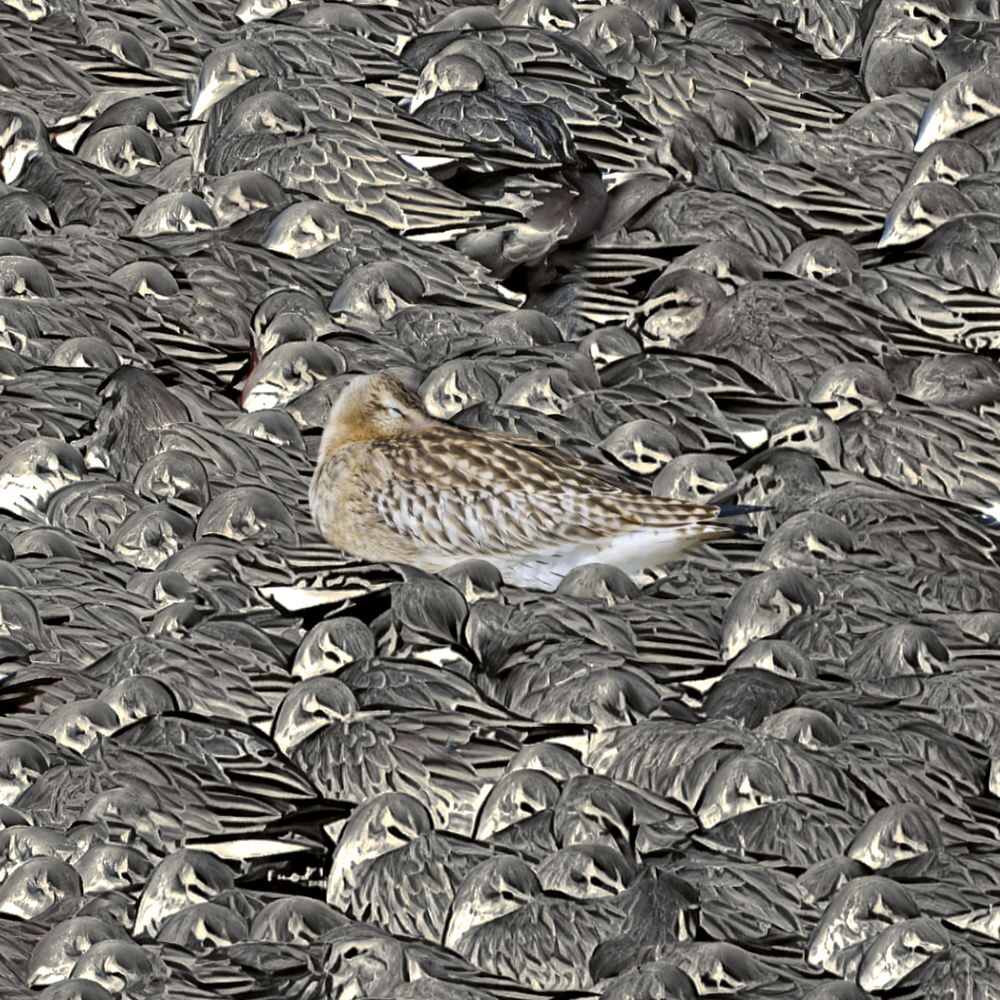
The knot don’t usually go around in one huge flock like this, rather they normally gather in flocks – of anywhere between a handful to a few hundred. While the tide was out and they were feeding, they would have been in these smaller groups. In the last hour or so as the sea slowly rose and covered their feeding grounds, the scattered flocks would have gradually given up the feeding frenzy and come in to roost. Flying over the shingle bank and into this sheltered hollow on the edge of the gravel pit lagoon, they would have seen some of their own already there and joined them – huddling together. The lone birds of other species would have been on their own initially, but as the mass of knot numbers swelled the “loners” would have been slowly engulfed.
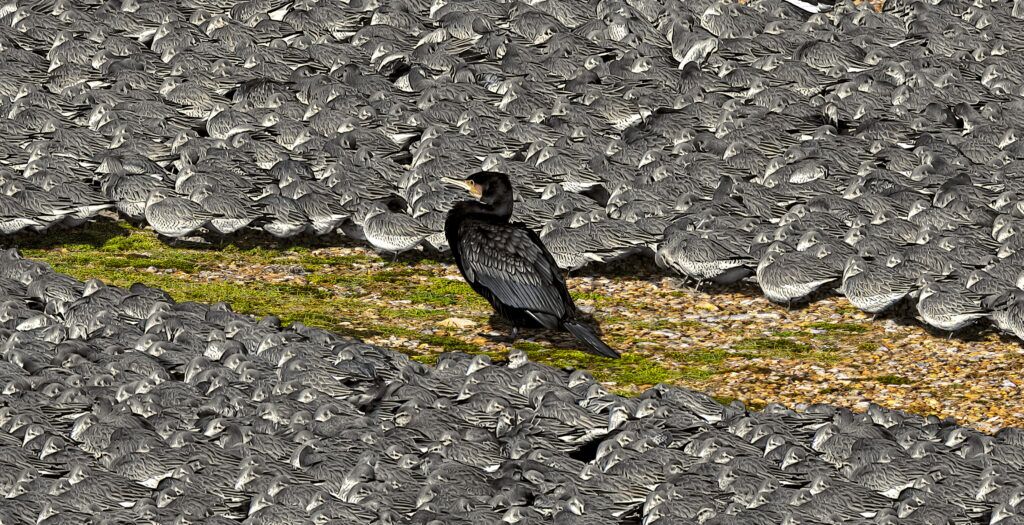
For me this image raises lots of questions. Why did the knot feel comfortable getting that close – literally touching – some of those other species – even some that are significantly bigger than them – and not the cormorant (the big black bird in the middle of the big flock)? Does the cormorant look dangerous to them? Did the cormorant try to attack them? I doubt that very much – since they are fish eaters and are not known to be aggressive to other birds. Is it just the look of the cormorant that makes them feel uneasy…? Predators have a knack of looking aggressive. So do the knot – and other species for that matter – have an instinct for what-looks-nasty-probably-is-nasty…?
And what does nasty look like? Two piercing, forward-looking, eyes; a certain stare-you-down-I’d-like-to-eat-you attitude; a big mouth with a sharp beak or teeth…? It is utterly amazing to me how such instincts can be carried in DNA…
What did the cormorant feel – being completely surrounded by a sea of small grey birds that wouldn’t get close to it…? What did the surrounding knot feel – especially those on the inner edge closest to the cormorant…? How did they decide what a safe distance from the cormorant would be? From the side-on view of this conglomeration of birds, the shape of the space around the main predator cormorant looks cigar-like, but from about it would look circular – with the cormorant very much in the centre. The radius of the circle – the distance from the cormorant to the nearest knot (plural) – reflects the average distance the knot are conformable being to the big black predator – the distance they think they could fly off before it could strike at them…
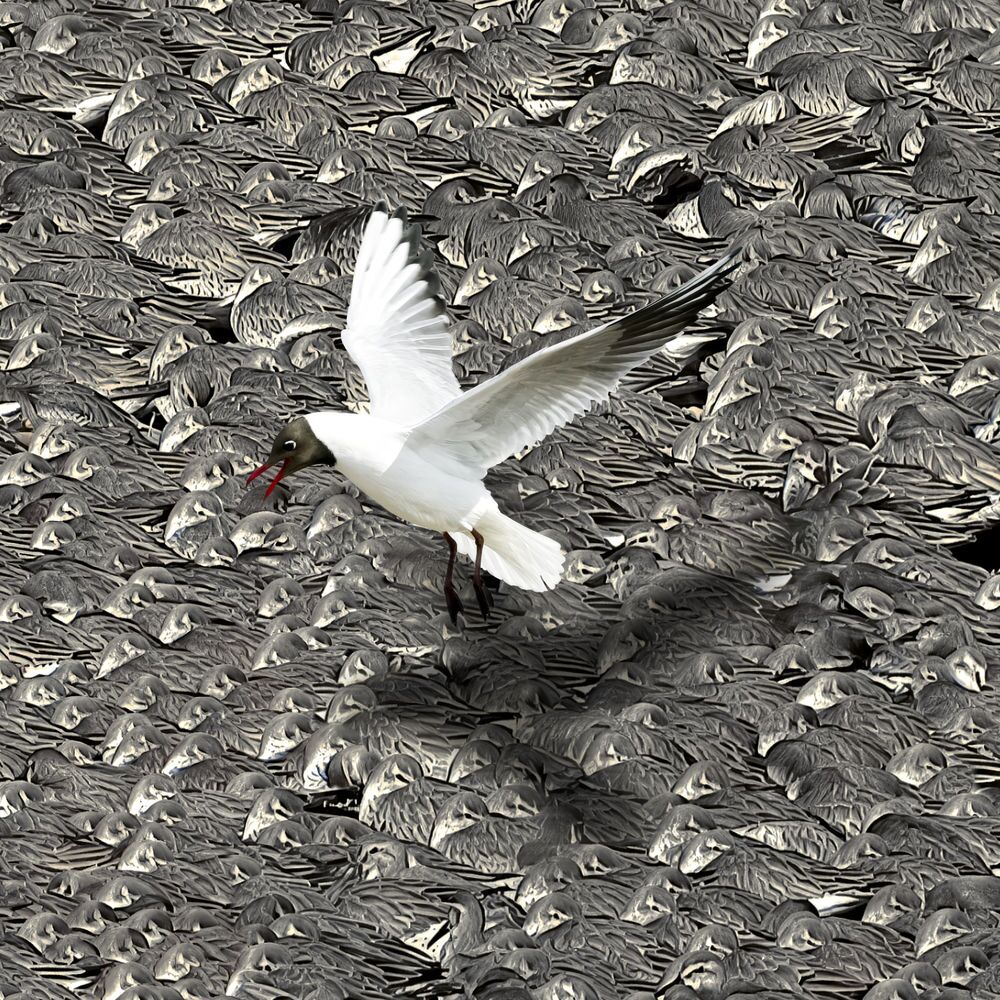
Does the black-headed gull flying over the huge flock think “bloody hell – that’s a lot of birds!”…? Does it even realise that they are birds at all – and not something like stones that it could land on…? How did the “loners” feel as they were being slowly surrounded by the knot – as their numbers swelled…? How do animals identify themselves…? Why are some “outsiders” allowed to get close and not others…?
Going back to the smaller flocks on the mudflats: if there were 8-10,000 individuals in the main roost, and the average size of smaller flocks was 200, then out on the mudflats there must have been somewhere in the region of 40-50 separate flocks of knot. I am interested to know what defines these flocks; how does an individual know it is part of a flock? Is there a leader of each flock? Imagine 200 individual birds foraging in the sand and mud for food: they can’t all spontaneously decide to fly off in the same direction to a roost like the one in the picture – surely one takes the lead? Is it that any one of them can take the lead and all the rest follow…? Or is there a flock leader…?
Do the members of the flock recognise each other as individuals – or is there just some general sense of belonging and not wanting to be left on their own? I’m not sure it can be the latter because when the main roost broke up, it broke up gradually. A succession of small flocks flew off – back to the mud-flats. There wasn’t one almighty exodus. This implies that while other birds were flying off, something kept the others where they were. Was it that no member of their group had taken flight, or did they have a leader who hadn’t taken flight? This behaviour suggests a high level of small flock individuality. If there was a perceived threat like a fox or human getting too close, then I’m sure the whole roost – all 8-10,000 of them – would have taken flight; but in the normal calm of the roost each small flock seemed to act autonomously – just temporarily taking advantage of the warmth afforded by bigger numbers. I’m not sure we can ever know what is going on in the mind of one of these little birds, but that would be incredibly fascinating to discover…
The parallels between birds and us humans are quite striking. We have our little groups – friends, family, work colleagues, team members, etc. Sometimes we come together in huge crowds – such as sports events, coronations, concerts, evacuations, etc. And when we are in these huge gatherings we are acutely aware of our group and make special effort to keep in contact and move around together – to arrive and depart together. Something may trigger us all to move off together – like the end of an event, or a fire, but we still keep to our personal group wherever possible. There is usually a leader…
I am also interested in how comfortable we are for different people to get close to us. Speaking for myself, generally I am happy for strangers to get within a couple of feet from me (unless they look nasty or threatening); I generally don’t like men to touch me at all, but for male friends it’s okay; I’m happy for women and children to get very close and even touch me; and it is very special and highly desirable for a woman I’m attracted to to get close and touch me…! Indeed, such a woman could trigger an adrenalin rush – where my whole mind and body would become fixated, excited, and physiologically charged…
As for the closeness we will allow other species to get to us, this very much depends on our familiarity with the species, knowledge of their likely behaviour, and our knowledge of specific individuals and their moods. Generally we are comfortable with cats and dogs (the species depends on the cultural norm – so it might be different species in different cultures), but some people are allergic to them, or allergic to specific ones; some people have had bad experiences with them and won’t go near them. Suffice it is to say, familiarity and affection draw us together; unfamiliarity and fear push us apart. It is interesting to note that the young of most species are very cute – giving us the innate feeling of warmth and affection towards them, and wanting to touch them and give them everything they need… It is interesting that many species are programmed to respond in similar ways to cuteness and nastiness…
Cambridge, England 28/10/2004
Update June 2026
I honestly thought this artwork was finished, and so after getting my new very large giclée printer (late in 2025), I was ready to print it this year (April 2026). While preparing to print it, I felt I could make some significant improvements. Mainly I didn’t like the shingle and vegetation – basically all the land – which occupies about 40% of the entire surface area – which is a lot of square feet! I didn’t like it because it lacked colour – I think it had had a coating of dust over the winter months – and/or it hadn’t rained for a long time.
I have hundreds of nature photos, and I looked at some I had taken several years after the original ones for this picture – and the shingle pebbles were really vibrant and multi-coloured – and the vegetation had much nicer, vibrant, greens (probably because they were taken later in the year – like spring). So I set about the mammoth task of masking out all the old shingle and vegetation, and, using nuanced techniques, I “repainted” all the areas I didn’t like with bits of shingle and vegetation I liked from other photos. When I finished this arduous task I then realised I was also unhappy with all the shadows over the old shingle and vegetation I replaced – so I then set about the equally arduous task of replacing all the shadows…!
I also improved the detail on most of the birds – particularly the black and white oystercatchers (and I replaced all their beaks to make them more detailed and to stand out more realistically) – so each bird was meticulously improved. I also added a few more birds (from other photos I have taken since the originals) that appeared (or would usually) over the hours I was there. This involved adding shadows and reflections where appropriate.
If you bear in mind that I try to make everything look as realistic and photographic as possible, you might not be surprised to know that the improvements I mentioned took over 300 hours – about six weeks (which is about as much as the original artwork took)…
Aberdeenshire, Scotland 6/6/2026