David Hockney (1937-2026), may he rest in peace, is one of the very, very, few artists I like and admire. He and I seem to be in the minority – in thinking that the main purpose of art is to be a source of joy. There is so much unjoyful art (putting it as kindly and politely as I possibly can!) these days that it makes me cringe, and makes me weary about calling myself an artist – least I be tarnished with the same brush (if you’ll pardon the pun…) and prejudice…
His artwork was far more substance than BS. So many contemporary “artists” are all BS and no substance – indeed this is what “art college” seems to encourage in recent decades – and this is why art is at its worst point in history – at its nadir. They believe it’s all about the concept/idea/s – it doesn’t matter what it looks like or how well executed it is. We totally disagree. Art that would be displayed in no place other than a modern art gallery/museum – because no sane person would have it in their home – is not art at all – its rubbish, pure and simple. Art – that most people who didn’t know who had created it would think it had been created by an unskilled child – is not art at all – its rubbish, pure and simple. Art that only exists in the minds of a very few very “learned” “art critics” (who make their living by bigging-up crap art – and often inventing “meaning” that was never there) – is not art at all – its rubbish, pure and simple…
David Hockney was a very deep thinker, immensely skilled artist, fabulous colourist, unpretentious, and worked all is life doing what he enjoyed doing – exploring new ways of seeing and bringing joy to people. May he rest in peace, and may history bring forth more like him…
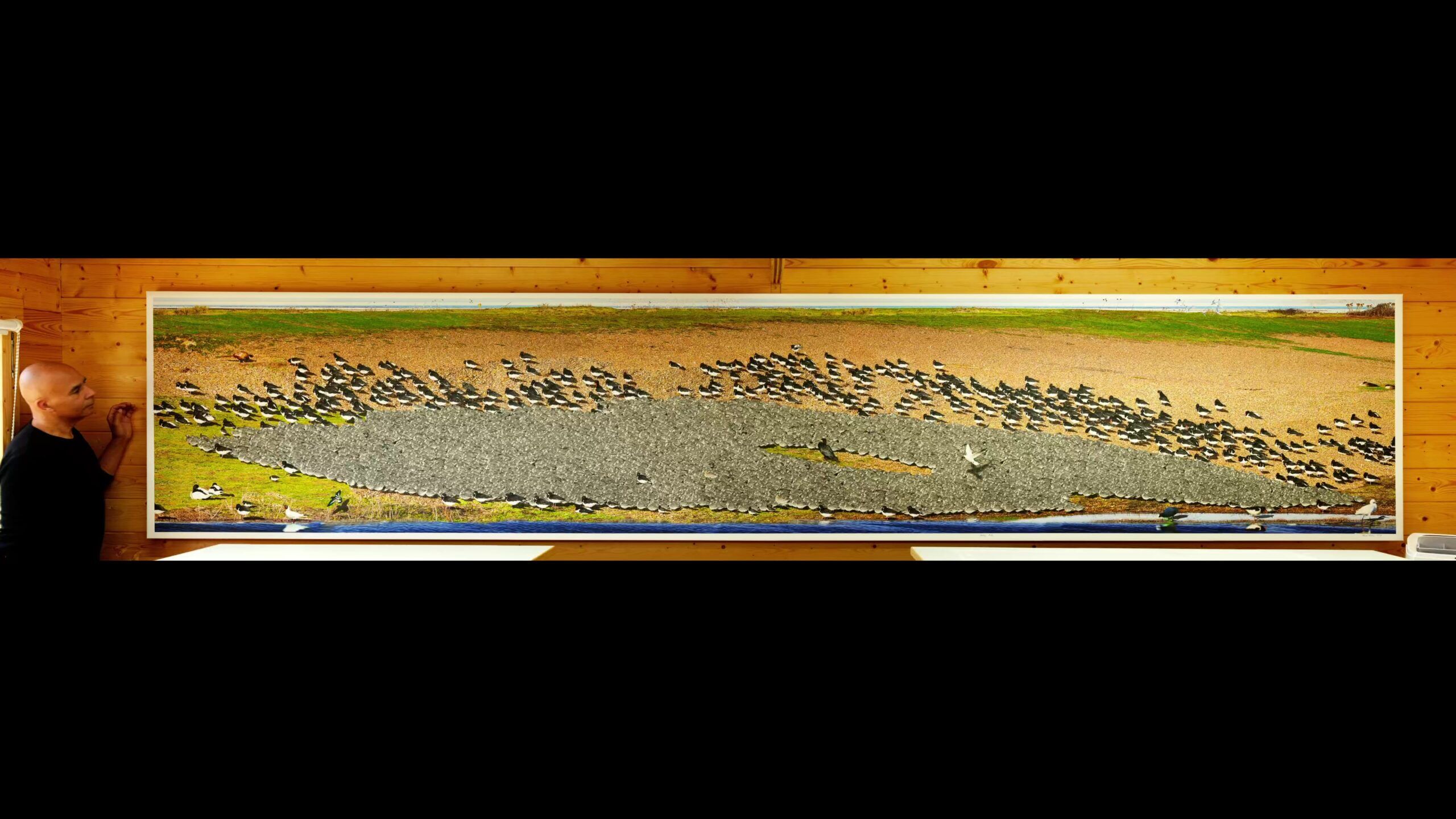
(Catalogue #100_1970-1982: 194” x 36.7” (5m x 1.1m), limited edition of 11)
TL;DR
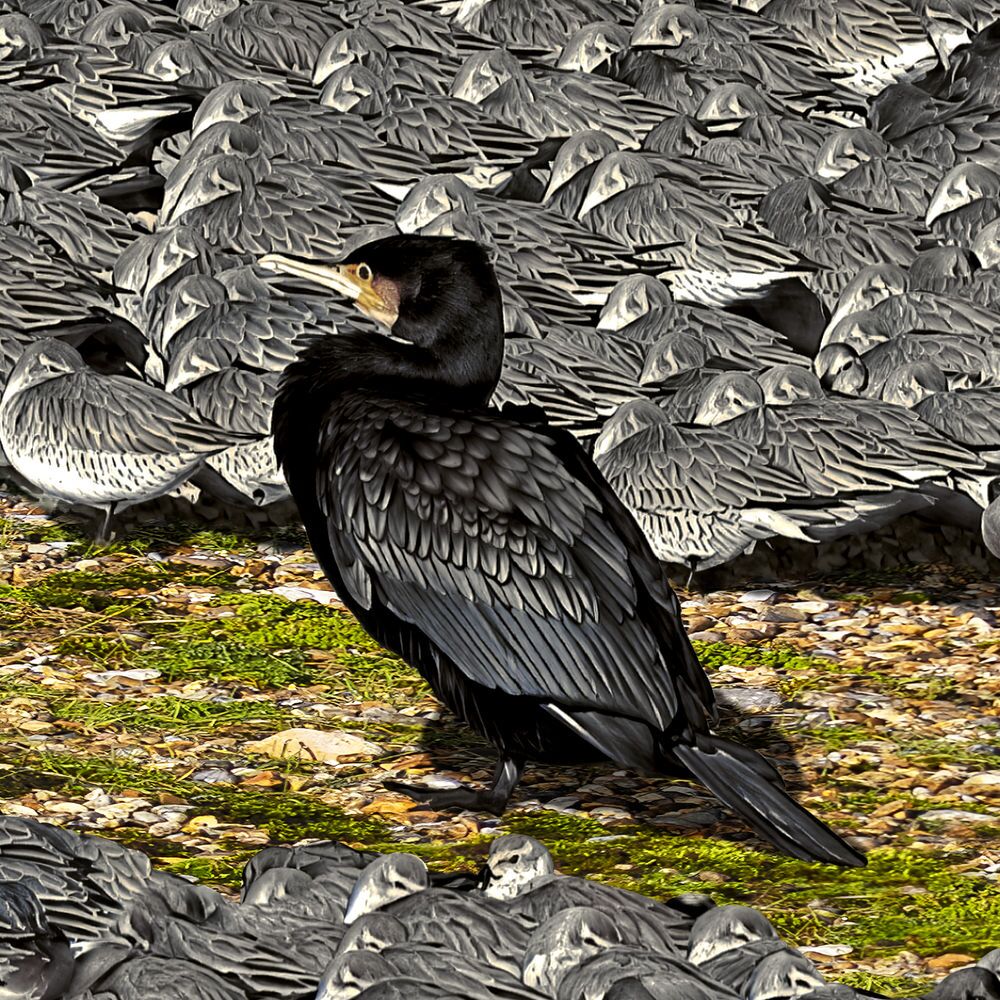
This is a painstakingly reproduced scene (with some artistic licence) of a natural phenomena at Snettisham (U.K.) (the south-eastern part of The Wash – between Norfolk and Lincolnshire) of hundreds of various species of birds roosting on a cold winter’s day – waiting for the tide to go out to resume feeding. The birds are predominantly waders – mudflat/shoreline-foraging, and migratory. What strikes me most about this mass gathering is the different behaviour of the various species – in particular how close they get to their own species and to other species… Each species must have some notion of each of the other species – and form notions about them – such as are they a threat…? One thing for sure is that they all have a concept of others and their own identity… The lone cormorant in the middle of the main flock is a predator (mainly of fish), and wouldn’t normally prey on any of these birds. However, predators usually have similar aggressive, threatening, features – forward-looking eyes, big, sharp, beaks, and are relatively large. The empty space around the cormorant – which would be more or less circular in shape from above – belies what the surrounding birds (knot) think about it…
I’m deeply intrigued, and spellbound, by Nature, and spend a lot of time watching, being mesmerised, and photographing/filming it. Every once in a while I come across something even more amazing than normal…
This scene is as authentic as I saw it, but I have had to overcome the limitations of photography. I have gone to great lengths to faithfully reproduce what I saw in all its detail. It was a very sharp, cold, blustery, early spring morning. The tide was high and these birds were roosting – unable to feed on the mudflats. They were waiting for the tide to go out.
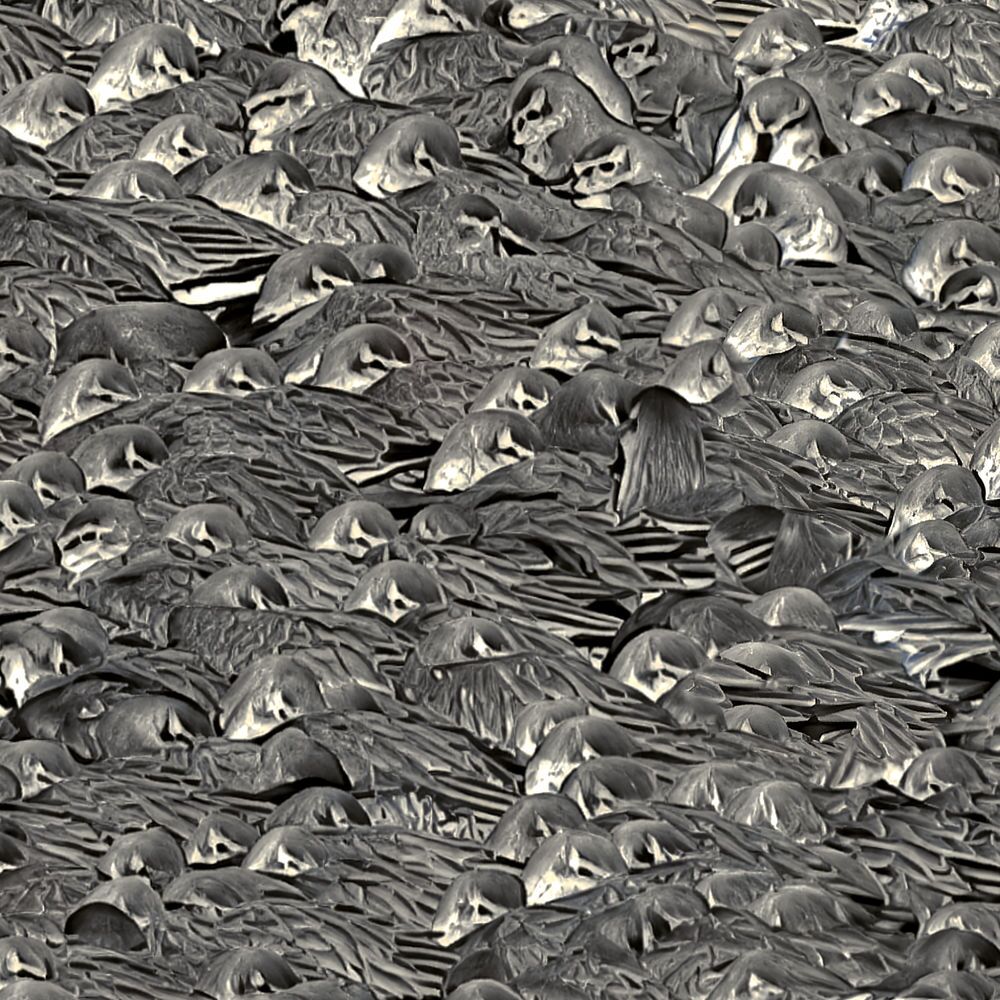
Identity – Knot huddling together detail
Some species like the knot (the predominant grey birds in the 8-10,000 strong central flock) huddle together to keep warm, whereas others don’t. Huddling together to keep warm is perfectly understandable, so why don’t the other species in the scene do it…? Generally in the animal kingdom, the smaller something is, the harder it is for it to keep warm – because its surface area – where warmth escapes – in proportion to size (e.g. height) increases the smaller the animal is (this is simple maths). So in theory this should lead to smaller animals huddling together…? But it’s not as simple as this because there are smaller sized species than the knot that don’t huddle – for example the turnstone (the smallest in the scene). Also, the only slightly larger black and white birds – the oystercatchers – don’t huddle together…
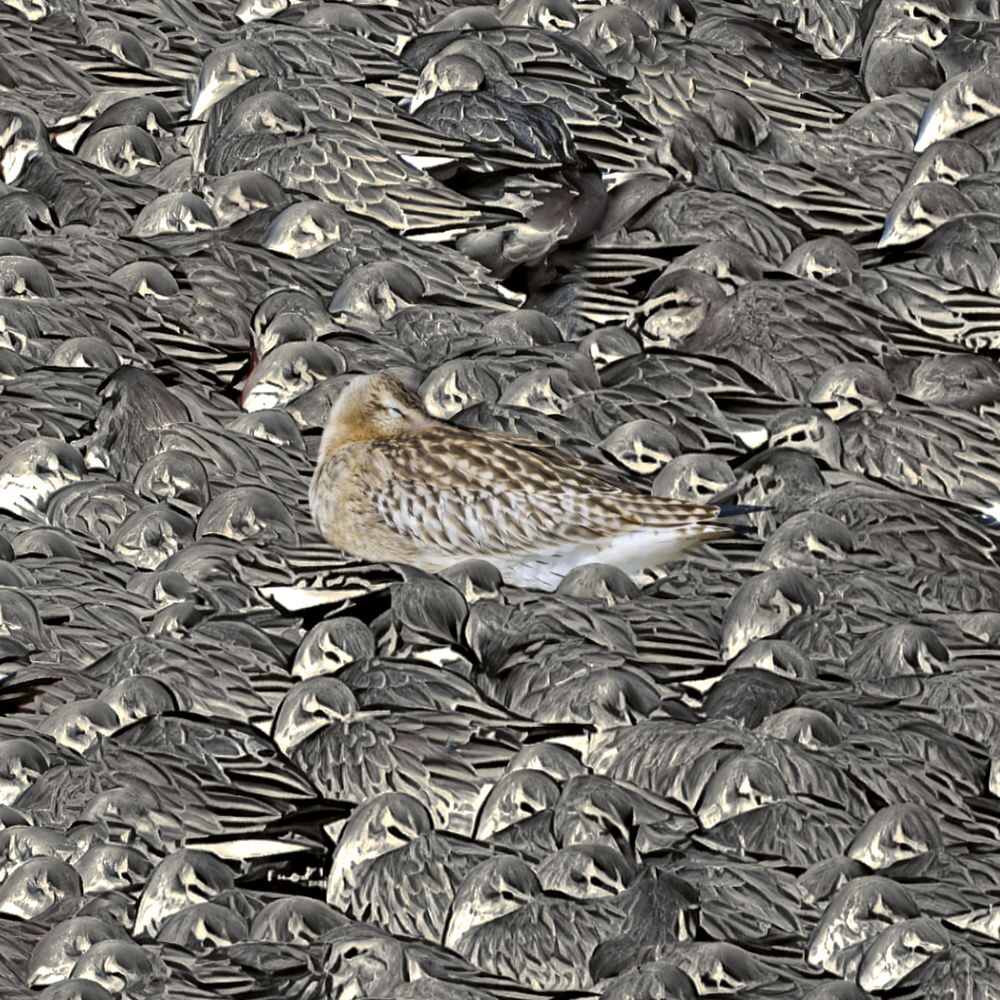
The few individuals of different species engulfed in the sea of knot – the few lone oystercatchers (big black and white birds with bright red beaks) and the bar-tailed godwits (the long-legged buff-coloured birds with long straight beaks) – almost certainly didn’t land in the middle of all the knot. Instead, they were probably slowly engulfed by them as the numbers of knot coming off the mudflats to roost gradually swelled.
Bar-Tailed Godwit engulfed by hundreds of Knot detail
The knot don’t usually go around in one huge flock like this, rather they normally gather in flocks – of anywhere between a handful to a few hundred. While the tide was out and they were feeding, they would have been in these smaller groups. In the last hour or so as the sea slowly rose and covered their feeding grounds, the scattered flocks would have gradually given up the feeding frenzy and come in to roost. Flying over the shingle bank and into this sheltered hollow on the edge of the gravel pit lagoon, they would have seen some of their own already there and joined them – huddling together. The lone birds of other species would have been on their own initially, but as the mass of knot numbers swelled the “loners” would have been slowly engulfed.
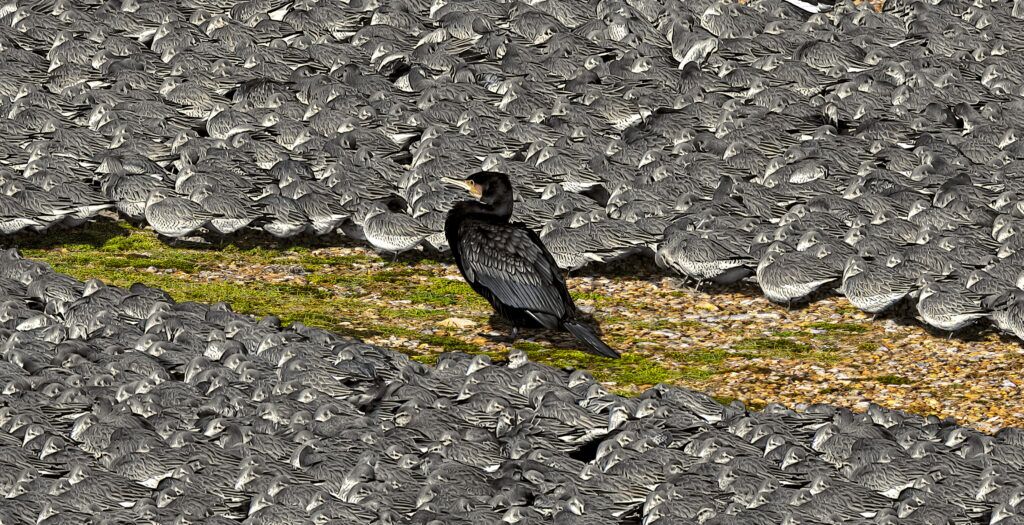
A lone cormorant (predator) isolated in the middle of a huge flock of mainly knot – that want to keep their distance…
For me this image raises lots of questions. Why did the knot feel comfortable getting that close – literally touching – some of those other species – even some that are significantly bigger than them – and not the cormorant (the big black bird in the middle of the big flock)? Does the cormorant look dangerous to them? Did the cormorant try to attack them? I doubt that very much – since they are fish eaters and are not known to be aggressive to other birds. Is it just the look of the cormorant that makes them feel uneasy…? Predators have a knack of looking aggressive. So do the knot – and other species for that matter – have an instinct for what-looks-nasty-probably-is-nasty…?
And what does nasty look like? Two piercing, forward-looking, eyes; a certain stare-you-down-I’d-like-to-eat-you attitude; a big mouth with a sharp beak or teeth…? It is utterly amazing to me how such instincts can be carried in DNA…
What did the cormorant feel – being completely surrounded by a sea of small grey birds that wouldn’t get close to it…? What did the surrounding knot feel – especially those on the inner edge closest to the cormorant…? How did they decide what a safe distance from the cormorant would be? From the side-on view of this conglomeration of birds, the shape of the space around the main predator cormorant looks cigar-like, but from about it would look circular – with the cormorant very much in the centre. The radius of the circle – the distance from the cormorant to the nearest knot (plural) – reflects the average distance the knot are conformable being to the big black predator – the distance they think they could fly off before it could strike at them…
Cormorant close-up
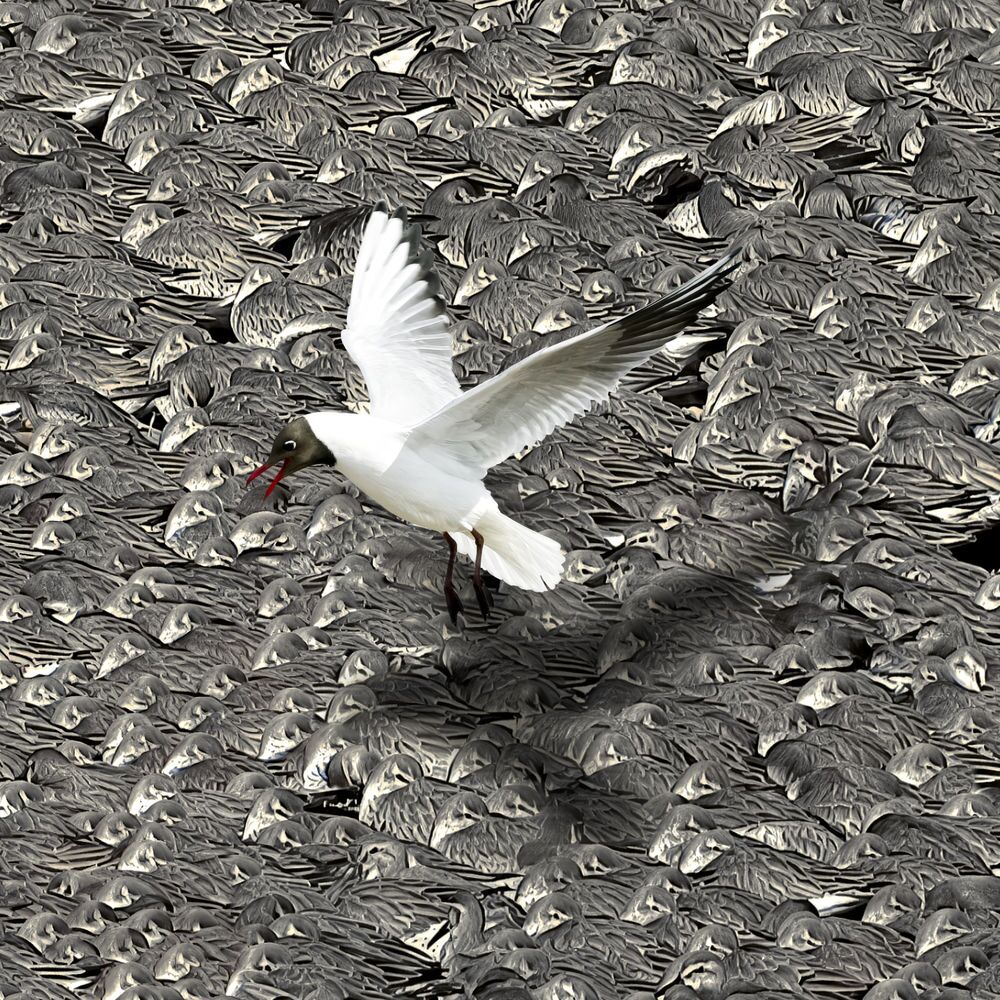
Does the black-headed gull flying over the huge flock think “bloody hell – that’s a lot of birds!”…? Does it even realise that they are birds at all – and not something like stones that it could land on…? How did the “loners” feel as they were being slowly surrounded by the knot – as their numbers swelled…? How do animals identify themselves…? Why are some “outsiders” allowed to get close and not others…?
Going back to the smaller flocks on the mudflats: if there were 8-10,000 individuals in the main roost, and the average size of smaller flocks was 200, then out on the mudflats there must have been somewhere in the region of 40-50 separate flocks of knot. I am interested to know what defines these flocks; how does an individual know it is part of a flock? Is there a leader of each flock? Imagine 200 individual birds foraging in the sand and mud for food: they can’t all spontaneously decide to fly off in the same direction to a roost like the one in the picture – surely one takes the lead? Is it that any one of them can take the lead and all the rest follow…? Or is there a flock leader…?
Black-hooded Gull looking for somewhere to land
Do the members of the flock recognise each other as individuals – or is there just some general sense of belonging and not wanting to be left on their own? I’m not sure it can be the latter because when the main roost broke up, it broke up gradually. A succession of small flocks flew off – back to the mud-flats. There wasn’t one almighty exodus. This implies that while other birds were flying off, something kept the others where they were. Was it that no member of their group had taken flight, or did they have a leader who hadn’t taken flight? This behaviour suggests a high level of small flock individuality. If there was a perceived threat like a fox or human getting too close, then I’m sure the whole roost – all 8-10,000 of them – would have taken flight; but in the normal calm of the roost each small flock seemed to act autonomously – just temporarily taking advantage of the warmth afforded by bigger numbers. I’m not sure we can ever know what is going on in the mind of one of these little birds, but that would be incredibly fascinating to discover…
The parallels between birds and us humans are quite striking. We have our little groups – friends, family, work colleagues, team members, etc. Sometimes we come together in huge crowds – such as sports events, coronations, concerts, evacuations, etc. And when we are in these huge gatherings we are acutely aware of our group and make special effort to keep in contact and move around together – to arrive and depart together. Something may trigger us all to move off together – like the end of an event, or a fire, but we still keep to our personal group wherever possible. There is usually a leader…
I am also interested in how comfortable we are for different people to get close to us. Speaking for myself, generally I am happy for strangers to get within a couple of feet from me (unless they look nasty or threatening); I generally don’t like men to touch me at all, but for male friends it’s okay; I’m happy for women and children to get very close and even touch me; and it is very special and highly desirable for a woman I’m attracted to to get close and touch me…! Indeed, such a woman could trigger an adrenalin rush – where my whole mind and body would become fixated, excited, and physiologically charged…
As for the closeness we will allow other species to get to us, this very much depends on our familiarity with the species, knowledge of their likely behaviour, and our knowledge of specific individuals and their moods. Generally we are comfortable with cats and dogs (the species depends on the cultural norm – so it might be different species in different cultures), but some people are allergic to them, or allergic to specific ones; some people have had bad experiences with them and won’t go near them. Suffice it is to say, familiarity and affection draw us together; unfamiliarity and fear push us apart. It is interesting to note that the young of most species are very cute – giving us the innate feeling of warmth and affection towards them, and wanting to touch them and give them everything they need… It is interesting that many species are programmed to respond in similar ways to cuteness and nastiness…
Cambridge, England 28/10/2004
Update June 2026
I honestly thought this artwork was finished, and so after getting my new very large giclée printer (late in 2025), I was ready to print it this year (April 2026). While preparing to print it, I felt I could make some significant improvements. Mainly I didn’t like the shingle and vegetation – basically all the land – which occupies about 40% of the entire surface area – which is a lot of square feet! I didn’t like it because it lacked colour – I think it had had a coating of dust over the winter months – and/or it hadn’t rained for a long time.
I have hundreds of nature photos, and I looked at some I had taken several years after the original ones for this picture – and the shingle pebbles were really vibrant and multi-coloured – and the vegetation had much nicer, vibrant, greens (probably because they were taken later in the year – like spring). So I set about the mammoth task of masking out all the old shingle and vegetation, and, using nuanced techniques, I “repainted” all the areas I didn’t like with bits of shingle and vegetation I liked from other photos. When I finished this arduous task I then realised I was also unhappy with all the shadows over the old shingle and vegetation I replaced – so I then set about the equally arduous task of replacing all the shadows…!
I also improved the detail on most of the birds – particularly the black and white oystercatchers (and I replaced all their beaks to make them more detailed and to stand out more realistically) – so each bird was meticulously improved. I also added a few more birds (from other photos I have taken since the originals) that appeared (or would usually) over the hours I was there. This involved adding shadows and reflections where appropriate.
If you bear in mind that I try to make everything look as realistic and photographic as possible, you might not be surprised to know that the improvements I mentioned took over 300 hours – about six weeks (which is about as much as the original artwork took)…
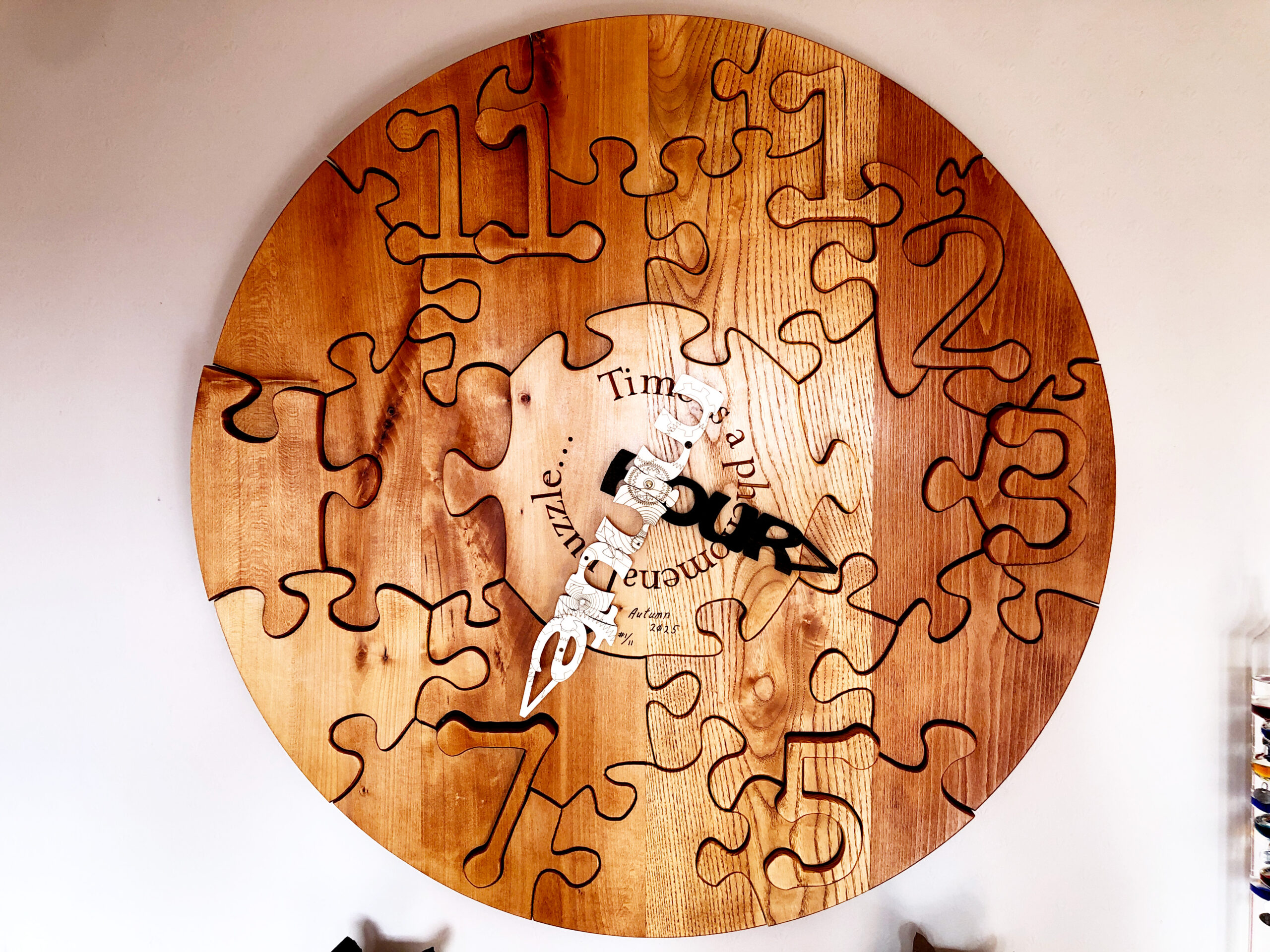
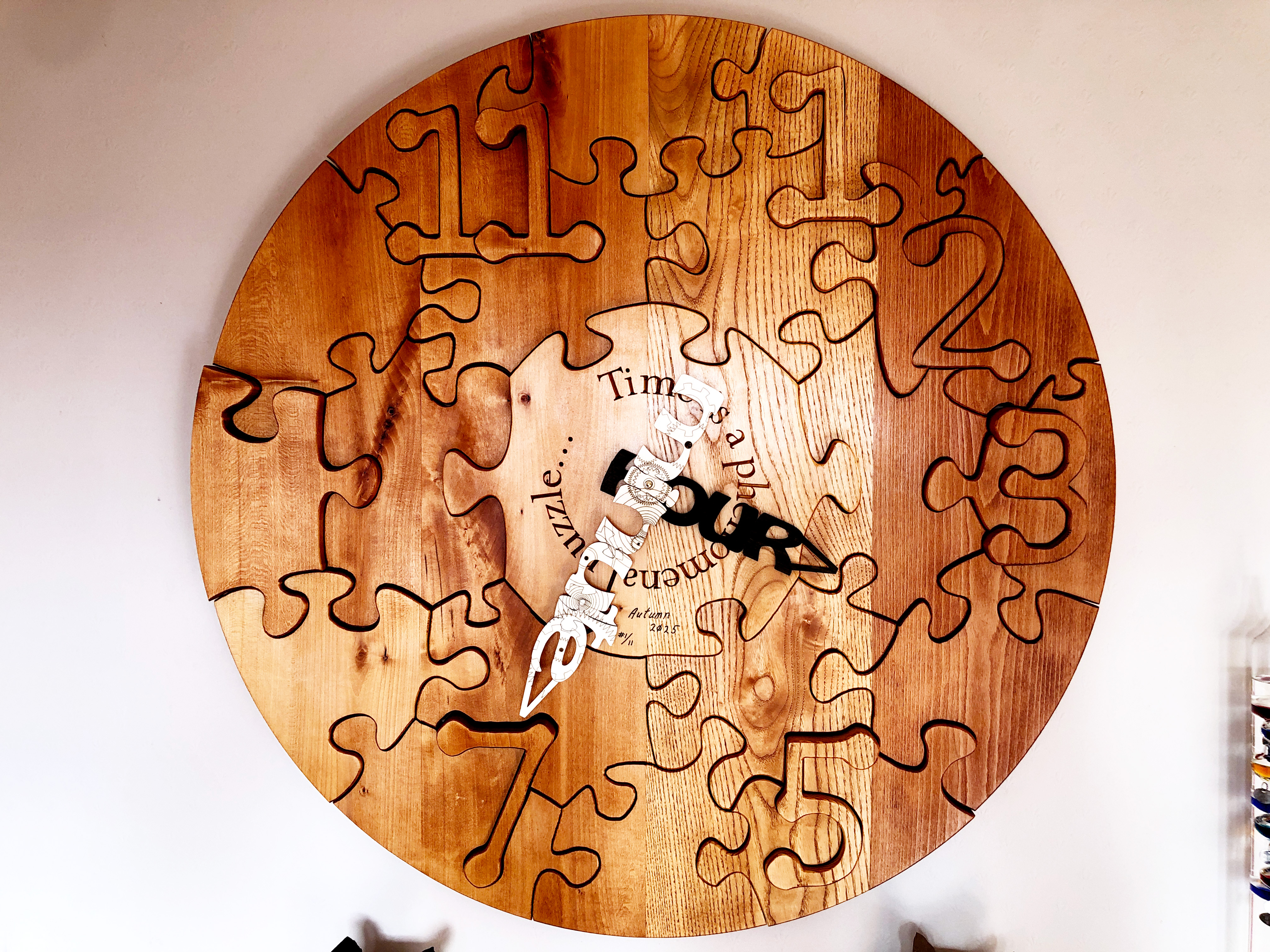
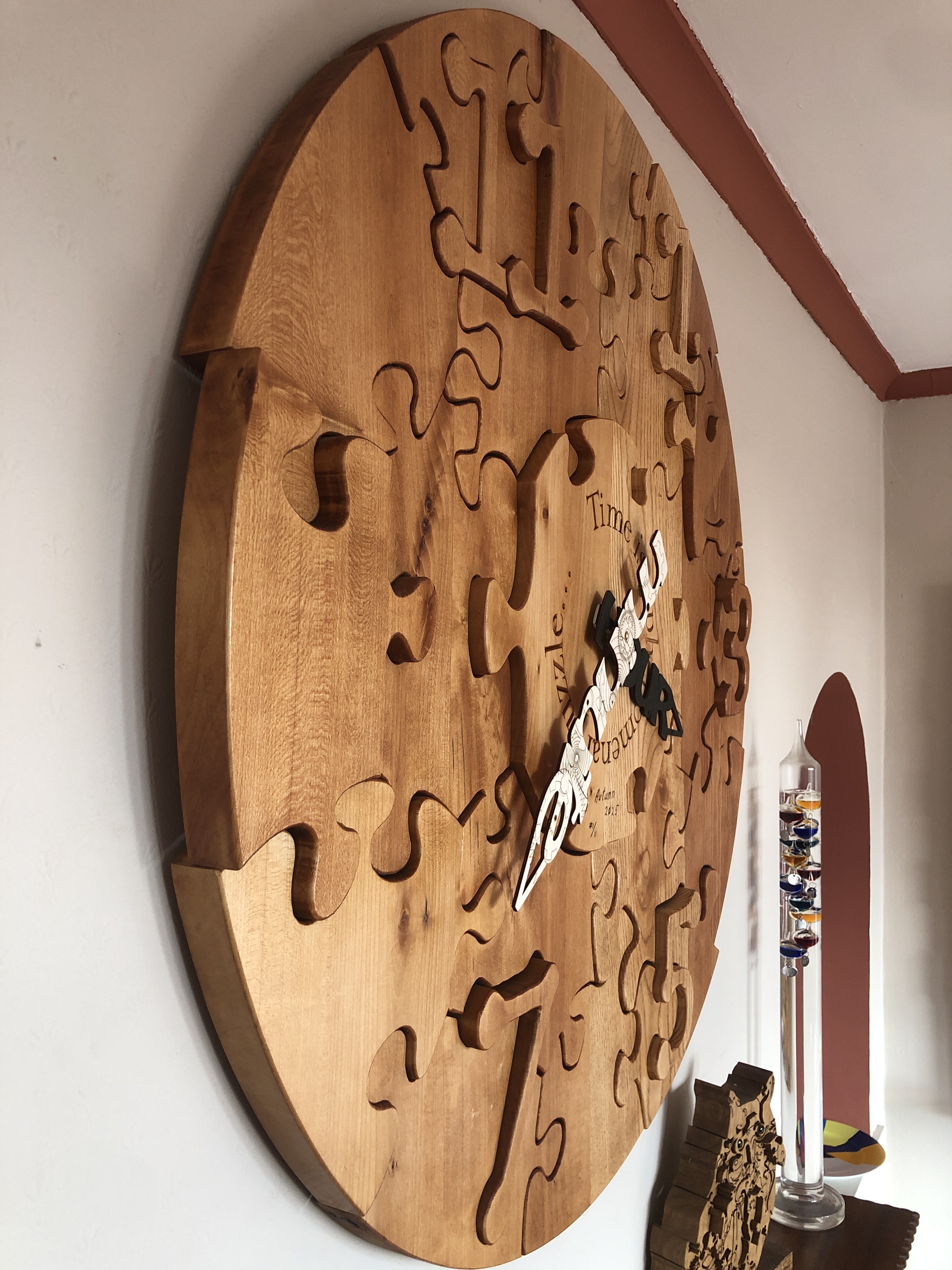
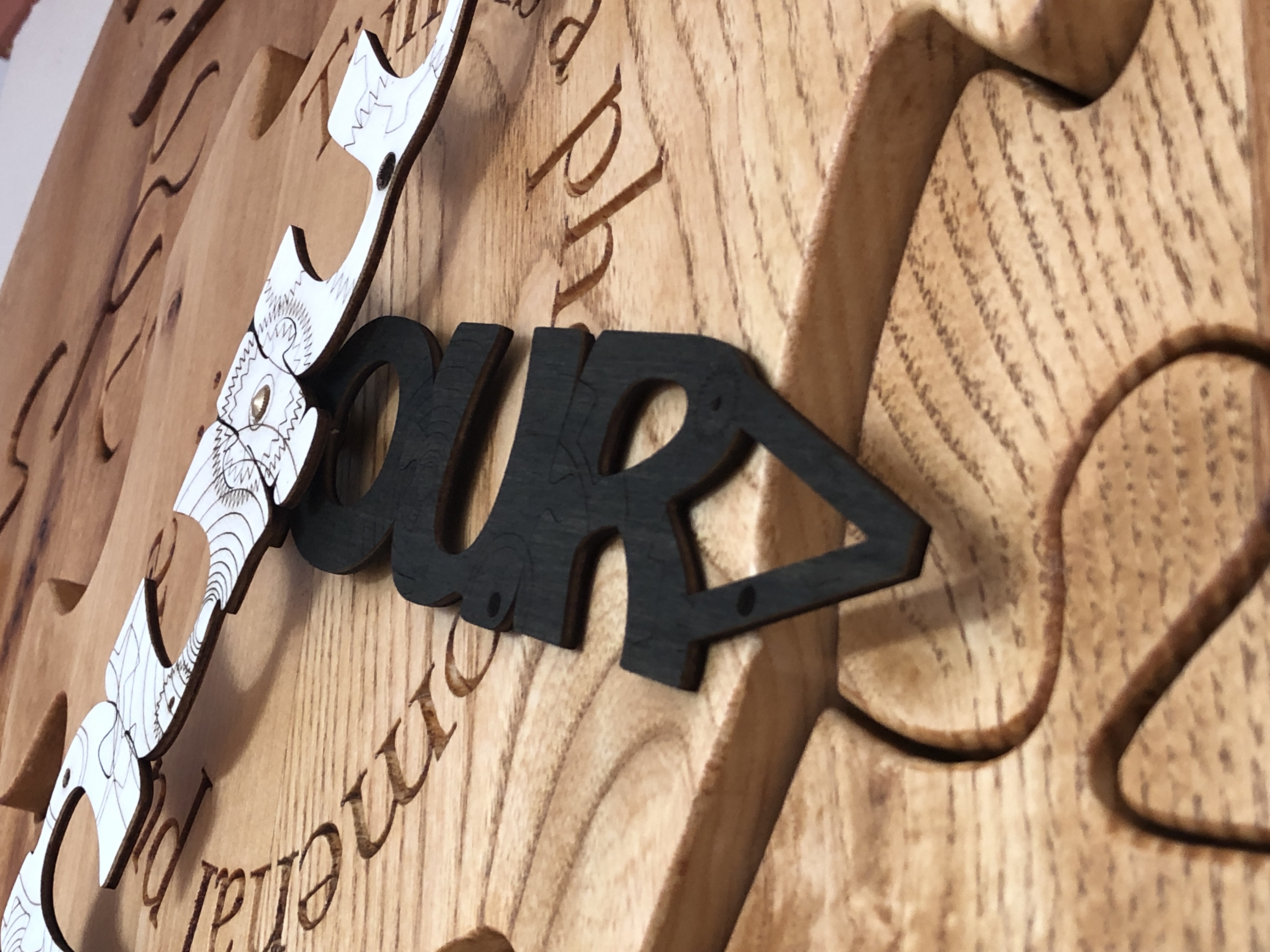
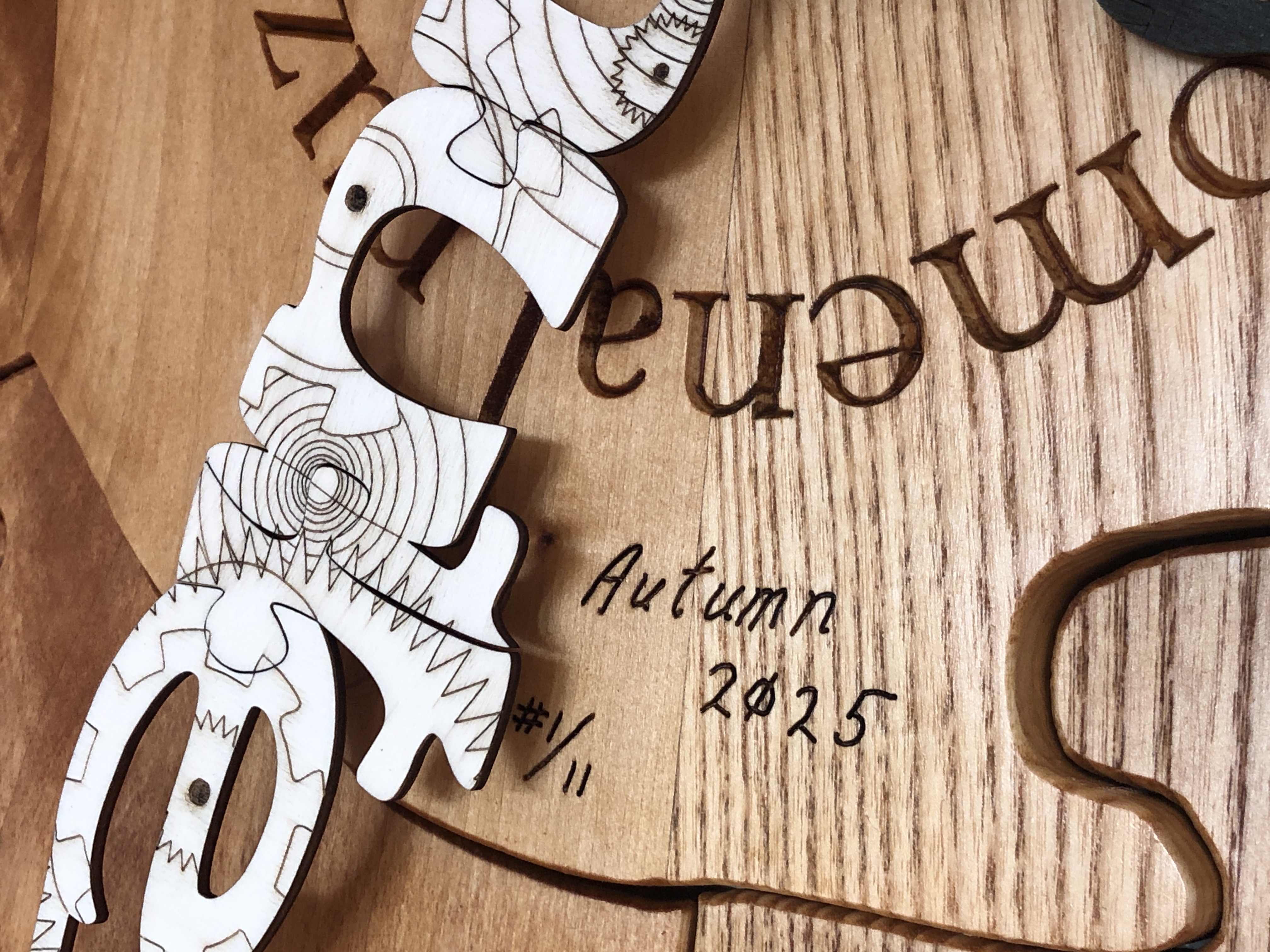
Title: “Time is a phenomenal puzzle…(Clock and Art Puzzle)” Artist: Michael Autumn Medium: Oak wood clock face and plywood hands. Working clock movement. Size: 95cm (W) x 95cm (H) Edition: 11 (only made to order) Authenticity: Hand-engraved (bottom, center of main central piece). Date: 03/2025
This is an artwork primarily about time – that eternal puzzle in human minds – mine included – and what better way to depict time than by a clock…? However, during my journey in creating this piece I realised that it is also about gravity – because without gravity this clock would simply fall apart – because there is nothing else holding it together…! And this ties in nicely with Einstein’s Theory of Relativity – where gravity deflects time (gravitational time dilation) in what is known as “spacetime”…
But this is not a normal clock (as you might expect from me!?): it is in fact two puzzles – and it was quite a technical challenge or puzzle to design and make both of them…! There is nothing holding the clock face or clock hands jigsaw pieces together – other than gravity – i.e. their own weight. There is no glue, screws, or nails – all the pieces are gravity-defying wooden joints!
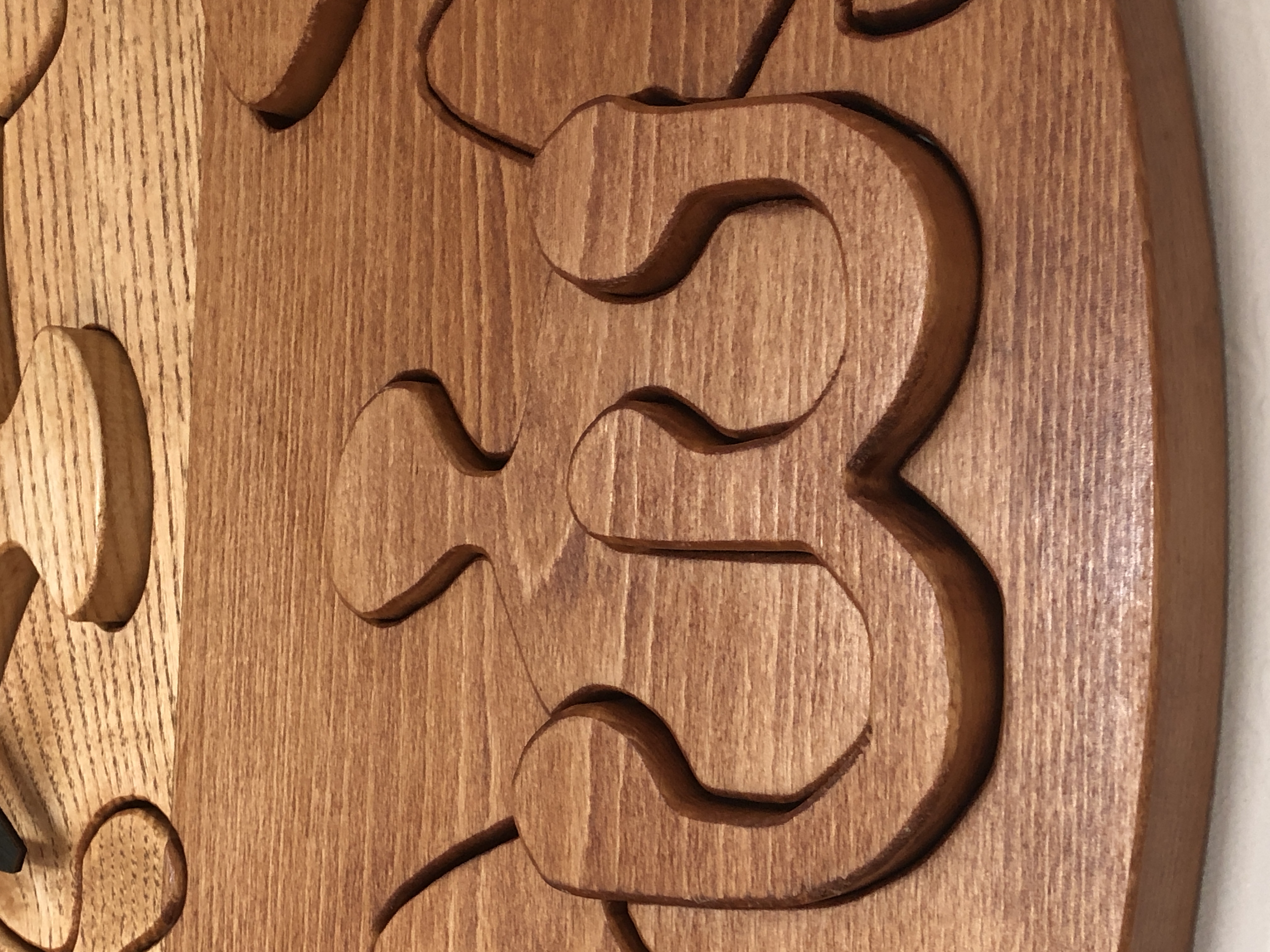
Close-up of some face pieces – they are all loose. I vary the depth of some pieces to make them stand out…
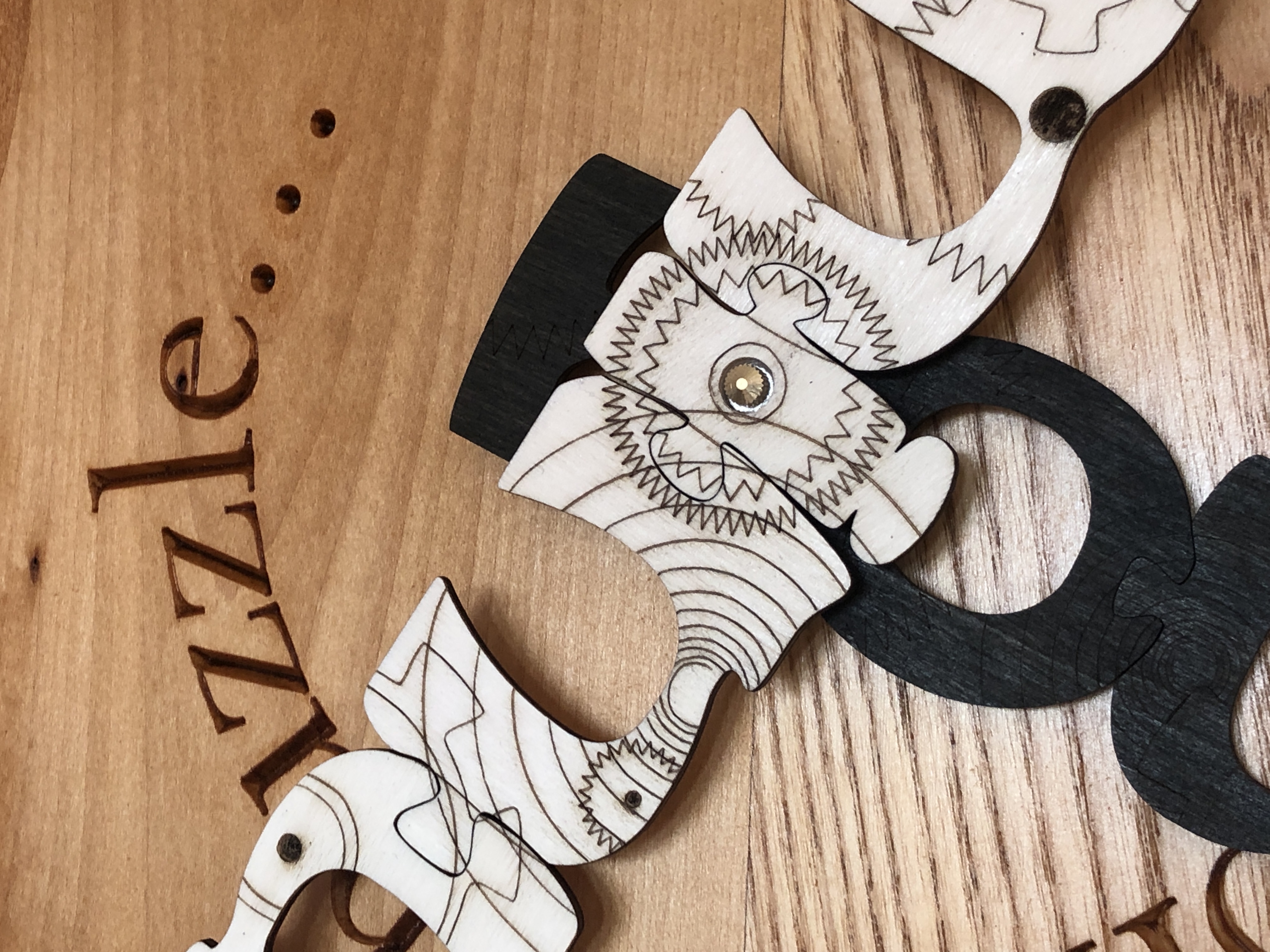
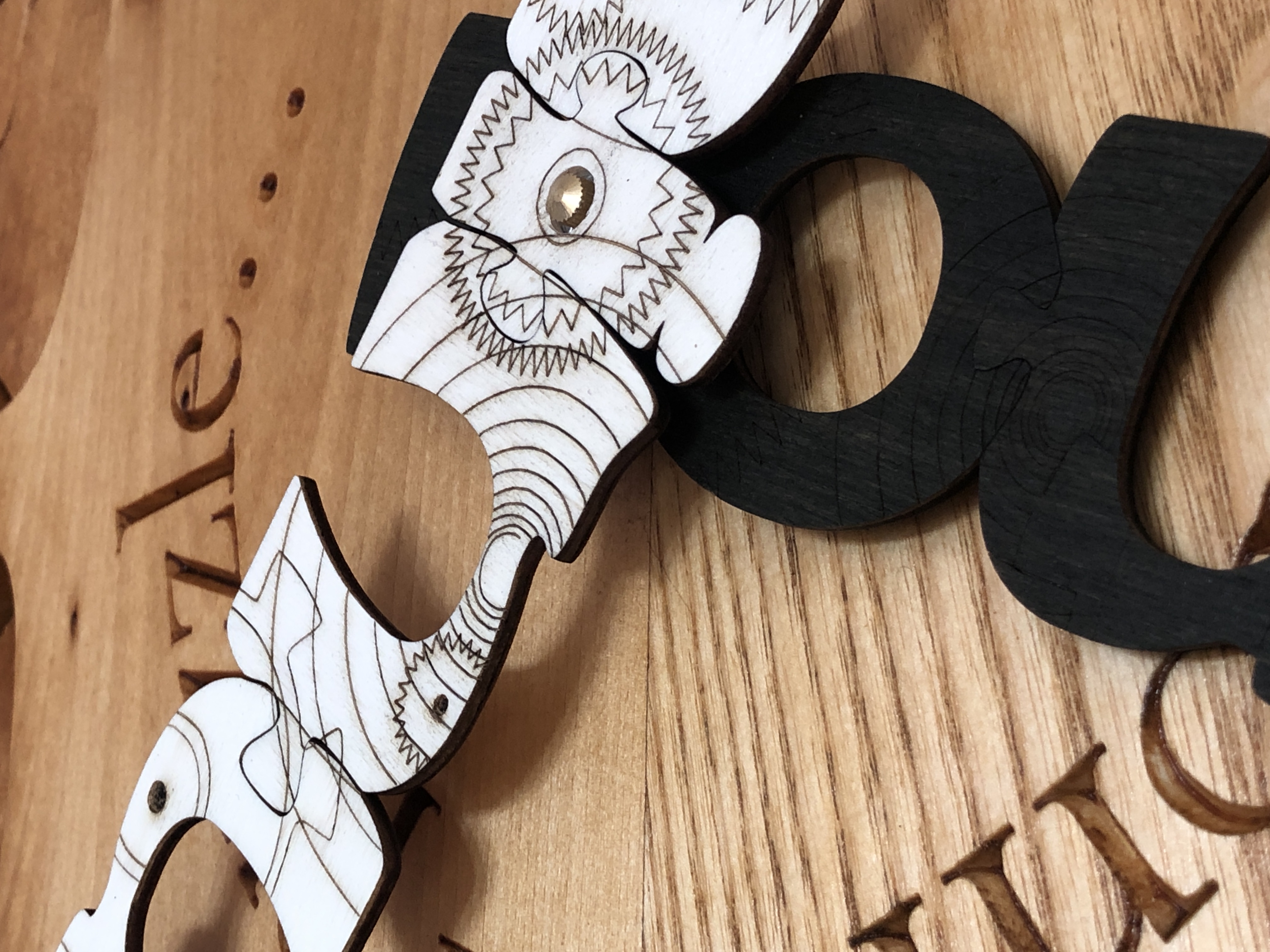
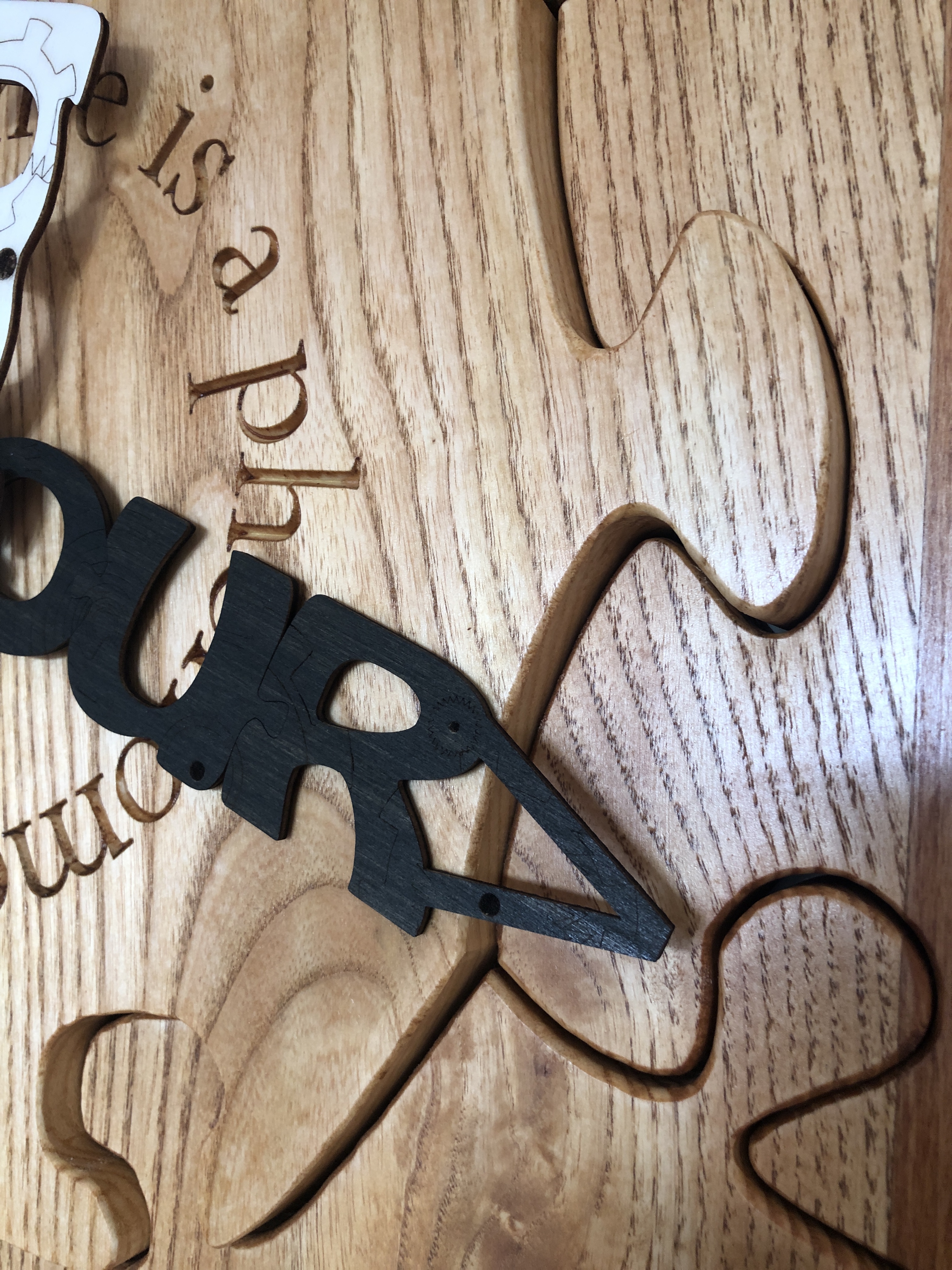
The clock face is a large (950mm or 37 ½ ” diameter) thick circular wooden jigsaw puzzle – where all the pieces are solid oak – about 32mm (1 ¼ ”) thick. The clock hands are very strong but light plywood jigsaw puzzle pieces 3mm (about an ⅛ ”) thick – spelling out the words “hour” and “minute”. They have a steampunk motif engraving of cogs, wheels, springs, shafts, and screws – as if they were word-shaped windows revealing the inner workings of the clock inside.
Close-up of steampunk motif engraving of cogs, wheels, springs, shafts, and screws
I designed and made the puzzle clock face about three years ago (December 2021) (albeit a “small” one – about 500mm – 20” – in diameter), but I couldn’t think of a design I was happy with for the clock hands. This proved really difficult because I wanted the clock hands to be puzzles in themselves – so the pieces had to reliably and tightly fit together – each as a rigid unit, be fully rotatable, and fit securely on a conventional working clock movement. The latter was an interesting technical challenge, but I really struggled with a suitable aesthetic design for them. What would look appropriate or conforming with the theme of a time puzzle? What would look aesthetically pleasing (to me at least!)?
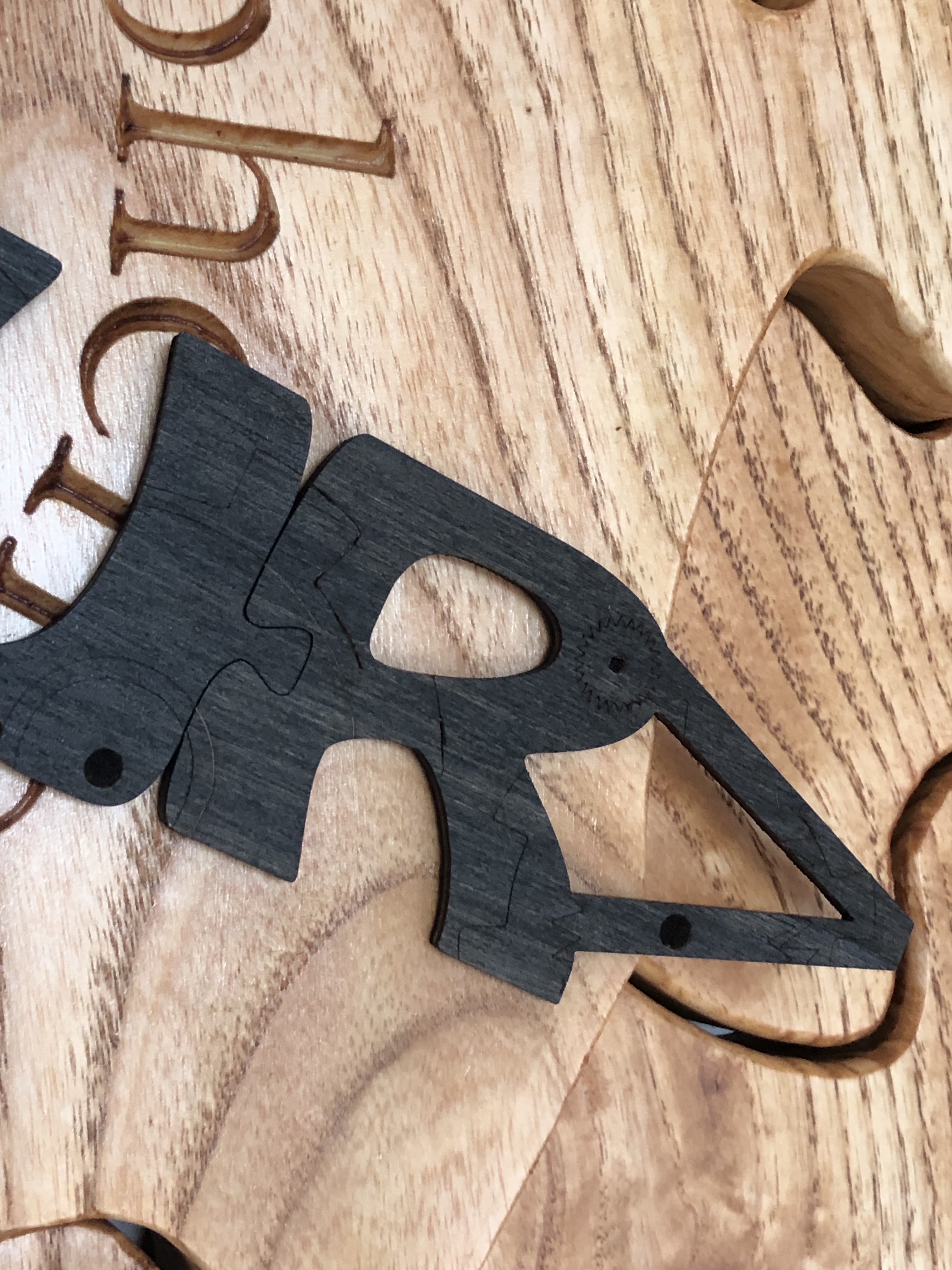
I toyed with several ideas and made prototypes – most of which failed – but recently I came up with the idea of a steampunk motif on the words “hour” and “minute” – and I figured out how to make them into actual jigsaw puzzle pieces. It involved the use of an extremely precise laser (you could be forgiven for thinking all lasers were equally precise, but that would be very wrong…), choosing extremely flat, strong, very light, and knife-edge-holding, material – with very careful preparation and handling. The hands have been dyed – not stained or painted – to give good contrast with each other and the clock face.
Close-up of the “R” of the HOUR hand. Note the join with the “U”.
The final artwork has been 95% made by hand, my hands, using the best tools at every stage (as the making-video shows). I’m very pleased to reference, and hope to provoke thought into, two fundamental and very puzzling concepts in physics and philosophy – time and gravity…
Why are some of the numbers missing on my clock face?
The keen-eyed amongst you might notice that the only numbers I’ve used are prime numbers. Having a penchant for prime numbers, when designing the clock face, I felt that putting on all the numbers – one to twelve – would make it look too crowded. Also, my goal was to design a clock puzzle – i.e. with interlocking puzzle pieces. Interlocking puzzle pieces are where two or more distinct puzzle pieces structurally hold together – and each piece connects with two or more other distinct puzzle pieces.
It is surely a coincidence that whoever came up with the shape of the Hindu-Arabic numbers we use today, all the single-digit prime numbers have no holes – or negative spaces – in them, whereas the non-prime numbers have holes. This means that the non-prime numbers – 4, 6, 8, and 9 – cannot be single, whole, puzzle pieces. They are two or more pieces – with one or more smaller (hole) pieces fully enclosed. These “hole” pieces – or negative spaces – are attachable to only one other piece – the positive space of the enclosing main digit shape – whereas the prime single digit numbers are all simple single puzzle pieces…
The negative spaces of the even numbers do not meet the criterion of a puzzle piece – each piece connects with two or more other distinct puzzle pieces – and were excluded from the design.
This clockface design is using only prime numbers because it is a proper structural puzzle – all the pieces meet the criteria of proper puzzle pieces – and, most importantly, this appeals to my aesthetic and numerophile senses (in fact I did originally call this artwork “Prime Jigsaw Clock”, but later changed my mind). A clock face is so familiar to modern people that numbers are not strictly necessary – and many clockface designs have no numbers at all. So, to be provided with six very special prime numbers, is six more than strictly necessary – and adds to the mystique of what this clock is all about…
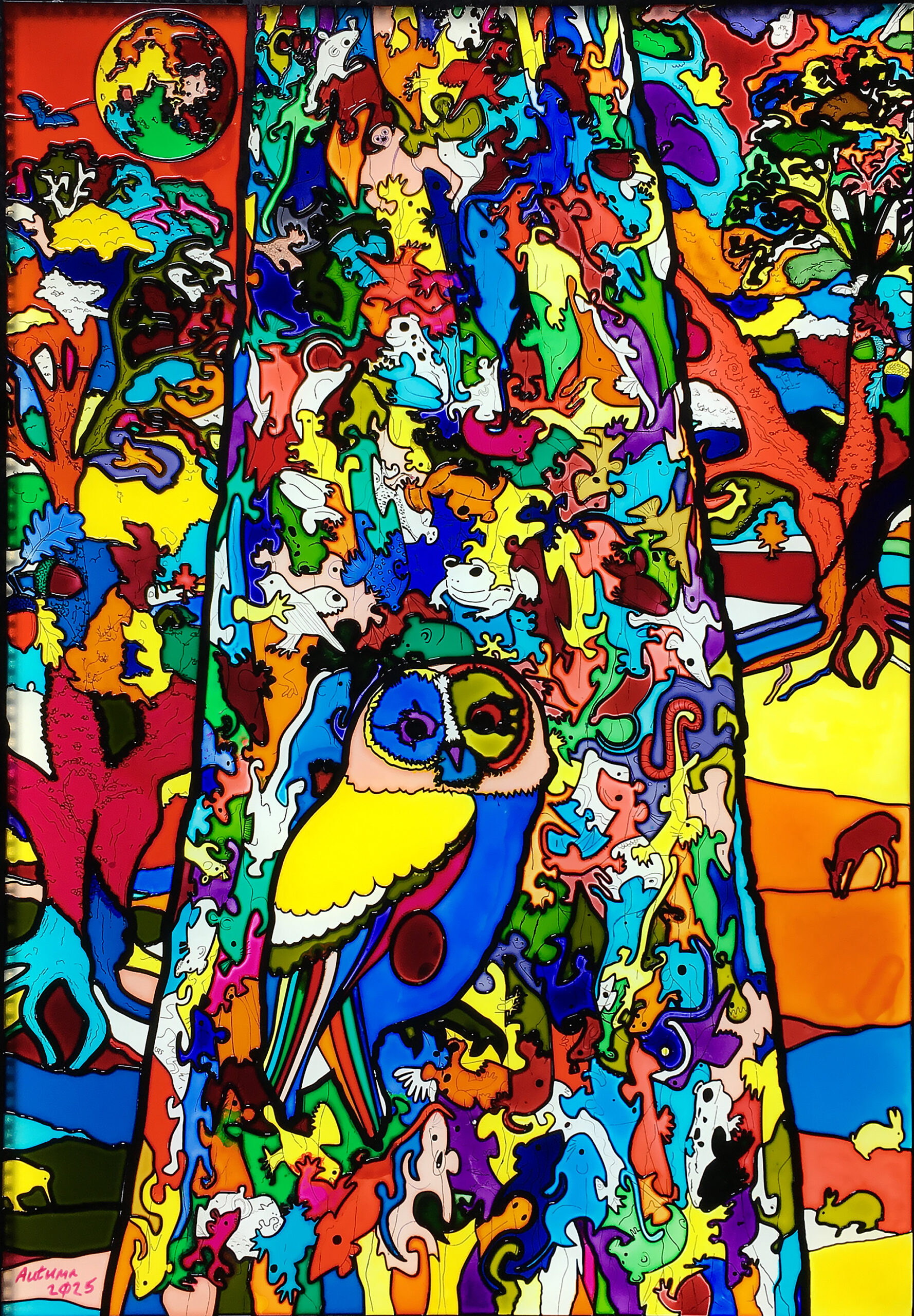
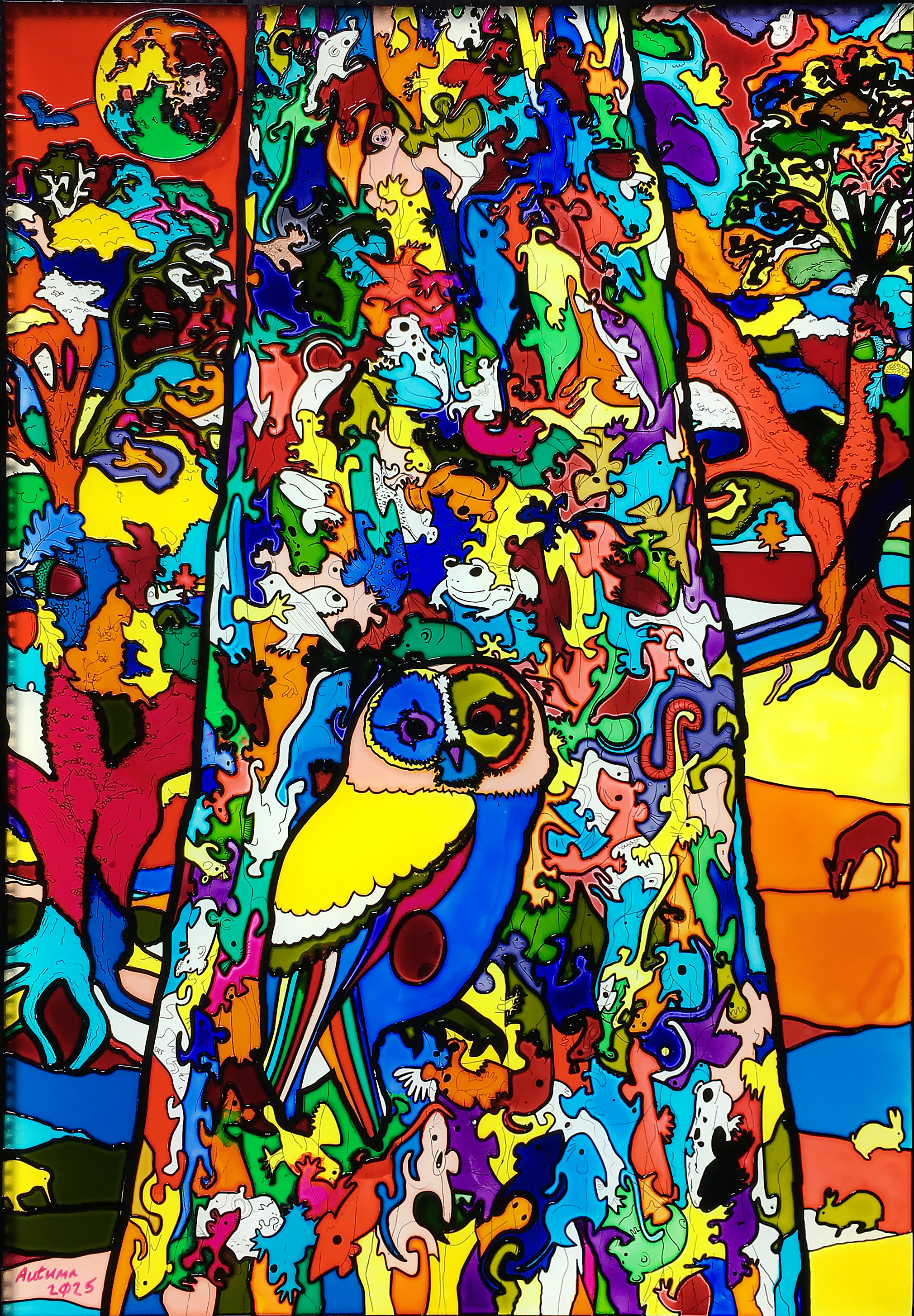
Title: “Tawny Owl in Landscape (Predator and Prey) (floral map)” Artist: Michael Autumn Medium: Resinous glass paints on faux leaded (composite plastic) clear cast acrylic sheet Size: 60cm (W) x 85cm (H) Edition: Original Authenticity: Hand-signed (bottom, far left) with purple glass paint on light pink painted cloisonné cell. Date: 02/2025
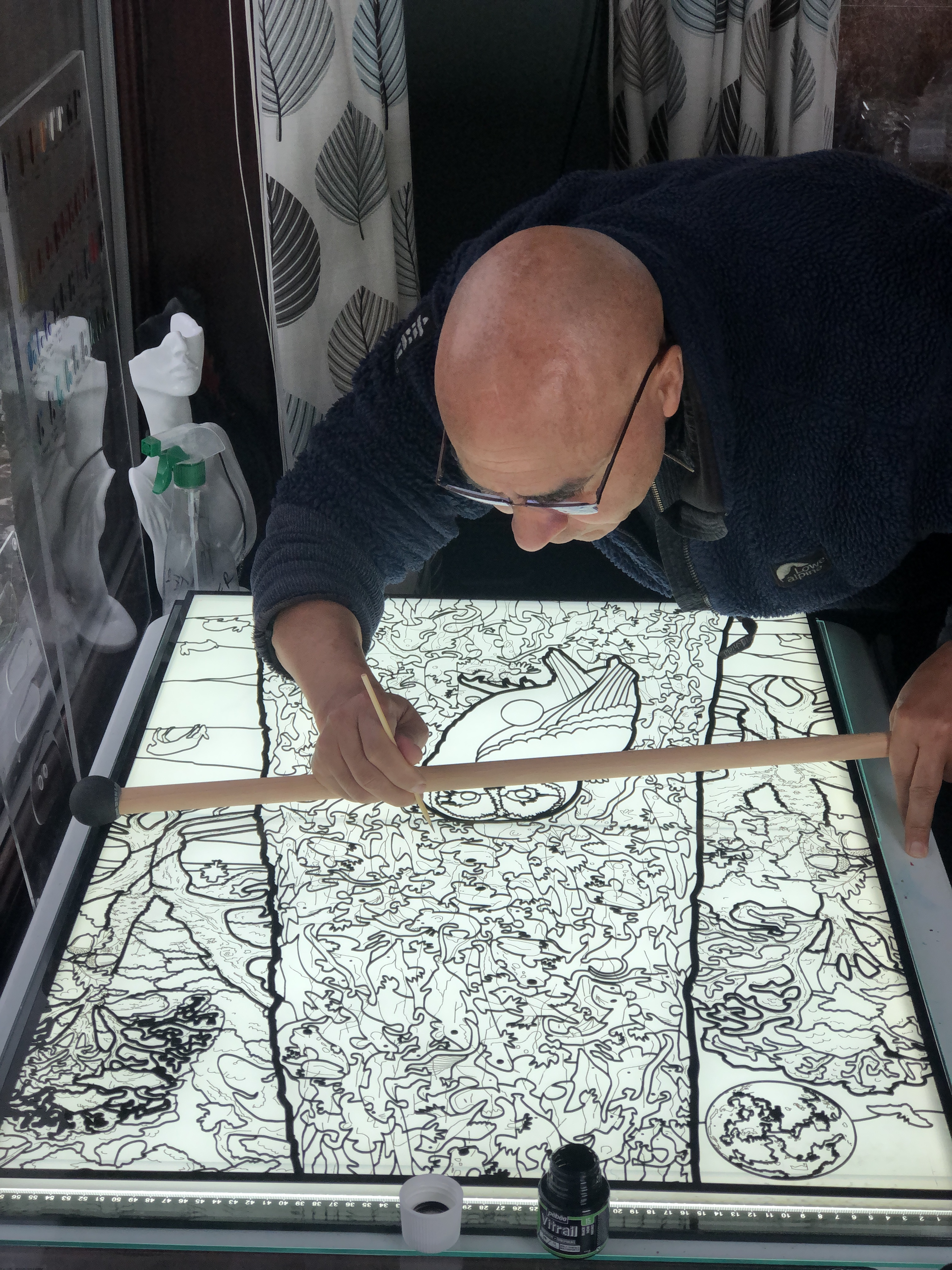
Michael Autumn drawing and painting black detail lines and spots amid the laser cut black composite plastic faux leading.
TL;DR
Not tied to any particular medium or technique, I have tried to devise a way of achieving a stained-glass look with much more detail than is conventionally possible – using a clear acrylic sheet, laser-cut black composite “leading” (aka “cames” – the “H”-shaped strips of lead holding the glass pieces together), and the coloured “glass pieces” are transparent resinous glass paint.
The scene is a tawny owl in a “tree”, in a landscape with animals, trees, bats, and the moon in the background. The main foreground “tree” trunk is actually made up of a variety of the owl’s prey creatures – and asks the question: if these owls eat 2-6 of these animals every day, and they live up to 24 years…?
The centre column (the main tree trunk) of this artwork comes directly from my original thick oak wooden art puzzle (see https://michaelautumn.wordpress.com/2023/05/03/tawny-owl-with-egg-art-puzzle/). That work is naturally quite dark and monochromatic because it is a nocturnal scene, and most of the prey animals (depicted in the main tree trunk) are also nocturnal, and therefore dark and dull coloured. So I thought it would be interesting to turn the idea upside-down and make it into a vibrant kaleidoscopic “stained-glass” landscape scene.
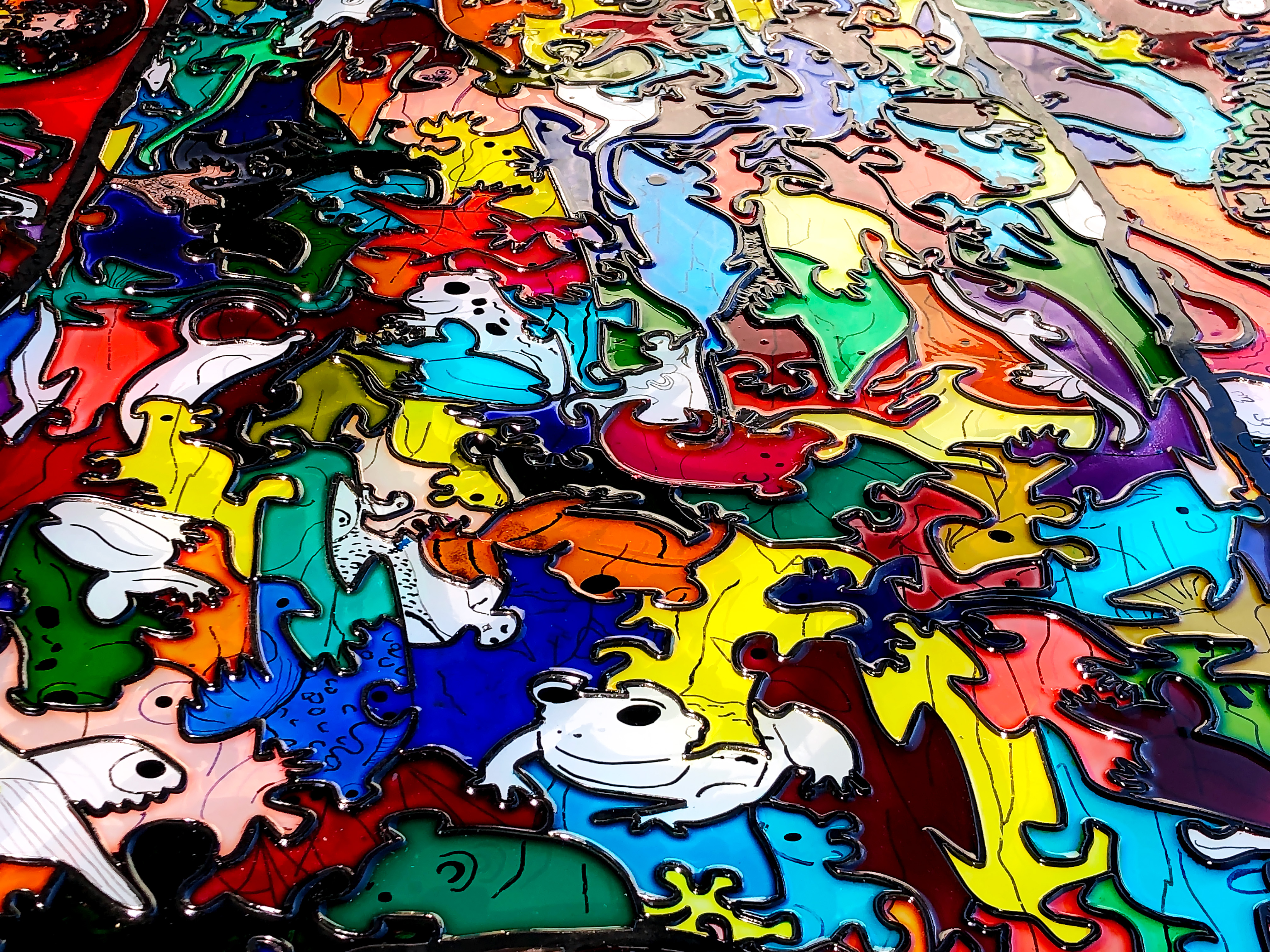
This imaginary landscape faux stained-glass artwork is my attempt to overcome some of the limitations of conventional stained-glass techniques. It’s hand drawn and hand painted (using transparent resinous glass paints) on a 10mm thick clear 850mm x 600mm acrylic base. The faux leading (aka “cames” – the “H”-shaped strips of lead holding the glass pieces together) (of different widths) is my devising: its hand-drawn, laser cut, black composite – glued to the acrylic base. The coloured glass effect is achieved with transparent resinous glass paint lasgely poured into each cell – an effect very much like cloisonné stained-glass.
I’m lucky to be a completely free artist – unaffiliated to any art movement, genre, or medium; and not tied to any particular materials, methods or techniques. My main interest is expressing my creativity and achieving my designs to the best of my ability – using any material/s or techniques I can think of to help me achieve my goals. I like exploring new materials, tools, and technologies: you might call me a tech geek. I’m very interested in pushing art forward – as opposed to continuing centuries-old traditions and techniques. In every historical medium I can think of, past masters in those mediums cannot be matched – let alone surpassed – and I think it’s pointless to try. All artists can do what they like, but I am keen on creating new things. I’m very interested in trying new materials and tools that give new and/or greater creative possibilities. While I like the look of stained-glass, I find that the centuries-old tradition of cutting glass and fusing pieces side-by-side with lead – is too restrictive, time-consuming, and cumbersome. Through my own research and tests I realised it’s possible to create the same look, but more easily and in much greater detail.
In this artwork I have simulated the opaque dark lead cames look of stained-glass using laser cut black plastic composite. I developed this idea through research and testing, and my design fully exploits the much greater detail possible. My most intricate laser can cut thin material and can readily cut 1mm latticework. The thinnest commercially available lead cames I can find are between 3.5mm and 5mm… The majority of the faux cames in this artword are 1mm, the widest is 8mm. This means not only that far greater detail in the design are achievable, but also more light can come through the window…
Lead cames have the function of binding pieces of transparent glass side by side. But I am using coloured transparent resinous glass paint – so I don’t need to bind pieces of glass together. Cames also have an aesthetic that I like that highlights shapes and colours. I use different widths giving me greater artistic freedom than with conventional cames.
Finally, the whole piece is covered in a thin layer of clear resin to seal everything and provide extra protection. So the actual stained-glass piece is a thin layer sandwiched between a sheet of clear cast acrylic and a clear resin topcoat. The base, or rear, acrylic sheet also acts as natural UV protection – filtering out up to 99% UV radiation. And, since this is the side facing the sun/daylight, means it is in the best position to protect the sandwiched coloured layer…
This is just the beginning of me trying this new technique…
Ever since submissions of works for consideration to the annual Summer Exhibition have had to be done solely by photographs of the works – rather than sending in the actual works – I have felt very uncomfortable and uneasy about the selection process.
Firstly, judging an artwork by a relatively small photograph on a small computer screen (of who-knows what quality…?) is a very disingenuous way of seeing art. This disproportionately disadvantages large works compared with smaller ones. Also it disproportionately disadvantages colourful, compared with monochrome, works. And the quality of the photographs may not do the image justice… I imagine some of the widely established best works of art in history would be rejected based on up to three 1920 x 1080 pixel photographs seen on a computer screen…
Secondly, I am especially concerned by the request for certain pieces of information on the application forms – information that should have absolutely no bearing whatsoever on the selection process. Whether this seemingly irrelevant information is used in the selection process or not is simply not know, but the mere fact that it is requested – and with the process not being transparent – leaves this open to question…
Why do you need to know if we have exhibited at the Summer Exhibition before?!
Why do you need to know if we are a Friend of the Royal Academy?!
Why do you need to know the price of the work (you can ask for this if the work is selected)?
The trouble of this covert digital selection process is that we have no way of even knowing if our photos are reviewed at all – or whether they are simply filtered out as rejects based on arbitrary, but irrelevant, information – or due to some other covert agenda… Who knows if preference is given to Friends of the RA…? Who knows if preference is given to people who have (or haven’t) exhibited before…? Who knows if decisions are based on the price of the work, or expected revenue from sales of the work…?
I am not casting aspersions or making accusations about the selection process, I am merely highlighting that it is not transparent at all, it is far from the ideal way to see art, and it is certainly open to abuse. If you persist with this selection process you should make every effort to make it transparent – and not ask for irrelevant information on the application form. Some information is only relevant if the work is selected – not before…
I mourn the days of simple transparency – when work was physically submitted and paraded in front of the selection panel – and it was sometimes filmed for all to see. This assured us that the visual impact of the whole work – with no irrelevant information – was the only selection criterion. In those halcyon days of knowing the selection panel were seeing the works in the flesh – and with no prior knowledge of the artist or the work – only then did we know that this was the most objective and honest way of a panel of RA artists making a collective subjective decision…
I fully understand that during COVID-19 there was no alternative other than to submit photographs of artwork, but now there is absolutely no excuse not to go back to the tried and tested physically present ways – the method the RA used for nearly 250 years prior to COVID. The reduced cost of using photographs and the sending of emails has considerably reduced costs to the RA Summer Exhibition, but it is to the great detriment of the exhibitors…
The Summer Exhibition is a hugely profitable source of revenue for the RA, but it relies entirely on the trust and support of artists. I will not be submitting any more works to future Summer Exhibitions unless we go back to the tried and tested way of doing it, or until the issues of transparency are completely addressed, and I urge other artists to seriously consider their position…
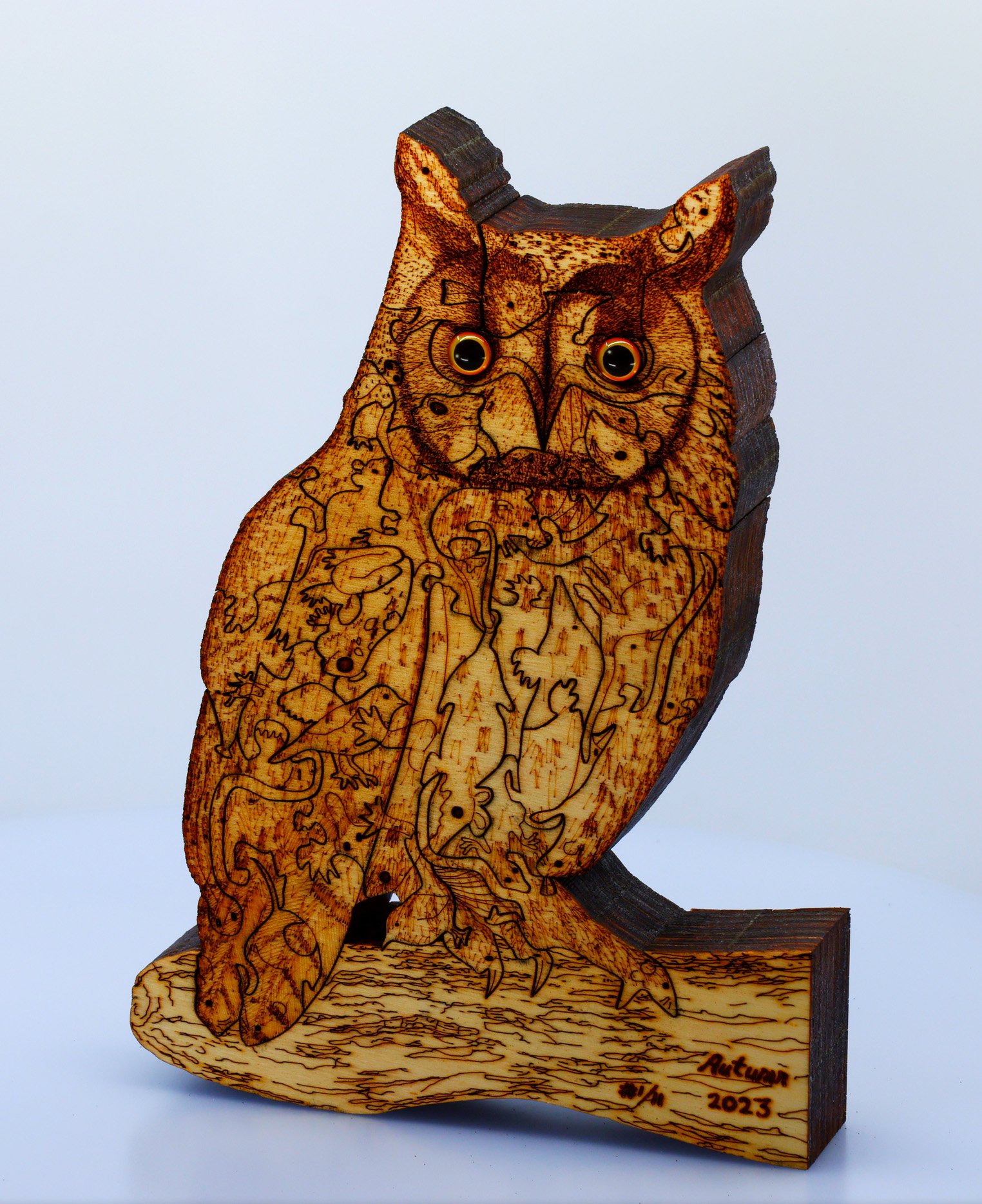
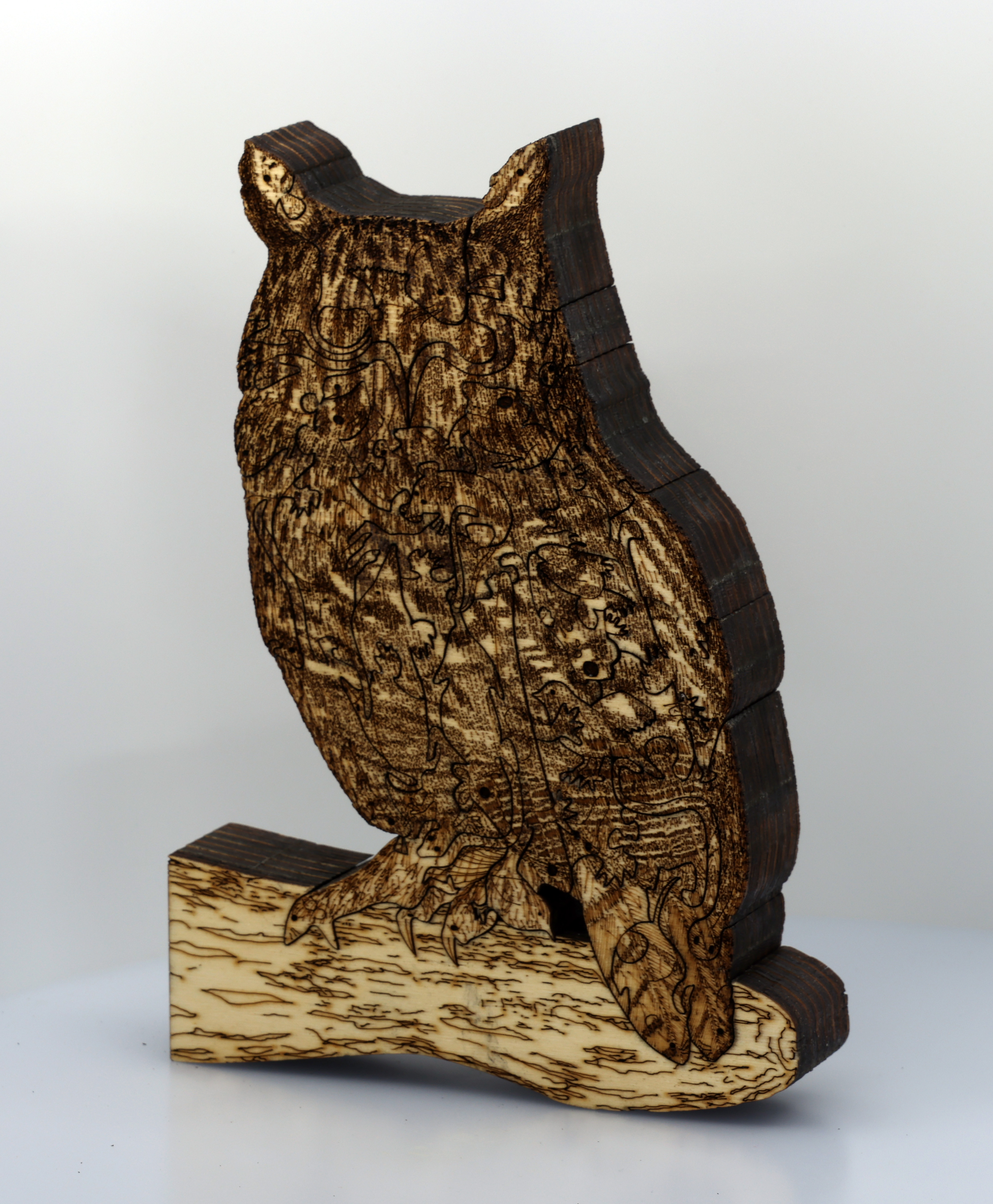
Title: “Long-eared Owl (Art Puzzle) (You Are What You Eat)” – laminated Artist: Michael Autumn Life-sized part-handmade, part laser-cut & engraved, two-sided, laminated plywood art puzzle (Limited Edition of 11)
Long-eared Owl (Art Puzzle) – Laminated: Full image – front
Size: 20cm (W) x 30cm (H) x 4cm (depth) @ 0.65kg weight Medium: 7 laminated layers of 6mm AB/AB Italian Panguaneta Poplar plywood + acrylic eyes. Date: 2023Rear of the laminated version
This is the culmination of three years of trying to find an engineering solution to making the incredibly intricate thick oak art puzzles I used to very laboriously (and painstakingly!) cut by hand using an electronic scroll (fret) saw. I tried waterjet cutting (that blasts away intricate areas and requires continuous cuts – totally wrong!). I bought and tried CNC routing (for about six months) with the smallest router bits available – but the bits that had the required diameter (1/32″) kept breaking and couldn’t reliably cut the depth required. And it require cutting at such small depths at each pass that even if the router bits didn’t keep breaking (and the whole job having to be restarted!) then it would have taken literally weeks to complete a single design!
The problem with conventional laser cutting (which I spent the best part of a year trying – with three different bought lasers) is that the deeper the material is, the more power is required – and therefore the wider the laser beam is. This results in an unacceptably wide kerf – gap between cuts. The kerf (gap) I managed by scroll-sawing – was about 0.7mm – which is the minimum I can accept. A laser that can cut through 42mm of plywood would ordinarily have a kerf of well over 1mm. So that is out of the question.
I pondered this dilemma for months, and tried various ideas – none of which worked. Eventually I can up with the idea of not trying to cut such thick material all at once – but to cut it much more finely in several thin layers – and then bond them together. This has (had) a number of issues and challenges in and of itself, however, I’m extremely please and relieved that I worked out solutions to the problems. And when I first produced the first fully acceptable complete version I was on cloud nine for several days…!
Suffice to say that the part hand-, part laser-, cut laminated version of my Long-eared Owl (Art Puzzle), is far more accurate, better fitting, and more reproducible – without causing RSI/hand arthritis! Having said all that, it takes about the same amount of time in total as hand-cutting(!) – about a week for each edition – because of all the part-laser cutting of multiple layers, doing the rear design – and quite a lot hand-finishing. But at least if is much less of a strain on my hands – and infinitely less daunting…!
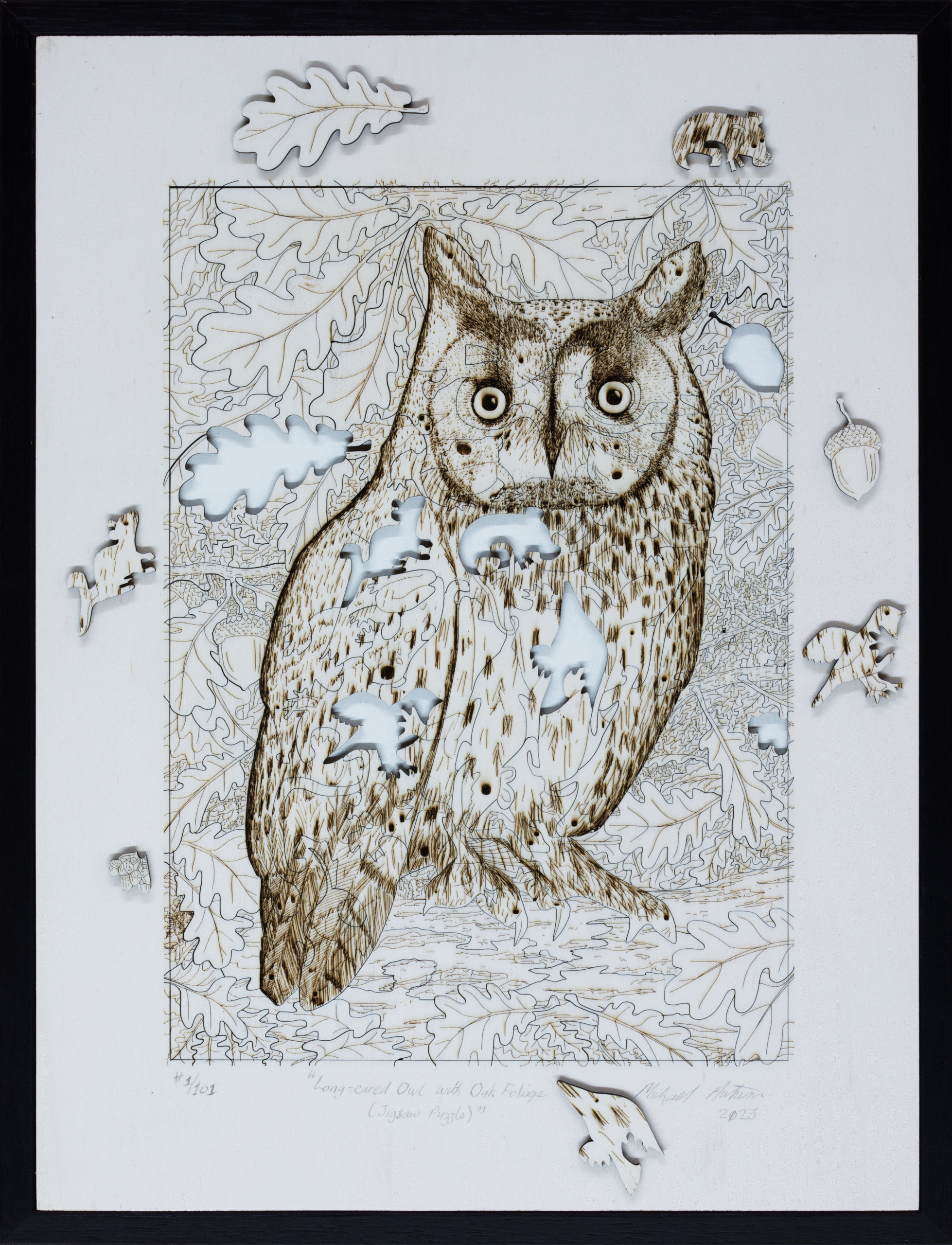
Medium: Hand-drawing – laser cut & engraved premium 3mm AB/AB Italian Panguaneta Poplar plywood Size: 48cm (H) x 38cm (W) (including the frame) Date: 2023 Country: UK
Description: The idea behind this artwork was to have a tactile, life-sized, long-eared owl, and to toy with the idea – “You are what you eat”. Long-eared owls are ferocious predators (as are all owls) – and will basically eat anything that moves that is smaller than them. They often swallow their prey whole, and regurgitate a large pellet of the undigestible parts – such as bones, teeth, hair, feathers. Indeed, examining their pellets is how ornithologists know so much about what they eat.
This is a very high (in the case of the unlimited edition), and extremely high (in the case of the limited edition), quality laser-cut “art” jigsaw puzzle – directly cut (and scored) from an original digital hand-drawing. The design is a specially modified drawing of his original hand-cut thick solid oak artwork entitled “Long-eared Owl (Jigsaw Puzzle) (You are what you eat)” (2022) (see https://michaelautumn.wordpress.com/2023/05/03/long-eared-owl-jigsaw-puzzle-you-are-what-you-eat/ and https://youtu.be/jWsK6TFEevk).
Jigsaw Puzzle?
This is not a jigsaw puzzle in the conventional sense of the word: it is not simply a print stuck on card or wood – and cut into puzzle pieces – where the jigsaw puzzle was never envisioned by the artist (or photographer). Most jigsaw puzzles are a commercial after-design afterthought. However, this artwork was designed from the outset, and from the ground up, as a jigsaw puzzle. This is an artwork where every single line drawn was specifically designed to be cut as interlocking puzzle pieces. This is not a cut-up picture – there are only completely intentional cuts/joints – to make a work of art.
The “art” side of this artwork is where I have designed the owl to show that it is literally made of many of the wide variety of creatures that it eats. I used the simple jigsaw-puzzle you-are-what-you-eat metaphor to illustrate this puzzling (pun intended!) transformation of lots of small animals making up an owl. My hope is that interacting with art like this will make you think more about the message in it than if it was a normal drawing or painting…
This is a line drawing – where the strong lines are cut through the wood (to form the jigsaw puzzle pieces), and the weaker lines are scored and engraved on to the surface of the wood (to add extra detail) – by the use of a very high quality laser.
This laser-cut artwork has considerable extra detail compared to the aforementioned artwork, and has a rich oak foliage background – to take full advantage of the extra cutting and scoring precision achievable with a very high quality laser – compared to hand-cutting and scoring. Also I wanted to produce much more affordable art – compared to my very laborious (and strenuous!), hand-cut, hand-finished, original artworks.
Laser-cut
This is not ordinary laser cutting: this is laser-cutting pushed to its limits. The usual flaws of laser cutting – scorching, burn marks, unsharp, brittle and crumbling edges, poor detail – might be acceptable to most people, but wasn’t acceptable to me – a self-confessed perfectionist with OCD! So over several months I exhaustedly researched the problems, tried various solutions, found some to be too labour intensive, thought outside the box, made a special tool, and eventually came up with a workflow of pre-, and post-, production, specially selected materials, and using special techniques. Now I’m very happy with the results: near perfection and consistency – I think it’s the best you are likely to see – or feel…
Editions: Available in both limited and unlimited editions (see respectively named sections below).
Material: finest quality 3mm hardwood plywood
sustainably produced wood
specially treated (protected against frequent handling, moisture, water spills, saliva, dirt)
non-cracking, non-peeling, non-flaking
(the limited edition has a higher specification – see “Limited Edition” section below)
Number of pieces in puzzle: 156
Jigsaw puzzle size: 297mm (H) x 210mm (W)
Size with extended mat (for unlimited editions): 400mm (H) x 300mm (W)
Custom Frame size (available for unlimited editions): 480mm (H) x 380mm (W) x 47mm (D)
N.B. Not suitable for young children due to the very small size of some of the pieces (the smallest are approximately 10mm x 5mm), however, the varnish meets child safety standards (EN 71.3).
Limited Edition
Details of the edition are hand-written by the artist in pencil on the special mat below the artwork in the following form :-
Edition number (left), title of artwork & year (middle), signature (right).
Edition Size: 101
Edition numbering format: #[space][edition number]/[edition size] – e.g. “# 23/101” (the “#” is to prevent any additional digits being added to the left).
While made from the same wood, the limited edition differ from the unlimited edition in the following important ways :-
Comparing pieces from unlimited (left) and limited (right)
Are lighter in colour (with staining) so that the design stands out more clearly.
The wood is specially treated for maximum UV protection, to minimise colour change, and to virtually eliminate yellowing, darkening, and radiation damage that normally occurs in unprotected wood after many years.
Are cut with a much finer laser to virtually eliminate the gap between pieces and to give even tighter joints than the unlimited edition. The laser cutting takes three times longer than normal – taking over three hours for each artwork.
They come with the outer perimeter wood (known as the “mat”) from which they were cut – with the design bleeding 2mm into it – making a natural-looking border. The mat is intended to be framed, and it provides space for the all-important hand-written edition number, the work title, the year, and the artist’s signature.
Available with the optional special bespoke museum-grade archival frame. Not everyone is concerned about protecting their investment and their art staying in excellent condition for hundreds of years – or they possibly are, but don’t want to spend the extra money on this – which is why the special framing offered is optional. The limited edition art jigsaw puzzle can be purchased unframed (it still comes with the aforementioned mat).
The frame has been specially designed and made by me. I am an experienced framer (and general carpenter/joiner), but I don’t relish framing! I only make special frames because unfortunately some of the types of frames I want can’t be made by most professional framers – they can need special joints, special and very exacting moulding, interlocking double frames with very precise features.
Most art is only for show – it is not meant to be touched at all – and is shielded behind a completely sealed frame and/or covered in layers of varnish. The custom frame made for this artwork is very special because I wanted the ability for the artwork to be hung on the wall – with all the pieces remaining in place(!) – whilst also being easily opened – so that the jigsaw puzzle can actually be solved as often as desired. How to achieve this, whilst at the same time providing the maximum level of protection so that the artwork lasts hundreds of years…? The answer was to make a two- part museum-grade frame – where one part fits snugly inside the other. The front (outer) part has the highest quality, clearest, anti-reflective, museum glass – that virtually eliminates all harmful UV radiation and naturally protects the artwork from dirt, dust, etc. The back (inner) part holds the mat of the artwork jigsaw puzzle completely flat to a museum-grade, acid-neutral, non-VOC, non-staining, 100% cotton rag mount board – which in turn is mounted on a very thick, very rigid, acid-free, non-VOC, non-staining, backing board – all using museum-grade adhesives, hinges, and tapes. The front (outer) frame is made from a customised precision moulding – because the required specifications are such that it is not available off-the-shelf.
The end result is a fabulous frame “sandwich” that can be put on the wall – like normal framed artwork – and can be taken down any time so you can attempt to solve it. The front part can easily be lifted off (by sliding open the clasps at the back), and the jigsaw puzzle pieces can be tipped out – ready to be solved. Afterwards, the front can be replaced, the clasps at the back closed, and the whole frame can be hung back on the wall.
This frame design is museum grade in all but one inevitable respect: it is designed to be opened – and is therefore not completelyand permanentlysealed. This is a very minor concession – that is obviously required for the ability to solve the jigsaw puzzle as often as required. However, obviously it can very easily be sealed at the back (preferably with readily available archival backing tape) if required – needing no special tools or skill. When sealed at the back like this, it would be 100% museum grade. But even without being sealed, it is 99% museum grade – and should last in pristine condition for hundreds of years.
Unlimited Edition
The unlimited edition is a very high quality laser-cut wooden product – probably the highest quality wooden jigsaw puzzle available anywhere – as of 2023 (apart from the limited edition version of course). These are not mass-produced: they are individually produced on a very fine laser – taking over an hour each – and the post-production is individually inspected and counted to guarantee quality control. The unlimited edition is not available framed.
It’s been a really long journey, I got lost in the blackest wilderness for a very long time, but I’m finally back on the right track – heading in my chosen direction… Art is not something where you can say you’ve achieved your goal: it’s the exploratory journey that is the pleasure and ambition. Yes, we may enjoy some wonderful sights and places along the way, but there is no particular destination…
When I left university – after failing in my academic ambitions (principally due to a complete change in interests from economics to philosophy and psychology – but not being allowed to change course) – I tried to make a living from my life-long creative passion – art. But I had no capital or support, and prostituted myself – doing mundane commissions and speculative commercial work – for a full year. I decided this extremely insecure, hand-to-mouth, existence, was no life for me, and I promised myself I would never financially rely on art again – or prostitute my art again – instead I would focus on doing the kind of art I wanted to do – for myself (in the first instance)…
After the brief encounter with “professional art” I stumbled into computing (IT) – something that came very naturally to me (I got engrossed with programming at university), and I thrived on it. In a very real sense computer programming is the complete opposite to art: programming is mostly convergent and objective thinking to solve very specific, precise, objective, mathematical and logical problems – using nothing but a Qwerty keyboard and VDU – and producing computer code – but it has no direct permanent artifacts. Whereas art is mostly divergent and subjective thinking – and a lot of manual dexterity and very skilled manipulation of physical materials – and is not trying to solve any problems at all – it is most often purely for beauty’s sake. And an artifact is always the end result.
During a long career in IT, I continued art (and photography – once I could afford it) on my own terms… (In the early years I took out – what was for me – a huge loan to buy professional photographic equipment – that cost about a year’s average salary.) I started entirely with analogue art and photographic equipment, and later evolved with the digital revolutions in both. My IT background helped considerably in this regard, and I was able to do more and more exciting things –making creative use of the extensive opportunities digital technology offered…
Eighteen years ago (at the time of writing this) I got married, and my wife and I bought a house together – with the main ambition being to develop our art interests and to start earning money from it (on own terms). I built a large studio (from a large barn), a workshop, a framing workshop, and a digital office. I converted a van for the safe transport of large framed glazed artworks. I was able to produce digital art to museum archival standards, and submitted work to the Royal Academy Summer Exhibitions – and sold some limited edition work at a good price. Things started to look up.
But no sooner had I started to get established, and it all collapsed due to a most heinous, psychopathic, sociopathic, attack by my insecure, irrationally and intensely jealous, (ex-)wife… The art-making complex I created, all my artworks, every photograph I have ever taken, every print I have ever made – over decades – have all gone. But that was as nothing compared to the unfathomable pain of not seeing the children, feeling their pain and confusion of not seeing me; a catastrophic breakdown, the utter terror, despair, hopelessness, blackness, I suffered – and suffer still to this day – thirteen years on… Indeed, if it were not for my son – and wanting him to learn the truth of what happened to him (and me) some day (when he becomes an adult?) – I would not be here now…
Some very intelligent women psychopaths (like Cleopatra and Livia Drusilla – and my ex), being physically weaker, are sociopaths as well – and often resort to coldly and completely selfishly manipulating others to achieve their nefarious ends – completely oblivious to the harm and pain they inflict along the way. This can magnify their powers enormously. Indeed, I would go so far as to suggest that such women are invariably very intelligent because they have to be to – to pull the wool over so many people’s eyes – often for years… They lead a web of lies and deceit that has to be very convincingly and consistently acted out – and so they have to be great actresses as well…
Years of depression and PTSD followed (I will never be the person I was, but I struggle on), with no creative output whatsoever for years. Most men suffer trauma like this on their own. For me, talking about it only made me feel worse. So-called “professionals”– who’ve probably never dealt with such cases before – asking naïve questions – is no help whatsoever. They are of the simple-mindedness of thinking that talking about pain helps – when in fact it doesn’t: it makes you feel worse. Re-living trauma is not any help for trauma…!
I could have produced some of the most melancholic and distressing art imaginable, but I hate depressive and dark art, and I chose not to inflict that on the world… Art for me always has been, and always will be, something positive and beautiful – something to bring light and joy into people’s lives, and preferably thought-provoking…
I look back now on those darkest years and wonder where the time went. I frequently see TV programmes, films, music, and sport from this period – but don’t remember anything about them – as if they happened before I was born – or I was in a coma all that time. For example, I recently (this late summer 2023) saw cricket documentaries about England winning the Ashes in 2015 and the world cup in 2019. I am a very keen follower of cricket (and played a huge amount in my youth: played for four different teams each week, and captained the school team), but I have absolutely no recollection of either of these momentous achievements…!
Such trauma, as I have suffered, either kills you – or you very slowly learn to live with it and slowly turn you attention to other things. Very slowly the blackness gives way to light. Very gradually the light started to come back into my life. IT has been good to me (and hopefully I to it), and it has many synergies in art and photography that I have been keen to explore. Among other things, IT has given me the financial opportunity to re-assess my life and prioritise what is important to me. Art is important to me, but I don’t want to be financially dependent on it. So in late 2021 (and largely due to melancholia) I decided to liquidate my assets, downsize, and find a suitable home in Scotland – with good art workshop/studio potential, close to the mountains, sea, and rivers (which I love) – and concentrate on art… Yes, I’d like to get my art “out there”, and sell non-originals – but I don’t want to be financiallydependent on it…
I’m finally getting back unto my stride. I’ve built a reasonably sized workshop and studio (adapted from an empty outbuilding) and fully equipped it. I’ve had the budget to buy and try just about everything I’ve wanted, and have fully resumed my art journey. This time I have seen to it that there will be no disruptions…
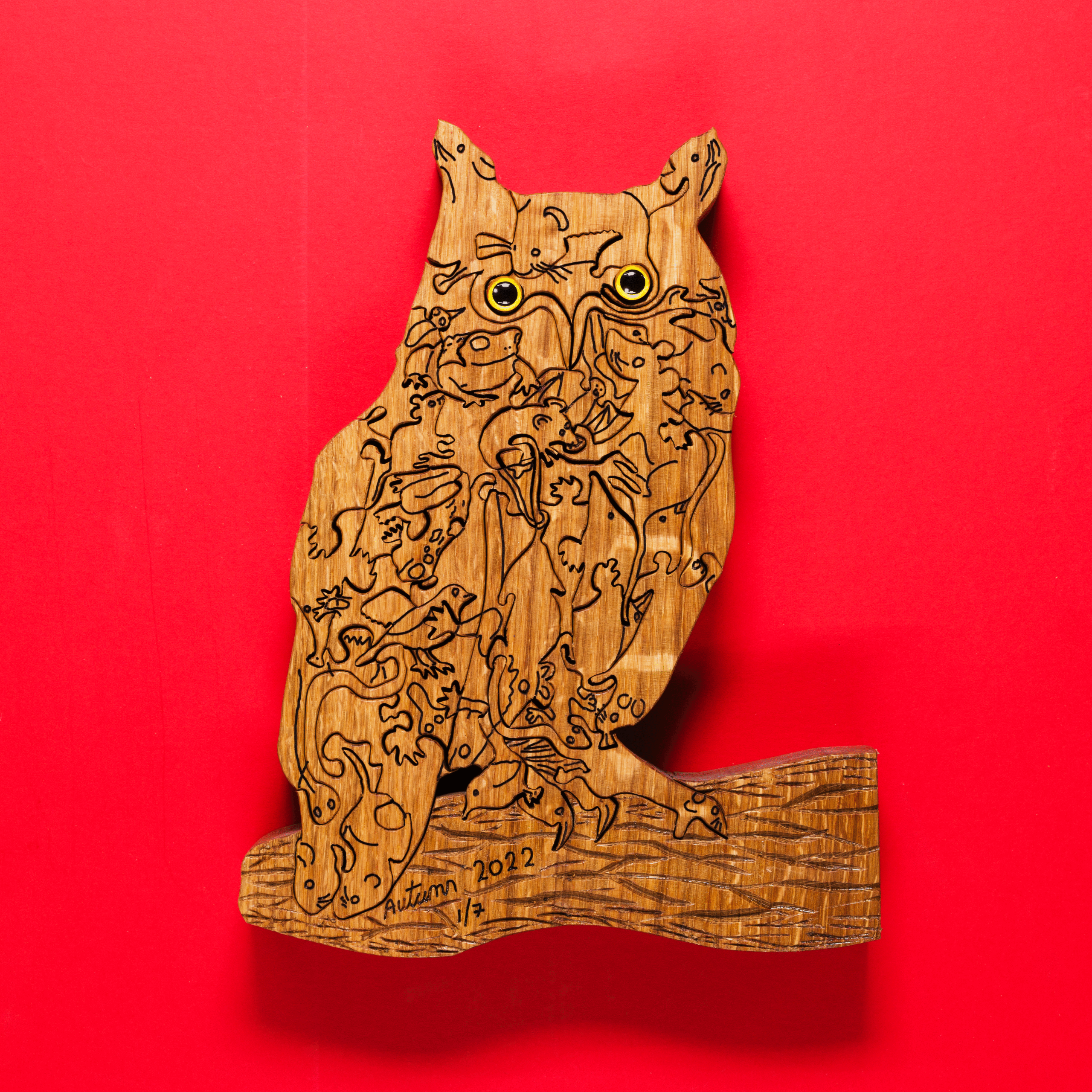
Title: “Long-eared Owl (Art Puzzle) (You Are What You Eat)” Artist: Michael Autumn Life-sized handmade solid oak jigsaw puzzle (Limited Edition of 7)
Long-eared Owl (Art Puzzle): Full image Size: 20cm (W) x 30cm (H) x 4cm (depth) @ 1.5kg weight Medium: Solid European Oak, hand-cut, hand-engraved, hand-carved, art puzzle + acrylic eyes. Date: 2022
Long-eared Owl
The story behind this art piece was to have a free-standing, tactile, life-sized long-eared owl, and to toy with the idea – “You are what you eat“. These birds are ferocious predators (as are all owls) – and will basically eat anything that moves that is smaller than them. They often swallow their prey whole, and regurgitate a large pellet of the undigestible parts – such as bones, teeth, hair, feathers. Indeed, examining their pellets is how ornithologists know so much about what they eat.
I often think about predator-prey relationships – perhaps being a veggie has something to do with this… All animals have to get their energy and material they are made of by consuming specific things – protiens, carbohydrates, and fats. Herbivores obviously get this material directly and indirectly from plants – which is often widely available (they don’t usually eat fats directly, but make them from carbohydrates). However, they usually have to eat a lot of plant material in relation to their size because it is a low concentrated source of food – requiring long, slow, complex digestion. Predators usually don’t eat plants – instead they prefer much more concentrated and complex food in the form of other animals.
I have designed the owl to show that it is literally made of many of the wide variety of creatures that it eats. From the moment of conception – where it starts as a single egg – it literally takes parts of smaller animals – and its amazing body chemistry converts them into material to make (and maintain) it’s growing body – and energy. I used the simple jigsaw-puzzle you-are-what-you-eat metaphor to illustrate this puzzling (pun intended!) transformation of lots of small animals making up an owl.
Owls typically eat 2-4 mice-sized animals per day – so about a thousand a year. Without owls, goodness know how many mice, moles, voles, rats, small birds, newts, etc. there would be…!
(I have to confess this was originally intended to be a tawny owl! I haven’t been lucky enough to actually see a wild long-eared owl, and as I got a long way into designing this piece I felt it would look better with ears – and, of course, a tawny owl doesn’t have visible “ears“… So I thought, okay, I’ll change it to a long-eared owl – they have great “ears” (well they look like ears, but they’re actually not – they’re just tufts of feathers!). The two species are quite similar in many respects – so the change was easy!)
The phrase limited edition in this case is a bit of a misnomer. These are all individually handmade by me from my original design. I really wish there was, but there is no mechanical or chemical process I know of by which these can be reproduced – like screen printing, lithographs, card puzzles (using a die and jigsaw press), etc. (for more details please see the aforementioned post).
Life-sized handmade solid oak art puzzle (Limited Edition of 7)
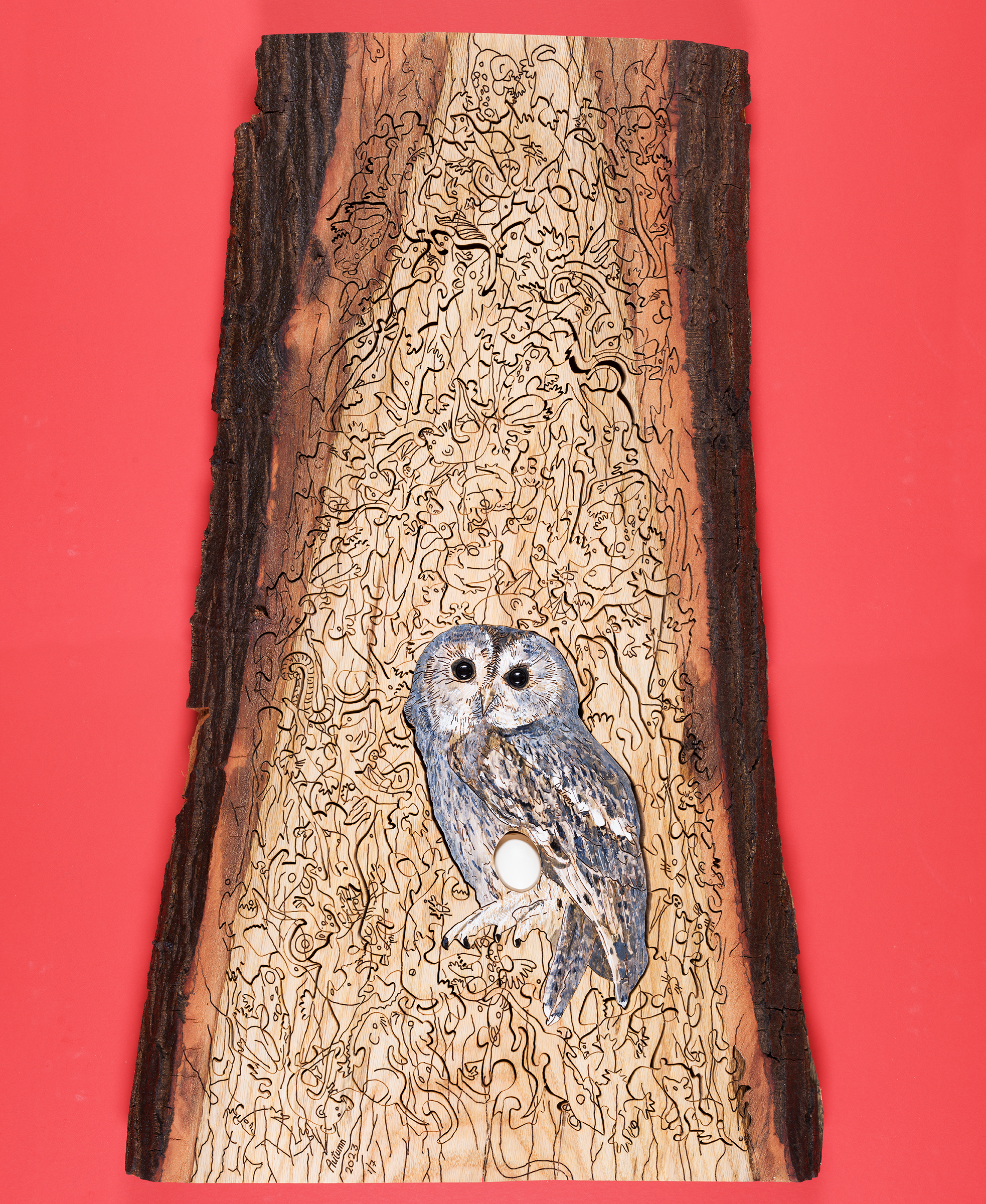
Tawny Owl with Egg (Art Puzzle): Full image Size: 50cm (W) x 82cm (H) x 8cm (depth) @ 20kg weight Medium: A single piece of waney-edged European Oak, hand-cut, hand-engraved, art puzzle with inset full-size replica tawny owl egg and acrylic eyes. Date: 2023
First and foremost I want to mention that the eggs used in my work are not real – for obvious ethical reasons (it is also illegal to take wild birds eggs). They are life-size replicas made of a plaster resin composite and hand-painted – not by me, but by a very reputable leading replica birds eggs maker.
Tawny Owl
Following on from Guillemot with Egg (Jigsaw Puzzle) (see https://michaelautumn.wordpress.com/2020/03/01/guillemot-with-egg-art-puzzle/), I thought I would pay homage to another favourite bird of mine – the Tawny Owl (Strix aluco). These, like all owls, are very mysterious – especially the noctornal ones (which tawnies are) – because they do things the opposite to us: they sleep/rest during the daylight, and come out – and hunt – at night. They are supremely designed and adapted to this lifestyle: they have excellent hearing and eyesight, they fly almost silently, and their hunting strategy is to hunt in the darkness – when other small nocturnal animals think it’s safe to come out…!
Mice, voles, shrews, moles – in fact any small rodent up to the size of a rat – are largely nocternal to avoid daylight predators – like kestrels, buzzards, merlin, sparrowhawks. But while rummaging for food and going about their normal lives – in what they think is the relative safety of darkness – a tawny owl – alerted to their presence by their quiet, but inevitable, sounds – can swoop undetected near to the unwitting little creatures. From close by the tawny can watch their prey’s every move – until they decide to pounce, crush and puncture them with their razor-sharp tallons – and then invariably swallow them whole…
Little birds could be roosting or sleeping in trees or bushes, but if they make any sounds in their sleep – even just quietly snooring or sleep-calling/singing – they are easy game for these owls… Frogs, toads, newts – in fact any small reptile – making any kind of sound at night – are likely to court the deadly attention of a tawny owl. Even fish splashing about at the water’s surface, or in the shallows, are fair game for these owls…
Suffice to say that if it is small and it makes a noise, it is on the menu…! So I thought I would play with this idea and illustrate as many of the small creatures tawny owls eat – as jumbled up jigsaw pieces surrounding the main protagonist. The whole design slightly resembles a huge regurgitated pellet of the tawny owl, and the small prey animals are all jumbled up – like fragments in a pellet.
I like art in the form of a jigsaw puzzle because it is interactive, and by careful design of the shapes and carving on the pieces, I can get the puzzle-solver to look at, and think very carefully about, them – in a way that is simply not possible with non-interactive art. Indeed, someone could look at a piece of art like this and not even notice the small creatures surrounding the main owl – let alone have any understanding why they are there – and why these particular animals. However, trying to solve a puzzle like this is a very different matter – they will definitely think more about what it is they are looking at…!
I have deliberately made the jigsaw puzzle very subtle because Nature is very subtle. These creatures are very difficult to see because of their camouflage and because they mainly come out at night – and it is precisely because they are so difficult to see that the owls rely on the noise they make to home in on them… The puzzle metaphor lets me toy with the idea that these small creatures think they are invisible – or out of harm’s way – but to a tawny owl, in the dead calm of night, their sounds makes them highly visible…
Owls typically eat 2-4 mice-sized animals per day – so about a thousand a year. Without owls, goodness know how many mice, moles, voles, rats, small birds, newts, etc. there would be…! If all the creatures a tawny own ate over the course of its lifetime were put into a 30cm diameter (about the width of this jigsaw puzzle) very tall clear tube – I wonder how high the pile of eaten animals would be…
Close-up of the life-sized tawny owl with replica eggSome of the art puzzle pieces laid out
The phrase limited edition in this case is a bit of a misnomer. These are all individually handmade by me from my original design. I really wish there was, but there is no mechanical or chemical process I know of by which these can be reproduced – like screen printing, lithographs, card puzzles (using a die and jigsaw press), etc. (for more details please see the aforementioned post).