Category: Artist

  • Golden Plover with Egg (Art Puzzle)

    Golden Plover with Egg (Art Puzzle)

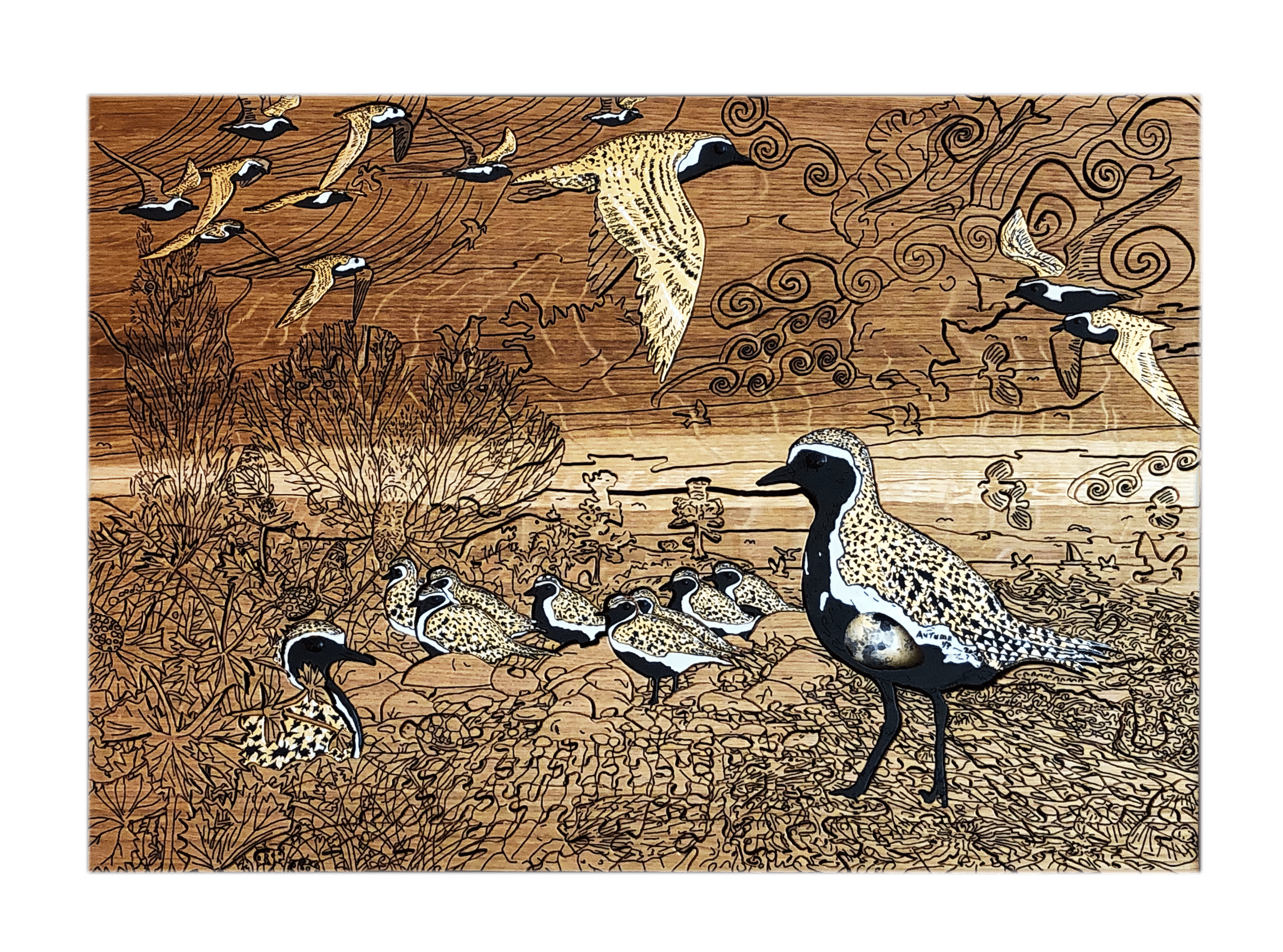
    Title: “Golden Plover with Egg (Art Puzzle)”

    Life-sized handmade solid oak art puzzle (Limited Edition of 7)

    Golden Plover with Egg (Art Puzzle): Full image
    Size: 59cm (W) x 41.5cm (H) x 4.4cm (depth) @ 9kg weight
    Medium: Solid European Oak, hand-cut, hand-engraved, jigsaw puzzle
    with inset full-size replica golden plover egg.
    Date: 2020
    Golden Plover in artist’s dining room (click on image to see artists’ home studio, workshop, and gallery).

    First and foremost I want to mention that the eggs used in my work are not real – for obvious ethical reasons (it is also illegal to take wild birds eggs). They are life-size replicas made of a plaster resin composite and hand-painted – not by me, but by a very reputable leading replica birds eggs maker.

    Golden Plover

    Following on from Guillemot with Egg (Jigsaw Puzzle) (see https://michaelautumn.wordpress.com/2020/03/01/guillemot-with-egg-art-puzzle/), I thought I would pay homage to another favourite bird of mine – the Golden Plover (Pluvialis apricaria). In winter plumage these birds are lovely, but unremarkable. However, in summer plumage they are absolutely stunning. The males are slightly more outstanding than the females, however, both are very distinctive and eye-catching. The spring transformation of the Golden Plover from winter to summer plumage is one of the most extreme, and beautiful, I know of. The word “dandy” comes to mind. They become the most striking of all the waders I know of.

    Golden Plover in summer plumage

    In summer their coal black bellies and faces, fringed with a slim cotton white mantle or fringe, and their “golden” upper parts – are a bold, brilliant sight to behold. But golden they are not! They are “buff”, ochre, or sandy brown – like most wading birds – who feed predominantly on mudflats and shorelines – and thus gain good overhead camouflage – so as not to draw attention to predators such as peregrine falcons, marsh harriers, etc.

    To highlight this golden misnomer I thought it would be fun to actually make them golden – 24 carat gold gilt to be precise! Gold is an incredibly beautiful and mysterious metal – mysterious both in terms of its physical properties and appearance, and its hold over us. Gold, with its density of 19.3 (over 19 times that of water), is the absolute nemesis of flight! Gold, with it strikingly bright, mirroring, shimmering sheen – is the nemesis of camouflage!

    24 carat gold gilded Golden Plover

    I hope the metallic gold of the Golden Plover in the above pictures is clear. Being metallic the light reflects differently according to the angle being viewed and the available light.

    Migration

    In summer Golden Plover breed in the tundra – countries such as Iceland, Greenland, Scandinavia, and northern Russia – where the days are very long indeed – and over-winter in warmer climes – and where there isn’t perpetual winter darkness – such as here in the UK (some go as far south as northern Africa). The migration to and from Iceland is no mean feat for such a small bird. The main bird in the picture is life-sized: they are approximately 20cm tall, and 28cm long. Many bird migrations follow land masses with hops over the shortest water expanses. For example many of our summer visitors, like the warblers, coocoos, hobbys, etc. come from Africa – where the largest stretch of water they have to fly continuously across is the English Channel – a mere 20-odd miles – less than a hour’s flight (the Straights of Gibraltar – the sea hop from Morocco to southern Spain is less than ten miles).

    In contrast, the non-stop shortest bird flight distance from Iceland to the UK is 850 miles. Golden Plover can fly at speeds up to 60 mph, but for long distances they are more likely to cruise at speeds more like 40 mph. So the non-stop flight from Iceland to the UK would take them a minimum of 21 hours. To salute this feat I have added an Icelandic reference in the picture – see if you can find it…

    “Art Puzzle” series

    At the risk of stating the obvious, this work is part of my Art Puzzle series. For readers interested, further details can be found at the originating work’s post @ https://michaelautumn.wordpress.com/2020/03/01/guillemot-with-egg-art-puzzle/

    “Limited Edition” of 7

    The phrase limited edition in this case is a bit of a misnomer. These are all individually handmade by me from my original design. I really wish there was, but there is no mechanical or chemical process I know of by which these can be reproduced – like screen printing, lithographs, card puzzles (using a die and jigsaw press), etc. (for more details please see the aforementioned post).

  • Artist Anxiety

    Artist Anxiety

    There are many different types of artist and many types of journeys in creating a work of art. Much art in the last century is what I call utter rubbish – slipshod, slapdash – made within minutes to a few hours or a day or two. And it shows. For example Pollock’s drip “paintings”, or Hirst’s “spin” “paintings”. Most of it is utter contemptible rubbish in my humble opinion. Even many of the Impressionist’s work was done in a day – often outside with a portable easel and done in a single sitting (however, purely aesthetically, I do like a lot of work from that period from that art movement).

    I’m certainly not saying that the more time and effort spent on an art work the better it will be – and vice se versa. I’m saying that the more effort an artist puts into their work the more I will respect it and the more I will try to understand and appreciate it – and the better quality it is likely to be. This seems obvious to me…?

    Consider a book of a handful of words compared to one of 100,000 words… The latter usually is expressing much more than the former. But a 100,000-word book is not necessarily saying more that a 10,000-word book. The former could be very waffly and poorly structured. Whatever one is trying to express there is usually some minimum or ideal way of expressing it (for the target audience)… My general point is that something expressed very briefly or quickly is usually not expressing very much – compared to something where a lot more time and effort has gone into it…

    I’ve been working on a piece called “Golden Plover with Egg” (Jigsaw puzzle) for over ten weeks now, and I’m coming to the final stages – where things are finally starting to take shape – and, at last, I’m beginning to feel good about it. Often through the long arduous hours – many of which have been physically very demanding – I’ve been deeply anxious. Why am I doing this? Why is it taking so long? Am I wasting my time? Will anyone appreciate it?

    Not that I am doing it for money (more on this later), but will the work be worth anything? Will it have a value that is reflective of the effort I have put into it ? I’ve worked in I.T. for many years where I was paid quite a high hourly rate. What I would earn in three months (because I have about another two weeks work to go on my current piece) was a not inconsiderable sum. What might my hourly rate be for this piece…? (Not that I will sell it, but I will hopefully sell other editions of it…)

    The peculiar thing about art is that some art created in a slapdash fashion sells for thousands, if not tens – or even hundreds – of thousands, of pounds (£) – making the hourly rate absolutely ridiculous. Picasso made about 46,000 works of art in his lifetime – many of which were created well within a day. So his hourly rate was in excess of £100,000!

    Some art takes hundreds of hours – and sells for a pittance – making the paid hourly rate utterly pitiful – and puts a contemptible value on the artist’s time/life. Clearly there is no relationship between an art work’s value and the amount of time and effort that went into making it. Yet, for most other goods in society, the more time taken to make them the more expensive they are. It’s a very strange world we live in…?

    Why do I do art – I keep asking myself?! I don’t have to. Unlike some artists, there are plenty of other things I could do – and have done – for a living. The simple answer is: I don’t really know! I just know that I like making things and commenting on things that interest me.

    Yesterday, while working on “Golden Plover with Egg”, I was thinking why I do art – and this piece in particular? It’s so much work, effort, and cost (the raw materials and special tools are expensive)?! Mahler’s beautiful Symphony No. 4 was playing in the background, and I thought of the effort he must have put into composing that sublime masterpiece – the trials and revisions that it must have gone through. I wonder what emotions and motivation drove him to do it, the frustrations he experienced, the ups and downs he went through, the anxiety he felt of what others might think of it…? He was a fellow artist, so I thought I must share some of his emotions and anxieties…?

    Malher didn’t have to compose that symphony. No one asked him to do it (as far as I know). Possibly something inspired him, but, like many great works or inventions, inspiration is one thing, implementing it is quite another… Something in his deep psyche drove him to do it. No one told him how long it must take. He just set about doing it, and didn’t stop until he was satisfied with it. And all through the journey he will have applied his skills as a musician, and his heart and sense of aesthetics to evaluate and refine it. He would have been striving for a level of quality acceptable to him – and only him.

    There are no rights and wrongs with art – so there are no objective ways to judge it, or to know if the objective has been achieved. Well that’s not strictly true. In each form of art there are usually a few ground rules. Like music for Mahler, I guess he ruled out discordances, wanted to use (or felt he should use) certain instruments, and he possibly wanted four movements – because that was the standard Western classic symphonic tradition he was raised in?

    He had to figure out how to make the sounds he wanted – or at least make sure it was practically possible – i.e. playable and audible. So finding a practical solution to each and every note, phrase, passage – were upmost in his mind. He possibly followed other music rules that we don’t know about (because he didn’t write them down), and those I’m not competent to know or understand.

    However, the vast majority of the huge number of decisions that go into the artistic creative process are entirely subjective. Do I like everything? Do all the pieces “go” together? Do they “gel” together and create some form of harmony? If not, what can I change so that they do? Is it good enough? How can I improve it? What am I trying to say or communicate with this? Is what I want to communicate interesting and/or important? Have I achieved my goal/s? Is it finished? (I certainly don’t believe all, or even most, artists think like this – but the best ones do…)

    I think Edison’s phrase: “Genius is 1% inspiration and 99% perspiration” is a gross understatement. I think it’s much more like 0.0001% inspiration – or even less – and the rest perspiration!

    Back to my thoughts yesterday and Mahler’s Symphony No 4. While listening to all four movements, I thought how each was utterly sublime, perfect, and complete on their own – yet Mahler created a unified whole with them all. A staggering and wonderful achievement that enhances and enriches anyone who listens to it. It occurred to me that possibly only artists fully appreciate other artists – because they will have some insight into, or empathy for, the effort and emotion that has gone into the creative process…

    I don’t know what drives artists to create unnecessary, uncalled for, unusable, works of art, but listening to Mahler’s Symphony No 4 I thought: “thank god they do”…

    I think back to my last piece – “Guillemot with Egg” (http://michaelautumn.wordpress.com/2020/03/01/guillemot-with-egg-jigsaw-puzzle/) – which took a similar amount of time and effort as my current piece – and I forget all the effort, trials and tribulations that went into designing and making it. It may seem strange, but I love to look it, and I’m just so glad I did it! It’s such a huge sense of achievement – of fulfilling something that was such a tall order. If it was easy many people would do it – and it wouldn’t be such a sense of achievement…?

    It’s very nice that other people seem to like it, but that’s not why I did it. And they will have no idea of the amount of work, sacrifice, and emotion that went into it. But hopefully it communicates something to them – about the ideas I was trying to express – that no other form of expression could achieve…

    But why, oh why…? And does anybody apart from me really care…?

  • A New Way of Seeing?

    Recorded music is ubiquitous and omnipresent: you can play it on a huge and growing number of devices, you can download it from millions of sites on the web, you can amplify it to play it as loud as you like, and you can choose the quality of the reproduction by the device you play it on (although quality of reproduction seems to be getting better all the time and at a more affordable price).Listening to music on the web in no way detracts from the quality of the reproduction or the pleasure you get from listening to it. Musicians and composers will generally not feel misrepresented if you listen to their creations via the web or on various players. There is something extra to be gained by going to a live performance or gig – which has much more to do with atmosphere and ambience – and this will probably always be the case. I would like art and photography to be as ubiquitous, omnipresent, and as accessible as music. Until now, to really appreciate art or photography (or any other two, three, four (video/animations) – dimensional images) you had to go and see them “in the flesh” as it were. This is very unsatisfactory for a number of reasons :-

    • It is severely limited by the number of people who can see the work.
    • It limits the times people can see the work (e.g. only during gallery opening times).
    • Access to close inspection is usually restricted for reasons of security or simply politeness (e.g. not wanted to get the the way of others!).
    • Lighting is generally difficult to control and so work may be viewed in less than idea conditions.
    • Some precious works may actually deteriorate by being exposed to light and uncontrolled atmospheric conditions.

    I set myself the challenge of creating a new web application to display still images on the web in the best possible way and to be accessible to as wide an audience as possible :-

    • It should work on any web browser.
    • The web browser should automatically maximize to fill the whole screen (where the browser permits this).
    • The images should automatically fill the whole browser display area.
    • It should have the option to fill the whole screen – without any browser clutter (e.g. toolbars, menus, scrollbars, status bars, address bars etc.) – so you can see the images as large as physically possible without any other distractions.
    • The image should “intelligently” fill the available space (initially – until you start zooming) in respect to its aspect ratio and the aspect ratio of the web browser or screen – without distortion.
    • There should be no limit on the size of the image – in terms of resolution (MBs/GBs) or physical size (H x W).
    • The image should be displayed at the highest possible quality or resolution for any given viewing scale.
    • There should be optional data about the image – i.e. you should be able to choose whether or not to display this information – easily and quickly. This should have the ability to display hyperlinks and other interactive web content.
    • There should be optional controls and navigation – i.e. you should be able to choose whether or not to display these.
    • To harness the full potential of the virtual gallery.

    I have been working towards this solution for the last 2 years (with a background of 25 years in computer architecture and software design), and, with a really big push in the last few months (and a huge sigh of relief!) – I have finally achieved my goal. The web application/tool is called iz2u™, and all the images you see in my portfolio and blog (Blog) use it. I have also started a new blog devoted to its’ development iz2u and feedback. (Please do not leave feedback about it on this (MA) blog as this is devoted to art and photography). Viewing images on the web with this new technology could actually be better in some respects than seeing them “in the flesh” : –

    • You can spend as long as you like studying the work.
    • You can zoom in to any part of the work (try doing this to the Mona Lisa in the Louvre!).
    • In principle you can supply any amount of supporting multi-media information.
    • You have the convenience of seeing the work any time and from any location.
    • Lighting conditions can be better controlled (art work can be scanned or photographed in perfect conditions, digital images remain in their native format).
    • There is no limit to the size of the images (you are however restricted to looking at them through the window of your computer screen).
    • There is no limit to the number of viewable images.
    • You can gain access to artwork and manuscripts etc. that are too fragile or precious to make accessible to the general public – thereby increasing the number of works available to show.

    There are some obvious drawbacks I can think of :-

    • There is nothing quite like seeing the image/artifact “in the flesh” – even though you may not be able to see it as well.
    • There is no replacement for the social experience and ambience of a gallery – similar to the real experience of going to a live performance or band.
    • The is no replacement for actually being inside a beautiful building and enjoying art in the context of architecture and history.
    • The role of the curator – in terms of juxtaposition, chronology, themes, aesthetics, etc. is missing. Having said that, there is a curatorial role in pure virtual galleries, for example, where the whole virtual space and experience has to be designed…

    Having developed this solution, I can see that there are many uniquely web-technology-based art projects waiting to be born. Watch this space…

  • Gallery #1 didn’t have the decency to reply…

    The gallery (which I shall refer to as Gallery #1 because there will be others) didn’t get back to me within a week so I decided to give them a call. I asked to speak to the owner (whom I named – I didn’t just say "may I speak with the owner" – the typical cold-calling approach!) but was told he was not in. I then started having a chat with the man who answered the phone. I said to him that I just wanted to make sure the owner had received my email – in this day-and-age of junk mail there was a good chance that he didn’t. The gentleman asked my name and said that the gallery receives maybe a dozen approaches from artists a day, that the owner generally checks all the mail, and if he hadn’t got back to me then the chances are he would not.

    The gentleman said that the gallery doesn’t have enough time in their calendar or space in their gallery to show all the work of their existing artists – let alone taking on new ones. He apologised and said that that was just the reality of the situation. I thanked him and that was the end of the conversation.

    I just feel that with a gallery owner making his living from hard-working artists – that at least he would have the decency to reply to a prospective artist who has approached him for representation. Suppose the situation was reversed: I was a famous artist, he was setting up a new gallery aiming for the big time, and he approached me… Did he ever stop to think how he might feel if I completely ignored him?

    He may live to regret it – who knows? The search goes on…

  • My First Approach to a Top Commercial Art Gallery

    Today I made my first approach to a top commercial art gallery to see if they are interested in representing me. This must be something akin to an author approaching a book publisher to try to get their work published. I am sure that, like novels, some will like your work and some will not…

    I selected them very carefully on the basis that they deal with famous contemporary artists – including those working in photographic and digital mediums, and I know of them indirectly through a buyer of one of my works.

    It will be interesting to see if they consider my work on merit or whether they are more interested in the CV – i.e. something which tells them you are good – or not – as the case may be…

    This endeavour has been slightly delayed due to the RA Summer Exhibition – where one of my three pieces was damaged and the insurance claim has taken some time to be settled. It has meant that some of my work has been sitting in their vaults awaiting collection. I did not want to arrange for more than one collection – preferring to await the outcome of the insurance claim. The RA has been very good in dealing with the damaged picture, has resolved it amicably, and they have returned all my work at their own expense.

    I am still struggling with the catch22 situation I am in – of trying to get financial security to do more art. I have to support my family and home, and somehow I have to break out of non-art work. Family life is precious, and there can be no better creation than children. However, they do sap art time…

  • RA Summer Exhibition 2007: How unlucky is that?

    After waiting nearly two months I finally got the bad news:

     
    “Dear Michael Autumn

    Summer Exhibition 2007
    11 June – 19 August

    Thank you for entering this year’s Summer Exhibition. With nearly 12,000 entries the competition was extremely strong. On this occasion, I am sorry to inform you that your works were not hung in the exhibition; two of them however were shortlisted, which is a fine achievement.

    …
    [ collection details]
    …

    I very much hope that you will submit work in future years.

    Yours sincerely

    Sir Nicholas Grimshaw CBE
    President”

    I can consider myself extremely unlucky to have had two of my three works shortlisted, put into one or two gallery rooms to be assessed for hanging with other works in those rooms – and for them both not to be selected! This could have been because there was not enough space or they didn’t make up the hanging aims of the gallery hanger – in terms of symmetry, size, balance, or some other aesthetics.

    My work is high risk in terms of the RA Summer Exhibition: it is big – with limited wall space smaller works have a better chance; digital – for a conservative institution this is not universally understood and appreciated; and they look photographic – for a conservative institution this is not universally understood and appreciated.

    It is high time the RA elected digital artists and photographers to better represent the diversity of art being produced today. Currently the Academy’s rules are that there must always be at least 14 sculptors, 12 architects, and 8 printmakers; the balance being made up of 46 painters. Things have moved on since 1769…

    It is a bit misleading to call it an “open” exhibition when the 80 Royal Academicians making up its membership can each submit up to six works as of right. With room for approximately 1000 works, up to 480 places – nearly half – are clearly not open. Moreover, the Academician’s work can be, and often is, very large, and sometimes huge – like Hockney’s “Bigger Trees Near Water“: it takes up a whole huge wall (about a third of a room allowing for doorways)! Last year, 2006, the Summer Exhibition included two memorial galleries (from a total of thirteen) dedicated to the late Members Sir Eduardo Paolozzi and Patrick Caulfield…

    With these “special privileges” I estimate the Royal Academicians take between 30-70% of the available hanging space. I am not criticising the RA as such: it is their club and they can have whatever rules they like. I just question the use of the term “open exhibition” – because clearly is it not entirely that.

    I would like there to be a really open annual art exhibition held in London, somewhere prestigious, where the selections were made by a large cross-section of artists (from all fields) – who couldn’t select their own work.

    I am not disheartened. I will try again next year because I like the spectacle, and I just accept that there is a large element of luck and a huge element of subjectivity. This is after all representative of art in general…

  • RA Summer Exhibition 2007: nearly missed it!

    I have been extremely busy recently – working away from home for weeks on end and naturally very busy when I come home to my family. On Saturday (17th March) I realised that I didn’t have an application form. I quickly fired up the internet and to my horror discovered that I could no longer order one on-line! Bugger! However, according to the RA web site I could order one over the phone Monday to Friday between 10 am and 5 pm. Knowing that Friday 23rd was the last day for application form submissions, I anxiously tried calling the RA at 10 am this morning (19th) – only to hear from a machine saying that it was no longer possible to get application forms over the phone and that you had to come into the RA and collect the forms in person. “Oh dear” I said to myself – NOT! I said something altogether stronger and completely unrepeatable!

    What on earth is wrong with their technology? One of the huge benefits of the internet is that you can let people self-serve and save a lot of time and money – and give a better customer experience. Why on earth would they stop allowing people to order on-line and force them to use a labour-intensive, cumbersome, technology – like a phone and a human at the other end? It was so annoying. There was no way to speak to a human. The call just hung up after the message.

    Quickly considering my options, I thought: “I’m a Friend, I’ll ring up the Friends department and surely they will be able to help me?” They couldn’t or wouldn’t. I pleaded with them. It was somehow impossible for someone in the Friends’ department to walk over to the information section, put a form in the post and sent it to me! Despite pleading with them that I have been a Friend for over twenty years, and the alternative is that I come in from over a hundred miles away just to pick up a form – they said they couldn’t help me. This is the problem with charities and other non-commercial institutions – they don’t do customer service, and they can’t bend a rule here and there and user their initiative. Bloody infuriating!

    I pondered the possibility of getting a biker to pick up the form and either post it Special Delivery or bring it up to the Fens. I thought better of it. Too much to go wrong. I resigned myself to make a fleeting journey into London and pick the darn thing up myself…

  • I did not get into the RCA: is that a good or a bad thing?!

    After all the trouble the applicants go through to apply, to put a portfolio together, the logistics of sending their portfolio in and collecting it (mine was very big: I had to make a portfolio case because you can’t buy them as big as I needed, and I had to hire a van) – if we are unsuccessful, is it asking too much to be informed why?

    Was it that they felt they had no one in the department who knows enough about digital art, digital and analogue photography, and natural digital painting – the areas I am particularly interested in? Do they even recognize this as a valid art form? Do they appreciate the amount of effort and skill involved in this art form? Are they relatively new to computing, and is their perception of computing so naive thet they think anything done using computers is easy? Is it just too new for them and do they feel they couldn’t support me at a sufficiently advanced level?

    Of course it could have been that the selection panel’s consensus of opinion of my work was simply that it wasn’t good enough and showed no potential or promise. Or it could have been that with only forty-five places available, they simply considered that there were at least forty-five other applicants who were better or more deserving than me? I have no idea.

    One thing we were told at the Open Day was that they were looking for applicants who showed a certain “need” or incompleteness: students who weren’t entirely sure where they were going. As soon as I heard this I started to doubt my chances… I am not in the least unclear about the art I am creating. This selection policy is at odds with scientific and social science disciplines (and almost certainly the other arts) – where academic establishments select the best on merit – i.e. those with the most promise, the most talent, and the clearest vision. What is wrong with being clear?! Surely the best artists are clear about what they are trying to achieve?!

    Now that the whole process is over and I am no longer trying to get a place at the RCA, I can speak my mind freely. First of all I am not in the least bitter about the rejection – a bit disappointed yes, but not bitter. In fact it takes a huge weight off my mind – the pressure of how to finance it. I confess I was hoping to go there mainly for the kudos, and to have the time to explore new things. I certainly don’t feel I need direction, and if the selection panel think someone else would benefit more from studying there than me – that is their prerogative.

    However, it does answer a few questions that I had… I spoke to a number of students on the Open Day and not one of them seemed to know what they were doing – artistically. One second-year student was really quite stressed out by it, and I really felt for her. What do they expect if they select students who don’t know what they are striving for?!

    It wasn’t all bad: on the Open Day some of the graduate illustration and animation work we were shown (via the internet) was excellent – but then it would be if you pick the best of the last few years?

    The exhibition of work-in-progress was outstandingly bad. It is no exaggeration to say that the whole exhibition wouldn’t have looked out of place in a secondary, or even primary, school art display. There was no display of talent, care, or pride of work (with the exception of some of the textile work). My jaw dropped when I saw it. With utter disbelief I said to myself “Is this the best of the best…?”

    If this is what is taught in art colleges, if this is the standard that art students are molded into producing and praised for – then that answers the fundamental question I have with modern art: why is the vast majority of it so bad, shoddy, poor in work-person-ship and professionalism, and almost irreverent? Are the lecturers so embroiled with theory and the quest for originality – almost at any cost – that they have lost sight of what art is about? Art is not about pandering to novelty-seeking academics – who are so caught up in art history and theory that they long for new ideas to muse and pontificate about. Art is for society, it is a public discipline, and as such is judged by the majority – by the public. If it doesn’t communicate with the public in a positive way at some level then it has failed. Period.

    A word of advice to aspiring artists, and you can take it or leave it. Academics are not wealthy people. They will not buy your work, or if they do, you will not get much from them for it. Think about who your buyers might be, and consider them, not you tutors, when producing work… If you get a first class degree or some other qualification and nobody buys your work because it is so obscure and inaccessible…

    In closing, I would say about the buildings themselves, that they in no way lend themselves to art. They would be better used as offices or a prison: totally uninspiring and with very poor natural lighting. I don’t think I could have spent much time there…

    I am not sure why the RCA has the kudos it undoubtedly has. What does this say about “lesser” art colleges…?

  • Royal Academy of Art Summer Exhibition 2007 – here we go again!

    The Royal Academy’s Summer Exhibition is the largest, and possibly oldest, open contemporary art exhibition in the world. Although it is meant to be only for living artists (established or unknown), last year one of its’ dozen or so gallery rooms was devoted entirely to a recently deceased Royal Academician – a tad unfair, you might think, for all the struggling living artists out there. Royal Academicians are not graduate students of the college – as you might expect – they are a self-elected, self-governing, board: new members by invitation only…

    Without exception the Summer Exhibition has been held annually since the Royal Academy’s foundation in 1768. An essential part of the London art calendar, the show drew over 150,000 visitors in 2006 and over 1200 works were included (out of about 9000+ submissions). Following long Academy tradition, the exhibition is curated by an annually rotating committee – whose members are all practising artists.

    The majority of works are for sale (with a commission going to the RA) and there are a few private viewing days before the exhibition opens properly to the general public – where private members – including the rich and famous, and art collectors (not necessarily mutually exclusive groups) get the best pickings…

    There will be a BBC2 television programme about it that will be aired just before the opening (last year was the first time they did this in the Summer Exhibition’s entire history).

    There are numerous prizes for different genres and one for the overall best-in-show – the value of which is £25,000. This is more than the Turner Prize, but not as prestigious. It’s all down to PR, and the RA is not as good as the Tate at this. It would be much more interesting if the prizes were decided by public vote (alas they are decided by the Academicians), because I think art ultimately has to stand up to public scrutiny. Indeed, I think it is exactly because so much art is not voted on or directly selected by the public that we get such a skewed selection of art in galleries these days – in favour of the new and out-landish – rather than what is good – in some democratic aesthetic…

    Royal Academicians have the right to exhibit up to six pieces – they do not have to go through a selection process – so in effect there are only about 600 slots available for about 8000+ submissions – quite competitive. Non-Academicians can submit up to three pieces each at a cost of £18 each.

    This year entry forms have to be in by 23rd March, works have to be submitted by early April (glazed works have to be submitted on different days to non-glazed works – which can be annoying if you want to submit both – it means two trips; sculpture is a month later), and notifications of acceptance or rejection are sent out by 1st June. The Summer Exhibition itself this year is from 11th June until 19th August.

    At this stage of my career I consider it essential to try to exhibit at the RA. Last year was my first attempt and I was fortunate enough to have one of my three submissions selected (Depth Of Tulip Field). This was no mean feat because despite what they say – the Royal Academy is quite a conventional art institution. Radicalism comes from the new – not the old… It was no mean feat because my work was a digital art print – quite a new thing for the Academy. It was hung in a gallery room devoted to contemporary art, alongside work by Damien Hirst, Tracey Emin, Grayson Perry – to name a few of the best known contemporary contemporary artists. I could complain about the fact it was hung too high to see all the detail in it (a very important aspect of the work), and about the fact it was tucked behind the exit boarding where you couldn’t see it when you entered the room – but I’m thankful it got exhibited at all – so I won’t 🙂

    This year’s theme is “Light” (there is a loose theme every year. Last year it was “From Life”). I have three pieces that I will probably submit which are broadly on that theme: Pregnant Reflections, Lindisfarne Walled Garden, and Times Square (all are featured on this blog site). I doubt very much if I will have time to finish any new work between now and then (now I am back doing computer consultancy to help pay for the RCA course which I hope to get accepted on…).

    There is some tradition associated with the Summer Exhibition – as you can probably imagine of an old English institution (something we seem quite fond of) – not least of which is the Artist’s Hanging Day. All successful artists are invited to attend a day at the academy (the day before the official opening) – ostensibly to tend to their hung works and to make any last-minute adjustments. While this may have been a serious professional, competitive, artistic matter in years gone by – today is it really just a party and celebration for the artists.

    On Hanging Day morning last year – and I think the format is the same every year – we gathered in the forecourt of Burlington House (home of the Royal Academy of Art since 1867), amid the joyful, smiley, sounds of calypso steel-drums (the music is possibly not the same every year!). At about 11-15 a.m. a senior-looking priest (in age and probably importance also) – with a big cross in hand – and his entourage – headed out of the forecourt, through the archway, and then turned left down Piccadilly. There was no announcement of what to do, and I for one didn’t really know what was happening. However, I followed all the other (presumed) artists – following the priest and his entourage.

    Soon there was a long stream of us with television and still cameras tracking us, walking out of the forecourt, under the arch, and then left down the middle of Piccadilly – where the traffic had been blocked off – just for us! It was a great feeling to have that little special moment with the world looking on (probably wondering what the hell was going on, and as for the stopped drivers – I bet they had a few choice words…). All this was helped by the fact it was glorious sunny day!

    It was just a short jaunt along Piccadilly before we turned right and headed into Wren’s favourite church – St. James’. I had never been in there before (much to my surprise) and therein gathered a colourful collection of happy, proud, fellow artists. The Service for Artists that followed, was, as you might have guessed, about art and artists – aimed at artists. There was a particularly eloquent sermon – more like a learned lecture – from the leader of the procession (who was also an eminent professor), on the subject of the meaning of art and how its’ meaning has changed over history. There was singing, poetry, and prayers. At the risk of sounding un-cool, in all honesty it was a very enjoyable and quite a poignant service – especially in such a beautiful setting.

    Afterwards, Piccadilly restored to its normal hustle and bustle, we made our way back to Burlington House (along the pavement!), and then we headed for the gallery rooms. At the entrance we were handed an official exhibition catalogue and an artists’ pass. I anxiously thumbed through catalogue – which for me was the final proof that I had got in – looking for my name. I went to the artist index, and, low and behold: I saw my name! It was even spelt correctly! (I was a bit concerned to find it had my address on it – a bit worrying from security point of view.) I then looked up my work, and there it was: number 1013, Depth of Tulip Field. Wow!

    In the gallery we were free to explore the exhibition and indulge in free drinks and quite tasty nibbles – which were being continually offered to us by Eastern-European looking and sounding men and women (mostly). It was a buzzing atmosphere – literally we were like bees in a beehive – with the anxiety and nerves and curiosity of findings one’s work. I didn’t just want to go off and rush to find my work: I wanted to stroll around the exhibition and stumble on it. I wanted it to find me, as it were. I was happy to take in the atmosphere, watch the other artists, chat with a few of them, drink, nibble – take my time…

    Eventually, right at the very end of the exhibition, in a small room of no more than twenty works, rather disappointingly tucked behind the exit boarding and hung much too high – I found her. I looked at it from the few angles it could be seen and couldn’t suppress my disappointment. In just about all the other galleries the pictures were hung much lower – in fact as many works as possible were squeezed in (albeit tastefully). But not in this room: there was plenty of space beneath my piece, but someone in their wisdom decided it should be high up! I wandered around for quite a while trying to find an official to see if I could get the picture lowered. When I eventually found someone I was politely told that it was up to the hanging committee. As soon as I heard the word “committee” I knew I was wasting my time… In the room where my work was I was pleasantly surprised to discover I was in good company – Damien Hirst, Tracy Emin, Grayson Perry, and some Royal Academicians. It wasn’t all bad. I left with a mixture of elation and disappointment…

  • Phew! Portfolio submitted to the RCA. Now it is an anxious waiting game…

    It didn’t help the fact that the Open Day I decided to go on was the last one of the two-month season – prior to formal applications being required to be submitted (all departments have different Open Day dates because they are sharing the same space and resources). Prior to the Open Day on January 11th, I didn’t even know I wanted to study at the RCA, or whether I would have any chance of being accepted – not having any formal art qualifications. So on deciding that I most definitely did want to study there and that I did have an albeit slim chance of being accepted – this left me three weeks, a), to get my application in by the 22nd of January; b), to get my portfolio together from scratch – and write it up – by the 31st of January; and c), to get paid work to finance the course (if I am lucky enough to be accepted).

    I’m guessing, but I suspect most art graduates – the majority of people applying for the MA courses at the RCA? – would already have a portfolio and all the supporting documentation. Of course little old me didn’t even have prints ready (unframed) – and so I had to print them all out (a two-day exercise in itself because they are so large). I decided to submit eight pieces: 6 large-scale digital art works (they are all on this blog), a digital print from a very poor 26-year-old photograph of an oil painting I did when I was nineteen (the only example of a painting I have!); and a black-and-white pen-and-ink drawing I did about twenty-four years ago – to show what, if any, drawing ability I have…

    I started some temporary IT consulting contract work last Monday (22nd January – some two hundred miles from where I live) – which left me evenings and the last two weekends to do all my writing up and preparations. So that I can continue with my art and related work while away from home, I ordered an Apple MacBook Pro, Cintiq pressure-sensitive computer screen, and two 500 GB external drives – which thankfully all arrived punctually by last weekend (20th January).

    I spent some time making the documentation look professional, with a consistent style and presentation, and included several small detail images to support and illustrate the text. I completed the final print-outs of the documentation this morning, packaged everything up in a huge make-shift portfolio case (portfolio cases aren’t made large enough for my work, so I had to make one from the packaging of some large aluminum honeycomb sheets I purchased last year. It measured approximately 2m x 1.5m x 6cm, or 66″ x 50″ x 2″. I had to cut it down a bit so I could fit it in my wide car, but obviously it had to be wide enough to avoid the folding of any of my larger pieces.). It was with much relief that I personally delivered it to the RCA portfolio room just before midday today (I was taking no chances with postal services).

    I probably couldn’t have done a much better portfolio or write-ups. I’ve given it my best shot. Announcements are made by the 2nd March as to whether you have succeeded in getting through to the next interview stage. It’s out of my hands and now it’s an anxious waiting game…