Category: Jigsaw Puzzle Art

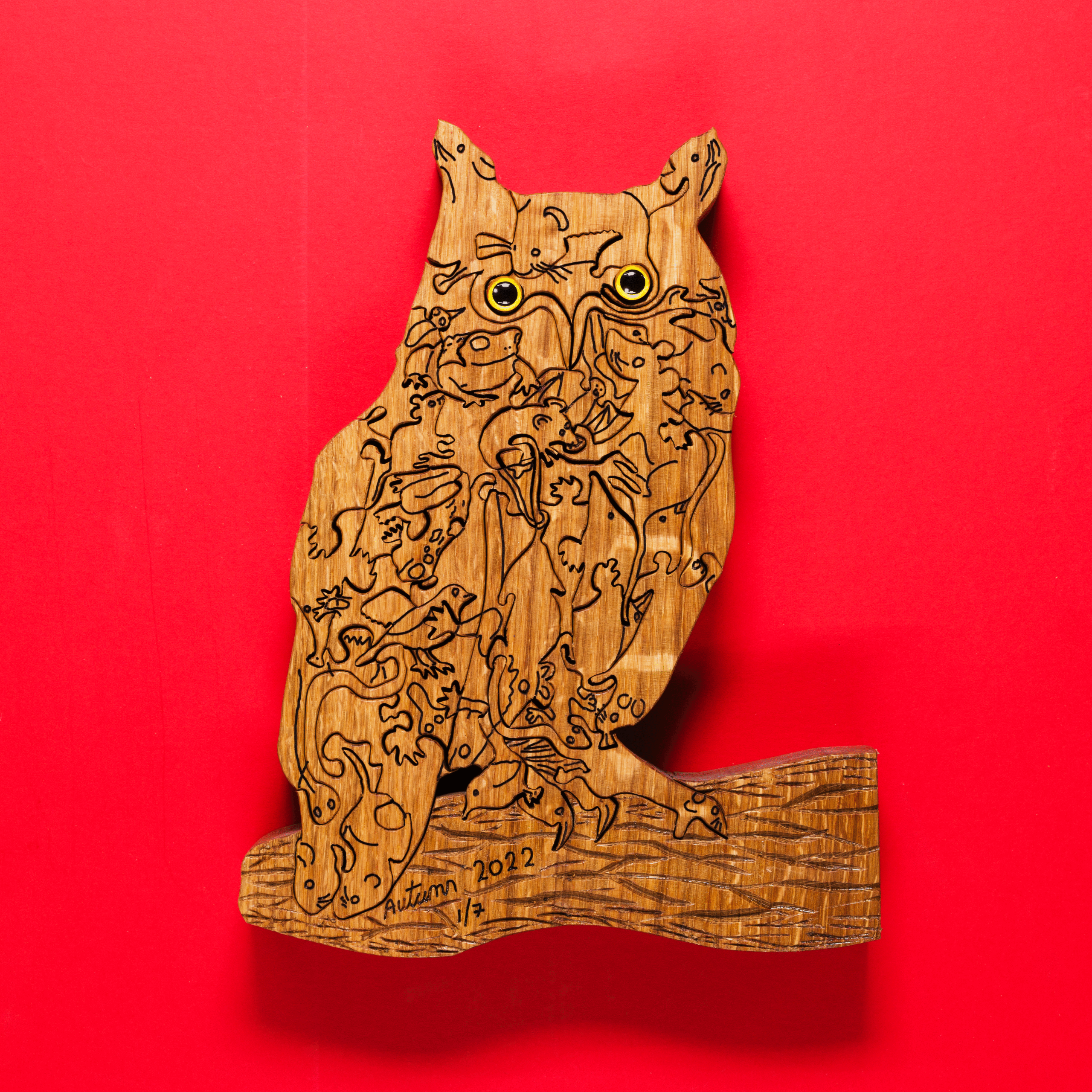
  • Long-eared Owl (Art Puzzle) (You Are What You Eat)

    Long-eared Owl (Art Puzzle) (You Are What You Eat)

    Title: “Long-eared Owl (Art Puzzle) (You Are What You Eat)”
    Artist: Michael Autumn
    Life-sized handmade solid oak jigsaw puzzle (Limited Edition of 7)

    Long-eared Owl (Art Puzzle): Full image
    Size: 20cm (W) x 30cm (H) x 4cm (depth) @ 1.5kg weight
    Medium: Solid European Oak, hand-cut, hand-engraved, hand-carved, art puzzle + acrylic eyes.
    Date: 2022

    Long-eared Owl

    The story behind this art piece was to have a free-standing, tactile, life-sized long-eared owl, and to toy with the idea – “You are what you eat“. These birds are ferocious predators (as are all owls) – and will basically eat anything that moves that is smaller than them. They often swallow their prey whole, and regurgitate a large pellet of the undigestible parts – such as bones, teeth, hair, feathers. Indeed, examining their pellets is how ornithologists know so much about what they eat.

    I often think about predator-prey relationships – perhaps being a veggie has something to do with this… All animals have to get their energy and material they are made of by consuming specific things – protiens, carbohydrates, and fats. Herbivores obviously get this material directly and indirectly from plants – which is often widely available (they don’t usually eat fats directly, but make them from carbohydrates). However, they usually have to eat a lot of plant material in relation to their size because it is a low concentrated source of food – requiring long, slow, complex digestion. Predators usually don’t eat plants – instead they prefer much more concentrated and complex food in the form of other animals.

    I have designed the owl to show that it is literally made of many of the wide variety of creatures that it eats. From the moment of conception – where it starts as a single egg – it literally takes parts of smaller animals – and its amazing body chemistry converts them into material to make (and maintain) it’s growing body – and energy. I used the simple jigsaw-puzzle you-are-what-you-eat metaphor to illustrate this puzzling (pun intended!) transformation of lots of small animals making up an owl.

    Owls typically eat 2-4 mice-sized animals per day – so about a thousand a year. Without owls, goodness know how many mice, moles, voles, rats, small birds, newts, etc. there would be…!

    (I have to confess this was originally intended to be a tawny owl! I haven’t been lucky enough to actually see a wild long-eared owl, and as I got a long way into designing this piece I felt it would look better with ears – and, of course, a tawny owl doesn’t have visible “ears“… So I thought, okay, I’ll change it to a long-eared owl – they have great “ears” (well they look like ears, but they’re actually not – they’re just tufts of feathers!). The two species are quite similar in many respects – so the change was easy!)

    “Art Puzzle” series

    At the risk of stating the obvious, this work is part of my Art Puzzle series. For readers interested, further details can be found at the originating work’s post @ https://michaelautumn.wordpress.com/2020/03/01/guillemot-with-egg-art-puzzle/

    “Limited Edition” of 7

    The phrase limited edition in this case is a bit of a misnomer. These are all individually handmade by me from my original design. I really wish there was, but there is no mechanical or chemical process I know of by which these can be reproduced – like screen printing, lithographs, card puzzles (using a die and jigsaw press), etc. (for more details please see the aforementioned post).

    Working photos

    Finished photos

  • Tawny Owl with Egg (Art Puzzle)

    Tawny Owl with Egg (Art Puzzle)

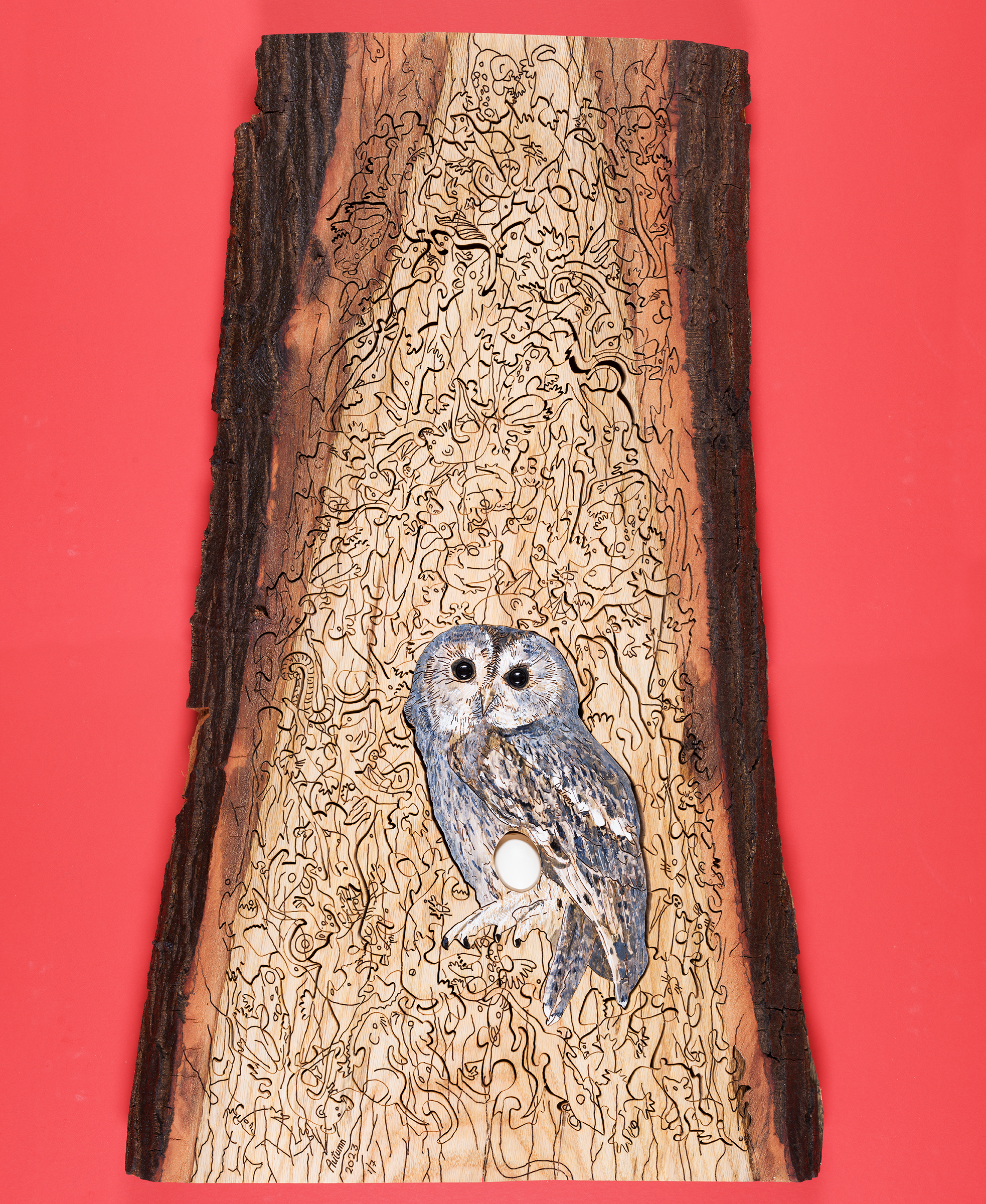
    Title: “Tawny Owl with Egg (Art Puzzle)”

    Life-sized handmade solid oak art puzzle (Limited Edition of 7)

    Tawny Owl with Egg (Art Puzzle): Full image
    Size: 50cm (W) x 82cm (H) x 8cm (depth) @ 20kg weight
    Medium: A single piece of waney-edged European Oak, hand-cut, hand-engraved, art puzzle
    with inset full-size replica tawny owl egg and acrylic eyes.
    Date: 2023

    First and foremost I want to mention that the eggs used in my work are not real – for obvious ethical reasons (it is also illegal to take wild birds eggs). They are life-size replicas made of a plaster resin composite and hand-painted – not by me, but by a very reputable leading replica birds eggs maker.

    Tawny Owl

    Following on from Guillemot with Egg (Jigsaw Puzzle) (see https://michaelautumn.wordpress.com/2020/03/01/guillemot-with-egg-art-puzzle/), I thought I would pay homage to another favourite bird of mine – the Tawny Owl (Strix aluco). These, like all owls, are very mysterious – especially the noctornal ones (which tawnies are) – because they do things the opposite to us: they sleep/rest during the daylight, and come out – and hunt – at night. They are supremely designed and adapted to this lifestyle: they have excellent hearing and eyesight, they fly almost silently, and their hunting strategy is to hunt in the darkness – when other small nocturnal animals think it’s safe to come out…!

    Mice, voles, shrews, moles – in fact any small rodent up to the size of a rat – are largely nocternal to avoid daylight predators – like kestrels, buzzards, merlin, sparrowhawks. But while rummaging for food and going about their normal lives – in what they think is the relative safety of darkness – a tawny owl – alerted to their presence by their quiet, but inevitable, sounds – can swoop undetected near to the unwitting little creatures. From close by the tawny can watch their prey’s every move – until they decide to pounce, crush and puncture them with their razor-sharp tallons – and then invariably swallow them whole…

    Little birds could be roosting or sleeping in trees or bushes, but if they make any sounds in their sleep – even just quietly snooring or sleep-calling/singing – they are easy game for these owls… Frogs, toads, newts – in fact any small reptile – making any kind of sound at night – are likely to court the deadly attention of a tawny owl. Even fish splashing about at the water’s surface, or in the shallows, are fair game for these owls…

    Suffice to say that if it is small and it makes a noise, it is on the menu…! So I thought I would play with this idea and illustrate as many of the small creatures tawny owls eat – as jumbled up jigsaw pieces surrounding the main protagonist. The whole design slightly resembles a huge regurgitated pellet of the tawny owl, and the small prey animals are all jumbled up – like fragments in a pellet.

    I like art in the form of a jigsaw puzzle because it is interactive, and by careful design of the shapes and carving on the pieces, I can get the puzzle-solver to look at, and think very carefully about, them – in a way that is simply not possible with non-interactive art. Indeed, someone could look at a piece of art like this and not even notice the small creatures surrounding the main owl – let alone have any understanding why they are there – and why these particular animals. However, trying to solve a puzzle like this is a very different matter – they will definitely think more about what it is they are looking at…!

    I have deliberately made the jigsaw puzzle very subtle because Nature is very subtle. These creatures are very difficult to see because of their camouflage and because they mainly come out at night – and it is precisely because they are so difficult to see that the owls rely on the noise they make to home in on them… The puzzle metaphor lets me toy with the idea that these small creatures think they are invisible – or out of harm’s way – but to a tawny owl, in the dead calm of night, their sounds makes them highly visible…

    Owls typically eat 2-4 mice-sized animals per day – so about a thousand a year. Without owls, goodness know how many mice, moles, voles, rats, small birds, newts, etc. there would be…! If all the creatures a tawny own ate over the course of its lifetime were put into a 30cm diameter (about the width of this jigsaw puzzle) very tall clear tube – I wonder how high the pile of eaten animals would be…

    Close-up of the life-sized tawny owl with replica egg

    Some of the art puzzle pieces laid out

    “Art Puzzle” series

    At the risk of stating the obvious, this work is part of my Art Puzzle series. For readers interested, further details can be found at the originating work’s post @ https://michaelautumn.wordpress.com/2020/03/01/guillemot-with-egg-art-puzzle/

    “Limited Edition” of 7

    The phrase limited edition in this case is a bit of a misnomer. These are all individually handmade by me from my original design. I really wish there was, but there is no mechanical or chemical process I know of by which these can be reproduced – like screen printing, lithographs, card puzzles (using a die and jigsaw press), etc. (for more details please see the aforementioned post).


    Working-on photos


    Finished photos

  • Oak Tree (Art Puzzle)

    Oak Tree (Art Puzzle)

    Title: “Oak Tree (Art Puzzle)”
    Medium: Hand-drawn, hand-cut and engraved solid European Oak art puzzle (Limited Edition of 7).
    Size: 60cm (H) x 61cm (W) x 4.4cm (depth) @ 11.8kg weight
    Date: 2022

    It started out as a clock!

    I can’t remember why, but this started out as a design for a clock! But after a short while I decided I should make a clock jigsaw puzzle and an oak tree jigsaw puzzle – as completely separate works.

    My Favourite Tree

    The oak (English Oak – Quercus robur) – is probably my favourite English tree, and I’ve wanted for many years to pay homage to them. I’ve travelled quite a bit over the UK, and often it has been to get somewhere lovely by sunrise – or close to it – and often I’ve driven home at sundown – because I don’t particularly like driving in the dark (for the simple reason I can’t see anything). So I have seen a lot of sun rises and sunsets (sometimes both in the same day) – and the visions that stand out most in my memory are oak trees with the sun rising or setting behind them. Many an oak I have seen with blood red skies, blazing yellow and orange skies, gloomy slate skies, fresh cold blue skies, stiflingly hot blue skies.

    A great irony of the massive plunder we have done of the natural oak forests in the UK is that the very few trees that remain really stand out alone in the landscape. Often you will see a solitary great oak forming part of a hedge, or standing proud in the middle of a field. And so we can probably see and appreciate them much better now than if we were to go back a thousand years or more – when the country was blanketed in them – and you literally couldn’t see the tree for the forests.

    I particularly like to see oak trees in winter – when you can see their gnarly cauliflower-shaped fractal trunks, branches, and twigs – and the great silhouettes formed by the trees and the ubiquitous chocking parasitic ivy.

    How to capture the essence of an Oak Tree?

    A 2D photograph doesn’t do an oak tree justice because there is so much to them. But as a starting point, what better way to depict an oak tree than by carving an oak tree from a big chunk oak…?

    How to capture an oak tree in all of its many different guises? Among other things, I wanted to try to depict their status as a keystone species. So many species of mammals (like squirrels, mice, bats), insects (like moths, butterflies (and their caterpillars), and flies), most woodland birds (like owls, tree creepers, nuthatches, tits, finches, warblers, pigeons, doves) – depend on the oak as a place to live. Birds and bats live, rest, and/or nest in the branches, holes bored into the wood, or simply cracks in the bark. Insects shelter on, and in, the bark and leaves (often highly camouflaged). Many parasitic plants like ivy and mosses live on it, as do many species of lichens and fungi.

    Many species depend on oak trees directly or indirectly for food: fungi have a symbiotic relationship with them, bees and wasps pollenate its flowers in spring, insects eat its leaves, bark, and wood. Moths prey on its flies, bats prey on its moths.

    Birds eat the oak tree’s caterpillars (of the butterflies and moths) – indeed many, like tits, specifically time their breeding to coincide with the huge glut of the caterpillars in spring – and most warblers in the UK travel all the way from Africa in early spring specifically to do this. Jays, squirrels, and some wasps and bees feed on the acorns, but it is the Jays and squirrels that actually hugely benefit the oak tree by spreading its acorns (seeds) far from where they fall. Without these, the oak tree would depend on the very poor and unreliable mechanical dispersal of acorns rolling downhill or being washed by rain water away from its canopy – in order to spread far and away, and stand a good chance of survival (often there are no plants on the ground under an oak tree’s canopy because of its very dense leaf cover and the competition for nutrients – so this is a very hostile place for the oak tree’s own seedlings to grow).

    The oak tree is a keystone species even when it is dead (or killed). Fungi, lichen, mosses, and insects will eat and/or digest them, many insects will lay their eggs in them (which in turn will eat the dead wood), and homo sapiens have built navies, buildings, used them as firewood and in the smelting of metal ores and in metals for thousands of years.

    So in a very small way I have tried to capture some of this ecological complexity…

    Fractals

    I also wanted to capture something about the oak tree’s fractal appearance. Small branches resemble a whole tree, and so do large branches. If they are pollarded, what look like whole trees grow out of their stump.

    Seasonality

    I also wanted to capture something about the oak’s seasonal differences – specifically that they have two distinct personalities: one with leaves and one without leaves. Most of the leaf clumps (summer) in the work can be removed – leaving exposed branches (winter).

    Oak’s Fruit

    I wanted to capture something about the fruit of the tree – the humble acorn – and how that tiny thing can grow into a monster of a plant – with the chance of living five hundred years or more – and it’s dead body – timber – in the right conditions capable of surviving a thousand years or more.

    Why a Jigsaw Puzzle?

    A jigsaw puzzle seemed a very apt way to represent or capture some the complexity and interconnectedness of the oak tree – which is very interesting because this is proving to be a very fruitful visual communication medium phase I am going through at the moment (I have worked in many art mediums)…

    A jigsaw puzzle is, among other things, a metaphor for my appreication of the wonder of Nature and its mysteries. It is my (very feeble) 2D representation of the 4D (3D + time = 4D) complexties and variaties of some of the huge number of spieces’ interconnectedness – where jigsaw pieces and carved lines are symbolic of some of Nature’s species, camouflage, and its mixed uses.

    Naturally, with this jigsaw puzzle being made of quite chunky oak, the hard, heavy, wood directly communicates oakness to the viewer. So in some unique, and perhaps mysterious, way, the material and the original whole subject – the oak tree – express each other…

    Texture

    Finally I wanted to capture the texture of the tree – particularly its very rough bark. I’ve tried to do this by the tactile nature of the puzzle pieces and the engraving on the work.

    “Limited Edition” of 7

    The phrase limited edition in this case is a bit of a misnomer. These are all individually handmade by me from my original design. I really wish there was, but there is no mechanical or chemical process I know of by which these can be reproduced – like screen printing, lithographs, card puzzles (using a die and jigsaw press), etc.

  • Golden Plover with Egg (Art Puzzle)

    Golden Plover with Egg (Art Puzzle)

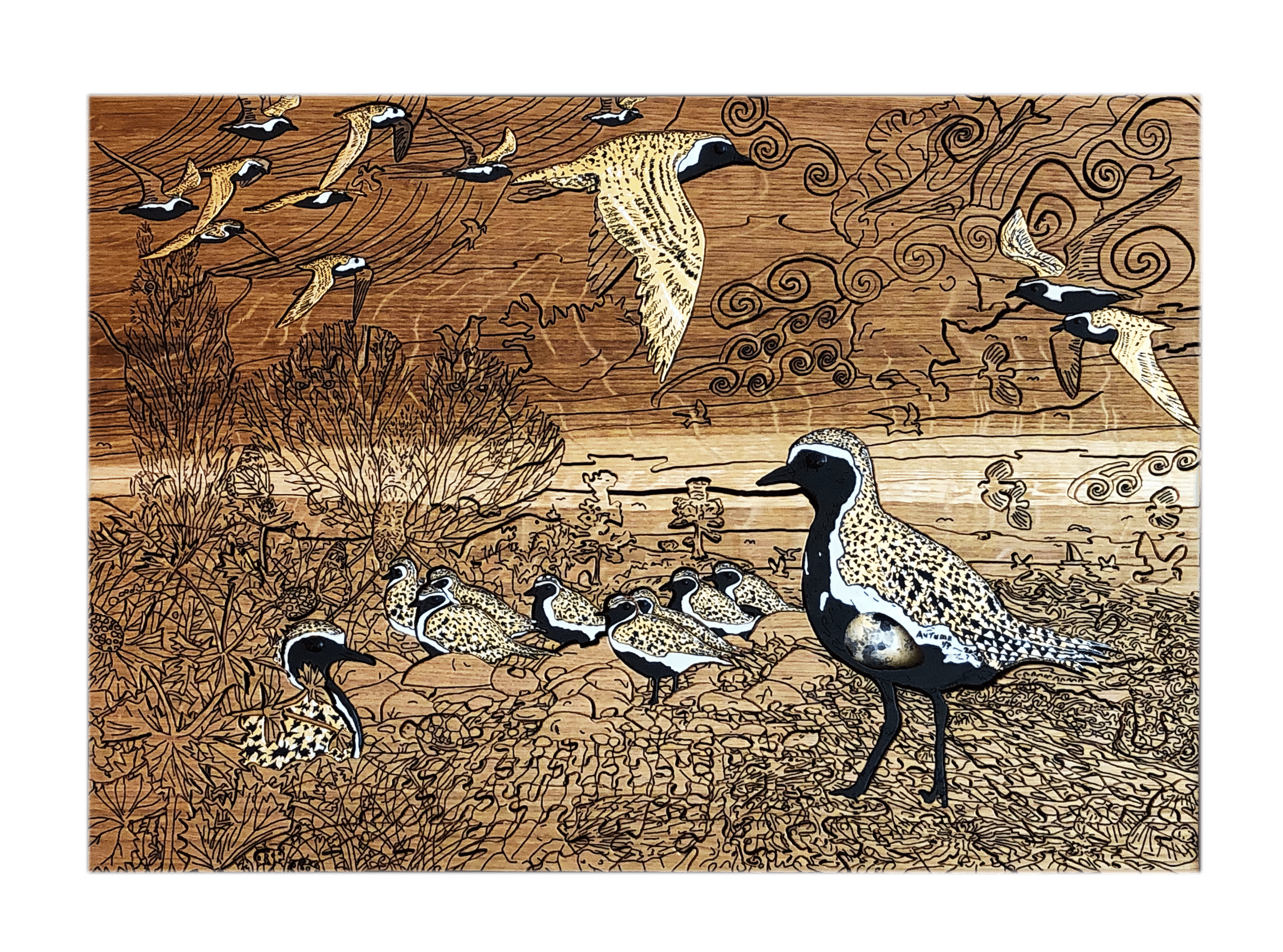
    Title: “Golden Plover with Egg (Art Puzzle)”

    Life-sized handmade solid oak art puzzle (Limited Edition of 7)

    Golden Plover with Egg (Art Puzzle): Full image
    Size: 59cm (W) x 41.5cm (H) x 4.4cm (depth) @ 9kg weight
    Medium: Solid European Oak, hand-cut, hand-engraved, jigsaw puzzle
    with inset full-size replica golden plover egg.
    Date: 2020
    Golden Plover in artist’s dining room (click on image to see artists’ home studio, workshop, and gallery).

    First and foremost I want to mention that the eggs used in my work are not real – for obvious ethical reasons (it is also illegal to take wild birds eggs). They are life-size replicas made of a plaster resin composite and hand-painted – not by me, but by a very reputable leading replica birds eggs maker.

    Golden Plover

    Following on from Guillemot with Egg (Jigsaw Puzzle) (see https://michaelautumn.wordpress.com/2020/03/01/guillemot-with-egg-art-puzzle/), I thought I would pay homage to another favourite bird of mine – the Golden Plover (Pluvialis apricaria). In winter plumage these birds are lovely, but unremarkable. However, in summer plumage they are absolutely stunning. The males are slightly more outstanding than the females, however, both are very distinctive and eye-catching. The spring transformation of the Golden Plover from winter to summer plumage is one of the most extreme, and beautiful, I know of. The word “dandy” comes to mind. They become the most striking of all the waders I know of.

    Golden Plover in summer plumage

    In summer their coal black bellies and faces, fringed with a slim cotton white mantle or fringe, and their “golden” upper parts – are a bold, brilliant sight to behold. But golden they are not! They are “buff”, ochre, or sandy brown – like most wading birds – who feed predominantly on mudflats and shorelines – and thus gain good overhead camouflage – so as not to draw attention to predators such as peregrine falcons, marsh harriers, etc.

    To highlight this golden misnomer I thought it would be fun to actually make them golden – 24 carat gold gilt to be precise! Gold is an incredibly beautiful and mysterious metal – mysterious both in terms of its physical properties and appearance, and its hold over us. Gold, with its density of 19.3 (over 19 times that of water), is the absolute nemesis of flight! Gold, with it strikingly bright, mirroring, shimmering sheen – is the nemesis of camouflage!

    24 carat gold gilded Golden Plover

    I hope the metallic gold of the Golden Plover in the above pictures is clear. Being metallic the light reflects differently according to the angle being viewed and the available light.

    Migration

    In summer Golden Plover breed in the tundra – countries such as Iceland, Greenland, Scandinavia, and northern Russia – where the days are very long indeed – and over-winter in warmer climes – and where there isn’t perpetual winter darkness – such as here in the UK (some go as far south as northern Africa). The migration to and from Iceland is no mean feat for such a small bird. The main bird in the picture is life-sized: they are approximately 20cm tall, and 28cm long. Many bird migrations follow land masses with hops over the shortest water expanses. For example many of our summer visitors, like the warblers, coocoos, hobbys, etc. come from Africa – where the largest stretch of water they have to fly continuously across is the English Channel – a mere 20-odd miles – less than a hour’s flight (the Straights of Gibraltar – the sea hop from Morocco to southern Spain is less than ten miles).

    In contrast, the non-stop shortest bird flight distance from Iceland to the UK is 850 miles. Golden Plover can fly at speeds up to 60 mph, but for long distances they are more likely to cruise at speeds more like 40 mph. So the non-stop flight from Iceland to the UK would take them a minimum of 21 hours. To salute this feat I have added an Icelandic reference in the picture – see if you can find it…

    “Art Puzzle” series

    At the risk of stating the obvious, this work is part of my Art Puzzle series. For readers interested, further details can be found at the originating work’s post @ https://michaelautumn.wordpress.com/2020/03/01/guillemot-with-egg-art-puzzle/

    “Limited Edition” of 7

    The phrase limited edition in this case is a bit of a misnomer. These are all individually handmade by me from my original design. I really wish there was, but there is no mechanical or chemical process I know of by which these can be reproduced – like screen printing, lithographs, card puzzles (using a die and jigsaw press), etc. (for more details please see the aforementioned post).

  • Artist Anxiety

    Artist Anxiety

    There are many different types of artist and many types of journeys in creating a work of art. Much art in the last century is what I call utter rubbish – slipshod, slapdash – made within minutes to a few hours or a day or two. And it shows. For example Pollock’s drip “paintings”, or Hirst’s “spin” “paintings”. Most of it is utter contemptible rubbish in my humble opinion. Even many of the Impressionist’s work was done in a day – often outside with a portable easel and done in a single sitting (however, purely aesthetically, I do like a lot of work from that period from that art movement).

    I’m certainly not saying that the more time and effort spent on an art work the better it will be – and vice se versa. I’m saying that the more effort an artist puts into their work the more I will respect it and the more I will try to understand and appreciate it – and the better quality it is likely to be. This seems obvious to me…?

    Consider a book of a handful of words compared to one of 100,000 words… The latter usually is expressing much more than the former. But a 100,000-word book is not necessarily saying more that a 10,000-word book. The former could be very waffly and poorly structured. Whatever one is trying to express there is usually some minimum or ideal way of expressing it (for the target audience)… My general point is that something expressed very briefly or quickly is usually not expressing very much – compared to something where a lot more time and effort has gone into it…

    I’ve been working on a piece called “Golden Plover with Egg” (Jigsaw puzzle) for over ten weeks now, and I’m coming to the final stages – where things are finally starting to take shape – and, at last, I’m beginning to feel good about it. Often through the long arduous hours – many of which have been physically very demanding – I’ve been deeply anxious. Why am I doing this? Why is it taking so long? Am I wasting my time? Will anyone appreciate it?

    Not that I am doing it for money (more on this later), but will the work be worth anything? Will it have a value that is reflective of the effort I have put into it ? I’ve worked in I.T. for many years where I was paid quite a high hourly rate. What I would earn in three months (because I have about another two weeks work to go on my current piece) was a not inconsiderable sum. What might my hourly rate be for this piece…? (Not that I will sell it, but I will hopefully sell other editions of it…)

    The peculiar thing about art is that some art created in a slapdash fashion sells for thousands, if not tens – or even hundreds – of thousands, of pounds (£) – making the hourly rate absolutely ridiculous. Picasso made about 46,000 works of art in his lifetime – many of which were created well within a day. So his hourly rate was in excess of £100,000!

    Some art takes hundreds of hours – and sells for a pittance – making the paid hourly rate utterly pitiful – and puts a contemptible value on the artist’s time/life. Clearly there is no relationship between an art work’s value and the amount of time and effort that went into making it. Yet, for most other goods in society, the more time taken to make them the more expensive they are. It’s a very strange world we live in…?

    Why do I do art – I keep asking myself?! I don’t have to. Unlike some artists, there are plenty of other things I could do – and have done – for a living. The simple answer is: I don’t really know! I just know that I like making things and commenting on things that interest me.

    Yesterday, while working on “Golden Plover with Egg”, I was thinking why I do art – and this piece in particular? It’s so much work, effort, and cost (the raw materials and special tools are expensive)?! Mahler’s beautiful Symphony No. 4 was playing in the background, and I thought of the effort he must have put into composing that sublime masterpiece – the trials and revisions that it must have gone through. I wonder what emotions and motivation drove him to do it, the frustrations he experienced, the ups and downs he went through, the anxiety he felt of what others might think of it…? He was a fellow artist, so I thought I must share some of his emotions and anxieties…?

    Malher didn’t have to compose that symphony. No one asked him to do it (as far as I know). Possibly something inspired him, but, like many great works or inventions, inspiration is one thing, implementing it is quite another… Something in his deep psyche drove him to do it. No one told him how long it must take. He just set about doing it, and didn’t stop until he was satisfied with it. And all through the journey he will have applied his skills as a musician, and his heart and sense of aesthetics to evaluate and refine it. He would have been striving for a level of quality acceptable to him – and only him.

    There are no rights and wrongs with art – so there are no objective ways to judge it, or to know if the objective has been achieved. Well that’s not strictly true. In each form of art there are usually a few ground rules. Like music for Mahler, I guess he ruled out discordances, wanted to use (or felt he should use) certain instruments, and he possibly wanted four movements – because that was the standard Western classic symphonic tradition he was raised in?

    He had to figure out how to make the sounds he wanted – or at least make sure it was practically possible – i.e. playable and audible. So finding a practical solution to each and every note, phrase, passage – were upmost in his mind. He possibly followed other music rules that we don’t know about (because he didn’t write them down), and those I’m not competent to know or understand.

    However, the vast majority of the huge number of decisions that go into the artistic creative process are entirely subjective. Do I like everything? Do all the pieces “go” together? Do they “gel” together and create some form of harmony? If not, what can I change so that they do? Is it good enough? How can I improve it? What am I trying to say or communicate with this? Is what I want to communicate interesting and/or important? Have I achieved my goal/s? Is it finished? (I certainly don’t believe all, or even most, artists think like this – but the best ones do…)

    I think Edison’s phrase: “Genius is 1% inspiration and 99% perspiration” is a gross understatement. I think it’s much more like 0.0001% inspiration – or even less – and the rest perspiration!

    Back to my thoughts yesterday and Mahler’s Symphony No 4. While listening to all four movements, I thought how each was utterly sublime, perfect, and complete on their own – yet Mahler created a unified whole with them all. A staggering and wonderful achievement that enhances and enriches anyone who listens to it. It occurred to me that possibly only artists fully appreciate other artists – because they will have some insight into, or empathy for, the effort and emotion that has gone into the creative process…

    I don’t know what drives artists to create unnecessary, uncalled for, unusable, works of art, but listening to Mahler’s Symphony No 4 I thought: “thank god they do”…

    I think back to my last piece – “Guillemot with Egg” (http://michaelautumn.wordpress.com/2020/03/01/guillemot-with-egg-jigsaw-puzzle/) – which took a similar amount of time and effort as my current piece – and I forget all the effort, trials and tribulations that went into designing and making it. It may seem strange, but I love to look it, and I’m just so glad I did it! It’s such a huge sense of achievement – of fulfilling something that was such a tall order. If it was easy many people would do it – and it wouldn’t be such a sense of achievement…?

    It’s very nice that other people seem to like it, but that’s not why I did it. And they will have no idea of the amount of work, sacrifice, and emotion that went into it. But hopefully it communicates something to them – about the ideas I was trying to express – that no other form of expression could achieve…

    But why, oh why…? And does anybody apart from me really care…?